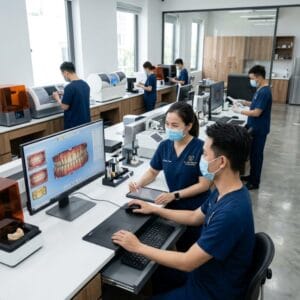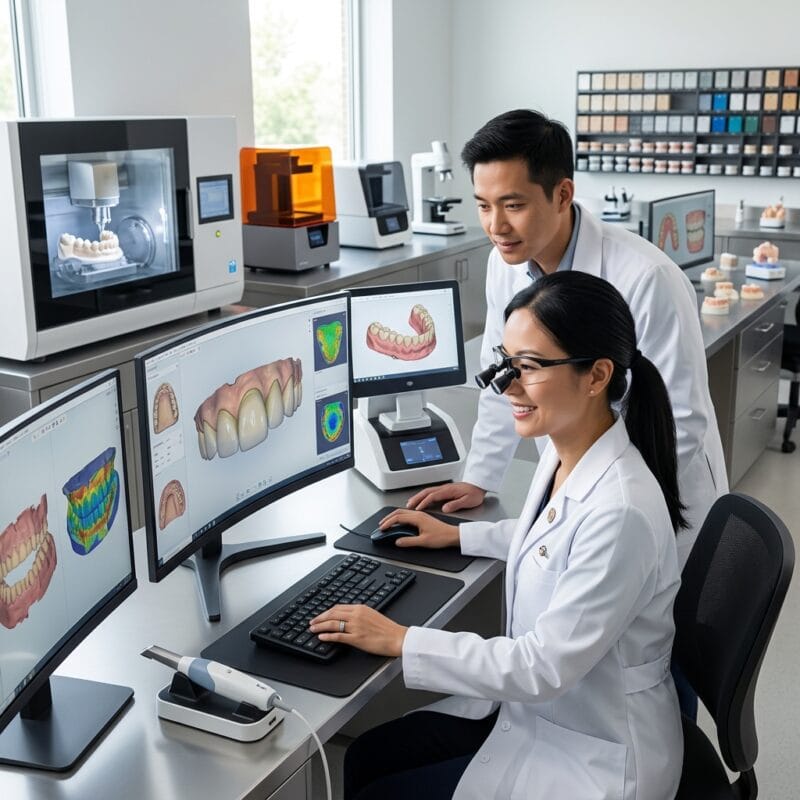
The business of modern dentistry across Canada is experiencing a profound shift as clinical practices and Dental Support Organizations (DSOs) confront rising operational overhead, persistent dental laboratory technician shortages, and changing patient expectations. At the epicenter of clinical profitability and patient satisfaction sits a single, high-impact metric: the chairside remake rate. When a crown, implant crown, denture, or night guard fails to seat perfectly during an appointment, the financial damage extends far beyond the physical replacement cost. Lost chair time, frustrated patients, disrupted clinical schedules, and duplicate administrative workflows severely strain practice margins. Understanding how Canadian dental clinics reduce high remake rates in 2026 has consequently become a central operational priority for progressive dental practice owners from Vancouver to Halifax.
Historically, remake rates of 4% to 8% were quietly absorbed as an inevitable cost of doing business in traditional analog workflows. Physical alginate or polyether impressions were subject to dimensional instability, stone models tore or bubbled, and manual wax-up techniques introduced subtle human errors. However, with intraoral scanners becoming standard equipment in contemporary practice, clinicians quickly discovered that digital impressions alone do not automatically eliminate remakes. A digital scan is only as accurate as its underlying capture quality and the software design parameters applied during the computer-aided design (CAD) phase. Mastering how Canadian dental clinics reduce high remake rates in 2026 requires looking holisticly at the entire digital value chain—from intraoral tissue management at the chairside to specialized remote CAD design and final computer-aided manufacturing (CAM).
What causes high dental restoration remake rates in Canadian practices?
High remake rates are primarily driven by sub-optimal intraoral scanning, incorrect margin detection, improper occlusal clearance, and inconsistent laboratory CAD design protocols.
To systematically eliminate remakes, clinicians must first diagnose where errors originate across the restorative workflow. While impression artifacts were historically to blame, digital dentistry presents its own distinct subset of failure points. When examining how Canadian dental clinics reduce high remake rates in 2026, dental directors systematically categorize remakes into three primary origin points: clinical preparation errors, intraoral scan capturing artifacts, and CAD design parameter misconfigurations.
- Inadequate Prep Clearance: Insufficient reduction during tooth preparation forces the CAD designer to either thin the restorative material beyond its structural safety threshold—leading to premature fractures—or over-contour the occlusion, resulting in high bites that demand heavy intraoral adjustment.
- Margin Submersion and Scan Shadowing: Gingival fluid, blood, or unretracted tissue obscure the cavosurface margin. Intraoral scanners cannot image what they cannot visually register, resulting in CAD designers “guessing” margin location on a blurry mesh surface.
- Sub-Optimal Intraoral Scan Stitching: Fast, uncalibrated scanning passes across full arches create rotational distortions or “towel wringing” effects across the anterior segment, causing distal contact tightness or posterior open bites on final restorations.
- Incorrect Occlusal Bite Registration: Patients biting in a forced centric relation or sliding laterally during scan capture yield false occlusal maps, leading directly to elevated seating appointments.
- Generic CAD Software Presets: Using automated or semi-automated default CAD settings without customizing parameters for specific material choices (e.g., layered zirconia versus monolithic lithium disilicate) produces inconsistent contacts and embrasure spaces.
Recognizing these root vulnerabilities is fundamental to exploring how Canadian dental clinics reduce high remake rates in 2026. When practices audit their remake logs, they frequently find that over 80% of fit issues stem from a repeatable mismatch between chairside preparation techniques and downstream CAD design parameters.
How does CAD/CAM digital design outsourcing lower remake frequency?
Digital CAD/CAM outsourcing lowers remake frequency by standardizing digital design parameters, utilizing expert certified dental technicians, and applying precise validation algorithms to every scan prior to milling.
As Canadian dental practices scale, managing internal CAD design in-house often introduces bottle-necks. Hygienists, assistants, or busy lab technicians stretched across multiple responsibilities may lack the dedicated expertise required for complex digital design. Outsourcing digital CAD design to a specialized partner solves this problem by inserting dedicated, highly trained CAD architects into the workflow. Analyzing how Canadian dental clinics reduce high remake rates in 2026 reveals that elite clinics treat their outsourcing partner as a rigorous quality assurance gatekeeper before any physical milling or printing occurs.
Specialized CAD design partners operate using professional software suites like exocad and 3Shape. These platforms allow skilled technicians to set microscopic tolerances tailored precisely to the restoration material, the clinical indication, and the individual milling machine’s capability. For instance, an outsourced CAD expert reviewing an intraoral scan will instantly catch an ambiguous subgingival margin or insufficient prep clearance. Rather than proceeding with a flawed design that will ultimately fail at chairside, the design center communicates immediately with the clinic, requesting a quick scan touch-up while the patient is still in the chair or advising on preparation adjustments.
Furthermore, evaluating how Canadian dental clinics reduce high remake rates in 2026 highlights the value of standardized design parameters across multi-location DSOs. When a practice group operates five or ten clinics across Ontario or Alberta, maintaining consistent clinical quality across dozens of associate dentists is challenging. Partnering with a dedicated CAD design center ensures that standardized digital protocols—such as uniform cement gaps, precise contact strengths, and biomechanically sound emergence profiles—are applied universally, regardless of which clinic submitted the scan.
How Canadian dental clinics reduce high remake rates in 2026 with digital CAD workflows?
Canadian dental practices reduce remakes in 2026 by integrating high-precision intraoral scanners with specialized remote CAD design labs that strictly validate digital margins and contacts before fabrication.
The integration of high-precision digital workflows represents a multi-step transformation that bridges the gap between chairside clinical execution and technical design perfection. Exploring how Canadian dental clinics reduce high remake rates in 2026 involves dissecting each clinical discipline to see how targeted CAD protocols protect clinical outcomes.
1. Crown & Bridge Restorations: Perfecting Margins and Occlusion
Crown and bridge cases constitute the highest volume of restorative treatments in general practice, making them the largest single contributor to aggregate remake costs. When studying how Canadian dental clinics reduce high remake rates in 2026 within single-unit and multi-unit fixed prosthodontics, the emphasis rests heavily on digital margin refinement and virtual articulation.
In a refined digital crown workflow, the intraoral scan is transmitted instantly to the remote CAD team. Skilled designers utilize high-magnification digital inspection tools to trace the prep margin with absolute fidelity. If the preparation margin is crisp, the CAD software applies a pre-calibrated cement gap—typically 30 to 50 microns starting 1 millimeter above the margin line. This precise offset prevents hydraulic lock during cementation while ensuring zero marginal leakage. Furthermore, proximal contacts are designed with micro-meter accuracy, adjusted dynamically based on adjacent tooth surface morphology and whether the final restoration is monolithic zirconia or lithium disilicate.
For multi-unit bridges, assessing how Canadian dental clinics reduce high remake rates in 2026 requires evaluating path of insertion analysis. Remote CAD software automatically evaluates multi-abutment preparations for undercuts. If an undercut is detected that would prevent successful seating, the CAD system alerts the designer to adjust the insertion trajectory digitally or recommend a minimal chairside prep modification, preventing catastrophic seating failures on delivery day.
2. Implant Restorations & Custom Abutments: Emergence Profile Precision
Implant dentistry carries zero tolerance for dimensional distortion. An ill-fitting implant crown can lead to screw loosening, crestal bone loss, or mechanical component fracture. A key component of how Canadian dental clinics reduce high remake rates in 2026 involves replacing stock implant abutments with digitally customized abutments and monolithic screw-retained crowns.
Using accurate scan bodies, the intraoral scanner captures the exact three-dimensional spatial orientation of the implant fixture. Specialized remote CAD designers then construct custom emergence profiles that gently support the peri-implant soft tissue without creating excessive ischemia. By controlling the subgingival contour in CAD software, designers ensure the transition zone from the round implant platform to the natural tooth cross-section is smooth, cleanable, and anatomically correct.
Additionally, studying how Canadian dental clinics reduce high remake rates in 2026 in implant therapy shows a major shift toward screw-retained single-tooth restorations. Screw-retained designs completely eliminate the risk of subgingival residual cement retention—one of the leading causes of late-stage implant failure and peri-implantitis. When screw access holes are designed precisely in CAD to exit through the non-aesthetic lingual or occlusal fossa, chairside delivery becomes simple, predictable, and exceptionally fast.
3. Surgical Guides: Predictable Implant Placement
Sub-optimal implant positioning is a root cause of subsequent restorative remakes. If an implant is placed too far buccally, too close to an adjacent root, or at an unserviceable angulation, restoring it predictably becomes nearly impossible. Investigating how Canadian dental clinics reduce high remake rates in 2026 reveals that leading practices now mandate fully guided implant surgery using dual-dataset CAD planning.
By merging intraoral optical scans (STL/PLY format) with Cone Beam Computed Tomography (CBCT) DICOM data, specialized CAD technicians create comprehensive virtual surgical plans. The restoration is designed first (prosthetically driven planning), and the implant is then virtually positioned in the optimal anatomical bone volume to support that pre-planned restoration. Once approved by the clinician, a custom guided surgical template is created via specialized surgical guide design protocols.
By executing implant surgery using precision guides, Canadian clinicians ensure that the depth, trajectory, and rotational hex position of every implant match the digital master model exactly. Consequently, when the time comes to fabricate the final crown, the digital workflow proceeds smoothly without the need for corrective angulation abutments or complex, custom-milled workarounds. This prosthetically driven methodology sits at the core of how Canadian dental clinics reduce high remake rates in 2026.
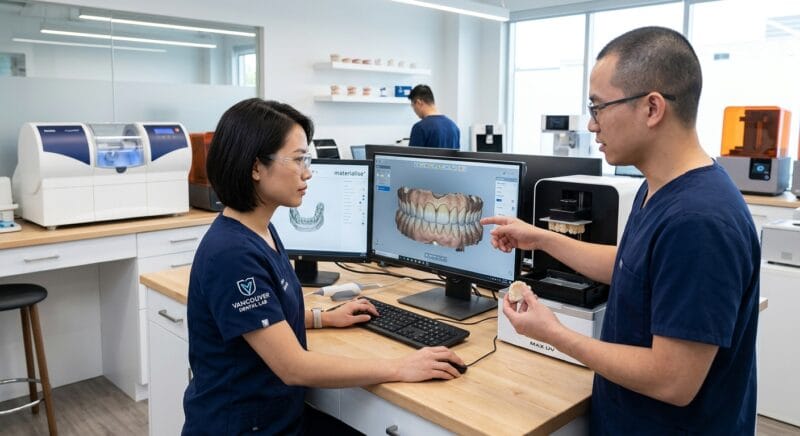
4. Digital Dentures & Removable Prosthetics: Conquering Tissue Variability
Removable prosthetics have historically exhibited some of the highest clinical remake rates in dentistry due to the soft tissue’s viscoelastic nature and complex boundary muscular movements. Investigating how Canadian dental clinics reduce high remake rates in 2026 highlights how digital removable workflows have completely re-engineered denture manufacturing.
Rather than relying on multi-step manual impression techniques that distort mobile tissue, clinics use intraoral scanning combined with specialized digital impression trays. The CAD software allows technicians to virtually model border extensions, relief areas, and anatomical landmarks with absolute reproducibility. For full-arch cases, full arch denture design protocols permit precise digital control over the Vertical Dimension of Occlusion (VDO) and centric relation parameters.
Furthermore, monoblock or two-piece milled and 3D-printed dentures manufactured from monolithic CAD designs do not suffer from the acrylic shrinkage inherent to traditional heat-cured processing methods. The resulting bases fit the hard palate and alveolar ridges with microscopic adaptation, drastically reducing post-insertion pressure spots, sore spots, and remakes driven by poor retention. This technological jump explains a major portion of how Canadian dental clinics reduce high remake rates in 2026 within geriatric and edentulous patient populations.
5. Orthodontic Aligners: Precise Staging and Biomechanics
Clear aligner therapy is another rapidly expanding clinical area where improper digital design leads directly to tracking errors, mid-course refinements, and costly mid-treatment remakes. Understanding how Canadian dental clinics reduce high remake rates in 2026 requires analyzing the biomechanical setups behind clear aligner CAD design.
Inexperienced aligner designers frequently program unrealistic tooth movements—such as attempting large root torque adjustments or massive bodily movements without adequate attachment leverage or space creation. Specialized CAD aligner technicians evaluate each arch using proven orthodontic principles. They break complex movements down into predictable, incremental stages (typically 0.2 mm of translation or 1 to 2 degrees of rotation per aligner step).
By embedding proper attachment geometry, optimizing Interproximal Reduction (IPR) timing, and respecting biological movement velocities in the software stage, outsourced CAD design services ensure that clinical tracking matches the virtual setup step-for-step. Consequently, patients progress through their aligner trays smoothly without suffering from off-track aligners that require clinical rescans and complete series remakes. This level of setup precision is central to how Canadian dental clinics reduce high remake rates in 2026 in cosmetic and orthodontic practice segments.
6. Night Guards & Occlusal Splints: Balancing Contact Kinetics
Night guards and protective splints are frequently blighted by high seating appointment times and remakes caused by heavy occlusal interferences or uncomfortable fits. Examining how Canadian dental clinics reduce high remake rates in 2026 demonstrates the power of digital occlusal design for night guards.
Instead of relying on manual articulation of stone models—which often introduces vertical alignment shifts—CAD technicians utilize dynamic digital articulators within exocad or 3Shape. The designer can simulate lateral excursive movements, canine guidance, and protrusive ramps with extreme mathematical accuracy. Occlusal contacts can be set to precise, uniform point contacts in centric occlusion, while releasing anterior and lateral interferences during movement.
Milled or 3D-printed splints produced from validated CAD files seat instantly with minimal to zero chairside adjustment. Patients receive a comfortable, stress-free appliance that protects their natural teeth or expensive restorative dentistry, demonstrating once again how Canadian dental clinics reduce high remake rates in 2026 through intelligent, specialized digital design strategies.
Establishing Standardized Chairside-to-CAD Protocols
To fully realize the clinical advantages of digital outsourcing, practice owners must refine their intraoral scanning techniques at the chairside. A digital CAD designer, regardless of skill, cannot reconstruct geometry that was missed during optical acquisition. A critical aspect of how Canadian dental clinics reduce high remake rates in 2026 relies on rigorous chairside staff training and standardized scan protocol execution.
Dental teams across Canada are implementing standardized operational checklists before submitting any scan to their remote CAD team:
- Tissue Management Verification: Utilizing double-cord retraction techniques, laser gingivectomy, or hemostatic agents to ensure 360-degree margin visibility on every prepped tooth prior to pressing start on the intraoral scanner.
- Moisture Control Management: Ensuring the prep area is thoroughly air-dried, as pooling saliva refracts scanner light, creating distorted surface meshes that ruin CAD margin detection.
- Scan Pass Consistency: Following scanner-specific manufacturer movement pathways (e.g., occlusal pass, lingual sweep, buccal sweep) to avoid artificial mesh warping over long arches.
- Bite Scan Optimization: Inspecting the bilateral bite registration scans visually in 3D to confirm complete intercuspation without artificial soft-tissue impingement or forced shifts.
- Immediate Chairside Mesh Inspection: Enabling color-coded clearance maps on intraoral scanners to confirm adequate occlusal reduction before dismissing the patient.
When practice teams combine thorough chairside preparation with expert outsourced design, the clinical outcome becomes highly predictable. This dual-pronged strategy forms the bedrock of how Canadian dental clinics reduce high remake rates in 2026.
Analyzing the Economic Impact: Cost of Remakes vs. CAD Outsourcing
The financial argument for reducing clinical remakes in Canadian practice operations is overwhelming. Consider the direct and indirect expenses incurred every time a crown restoration must be remade. Analyzing the financial data illustrates why understanding how Canadian dental clinics reduce high remake rates in 2026 is vital for long-term practice solvency.
When a crown fails to fit, the clinic loses an additional 45 to 60 minutes of chair time to perform a new impression, place a new temporary, and re-schedule delivery. In urban Canadian centers such as Toronto, Calgary, or Montreal, clinical chair time overhead ranges from $250 to $500+ per hour. Add to this the cost of replacement materials, duplicate shipping charges, staff administrative re-work, and potential patient churn due to loss of confidence. A single remake easily costs a practice between $400 and $800 in unrecoverable net income.
By contrast, partnering with a dedicated digital CAD design service costs a fraction of a single remade unit. The return on investment (ROI) is immediate. When evaluating how Canadian dental clinics reduce high remake rates in 2026, practice management consultants emphasize that dropping a practice remake rate from 6% down to under 1% reclaims hundreds of hours of productive chair time annually. That reclaimed time is directly converted into high-margin primary procedures, driving significant net practice growth.
Addressing Dental Technician Shortages in the Canadian Market
Canada’s dental industry faces a well-documented shortage of certified dental technicians (RDTs). Educational programs have contracted, while experienced technicians from the baby boomer generation are retiring in large numbers. Consequently, finding local, highly skilled CAD technicians capable of handling rapid digital turnarounds has become increasingly difficult and expensive for dental laboratories and DSO-integrated labs across the country.
Investigating how Canadian dental clinics reduce high remake rates in 2026 reveals that remote CAD design outsourcing offers a scalable, sustainable solution to this labor constraint. Instead of competing in a tight domestic talent pool for scarce CAD technicians, Canadian clinics tap into global design centers powered by expert, certified digital technicians who operate around the clock.
This overnight processing model creates a distinct workflow advantage for Canadian practices. A dentist takes an intraoral scan at 4:00 PM EST in Toronto. The digital file is instantly uploaded to the secure CAD design portal. Overnight, expert CAD technicians design the restoration to exact clinical specs, perform quality checks, and deliver production-ready STL files back to the clinic or local milling center by 7:00 AM EST the next morning. The clinical team reviews and approves the design before milling begins. This seamless 24-hour cycle is an integral pillar of how Canadian dental clinics reduce high remake rates in 2026 without inflating domestic labor overhead.
Selecting the Ideal Digital CAD Design Partner
Not all CAD design services offer equal technical precision or clinical quality assurance. To ensure success, practice leaders and DSO procurement managers must carefully evaluate prospective CAD design partners against rigorous clinical criteria. Understanding how Canadian dental clinics reduce high remake rates in 2026 requires selecting partners who understand North American clinical standards, material specifications, and regulatory compliance.
Key evaluation criteria include:
- Software Expertise: Proficiency across leading software platforms including exocad, 3Shape, and Dental Wings to accommodate any intraoral scanner output seamlessly.
- Turnaround Time & Reliability: Guaranteed 12- to 24-hour design delivery windows that align with fast-paced clinical scheduling demands.
- Communication Channels: Instant digital communication tools for real-time design feedback, case flagging, and clinical approval before production.
- Customizable Parameter Profiles: Ability to build bespoke clinical preference profiles for every dentist in a practice (e.g., custom contact tightness thresholds, relief offsets, margin designs).
- Rigorous Quality Control Protocols: Multi-tiered supervisory review processes where senior master technicians inspect every design prior to client delivery.
By rigorously vetting CAD design providers against these criteria, clinics ensure that their digital ecosystem remains robust, predictable, and virtually error-free. This careful selection strategy is central to how Canadian dental clinics reduce high remake rates in 2026.
Strategic Integration Across Dental Support Organizations (DSOs)
Dental Support Organizations operating across multiple provinces face unique operational hurdles when standardizing clinical quality. A DSO managing 30 practices across Ontario, British Columbia, and Alberta may have over a hundred dentists with varying levels of experience with digital impression tools. Assessing how Canadian dental clinics reduce high remake rates in 2026 across DSO networks highlights the role of centralized digital design hubs.
By routing all intraoral scans through a single, centralized CAD design partner, DSOs establish an objective, centralized quality filter. The outsourced design hub maintains a database of clinical preferences for each individual associate doctor while enforcing group-wide standards for material thickness and structural integrity. If an associate dentist consistently submits scans with insufficient clearance or obscured margins, the CAD center generates automated analytical reports. Clinical directors use this data to provide targeted coaching and continuing education, resolving clinical deficiencies at their root cause. This systemic approach demonstrates how Canadian dental clinics reduce high remake rates in 2026 at enterprise scale.
Future-Proofing Canadian Practices with AI and CAD Innovation
As we look further into 2026, artificial intelligence (AI) is playing an increasingly complementary role alongside expert human CAD designers. Modern CAD software integrates machine-learning algorithms that analyze millions of successful natural dentition scans to propose hyper-realistic occlusal anatomy, optimized contact areas, and precise margin proposals.
However, AI alone cannot replace human clinical judgment. The most effective digital strategy—and the defining feature of how Canadian dental clinics reduce high remake rates in 2026—is a hybrid intelligence model. AI algorithms execute rapid initial margin proposals and anatomical proposals, which are then meticulously reviewed, refined, and perfected by experienced master CAD technicians. This combination delivers unmatched design consistency, extreme processing speed, and virtually zero seating errors.
Furthermore, cloud-based practice management platforms allow dentists to track case status in real time, review 3D PDF design previews on tablets or smartphones, and communicate mid-design adjustments with a single tap. This level of transparency and real-time collaboration ensures that what is designed on screen is exactly what seats in the patient’s mouth, cementing how Canadian dental clinics reduce high remake rates in 2026 as a permanent standard of modern clinical care.
Conclusion: The Path to Zero-Remake Dentistry
Eliminating clinical remakes is no longer an unrealistic ideal; it is an achievable operational benchmark for modern dental practices across Canada. By pairing state-of-the-art chairside intraoral scanning with specialized, highly controlled CAD/CAM design outsourcing, dental practices effectively remove the guesswork from restorative dentistry. From single crowns and complex implant bridges to full-arch dentures, clear aligners, and precision surgical guides, robust digital design protocols protect practice margins and elevate patient care.
As practice overhead costs remain high and patient demands for rapid, painless treatments grow, mastering how Canadian dental clinics reduce high remake rates in 2026 provides a definitive competitive advantage. By establishing rigid scan validation protocols, leveraging specialized CAD expertise, and monitoring remake analytics continuously, Canadian practitioners can look forward to predictable seating appointments, happier patients, and dramatically improved clinical profitability.
Ready to eliminate costly remakes and streamline your digital workflow? Contact our expert CAD/CAM design team today to start your risk-free trial!