The Evolution of Digital Dentistry in the German Dental Market
The dental laboratory landscape in Germany has undergone a dramatic transformation over the past decade, culminating in unprecedented levels of digital adoption. When analyzing how German dental labs use CAD CAM outsourcing in 2026, it becomes immediately apparent that remote design collaboration is no longer a fringe operational strategy or a temporary cost-cutting measure. Instead, digital design delegation has become an integral pillar of high-efficiency laboratory management across Germany, Austria, and Switzerland. German dental laboratories, historically renowned for their exacting engineering standards and meticulous craftsmanship, have successfully harmonized hand-finishing traditions with cutting-edge global design networks.
Understanding how German dental labs use CAD CAM outsourcing in 2026 provides a clear blueprint for dental laboratories worldwide seeking to scale production without sacrificing precision. Today, intraoral scanner penetration in German dental practices exceeds 75%, generating a continuous stream of digital impressions in open STL, PLY, and OBJ formats. Rather than allowing in-house computer-aided design (CAD) bottlenecks to delay production cycles, laboratory owners strategically leverage specialized external design teams. This structural shift allows German master technicians (Zahntechniker-Meister) to focus their expertise where it creates the highest value: complex clinical consultation, material selection, functional articulation, and aesthetic porcelain hand-layering.
Key Operational Drivers Behind German CAD/CAM Outsourcing
When examining how German dental labs use CAD CAM outsourcing in 2026, the impact of severe demographic shifts and labor market realities cannot be overstated. Germany continues to face a critical shortage of certified dental technicians, driven by a wave of retirements among senior technicians and a lower influx of young apprentices entering specialized dental technology programs. As a result, lab owners face intense competition for qualified CAD operators, leading to escalating labor costs and operational overhead. Outsourcing digital CAD design provides an immediate, reliable solution to this capacity constraint.
A core driver behind how German dental labs use CAD CAM outsourcing in 2026 is the urgent need to maintain fast turnaround times without expanding fixed physical space or hardware infrastructure. By establishing structured partnerships with off-site digital design centers, a laboratory can process dozens or hundreds of extra cases daily without purchasing additional CAD software licenses or high-performance computer workstations. This flexible capacity model ensures that peak order volumes—such as year-end rush periods—are handled seamlessly without employee burnout or compromised turnaround times.
This financial reality shapes how German dental labs use CAD CAM outsourcing in 2026 as a strategic necessity under the standard German reimbursement frameworks like the Bundeseinheitliches Leistungsverzeichnis (BEL II) and the Behandlungs- und Kostenplan (BKP) structures. By reducing the variable cost per design file, laboratory managers protect their profit margins while continuing to offer competitive pricing to partner dental practices and Dental Service Organizations (DSOs).
Software Platforms and Interoperability Standards
Investigating how German dental labs use CAD CAM outsourcing in 2026 reveals a deep integration with modern CAD platforms and open-architecture digital ecosystems. German laboratories overwhelmingly favor standardized digital file formats and established CAD platforms that guarantee seamless interoperability between intraoral scanners, desktop laboratory scanners, design software, and 5-axis milling machines. The global standard for open architecture CAD design, widely utilized across German labs, is exocad, alongside established software ecosystems like 3Shape Dental System.
Software interoperability is key to how German dental labs use CAD CAM outsourcing in 2026 without disrupting existing bench workflows. Dental practices transmit intraoral scan files directly through secure cloud portals or direct platform integration. Once received, the laboratory automatically routes the digital impression data to dedicated design partners along with precise prescription parameters. These parameters specify occlusal clearance, contact point tightness, cement gap distance, margin definitions, and aesthetic anatomy preferences tailored to the specific German clinician’s habits.
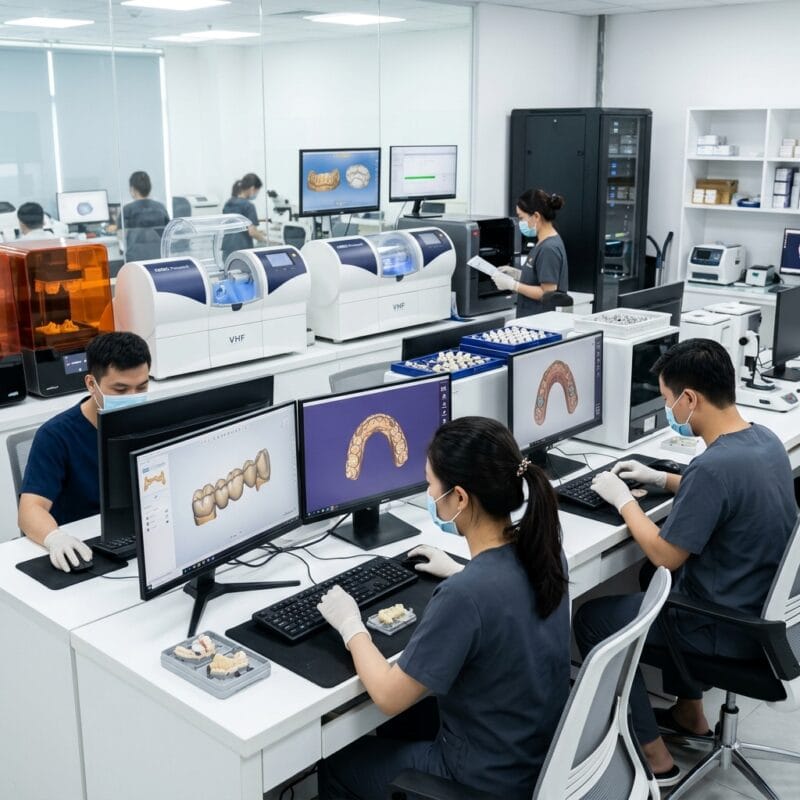
Furthermore, how German dental labs use CAD CAM outsourcing in 2026 relies on automated file routing and cloud-based management software. Modern laboratory management systems (LMS) automatically assign incoming digital cases to external designers based on case complexity, clinical indication, and required delivery turnaround. Once the digital design file (construction file) is completed remotely, it is securely uploaded back to the local lab’s server for rapid technical review and quality check prior to local 3D printing or milling.
In practice, how German dental labs use CAD CAM outsourcing in 2026 allows master technicians to focus on final aesthetic layering, quality assurance, and clinical consultation. Rather than spending 30 to 45 minutes manually drawing margins and adjusting contacts on a standard single crown, a master technician spends just two minutes reviewing and fine-tuning an externally designed CAD file. This high-efficiency paradigm dramatically amplifies individual technician productivity.
Understanding How German Dental Labs Use CAD CAM Outsourcing in 2026 Across Indication Types
Analyzing how German dental labs use CAD CAM outsourcing in 2026 across various clinical indications highlights versatile applications spanning routine restorations to highly intricate full-mouth rehabilitation projects. External CAD design centers employ dedicated teams specialized in specific restoration categories, ensuring expert-level execution regardless of case complexity.
- Crown and Bridge Restorations: Monolithic zirconia crowns, layered zirconia copings, lithium disilicate restorations, and temporary PMMA bridges form the backbone of daily CAD outsourcing. External designers strictly adhere to prescribed minimum wall thicknesses and margin parameters to ensure structural integrity during local sintering and milling.
- Implant Prosthetics: Custom titanium abutments, screw-retained zirconia crowns, and hybrid bridge frameworks require meticulous digital design. Outsourcing partners utilize precise original implant library geometries to guarantee exact passive fit across major European implant systems. Utilizing specialized remote design expertise also works well alongside full arch implant bridge design workflows for complex edentulous cases.
- Removable Prosthetics: Digital removable partial denture (RPD) frameworks, milled cobalt-chromium structures, and 3D-printed full denture bases are increasingly designed remotely, eliminating time-consuming manual waxing and casting steps.
- Surgical Guides and Orthodontics: Implant placement planning, stackable surgical guide design, clear aligner staging, and custom night guards are routinely outsourced to specialized CAD technicians. Combining diagnostic CBCT data with intraoral scans allows remote designers to generate highly precise surgical tools, frequently complementing internal surgical guide design protocols.
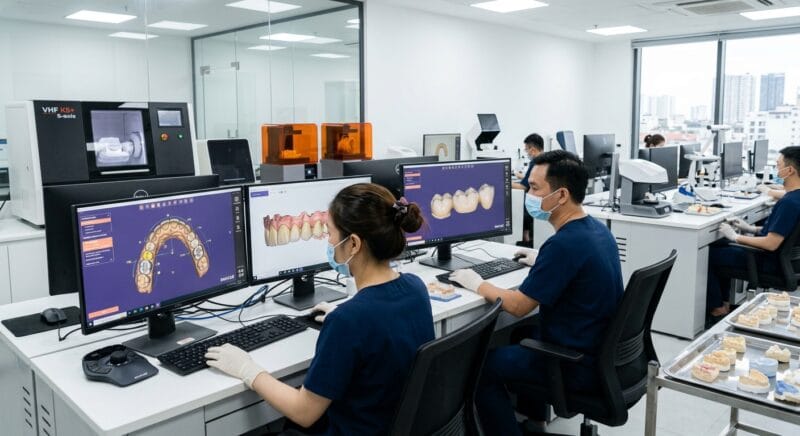
Why do German dental labs outsource CAD CAM design in 2026?
German dental labs outsource CAD/CAM design in 2026 primarily to overcome severe shortages of qualified dental technicians (Zahntechniker) while expanding their daily production capacity without increasing fixed operational overhead.
By leveraging global design networks, lab owners can scale their business operations flexibly. The decision to delegate digital design tasks is driven by the necessity to maintain rapid 24-hour manufacturing cycles. Exploring how German dental labs use CAD CAM outsourcing in 2026 to maintain competitive pricing demonstrates how outsourcing transformed fixed operational expenses into scalable variable costs. When case volume fluctuates, laboratories only pay for the specific designs generated, protecting their cash flow during slower periods.
Another dimension of how German dental labs use CAD CAM outsourcing in 2026 involves handling peak workload spikes without forcing staff to work excessive overtime. Rather than turning down urgent work from valued dental practices during busy seasons, laboratories seamlessly offload excess CAD design tasks to external partners overnight. While the German laboratory rests, international design centers located in different time zones complete the CAD files, allowing local milling units to start production first thing in the morning.
How does digital crown design outsourcing work for high-volume German labs?
Digital crown design outsourcing works by securely transmitting open STL or PLY scan files from local scanner systems to remote CAD specialists who return production-ready design files within 2 to 24 hours.
This streamlined digital workflow begins at the chairside, where the dentist captures an intraoral scan and transmits the file to the laboratory via a secure digital platform. The practical execution of how German dental labs use CAD CAM outsourcing in 2026 to optimize crown and bridge workflows relies on standardized communication templates. These templates capture essential clinical parameters, including shade selection, antagonist clearance, interproximal contact intensity, emergence profile, and preferred material type.
Once the remote design team receives the scan data, specialized CAD operators construct the anatomical restoration using advanced software tools. They systematically inspect the preparation line, evaluate dynamic occlusion against the virtual articulator, and verify minimum material thickness. Upon completion, the final digital design file is uploaded to the laboratory’s secure server. The local German lab performs a rapid quality assurance review, approves the file, and sends it directly to their in-house 5-axis milling machine or 3D printer for physical fabrication.
Technical precision is central to how German dental labs use CAD CAM outsourcing in 2026 for complex anatomical restoration. External designers receive continuous training on precise material behaviors, understanding how different zirconia formulations, lithium disilicate ceramics, and PMMA resins behave during milling and post-processing. This specialized knowledge minimizes local grinding adjustments and ensures perfect fit right out of the milling machine.
What are the regulatory requirements for CAD CAM outsourcing in Germany?
Regulatory compliance for CAD/CAM outsourcing in Germany requires strict adherence to the Medical Device Regulation (MDR) standards, precise material definitions, and complete traceability throughout the digital design and manufacturing pipeline.
Under European Union law, dental restorations are classified as custom-made medical devices. Consequently, understanding how German dental labs use CAD CAM outsourcing in 2026 while staying compliant with EU Medical Device Regulation (MDR) guidelines is a top priority for laboratory directors. The local German laboratory remains legally responsible as the manufacturer of record for the final medical device delivered to the dentist. Therefore, external design partners must operate under strict quality management systems (QMS) that align with ISO 13485 standards.
Data protection rules under General Data Protection Regulation (GDPR) mandates also dictate how German dental labs use CAD CAM outsourcing in 2026 with encrypted file transfers. To ensure absolute compliance, all patient-identifying health information is anonymized before scan data leaves the clinic or laboratory network. External designers work strictly with numerical case IDs and anonymized 3D surface meshes, ensuring complete privacy and regulatory alignment.
Evaluating how German dental labs use CAD CAM outsourcing in 2026 shows a shift toward hybrid production models that seamlessly merge digital efficiency with legal compliance. Local lab managers maintain comprehensive digital archives of all CAD construction files, design logs, material certifications, and milling parameters. This rigorous documentation guarantees full technical traceability in the rare event of a clinical issue or regulatory audit.
Ultimately, how German dental labs use CAD CAM outsourcing in 2026 sets a new standard for global dental laboratory operations, demonstrating that digital delegation, strict quality control, and economic efficiency can coexist harmoniously.
Best Practices for Implementing CAD/CAM Outsourcing in German Labs
To successfully replicate how German dental labs use CAD CAM outsourcing in 2026, laboratory leaders must adopt a systematic approach to vendor integration, communication, and quality management. Smooth implementation requires clear protocols and standardized parameters to achieve consistent, predictable clinical outcomes.
- Establish Standardized Design Profiles: Define precise digital design guidelines for each partner clinician. Specify parameters such as cement space gap (e.g., 30 microns starting 1mm above the margin), contact point tightness, occlusal relief, and anatomical carving intensity.
- Implement Multi-Stage Quality Assurance: Conduct thorough local checks of incoming CAD files on a calibrated monitor prior to milling. Check margin seating, contact strength, and wall thickness to eliminate remakes before material is consumed.
- Maintain Open Technical Communication: Utilize dedicated direct messaging or video review channels with remote design leads. Clear visual feedback on complex cases helps refine remote design parameters over time.
- Utilize Secure Cloud Architecture: Ensure all digital file exchanges occur through encrypted cloud platforms featuring automated file archiving, full data security compliance, and continuous audit trails.
The Future of Outsourced Dental Design in Europe
Mastering how German dental labs use CAD CAM outsourcing in 2026 allows lab managers to secure long-term profitability, maintain competitive turnaround times, and alleviate skilled labor bottlenecks. As artificial intelligence (AI) automated design tools continue to mature, the synergy between AI-assisted CAD algorithms and expert remote designers will further streamline digital dental manufacturing.
By analyzing how German dental labs use CAD CAM outsourcing in 2026, forward-thinking laboratories worldwide can scale effortlessly, protecting their reputation for clinical excellence while expanding their operational capacity into the digital future.
Ready to streamline your laboratory’s CAD workflow and expand your production capacity? Contact our expert digital design team today to start your risk-free trial case.