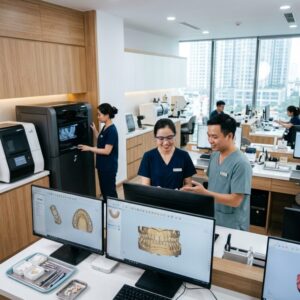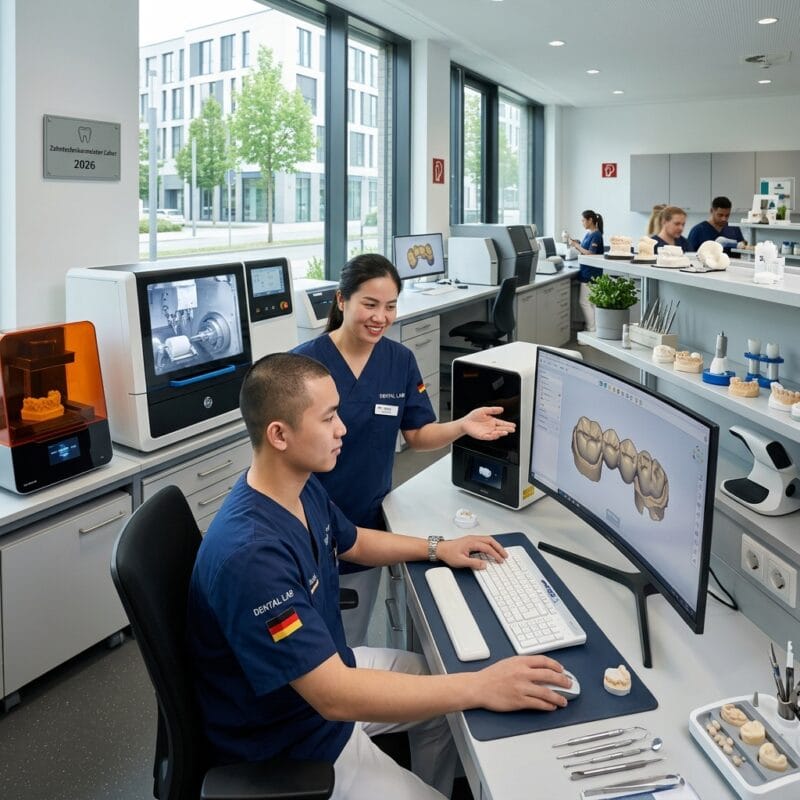
The European dental technology landscape is undergoing a massive digital evolution. Understanding how to start a dental lab in Germany in 2026 requires a clear grasp of both stringent regulatory standards and rapid technological shifts toward fully digital workflows. Germany represents the largest market for dental prosthetics in Western Europe, characterized by highly discerning dentists, a strong reimbursement infrastructure, and strict national quality benchmarks.
For entrepreneurs, certified master technicians, and dental groups evaluating how to start a dental lab in Germany in 2026, the market offers unprecedented opportunities driven by digital dentistry. Intraoral scanners are now standard equipment in German dental clinics (Zahnarztpraxen), shifting practitioner demands away from traditional physical impressions toward instantaneous digital file transfers. This shift fundamentally alters the economic and operational blueprint for launching a commercial laboratory.
Anyone researching how to start a dental lab in Germany in 2026 will quickly realize that modern dental practices expect seamless digital workflows, fast turnaround times, and ultra-precise restorations. To meet these expectations while remaining financially viable, new laboratory owners must combine traditional German craftsmanship with modern, scalable digital infrastructure—including strategic CAD design outsourcing partners.
What qualifications are required to open a dental laboratory in Germany?
To open a dental laboratory in Germany, the legal owner or appointed technical director must hold a Master Dental Technician (Zahntechnikermeister) qualification under the German Crafts Code. This requirement forms the legal backbone of the German dental laboratory sector, ensuring that every commercial lab operates under certified technical leadership.
When researching how to start a dental lab in Germany in 2026, your first consideration must be meeting these strict statutory qualification standards governing the German dental technology sector. Under the German Crafts Code (Handwerksordnung – HwO), dental technology is classified as a craft requiring approval (zulassungspflichtiges Handwerk). This designation means you cannot simply register a general business and begin manufacturing commercial crowns, bridges, or dentures without meeting specific supervisory criteria.
A critical milestone in learning how to start a dental lab in Germany in 2026 is understanding how the Meisterpflicht rule functions in practice. If you are not personally a certified Zahntechnikermeister, you must hire a full-time Master Dental Technician who serves as the designated technical manager (fachlicher Leiter) registered with the local Chamber of Crafts (Handwerkskammer). This certified professional bears legal oversight responsibility for quality standards, technical accuracy, and adherence to medical device regulations.
Legal compliance is central to how to start a dental lab in Germany in 2026, including formal registration with the regional Chamber of Crafts, registration with the local trade office (Gewerbeamt), and obtaining appropriate commercial liability and product liability insurance policies tailored to medical device fabrication. Furthermore, laboratories must register with the German Institute for Medical Documentation and Information (DIMDI) system or its current successor database under EU Medical Device Regulation (MDR) rules.
Navigating European and German Regulatory Frameworks in 2026
Compliance is non-negotiable in the German healthcare space. A fundamental part of understanding how to start a dental lab in Germany in 2026 involves building a comprehensive compliance management framework that satisfies both European Union mandates and federal German statutory laws. The primary governing directive is the EU Medical Device Regulation (MDR 2017/745), which classifies custom-made dental restorations as custom devices requiring full material traceability and documentation.
To successfully execute how to start a dental lab in Germany in 2026, your facility must establish standardized protocols for maintaining material safety data sheets, tracking batch lot numbers for all consumables (zirconia disks, PMMA resin, titanium custom abutments, ceramic powders), and issuing a formal Declaration of Conformity for every completed patient case. German dental clinics routine inspect these declarations to satisfy their own billing and audit requirements with public (GKV) and private health insurance providers.
Furthermore, understanding price structuring under the statutory billing frameworks—such as the BEL II (Bundeseinheitliches Leistungsverzeichnis) for public health insurance cases and BEB (Bundeseinheitliche Benennungsliste) for private or custom private cases—is essential when planning how to start a dental lab in Germany in 2026. Establishing pricing algorithms that align with these reimbursement structures ensures your practice client network can easily bill end-paying patients and health funds without administrative friction.
Capital Requirements and Budgeting Strategies for 2026
Formulating a realistic capital plan is a foundational step when analyzing how to start a dental lab in Germany in 2026. Historically, starting a full-service dental laboratory in Germany required significant initial investments ranging from €250,000 to over €600,000. These funds were traditionally allocated toward large physical facilities, heavy ceramic furnaces, wet and dry 5-axis milling machines, model cast equipment, and expensive localized computer hardware and software licenses.
However, traditional capital investment models are changing dramatically, which directly impacts how to start a dental lab in Germany in 2026 efficiently. By adopting a lean digital model, new entrants can launch a high-capacity dental laboratory with a fraction of traditional capital outlay. Rather than purchasing five separate milling machines and hiring three dedicated in-house CAD designers, new lab founders can invest in essential finishing equipment while outsourcing their core digital CAD design workload.
Budgeting for commercial real estate leased to local zoning regulations, specialized HVAC dust extraction systems, ceramic sintering ovens, light-curing units, and initial material inventory forms the financial baseline of how to start a dental lab in Germany in 2026 with minimal operational risk. Maintaining dynamic working capital reserves equivalent to at least six months of operational expenses (rent, utilities, technician salaries, licensing, and outsourcing fees) provides a secure financial runway while establishing clinical practice accounts.
Key Steps for How to Start a Dental Lab in Germany in 2026
Mastering the practical execution of how to start a dental lab in Germany in 2026 requires balancing core operational pillars: establishing a secure digital infrastructure, defining local production capabilities, and integrating efficient software platforms. The transition from physical impression trays to digital intraoral STL scans allows new lab operators to organize their facility layout around clean, streamlined digital workstations rather than messy plaster casting rooms.
Technicians exploring how to start a dental lab in Germany in 2026 must choose between building an expansive in-house design team or leveraging specialized design service partners. Operating an entirely in-house design team requires purchasing permanent software dongles or annual floating licenses for platforms like exocad, while simultaneously competing for scarce, highly compensated digital technicians in the German job market.
Softwares like exocad have transformed production, redefining how to start a dental lab in Germany in 2026 with high-speed digital design capabilities. However, tying your early business viability entirely to local staffing availability creates critical growth bottlenecks. If your sole in-house designer calls in sick or resigns during peak production weeks, turnaround times break down, causing severe reputational damage among clinical clients.
By analyzing modern software deployment options, founders who want to know how to start a dental lab in Germany in 2026 can optimize their software licensing overhead. Combining focused in-house software capabilities with an external, round-the-clock CAD design service provider guarantees operational elasticity and guarantees that incoming optical scans are processed instantly without technical delays.
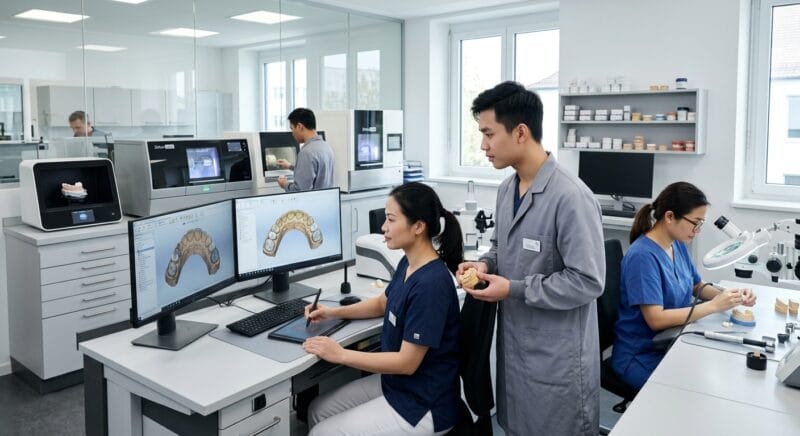
How does CAD/CAM design outsourcing reduce startup capital requirements?
CAD/CAM design outsourcing reduces startup capital requirements by eliminating initial software license purchases, costly design workstation hardware, and fixed full-time technician salaries. By converting fixed operational overhead into flexible, pay-per-case expenditures, startup labs maintain lean balance sheets while offering a complete catalog of dental restorations from day one.
When considering how to start a dental lab in Germany in 2026, outsourcing CAD design allows new labs to scale instantly without bottlenecking operations during unexpected volume spikes. Rather than spending tens of thousands of Euros on initial hardware workstations and specialized module add-ons, startup founders can submit raw optical intraoral scans directly to expert digital design teams who return production-ready STL files within hours.
This operational flexibility is vital for anyone discovering how to start a dental lab in Germany in 2026 on a controlled budget. Instead of turning down complex cases outside your local team’s immediate skill set—such as multi-unit implant bridges, custom titanium bars, or full-mouth rehabs—you can rely on an external team of veteran CAD designers who handle high-complexity cases seamlessly.
Partnering with digital design experts changes the economic outlook of how to start a dental lab in Germany in 2026 by transforming unpredictable labor expenses into flat, predictable unit costs. This model empowers the lab founder to focus on local client acquisition, clinical consultation, precision milling or 3D printing, staining, glazing, and local hand-finishing, where true artistic craftsmanship adds tangible value.
Broadening Your Product Catalog via Digital Design Partnerships
Tailoring a diverse product portfolio—ranging from single-unit crown & bridge restorations to complex full-arch implant prosthetics design—is central to how to start a dental lab in Germany in 2026 with immediate competitive appeal. German dental clinics prefer working with comprehensive service partners who can fulfill all patient prescription types rather than splitting orders across multiple specialized vendors.
Advanced clinical offerings like 3D-printed surgical guides and custom nightguard and aligner design give new labs a substantial strategic edge when determining how to start a dental lab in Germany in 2026. By offering implant surgical planning alongside restorative design, your laboratory transforms into an indispensable clinical partner for dental practices and Dental Support Organizations (DSOs) performing guided implant surgery.
Leading software ecosystems like 3Shape allow seamless integration between intraoral scanners and lab management systems, demonstrating how to start a dental lab in Germany in 2026 with fully connected digital infrastructure. When your lab receives scan files from open intraoral systems, professional design services rapidly generate precise CAD files optimized for your local 5-axis milling units or 3D printers, ensuring micro-gap margins and optimal contact points every time.
What are the primary operational challenges when building a new dental lab?
The primary operational challenges when building a new dental lab include securing qualified technical staff, maintaining strict quality control under MDR regulations, managing fluctuating daily case loads, and controlling operational overhead. Overcoming these hurdles requires a reliable hybrid workflow combining local craftsmanship with scalable digital resources.
Navigating skilled labor shortages is consistently cited as one of the hardest aspects of how to start a dental lab in Germany in 2026. The German dental technology sector faces an aging workforce and a shortage of incoming apprentice technicians proficient in both classic morphology and modern CAD/CAM applications. Relying solely on local hiring to expand design bandwidth can severely restrict growth capacity.
Quality management systems under MDR standards represent another key hurdle in how to start a dental lab in Germany in 2026. Every ceramic crown, custom abutment, night guard, and orthodontic aligner must conform to strict dimensional tolerances and material safety standards. Integrating verified digital workflows with validated design protocols significantly reduces manual remakes, protecting your bottom-line margin.
Managing fluctuating daily case volumes efficiently is essential when figuring out how to start a dental lab in Germany in 2026 without overhiring during peak periods or suffering under high fixed payroll during seasonal lulls. Digital CAD design outsourcing grants complete operational elasticity: during busy clinical months, design volume expands instantly, and during slower holiday seasons, design expenses contract automatically.
Step-by-Step Execution Plan for Launching in 2026
Developing an effective go-to-market and operational plan is a pivotal phase of how to start a dental lab in Germany in 2026. To ensure a smooth business launch, follow a structured, phased execution plan designed for modern digital healthcare environments:
- Phase 1: Qualification & Legal Registration: Secure or verify your Zahntechnikermeister credentials, establish your business entity (e.g., GmbH or e.K.), register with the Chamber of Crafts (Handwerkskammer), and register with local trade authorities.
- Phase 2: Digital Ecosystem Setup: Establish secure, GDPR-compliant cloud servers, client portals, and intake channels for intraoral scan files (STL, PLY, OBJ). Configure integration links for exocad, 3Shape, and Medit Link ecosystems.
- Phase 3: Strategic Design Outsourcing Integration: Partner with a professional dental CAD design outsourcing provider to handle crown & bridge, implant, surgical guide, denture, and aligner designs on demand. Establish turn-around protocols and quality control parameters.
- Phase 4: Facility & Equipment Deployment: Set up light industrial laboratory space with certified dust management, sintering ovens, 3D printers for working models and splints, milling equipment, and finishing stations for glazing and characterization.
- Phase 5: Regulatory Compliance & Quality Control: Establish MDR-compliant documentation procedures, create material batch tracking systems, and prepare standard Declarations of Conformity templates for clinical clients.
- Phase 6: Practice Acquisition & Go-To-Market: Launch targeted marketing campaigns toward local dental clinics and DSOs, offering rapid turnaround times, flawless digital integration, and competitive BEL II / BEB tariff pricing.
Building strong relationships with local DSOs and private clinics is core to how to start a dental lab in Germany in 2026 with sustainable, high-margin revenue streams. Emphasize your ability to accept direct intraoral scans, deliver fast turnaround times on digital wax-ups, and provide surgical guide designs that increase implant placement predictability.
Establishing transparent digital intake portals simplifies customer onboarding when evaluating how to start a dental lab in Germany in 2026. Dentists value simple digital workflows: they upload scan files via your branded online portal, select their prescribed material options, and receive back validated design previews or pre-milled prosthetics ready for intraoral seating.
Scaling Your Dental Lab for Long-Term Profitability
In summary, mastering how to start a dental lab in Germany in 2026 requires balancing statutory compliance, modern digital software capabilities, and lean, intelligent design outsourcing strategies. By removing digital design bottlenecks and keeping fixed hardware overhead low, lab owners can allocate their focus where it matters most: delivering impeccable restorative craftsmanship, serving dentist preferences, and expanding client acquisition throughout Germany.
The dental technology landscape will continue to reward agile, digitally fluent labs that combine regional technical oversight with global digital scalability. Establishing a flexible hybrid operational model today positions your laboratory for sustainable profitability and long-term market leadership for years to come.
Ready to streamline your new German dental laboratory with expert, scalable digital design solutions? Contact Evident Art today to discuss our white-label CAD design outsourcing services for all restorative and orthodontic cases.