Navigating the Evolving Landscape of Dental Lab Regulations in Germany 2026
The dental technology sector across Europe is experiencing an unprecedented regulatory shift, with the federal republic of Germany standing at the absolute forefront of enforcement. As we approach 2026, compliance requirements for dental laboratories, milling centers, and Dental Service Organizations (DSOs) are becoming substantially more stringent. Understanding the full scope of dental lab regulations in Germany 2026 is no longer just a legal necessity for laboratory owners; it is a core operational strategy that dictates profitability, risk management, and market competitiveness. The intersection of the European Union Medical Device Regulation (EU MDR 2017/745), national legislation such as the Medizinprodukterecht-Durchführungsgesetz (MPDG), and stringent digital data protection guidelines has reshaped how custom-made dental prosthetics are designed, fabricated, and documented.
For commercial dental laboratories and growing DSOs operating in or supplying the German market, compliance extends across every stage of the manufacturing workflow. From the moment an intraoral scan file is captured at the chairside to the final QC inspection of a zirconia crown, full traceability is mandatory. The upcoming enforcement deadlines inherent to the dental lab regulations in Germany 2026 place particular scrutiny on digital dental design workflows, software validation, material certification, and third-party outsourcing. As laboratories face persistent skilled labor shortages and rising operating costs in Western Europe, turning to high-quality digital CAD/CAM design outsourcing has emerged as an essential solution. However, delegating digital design work requires a granular understanding of how third-party services fit into the German regulatory matrix.
This comprehensive guide explores the specific mandates governing dental prosthetics, the technical requirements for digital CAD file generation, and how dental laboratories can successfully leverage expert outsourced CAD design services while maintaining absolute adherence to all dental lab regulations in Germany 2026.
What are the primary compliance requirements under dental lab regulations in Germany 2026?
The primary compliance requirements under dental lab regulations in Germany 2026 include rigorous custom-made device documentation, mandatory risk management protocols, strict GDPR data handling for digital impressions, and full material traceability. Under the harmonized framework of EU MDR and German MPDG, dental laboratories are legally classified as manufacturers of custom-made devices. This designation means that every single crown, bridge, implant superstructure, removable partial denture, clear aligner, and night guard produced must be backed by an exhaustive technical file.
Laboratories are required to maintain detailed records for a minimum of 15 years, particularly for implantable devices and complex prosthetics. The dental lab regulations in Germany 2026 demand that this documentation contains:
- Statement of Conformity (Annex XIII): A detailed declaration explicitly identifying the patient, the prescribing dentist, the exact specifications of the custom device, and a statement certifying that the device conforms to the general safety and performance requirements (GSPRs).
- Full Material Traceability: Complete tracking of raw material lot numbers, including CAD/CAM zirconia discs, titanium bases, PMMA resins, and ceramic stains used in the fabrication process.
- Design Software Validation: Proof that all digital design software—such as exocad or 3Shape—is properly licensed, validated, updated, and operated according to standardized manufacturing protocols.
- Post-Market Surveillance (PMS): An active system for logging customer feedback, non-conformities, remake rates, and corrective actions taken by the laboratory.
Failure to meet these strict standards outlined in the dental lab regulations in Germany 2026 can result in severe financial penalties, operational suspension, and loss of commercial accreditation. Therefore, dental laboratories must ensure that every segment of their workflow—whether internal or external—adheres to these exact legal parameters.
Understanding the Digital CAD/CAM Mandates in the German Market
The rapid transition from conventional physical impressions to fully digital intraoral workflows has streamlined crown and bridge production, but it has also introduced complex legal challenges. Under the dental lab regulations in Germany 2026, digital CAD files (such as STL, PLY, or OBJ datasets) are legally defined as integral components of the medical device manufacturing process. A CAD design is not merely a technical drawing; it represents the structural blueprint of a custom medical device that directly impacts patient health, occlusion, tissue compatibility, and structural longevity.
Consequently, digital CAD designers must adhere to standardized anatomical parameters, structural minimum thickness guidelines, and verified margin definitions specified by dental material manufacturers. When a laboratory chooses to utilize outsourced crown and bridge design services, the responsibility for regulatory compliance remains firmly with the primary dental laboratory of record in Germany. The primary lab must verify that the digital CAD file produced by an external design center meets all parameters defined by the dental lab regulations in Germany 2026 before the restoration is sent to a milling machine or 3D printer.
Furthermore, digital software platforms utilized for CAD design must maintain rigorous cybersecurity measures and operational logging. Every modification made to a digital tooth setup, custom abutment profile, or denture base must be recorded in an audit trail to satisfy regulatory inspectors evaluating compliance with the dental lab regulations in Germany 2026.
How do dental lab regulations in Germany 2026 affect outsourced CAD design?
The dental lab regulations in Germany 2026 mandate that all outsourced CAD design workflows remain fully traceable, compliant with the EU Medical Device Regulation (MDR), and backed by complete technical documentation. Outsourcing the CAD design phase does not exempt a German laboratory from its regulatory obligations; rather, it requires the establishment of a formal Quality Management Agreement (QMA) with the remote CAD design partner.
When working with a specialized CAD design outsourcing partner, German laboratories must ensure several critical criteria are satisfied to comply with dental lab regulations in Germany 2026:
- Standardized Protocol Alignment: The offshore or nearshore design team must operate strictly according to the German laboratory’s custom parameters, including exact cement gap settings, contact point tightness, occlusal clearance, and minimum wall thickness based on the specific restorative material chosen.
- Data Protection & Anonymization: Intraoral scan data transferred to external design centers must be completely stripped of Personally Identifiable Information (PII) to comply with European General Data Protection Regulation (GDPR) mandates linked to the dental lab regulations in Germany 2026. Patient IDs should be referenced solely via unique laboratory case numbers.
- Version-Controlled Software Ecosystems: External designers must use fully updated, legally licensed CAD software suites that generate uncorrupted, standard open-format STL or PLY files capable of being audited during regulatory inspections.
- Archival of CAD Datasets: Both the original raw intraoral scan and the finalized 3D CAD design file must be securely stored in compliant cloud archives for the mandatory retention period required by dental lab regulations in Germany 2026.
By establishing tight digital integration with a qualified design service, dental laboratories can effortlessly scale their production volume without exposing their business to regulatory vulnerabilities associated with non-compliant CAD files.
ISO 13485 and Quality Management Systems for German Dental Labs
While ISO 13485 certification is technically voluntary for smaller custom-made device manufacturers, the practical reality under the dental lab regulations in Germany 2026 is that having an audited Quality Management System (QMS) aligned with ISO 13485 has become the gold standard for doing business. Major DSOs, university clinics, and large private dental practices in Germany increasingly demand that their laboratory partners prove ISO compliance.
A compliant QMS under the dental lab regulations in Germany 2026 framework requires standardized operating procedures (SOPs) across all departments. This includes clear incoming inspection protocols for physical impressions and intraoral scans, validated milling and sintering curves, regular calibration of 3D printers, and structured training records for all laboratory technicians and digital designers.
When incorporating an external CAD design team into an ISO-aligned QMS, the domestic lab must conduct formal vendor qualification. Partnering with a dedicated, professional CAD design center that already operates under ISO-compliant workflows ensures that the digital files flowing into your German facility seamlessly merge into your overall quality management ecosystem, satisfying all requirements of the dental lab regulations in Germany 2026.
Why should dental labs outsource digital design under dental lab regulations in Germany 2026?
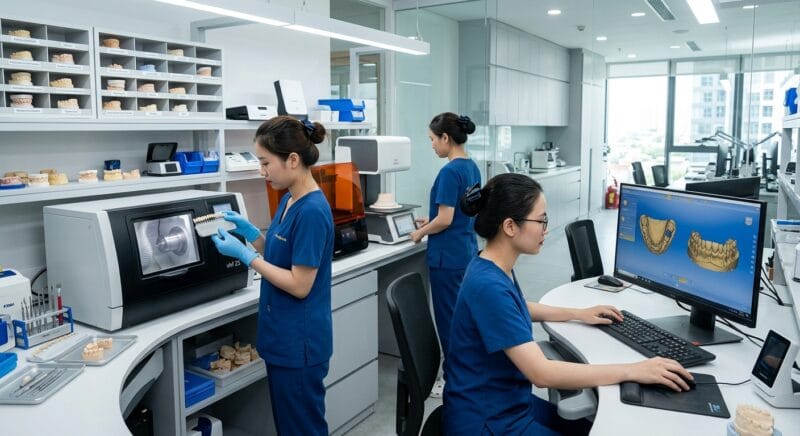
Dental labs outsource digital design under dental lab regulations in Germany 2026 to scale production capacity, reduce domestic overhead, and leverage certified CAD specialists without compromising regulatory compliance. The economic pressure on European dental laboratories has reached a critical point; rising labor costs, high technician turnover, and the expensive capital expenditure required for software licenses make maintaining a large in-house CAD department increasingly difficult.
Outsourcing digital CAD design presents a powerful strategic advantage for German dental facilities navigating the dental lab regulations in Germany 2026. Rather than spending valuable hours having master technicians sit behind CAD workstations designing basic single crowns or routine night guards, labs can delegate these digital tasks to specialized design centers. This allows high-salaried German technicians to focus on complex clinical case planning, shade matching, aesthetic ceramic layering, and final quality control—the high-value tasks that directly drive practice satisfaction and laboratory revenue.
Furthermore, remote CAD design partners operate around the clock across global time zones. A German dental lab can upload intraoral scans at the end of the business day and receive fully designed, production-ready STL files by the following morning. This overnight turnaround dramatically shortens lead times for dental practices while maintaining strict conformity with the dental lab regulations in Germany 2026.
Application of Regulations Across Key Prosthetic Workflows
The reach of the dental lab regulations in Germany 2026 spans all categories of dental prosthetics and orthodontic appliances. Each indication requires specific technical considerations during the CAD design phase to ensure clinical safety, structural integrity, and regulatory compliance.
Crown and Bridge Restorations
Monolithic zirconia, lithium disilicate, and layered porcelain-fused-to-metal (PFM) restorations remain the foundation of laboratory production. Under dental lab regulations in Germany 2026, CAD designers must adhere strictly to material manufacturers’ structural guidelines. For example, designing a posterior zirconia crown with a wall thickness below the manufacturer’s specified minimum violates GSPR safety norms. Professional digital design partners utilize pre-configured software libraries that automatically enforce material-specific safety thresholds, mitigating the risk of structural failure and regulatory non-compliance.
Implant Superstructures and Custom Abutments
Implant prosthetics represent high-risk medical devices under the dental lab regulations in Germany 2026. Whether designing single custom titanium abutments or complex screw-retained full-arch bridges, CAD design software must account for precise connection geometries and emergence profiles. Outsourcing implant CAD design requires specialized expertise to ensure that screw channels are properly angled, interface tolerances are exact, and titanium base connections comply with original component manufacturer specifications. Complete traceability of every digital implant components file is mandatory under German law.
Surgical Guides and Digital Implant Planning
Guided implant surgery relies entirely on high-precision digital design merging CBCT DICOM data with intraoral STL scans. Under the dental lab regulations in Germany 2026, surgical guides are categorized as critical single-use instruments. The digital design of a surgical guide must feature accurate sleeve offsets, adequate inspection windows, and robust structural thickness to prevent fracture during drilling. Utilizing specialized services for surgical guide CAD design ensures that complex multi-implant cases are planned with absolute surgical precision and full regulatory compliance.
Removable Dentures and Digital Partial Frameworks
The digital design of full dentures, partial frameworks, and flexible night guards has advanced rapidly. Under the dental lab regulations in Germany 2026, digitally designed removable prosthetics must maintain consistent tissue relief, proper clasp flexibility, and verified occlusal schemes. Outsource CAD partners specializing in digital removable prosthetics utilize sophisticated design algorithms to create ergonomic, biocompatible appliances that drastically reduce chairside adjustment time for German dentists.
Orthodontic Aligners and Retention Appliances
Clear aligners and night guards require precise staging algorithms and material calibration. The dental lab regulations in Germany 2026 demand that aligner setups demonstrate controlled biomechanical forces and predictable tooth movements. Offloading clear aligner staging and guard design to certified CAD experts allows German laboratories to enter the lucrative clear aligner market without investing in costly specialized software or extensive staff retraining.
GDPR and Cybersecurity in Digital Dental Workflows
Data protection is an inseparable component of dental lab regulations in Germany 2026. Germany enforces some of the strictest data privacy frameworks in the world under the European General Data Protection Regulation (GDPR) alongside national data security statutes. Because intraoral scans contain detailed three-dimensional biological data, they are classified as sensitive health data.
When transmitting digital files between dental practices, dental laboratories, and external CAD design partners, strict end-to-end encryption protocols must be utilized. German laboratories must implement secure, HIPAA- and GDPR-compliant cloud platform transfers rather than sending unencrypted files via standard email attachments. To remain 100% compliant with dental lab regulations in Germany 2026, laboratories must anonymize all scan files before sending them to third-party design centers, ensuring that no patient names, birthdates, or personal identifiers are embedded within the STL file metadata.
| Compliance Category | Regulatory Mandate (2026) | Implementation Requirement |
|---|---|---|
| Device Identification | MDR Annex XIII Custom-Made Declaration | Complete technical passport for every case delivered to dentist |
| Data Transfer | GDPR & German Health Data Protection | Anonymized STL files transferred via encrypted cloud architecture |
| Software Validation | Medical Software Quality Standards | Validated CAD platforms (Exocad/3Shape) with full audit logging |
| Traceability | 15-Year Archive Mandate | Secure retention of raw scans, CAD files, and material lot numbers |
Building a Future-Proof Strategy for German Labs and DSOs
As enforcement of the dental lab regulations in Germany 2026 reaches full implementation, proactive dental laboratory owners and DSO executives must modernize their business models. Viewing compliance not as an obstacle, but as a quality benchmark, allows German labs to differentiate themselves in a crowded marketplace.
To successfully integrate outsourcing while guaranteeing compliance with dental lab regulations in Germany 2026, laboratory leadership should take the following strategic steps:
- Perform a Complete Regulatory Audit: Evaluate all current workflows, software licenses, data transfer mechanisms, and material tracking systems to identify potential compliance gaps under the 2026 framework.
- Establish Standard Operating Procedures (SOPs) for CAD: Create documented parameters for every restoration type, specifying minimum wall thicknesses, cement margins, and anatomical preferences. Provide these exact SOPs to your CAD design outsourcing partner.
- Select a Regulatory-Aware CAD Partner: Partner with a dedicated digital dental design company that understands European medical device regulations, operates high-end CAD software, and guarantees total data anonymization and security.
- Implement Automated Archival Systems: Deploy cloud-based storage solutions that automatically link dentist prescriptions, intraoral scans, outsourced CAD files, and milling logs under a single searchable case ID for quick regulatory retrieval.
- Train In-House Staff on Quality Control: Shift the focus of internal technicians toward rigorous incoming case reviews, digital design checks, material finishing, and final compliance verification.
By implementing these strategic steps, German dental laboratories can fully protect their operations against regulatory liabilities while enjoying the tremendous cost savings, capacity growth, and turnaround speed offered by professional digital CAD design outsourcing.
Conclusion: Mastering Compliance and Growth in 2026
The arrival of the dental lab regulations in Germany 2026 marks a mature era for digital dentistry—one where quality, safety, and traceability are paramount. Operating a successful dental laboratory or DSO in this environment requires balancing rigorous regulatory adherence with operational efficiency. By selecting a highly qualified, security-conscious CAD design outsourcing provider, German dental labs can easily fulfill all legal mandates while scaling their business for long-term profitability.
Ready to streamline your CAD workflow and maintain complete compliance? Contact our expert digital dental design team today to start your risk-free trial case.