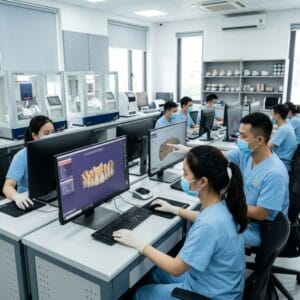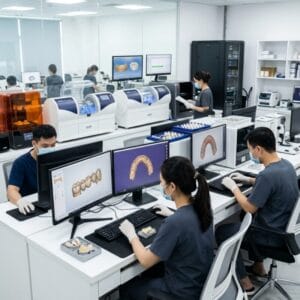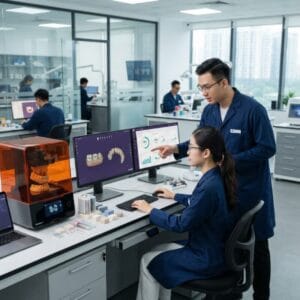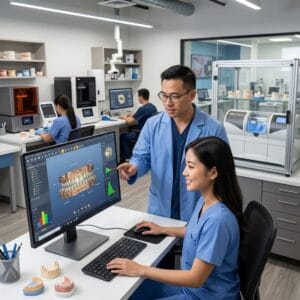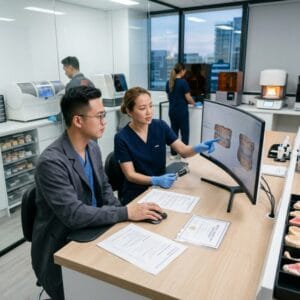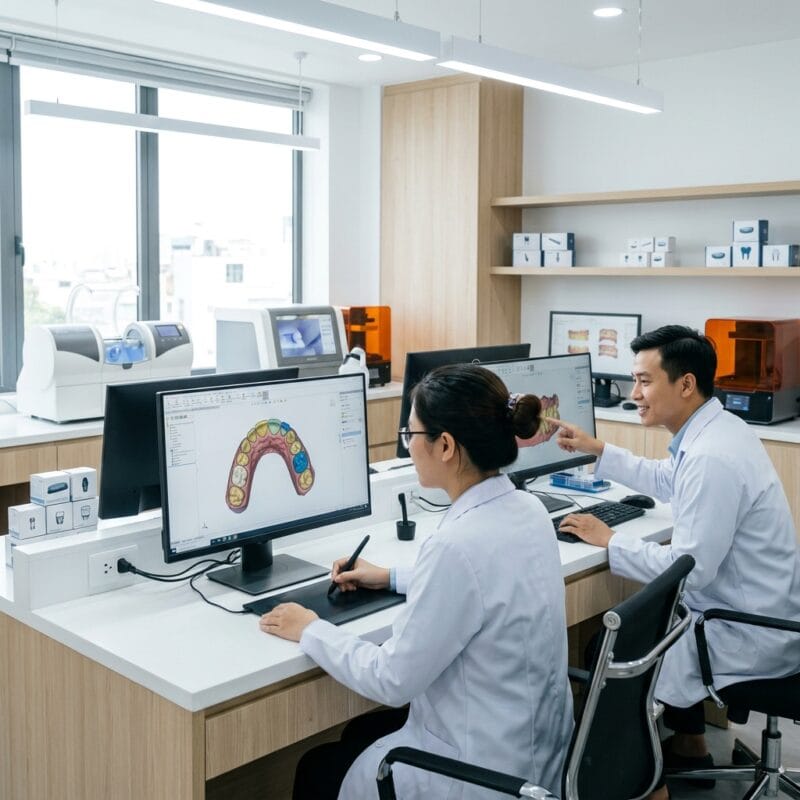
The dental industry in North America has reached a pivotal juncture. As patient demand for rapid, high-aesthetic restorative solutions rises, dental practices and Dental Service Organizations (DSOs) confront an unprecedented labor deficit. Finding experienced Certified Dental Technicians (CDTs) and skilled computer-aided design (CAD) operators has become one of the most pressing operational hurdles for clinical directors and practice owners. Understanding how US dental clinics solve staffing shortages through outsourcing in 2026 has become essential for practice survival and sustainable profit margins.
The transition toward intraoral scanners, desktop 3D printers, and chairside or central milling machines promised to streamline patient care. However, hardware alone cannot design complex crown and bridge restorations, full-arch implant prostheses, custom night guards, or orthodontic aligner setups. Digital machinery requires dedicated expertise behind the computer screen. This comprehensive guide explores how US dental clinics solve staffing shortages through outsourcing in 2026 while maintaining exceptional clinical outcomes and predictable turnarounds.
By delegating time-consuming computer-aided design tasks to remote specialized CAD centers, practices liberate their internal teams to focus on clinical delivery, patient communication, and in-house finishing. By examining real-world operational models, we highlight how US dental clinics solve staffing shortages through outsourcing in 2026 to stay competitive in a rapidly changing healthcare economy.
Why are US dental practices facing staffing shortages in 2026?
US dental practices face acute staffing shortages in 2026 due to an aging bench of experienced laboratory technicians, rapid clinical adoption of intraoral scanners, and rising labor costs across North America.
For decades, dental laboratories relied on a traditional apprenticeship model to train ceramicists, waxers, and bench technicians. As thousands of senior technicians retire without an equivalent volume of new graduates entering dental technology programs, the labor pool has shrunk drastically. According to recent healthcare workforce studies from the American Dental Association, the ratio of practicing dentists to skilled laboratory technicians has expanded, leaving many clinics unable to hire full-time design staff at sustainable wages.
Analyzing how US dental clinics solve staffing shortages through outsourcing in 2026 reveals a fundamental shift in labor distribution. Rather than competing in localized bidding wars for scarce CAD artists, forward-thinking clinical directors are expanding their operational horizons. They realize that local hiring bottlenecks do not need to restrict practice volume.
To maintain profitability, industry leaders demonstrate how US dental clinics solve staffing shortages through outsourcing in 2026 across urban and rural markets. Small single-doctor practices and large multi-state enterprise networks alike face identical overhead pressures. By eliminating the fixed overhead of internal CDT salaries, health benefits, and continuous software license updates, clinics insulate themselves from wage inflation.
The growing gap between patient demand and bench talent explains how US dental clinics solve staffing shortages through outsourcing in 2026. Clinics that adopt remote CAD design services convert a fixed payroll liability into a flexible, per-case variable expense, immediately balancing operational budgets while increasing daily case capacity.
What is dental CAD/CAM design outsourcing?
Dental CAD/CAM design outsourcing is the practice of delegating digital restorative design tasks—such as crown, bridge, implant, denture, and aligner CAD modeling—to specialized third-party digital laboratories.
Rather than designing every restoration on site after acquiring an intraoral scan, clinical teams export open 3D format files (such as STL, PLY, or OBJ) directly to dedicated digital design centers. These specialized offshore and nearshore design hubs employ hundreds of expert technicians working on advanced CAD software suites. Once the design file is completed and verified against strict clinical parameters, it is transmitted back to the practice or local laboratory for immediate local milling or 3D printing.
Understanding the digital architecture shows how US dental clinics solve staffing shortages through outsourcing in 2026 without sacrificing design precision. The modern CAD workflow bridges physical distance through high-speed cloud infrastructure. A scan captured in Chicago at 4:30 PM can be analyzed, contoured, and approved by a senior designer overnight, ready for milling in the Illinois clinic by 7:00 AM the following morning.
By leveraging 24/7 turnaround teams, we see how US dental clinics solve staffing shortages through outsourcing in 2026 while accelerating treatment schedules. Chairside time is optimized because local staff members no longer spend hours wrestling with software parameters, occlusion adjustments, or margin line placement.
In practice, how US dental clinics solve staffing shortages through outsourcing in 2026 hinges on seamless cloud integration. Open systems permit clinics to maintain full ownership of their physical production equipment—such as 5-axis mills and high-resolution resin 3D printers—while completely offloading the specialized human labor required for digital sculpting.
How does digital crown design work in an outsourced model?
Digital crown design in an outsourced model works by transmitting 3D intraoral scan data directly to remote lab technicians who craft precise STL design files using advanced CAD software for local milling.
When an intraoral scan is uploaded to a remote design portal, software tools such as exocad automatically identify preparation margins, adjacent contact points, and opposing occlusion patterns. A dedicated designer refines the anatomical contours, ensuring proper interproximal clearance, tissue relief, and functional morphology tailored to the doctor’s specific preferences.
Single-unit restorations represent the primary operational area where observing how US dental clinics solve staffing shortages through outsourcing in 2026 yields immediate returns. Crowns and small bridges constitute over 60% of daily restorative volume in general dental practices. When internal staff members are freed from designing routine posterior crowns, daily clinical throughput expands exponentially.
With anatomical accuracy guaranteed by senior CAD artists, how US dental clinics solve staffing shortages through outsourcing in 2026 translates to minimal chairside adjustment time. Clean seating, precise contact points, and harmonized occlusion mean patients spend less time in the dental chair, directly boosting clinical efficiency and patient satisfaction scores.
Standardizing crown design protocols illustrates how US dental clinics solve staffing shortages through outsourcing in 2026 effectively. Practices establish global clinical preferences—specifying preferred cement gap thickness, contact tightness, and occlusal relief values—ensuring every returned STL file aligns perfectly with the primary clinician’s operating style. For more complex rehabilitations, practices often pair routine single-unit outsourcing alongside specialized full-arch implant bridge design services.
Removables, Dentures, and Orthodontic Aligners
Digital workflows are no longer restricted to fixed crown and bridge prosthetics. The rapid evolution of digital removables, full dentures, partial frameworks, night guards, and clear orthodontic aligners has multiplied the digital workload inside the clinical practice. Managing these multi-disciplinary designs internally requires extensive software expertise across several specialized platforms.
When evaluating removables, studying how US dental clinics solve staffing shortages through outsourcing in 2026 highlights massive efficiency gains in denture base and tooth setups. Remote CAD specialists utilize artificial intelligence-assisted boundary detection and digital wax-try-in libraries to build balanced digital complete dentures in a fraction of the time required by local clinical staff.
Orthodontic clear aligner staging further proves how US dental clinics solve staffing shortages through outsourcing in 2026 across specialty practices. Calculating tooth movement velocities, attachment placements, and IPR (interproximal reduction) schedules requires meticulous attention to detail. Delegating aligner staging to dedicated orthodontic design labs allows clinicians to scale their in-house aligner brands without adding expensive internal treatment planners.
Custom splint fabrication showcases how US dental clinics solve staffing shortages through outsourcing in 2026 without increasing internal overhead. By combining intraoral scans with precise digital design templates, outsourced labs produce perfectly fitting bite splints ready for high-speed local printing. Practicing clinicians can explore specialized workflows like 3D printed night guard workflows to eliminate physical impressions while maintaining low labor costs.
Surgical Guides and Complex Implant Planning
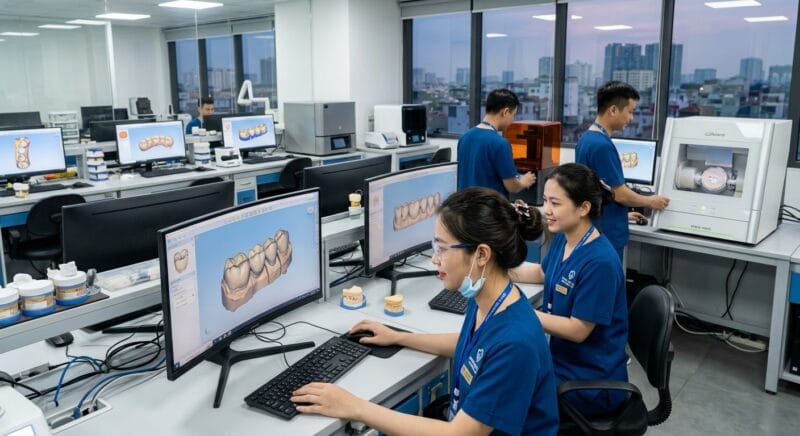
Implant dentistry represents one of the highest-revenue segments in modern clinical practice, yet it also presents significant technical risk. Merging Cone Beam Computed Tomography (CBCT) DICOM files with intraoral optical surface scans (STL) demands dedicated software proficiency and anatomical expertise. Designing tooth-borne, mucosal-borne, or bone-supported surgical guides requires meticulous attention to nerve path positioning, sinus proximity, and implant trajectory.
In implant dentistry, discovering how US dental clinics solve staffing shortages through outsourcing in 2026 ensures patient safety and prosthetic-driven planning. Specialized implant CAD planners work alongside board-certified radiologists and senior clinical master technicians to evaluate bone density and restorative space prior to surgical placement.
Multi-site DSO case studies prove how US dental clinics solve staffing shortages through outsourcing in 2026 during complex surgical guide creation. Rather than tasking local dental assistants or associates with stackable guide design, clinical directors route all implant scans to dedicated design partners. The resulting treatment plan is reviewed and digitally signed off by the treating surgeon in minutes, significantly shortening pre-surgical preparation cycles.
By delegating CBCT segmentation, clinical directors confirm how US dental clinics solve staffing shortages through outsourcing in 2026 across high-volume surgical practices. Custom healing abutments, immediate provisional crowns, and complex multi-implant guide stacks can be engineered simultaneously, providing true prosthetically driven surgical solutions without clogging internal staffing resources.
DSO & Multi-Site Operational Scaling
Dental Service Organizations face unique structural challenges when standardizing clinical care across tens or hundreds of practice locations. Regional variations in technician availability, fragmented software licensing models, and inconsistent design quality create operational bottlenecks that stifle corporate expansion.
For dental service organizations, examining how US dental clinics solve staffing shortages through outsourcing in 2026 offers a scalable blueprint for rapid regional growth. Centralizing file distribution through enterprise cloud platforms allows DSOs to aggregate design demand from hundreds of regional offices and submit them to unified, enterprise-grade design networks.
Enterprise management systems clarify how US dental clinics solve staffing shortages through outsourcing in 2026 across hundreds of clinical chairs. Centralized dashboards grant corporate clinical directors real-time visibility into case statuses, remake statistics, designer notes, and turnaround metrics. This transparent operational oversight guarantees that single-office acquisitions can be integrated into the DSO’s digital ecosystem almost overnight.
Standardizing digital protocols shows how US dental clinics solve staffing shortages through outsourcing in 2026 while maintaining brand consistency. Whether a patient presents at a clinic in Florida or Texas, the resulting restoration meets uniform standards of contact tightness, margin integrity, and anatomical aesthetics, driven by standardized digital design master templates.
- Centralized Portal Management: Single-dashboard upload and status tracking for all clinical locations.
- Elastic Labor Capacity: Instantly handle seasonal spikes in patient traffic without hiring temporary staff.
- Fixed Variable Costing: Predictable per-case design fees streamline enterprise budgeting and margin forecasting.
- Software License Consolidation: Eliminate thousands of dollars in annual software renewal fees per clinical location.
Quality Assurance, Turnaround Times, and Financial ROI
A common misperception regarding digital outsourcing is that delegating CAD tasks compromises quality control or lengthens turnaround times. In reality, modern offshore and nearshore design hubs operate under rigorous ISO-certified quality management protocols, enforcing multi-tier quality assurance checks before any file is marked complete.
Calculating ROI illustrates how US dental clinics solve staffing shortages through outsourcing in 2026 while significantly boosting profit margins. Consider the financial metrics: hiring a qualified, full-time CAD designer in North America carries an annual compensation package exceeding $70,000 to $90,000 when accounting for taxes, benefits, workspace, and ongoing software licensing fees. Conversely, outsourcing design on a per-case basis typically costs a fraction of that total expense, directly converting fixed labor overhead into profitable variable margins.
Evaluating night-shift time zones clarifies how US dental clinics solve staffing shortages through outsourcing in 2026 to achieve overnight design completion. Due to global time-zone differentials, cases submitted at the close of business in California are designed while the US clinic sleeps. The finalized digital files arrive in the clinic’s inbox before doors open the next morning, allowing local 3D printing or milling to begin immediately.
Consistently low remake rates demonstrate how US dental clinics solve staffing shortages through outsourcing in 2026 safely. Continuous designer training, automated quality control algorithms, and feedback-loop scoring systems ensure that digital designs routinely achieve remake rates under 1%, outperforming average internal bench design statistics.
Implementation Framework: How US Dental Clinics Solve Staffing Shortages Through Outsourcing in 2026
Transitioning from an internal design model to a streamlined outsourced CAD strategy requires a methodical, step-by-step implementation process. Success depends on clear communication, digital file standardization, and structured feedback loops between clinical operators and remote design teams.
Implementing a structured pilot project confirms how US dental clinics solve staffing shortages through outsourcing in 2026 efficiently. Clinics begin by submitting routine single-unit crown scans to evaluate design preferences, marginal fit quality, and communication speed. Once baseline settings are established, the practice systematically expands outsourcing to encompass night guards, surgical guides, and complex implant restorations.
Optimizing communication protocols details how US dental clinics solve staffing shortages through outsourcing in 2026 for long-term clinical excellence. Utilizing clear intraoral photos, shaded die references, precise clinical notes, and annotated 3D screenshots eliminates ambiguity, enabling remote designers to match doctor preferences consistently on every case.
Ultimately, understanding how US dental clinics solve staffing shortages through outsourcing in 2026 empowers practice owners to focus on direct patient care. By taking labor-intensive computer design off the practice’s plate, clinicians recover valuable operational time, reduce internal stress, and position their practices for sustainable financial growth.
As digital dentistry evolves, knowing how US dental clinics solve staffing shortages through outsourcing in 2026 secures operational resilience for years to come. Embracing remote CAD design services solves today’s labor challenges while building a flexible foundation for the future of digital dental healthcare.
Ready to eliminate design bottlenecks and scale your clinical workflow? Contact our expert CAD/CAM team today to start your free trial and experience seamless digital design outsourcing.