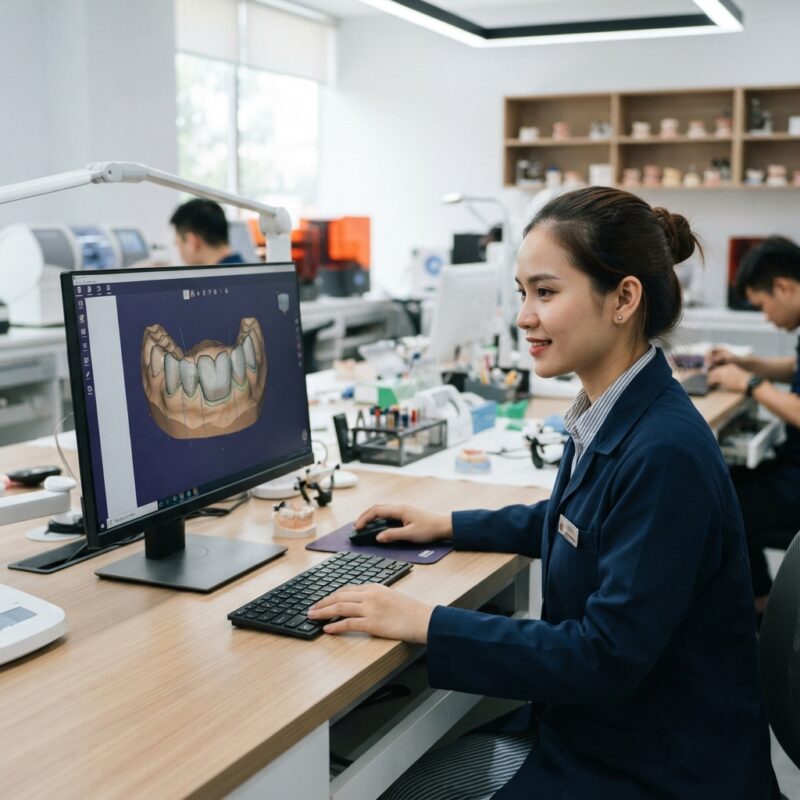
Executive Overview: US Dental Laboratory Industry Market Report and Growth Trends 2026
The dental laboratory landscape in North America is undergoing an unprecedented structural transformation. As highlighted in the latest US dental laboratory industry market report and growth trends 2026, commercial dental laboratories are shifting rapidly from traditional physical craftsmanship to high-throughput, software-driven manufacturing environments. This operational evolution is fueled by dramatic technological convergence, changing practitioner demographics, and evolving patient expectations for fast, highly aesthetic, and minimally invasive dental prosthetics.
According to data synthesized in the US dental laboratory industry market report and growth trends 2026, the domestic laboratory market is projected to expand steadily, even as the total number of independent laboratory facilities continues to consolidate. Independent lab owners face a paradox: while clinical demand for restorative solutions—including crown and bridge, implant prosthetics, clear aligners, surgical guides, and digital dentures—is reaching all-time highs, operational pressures such as skilled labor shortages and rising capital expenditures are squeezing margins. To navigate these pressures, lab executives and Dental Service Organizations (DSOs) are fundamentally reimagining their production pipelines.
Central to this structural shift is the widespread adoption of open-architecture CAD/CAM technology and digital design outsourcing. By offloading intricate software design tasks to specialized digital design partners, forward-thinking laboratories are unlocking unprecedented scalability without taking on onerous overhead burdens. Understanding the core findings of the US dental laboratory industry market report and growth trends 2026 is essential for laboratory owners, lab managers, and DSO executives aiming to defend their profit margins and capture market share over the coming decade.
What is driving the US dental laboratory industry market report and growth trends 2026?
The US dental laboratory industry market report and growth trends 2026 are primarily driven by rapid DSO consolidation, acute technician shortages, and accelerated adoption of intraoral scanning and CAD/CAM digital workflows.
To understand the trajectory of the market, one must analyze the macro-environmental forces reshaping clinical dentistry and technical manufacturing alike. First, the rapid proliferation of intraoral scanners (IOS) across dental practices in the United States has converted physical alginate and polyether impressions into instant digital surface files (.STL, .PLY, and .OBJ formats). Practitioners using scanners from major developers like 3Shape and iTero now expect near-instantaneous digital case acceptance, faster turnaround times, and flawless fit accuracy from their laboratory partners.
Second, demographic shifts within the dental technician workforce are compounding operational bottlenecks. As master CDT (Certified Dental Technician) ceramists retire across the United States, traditional bench skills are becoming increasingly scarce. The US dental laboratory industry market report and growth trends 2026 underlines that educational programs graduating skilled crown-and-bridge ceramists have declined sharply over the past fifteen years. As a result, commercial dental laboratories cannot rely on traditional bench staffing models to handle rising order volumes.
Third, macroeconomic inflation and margin compression are accelerating the shift toward digital automation. Laboratories that rely strictly on analog waxing, investing, and casting methodologies face unsustainably high labor costs per unit. The data presented in the US dental laboratory industry market report and growth trends 2026 underscores that transitioning design capacity to cloud-based digital ecosystems allows laboratories to stabilize production expenses, streamline quality assurance, and deliver consistently precise dental devices to clinical clients.
Macroeconomic Forces and Structural Consolidation in the Dental Sector
Economic indicators detailed within the US dental laboratory industry market report and growth trends 2026 point toward an industry environment where scale and technological capabilities dictate competitive survival. Smaller, low-volume analog laboratories are experiencing severe margin pressures, leading to an accelerated rate of facility closures and mergers. Conversely, mid-sized and enterprise-level laboratory organizations that invest in robust digital infrastructure are capturing market share rapidly.
Key economic variables impacting the commercial lab ecosystem include:
- Capital Expenditure Demands: High-end 5-axis dry and wet milling units, industrial SLA/DLP 3D printers, and high-temperature sintering furnaces require substantial capital outlay, forcing labs to optimize machine uptime to recover costs.
- Raw Material Volatility: Rising costs for high-translucency multilayer zirconia, medical-grade titanium, PMMA, and light-cured resins demand hyper-efficient nestings and minimal material waste during milling and printing cycles.
- Freight and Logistics Expenses: Daily physical pickup and delivery routes are being minimized through digital-first case intakes, saving thousands of dollars monthly in courier fees for digital-ready laboratories.
Furthermore, as discussed in the US dental laboratory industry market report and growth trends 2026, the broader healthcare investment community continues to view the dental prosthetics sector as an attractive growth target. Private equity interest is consolidating regional labs into regional networks. These networks rely on standardized, centralized digital production workflows to maintain uniform quality across dozens of clinical satellite offices.
The DSO Expansion and Its Impact on Laboratory Operations
The expansion of Dental Service Organizations (DSOs) represents one of the most powerful structural shifts documented in the US dental laboratory industry market report and growth trends 2026. DSOs now control a significant percentage of general and specialty dental practices across the United States, wielding enormous purchasing power and negotiating leverage. For dental laboratories, doing business with DSOs requires fulfilling rigid Service Level Agreements (SLAs), offering standardized pricing tiers, and supporting massive, unpredictable digital case volumes.
DSO clinical directors demand strict consistency across all restorative categories, ranging from single-unit posterior crowns to complex multi-unit implant restorations. In response, laboratory operations must shed artisanal variability in favor of repeatable, standardized CAD design parameters. Key expectations required by DSOs according to the US dental laboratory industry market report and growth trends 2026 include:
- Aggressive Turnaround Times: Guaranteed 3-to-5-day delivery windows for digital crown and bridge cases, requiring immediate design turnaround upon file receipt.
- Low Remake Rates: Strict adherence to clinical anatomical parameters, ensuring that remakes due to marginal fit or contact tightness remain well under 2%.
- Scalable Capacity: The ability to absorb sudden surges in case volume—such as end-of-year insurance benefit spikes—without sacrificing product quality or exceeding lead times.
To meet these demanding expectations without maintaining an overstaffed team of high-cost in-house CAD designers, laboratory managers are leveraging external CAD/CAM design service partners. Partnering with dedicated digital design specialists allows commercial labs and DSO-dedicated hubs to scale design volume dynamically up or down based on daily incoming case scans.
How does digital CAD/CAM design outsourcing transform dental lab workflows?
Digital CAD/CAM design outsourcing transforms dental lab workflows by shifting complex, time-consuming digital file creation to expert remote designers, enabling domestic labs to scale production without increasing fixed overhead.
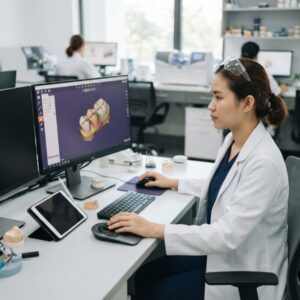
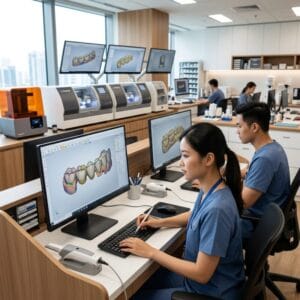
In traditional digital lab workflows, domestic laboratory technicians spend hours seated behind CAD workstations operating platforms like exocad or 3Shape Dental System. While these design steps are critical, they represent a significant labor bottleneck. When physical bench technicians are tied up virtually placing crown margins, sculpting emergency profiles, or adjusting contacts, local production lines slow down, and expensive milling machines sit idle waiting for validated design files (.STL).
By integrating a specialized CAD design outsourcing workflow, the domestic lab completely decouples design from physical manufacturing. Incoming intraoral scans received during normal US business hours are triaged, quality-checked, and uploaded to dedicated design teams. Overnight, expert CAD technicians design the cases to exact lab-customized parameters (e.g., specific cement gaps, occlusion relief values, margin angles, and tissue contact forces). When the domestic lab opens the next morning, completed design files are ready for immediate nesting, milling, and 3D printing.
The structural benefits outlined in the US dental laboratory industry market report and growth trends 2026 include a complete elimination of software capacity ceilings. Labs can handle sudden volume spikes from new clinical accounts without incurring recruitment delays, training costs, software license fees, or workstation hardware investments. Moreover, domestic staff can reallocate their high-value bench hours to final contouring, stain and glaze aesthetics, quality control checks, and client relationship management.
Crown & Bridge Innovations: Zirconia, Monolithic Restorations, and Digital Precision
Crown and bridge prosthetics remain the financial bedrock of commercial lab revenues. However, the material composition and production pathways of these restorations have shifted dramatically. The US dental laboratory industry market report and growth trends 2026 indicates that monolithic high-translucency zirconia restorations now account for the overwhelming majority of posterior crown units produced in North America, while layered porcelain-fused-to-metal (PFM) continues its steep market decline.
Digital precision in crown design is directly correlated with long-term clinical success. Modern intraoral scanners capture subtle prep details, subgingival margins, and subtle occlusal clearance variances. Designing restorations to meet these exacting specifications requires a deep understanding of dental anatomy and material science. External CAD designers working on crown and bridge cases must meticulously calibrate parameters tailored to specific zirconia formulations, such as 3Y-TZP, 4Y-PSZ, or 5Y-PSZ materials, ensuring optimal fracture resistance and aesthetic translucency.
Important design considerations highlighted in the US dental laboratory industry market report and growth trends 2026 for crown and bridge workflows include:
- Dynamic Occlusion Management: Utilizing virtual articulators to simulate lateral and protrusive movements, eliminating post-insertion chairside occlusal adjustments for the clinician.
- Margin Reinforcement: Crafting precise, chip-resistant digital margins optimized for 5-axis carbide endmills, reducing micro-fractures during green-state zirconia milling.
- Interproximal Contact Calibration: Standardizing virtual contact tightness parameters to ensure crowns drop into place with precise, ideal contact pressure every time.
When laboratories outsource their high-volume crown and bridge CAD design to skilled virtual technicians, they achieve tight consistency across thousands of monthly units, driving down chairside delivery times and cementing long-term dentist satisfaction.
Implant Prosthetics and Surgical Guide Design Trends
Implantology is among the fastest-growing and highest-margin market segments identified in the US dental laboratory industry market report and growth trends 2026. Modern implant therapy relies heavily on guided surgery principles, custom titanium abutments, and screw-retained monolithic zirconia crowns or full-arch bridges. The shift from stock abutments to patient-specific digital solutions has elevated the technical baseline required of dental laboratories.
Designing custom implant abutments and screw-retained restorations requires sophisticated CAD design protocols. Design technicians must manage anti-rotational implant connections, emergence profile transitions from tissue to crown, and screw channel orientations. Angled screw channel (ASC) technology has revolutionized posterior and anterior implant restorations, allowing designers to displace access holes up to 25 or 30 degrees away from aesthetic incisal edges or functional cusp tips.
Simultaneously, guided implant surgery has become a standard clinical expectation. Dentists frequently submit combined CBCT DICOM datasets and optical intraoral surface scans (.STL) to laboratories to request precision surgical guides. Specialized CAD design for full-arch implant bridge design and surgical guides demands flawless alignment between hard tissue bone anatomy and soft tissue surface contours.
The US dental laboratory industry market report and growth trends 2026 emphasizes that implant CAD designing is highly complex and time-intensive. Outsourcing these intricate design steps to dedicated implant CAD specialists allows commercial laboratories to offer premium guided surgery and custom implant prosthetics without taking on long learning curves or bottlenecking daily crown-and-bridge production.
Digital Dentures and Removables: Breaking the Final Analog Barrier
Historically, the removable prosthetics department—producing full dentures, partial dentures, and night guards—was considered the most labor-intensive and least digitized area of the dental laboratory. However, the US dental laboratory industry market report and growth trends 2026 highlights that digital dentures have officially crossed the threshold from experimental novelty to mainstream clinical standard.
Advanced digital denture software modules enable remote designers to execute complex tooth setups, balance occlusal planes, adjust border tissue reliefs, and design precision denture bases for either 3D resin printing or high-density PMMA puck milling. Multi-layer digital tooth libraries allow for hyper-realistic esthetics, while monolithic or two-piece bonded digital denture construction yields unparalleled impact strength compared to traditional cold-cure or heat-cured acrylic processing.
Key advantages of digital removable workflows identified in the US dental laboratory industry market report and growth trends 2026 include:
- Flawless Digital Archiving: If a patient loses or damages their denture, the laboratory can re-mill or re-print an exact duplicate instantly from the archived CAD file without requiring new clinical impressions.
- Predictable Fit and Suction: Software algorithms analyze anatomical landmarks—such as retromolar pads, incisive papillae, and palatal vaults—to establish optimal peripheral seals automatically.
- Reduced Manual Bench Time: Digital design eliminates hours of manual wax try-in setup, investing, boil-out, and flasking procedures.
As the geriatric population expands in North America, demand for high-quality removable prosthetics will continue to climb. Laboratories that combine 3D resin printing technology with remote CAD design expertise are uniquely positioned to capture market share in this rapidly evolving segment.
Orthodontic Aligners and Night Guard Production Shifts
Preventative and preventative-aesthetic dental devices—specifically clear orthodontic aligners and occlusal splints or night guards—represent another soaring growth domain within the US dental laboratory industry market report and growth trends 2026. Modern intraoral scanners enable general dentists and orthodontists to capture high-resolution arch data in seconds, fueling widespread clinical adoption of clear aligner therapies and custom-milled or printed protective guards.
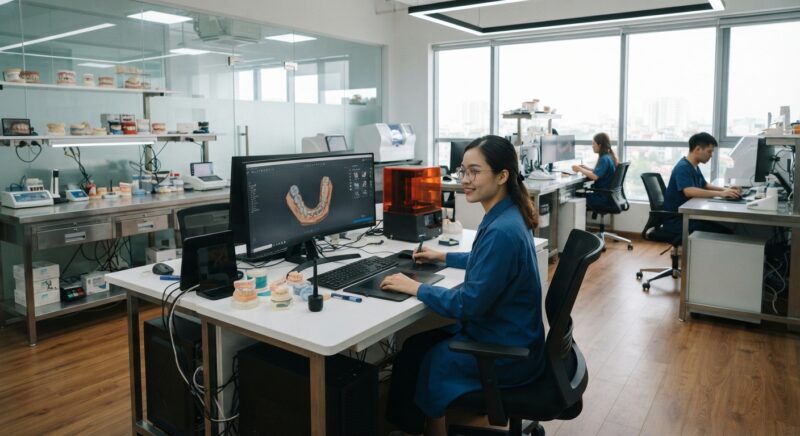
Clear aligner design demands complex biomechanical staging software skills. Virtual technicians must carefully map sequential tooth movements, place attachment shapes, calculate expansion and rotation forces, and generate sequential step files (.STL) for 3D model printing and thermoforming. Similarly, designing durable, comfortable night guards requires exact digital articulation, flat-plane balancing, ramp guidance design, and precise undercut analysis to guarantee comfortable clinical insertion.
According to research highlighted in the US dental laboratory industry market report and growth trends 2026, many commercial laboratories face bottlenecks when trying to handle high-volume 3D printed night guard design outsourcing internally. Occlusal splint cases frequently arrive in bulk batches from high-volume clinical practices. Leveraging dedicated external CAD design teams allows labs to process dozens of night guard and aligner staging cases overnight, sending ready-to-print files straight to high-speed 3D printers like those manufactured by SprintRay or Formlabs early the next morning.
This operational speed gives laboratories a distinct market advantage. Clinicians receive protective splints and staging models within days, improving patient compliance and securing recurring, high-margin revenue streams for the lab.
Labor Shortages, Skilled Technician Retention, and Workforce Strategy
No operational factor weighs more heavily on laboratory executives than the ongoing nationwide skilled labor shortage. The US dental laboratory industry market report and growth trends 2026 devotes significant analysis to the changing workforce dynamics in North America, noting a growing gap between retiring senior technicians and entry-level digital operators.
The traditional laboratory model relied on years of physical apprenticeship to master wax carving, porcelain layering, and metal finishing. Today’s young technicians entering the industry are digital natives who excel at navigating computer software interfaces but often lack decades of anatomical intuition. Training a new hire to become a proficient exocad or 3Shape designer can take 12 to 18 months of intensive supervision—a costly investment for a medium-sized laboratory facing immediate turnaround deadlines.
To overcome this labor crisis, forward-thinking laboratory leaders are executing a hybrid workforce strategy outlined in the US dental laboratory industry market report and growth trends 2026:
- Focus Domestic Staff on High-Value Bench Tasks: In-house Certified Dental Technicians focus their expertise on high-value aesthetic staining, ceramic characterization, complex full-mouth rehabilitation setups, and final quality control.
- Outsource Standard Digital CAD File Creation: Routine, repetitive single-unit crowns, night guards, simple implant abutments, and custom trays are routed to expert, specialized external CAD design services.
- Prevent Technician Burnout: By removing mandatory overtime hours spent grinding through virtual design queues late at night, domestic staff retention rates improve drastically.
This hybrid operational approach transforms the internal team from software operators into highly skilled quality managers and clinical advisors, improving workplace satisfaction while lowering per-unit production costs.
How can dental labs maintain quality control while outsourcing CAD design?
Dental labs can maintain stringent quality control while outsourcing CAD design by establishing standardized design protocol sheets, utilizing cloud-based file management software, and instituting daily technician feedback loops.
Maintaining uncompromised aesthetic and structural quality is the primary concern for any laboratory owner evaluating external design partners. The US dental laboratory industry market report and growth trends 2026 stresses that successful design outsourcing relies on clear, structured communication protocols rather than vague or informal requests.
To establish a flawless quality control system, commercial laboratories should implement a standardized CAD Design Preference Profile for every clinical customer and material line. This profile acts as a digital blueprint specifying exact numerical parameters, including:
- Cement Gap Thickness: e.g., 30 microns starting 1.0mm above the margin line.
- Occlusal and Interproximal Relief: e.g., -20 microns out of occlusion for light contact, or 0.0mm for tight physiological contact.
- Minimum Material Thickness: Aligning perfectly with manufacturer specifications for zirconia, lithium disilicate, or PMMA resins.
- Anatomical Style Preferences: Customized morphology settings matching specific clinician preferences (e.g., shallow functional cusps vs. deep, natural fissures).
When external CAD designers work within these well-defined boundaries, case-to-case variability vanishes. Furthermore, utilizing secure, cloud-based platform portals allows internal lab managers to review, tweak, and approve 3D CAD design previews in real time before sending files to production equipment. This closed-loop quality assurance process ensures every restoration exiting the facility strictly adheres to internal laboratory standards and dentist expectations.
Comparative Analysis: In-House CAD Staffing vs. Digital Design Outsourcing
To quantify the financial benefits of CAD design outsourcing, the US dental laboratory industry market report and growth trends 2026 offers detailed comparative data analyzing operational overhead costs between maintaining an all-internal CAD department versus utilizing an external design service model.
Consider a mid-sized commercial laboratory producing approximately 1,000 digital units per month (a mix of crowns, custom abutments, and night guards):
Traditional In-House CAD Staffing Model
- Design Staff Salaries: Requires 2 to 3 full-time experienced CAD designers ($65,000–$85,000 annual salary plus benefits per designer).
- Software Licensing & Hardware: Multiple active software module seats, annual upgrade fees, and high-performance workstation graphic PCs ($15,000+ annually).
- Capacity Bottlenecks: Fixed capacity ceiling. If volume surges by 30% during peak months, lead times collapse or paid overtime expenses surge. If volume dips, fixed salary overhead burns cash reserves.
Hybrid Digital Outsourcing Model
- Variable Pay-Per-Unit Cost: Labs pay exclusively for completed, approved CAD design files, converting fixed payroll into a dynamic variable cost aligned directly with monthly order revenue.
- Zero Capital Overhead: No need to buy extra CAD software seats, high-end workstations, or maintain expensive annual software upgrade contracts for auxiliary workstations.
- Infinite Elastic Scalability: Design volume can expand seamlessly from 50 units a day to 500 units a day overnight without hiring delays or staff training bottlenecks.
As documented in the US dental laboratory industry market report and growth trends 2026, shifting to a hybrid or fully outsourced CAD design model typically reduces a laboratory’s total labor cost per unit by 30% to 50%, while dramatically accelerating daily turnaround capacity.
Strategic Roadmap for Dental Labs and DSOs Heading into 2026
As commercial dental laboratories and DSOs map out their multi-year growth strategies, the insights presented in the US dental laboratory industry market report and growth trends 2026 point to a clear operational imperative: embrace digital agility, lean manufacturing, and specialized design partnerships.
To maintain a high-growth trajectory, laboratory leadership should execute a three-phase operational roadmap:
Phase 1: Modernize Digital Intake Infrastructure
Ensure your laboratory is fully integrated with all major intraoral scanner portals (such as 3Shape Communicate, iTero, Medit Link, and Dentsply Sirona Connect). Enable seamless digital intake capabilities to accept .STL and .PLY files directly from clinical partners without delay.
Phase 2: Integrate Professional CAD Design Outsourcing
Partner with a reliable, high-precision dental CAD design outsourcing provider. Establish detailed client preference profiles for crown and bridge, implant abutments, surgical guides, digital dentures, and night guards. Test workflow integration with pilot cases to validate turnaround speed and design precision.
Phase 3: Optimize In-House Manufacturing Uptime
Redirect internal capital and labor toward high-speed production equipment—such as 5-axis mills and industrial 3D printers—and high-value finishing artistry. Maximize daily machine uptime by feeding validated CAD design files into production nesting queues early every morning.
By implementing these strategic steps, dental laboratories and DSO network hubs can increase daily production output, deliver exceptional restorations, and secure sustainable profit margins in an increasingly competitive marketplace.
Navigating Technological Paradigms in the 2026 Dental Industry
The operational landscape mapped out in the US dental laboratory industry market report and growth trends 2026 makes one reality abundantly clear: the future of dental technology belongs to agile, digital-first organizations. Commercial dental laboratories that continue relying heavily on outdated manual workflows or bottlenecked in-house CAD queues risk falling behind in turnaround speed, product consistency, and price competitiveness.
Embracing external CAD design outsourcing provides a proven, highly profitable pathway forward. By entrusting virtual design creation to specialized CAD technicians, domestic laboratories free themselves from workforce constraints, eliminate capacity limits, and maximize the return on their capital equipment investments. As the industry advances toward 2026 and beyond, leveraging expert digital design services is not merely a short-term efficiency play—it is the foundational strategy for long-term business growth and operational excellence.
Ready to scale your lab’s capacity and streamline production? Contact our expert CAD design team today to start your free trial and experience seamless digital outsourcing.