Introduction: The Changing Landscape of Canadian Dentistry in 2026
The Canadian dental landscape in 2026 is defined by unprecedented structural shifts. Practice owners across provinces from Ontario to British Columbia face a complex economic environment characterized by high operating costs, skilled labor shortages, and evolving fee guides. With the expansion of the Canadian Dental Care Plan (CDCP) standardizing reimbursement levels across a broader patient demographic, clinic profit margins are under closer scrutiny than ever before. To maintain profitability while delivering exceptional clinical care, practice owners and Dental Service Organizations (DSOs) must evaluate every line item on their income statements. Among these expenses, laboratory fees represent one of the largest controllable operational costs. Understanding how Canadian dental clinics reduce lab costs through outsourcing in 2026 has become a vital strategic focus for forward-thinking practice leaders.
Historically, dental practices relied entirely on local full-service dental laboratories for all restorative, prosthetic, and orthodontic fabrications. While local labs offered proximity, the traditional model carried significant costs driven by domestic real estate prices, high local technician wages, and manual wax-and-cast production methods. As digital intraoral scanners have achieved widespread adoption across Canadian clinics, the physical constraints of dental production have dissolved. Intraoral scanners convert patient anatomy into high-resolution, open-format digital files (such as STL, PLY, and OBJ data) in minutes. This transition from physical impression trays to digital file generation forms the foundation for how Canadian dental clinics reduce lab costs through outsourcing in 2026.
By separating the digital design phase from physical fabrication, dental practices can choose dedicated, specialized offshore or specialized nearshore CAD design centers to handle their computer-aided design needs. This remote digital design strategy allows clinics to utilize in-office milling machines or local manufacturing hubs purely for physical production, eliminating redundant labor costs and software licensing overhead. Analyzing how Canadian dental clinics reduce lab costs through outsourcing in 2026 reveals that cost containment is not about compromising clinical quality; rather, it is about capitalizing on global design expertise, standardized digital quality control, and scalable digital workflows.
What is dental lab outsourcing?
Dental lab outsourcing is the operational practice where dental practices and laboratories partner with specialized off-site CAD/CAM design centers to handle digital restoration design, reducing overhead while expanding production capacity.
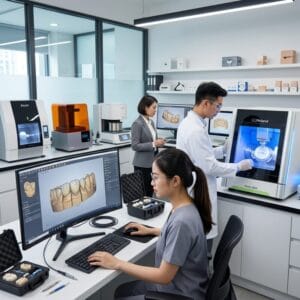
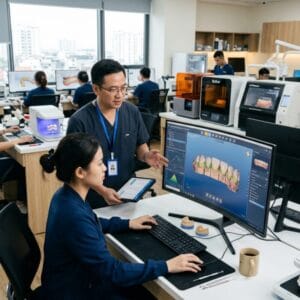
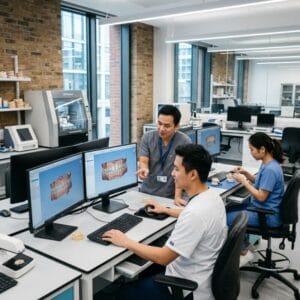
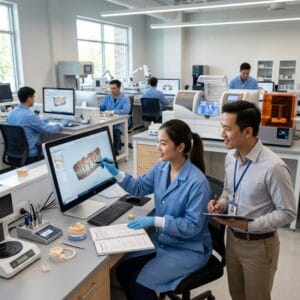
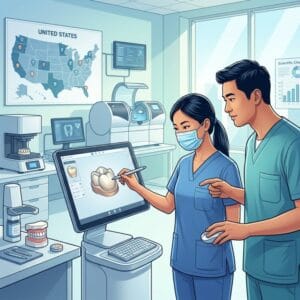
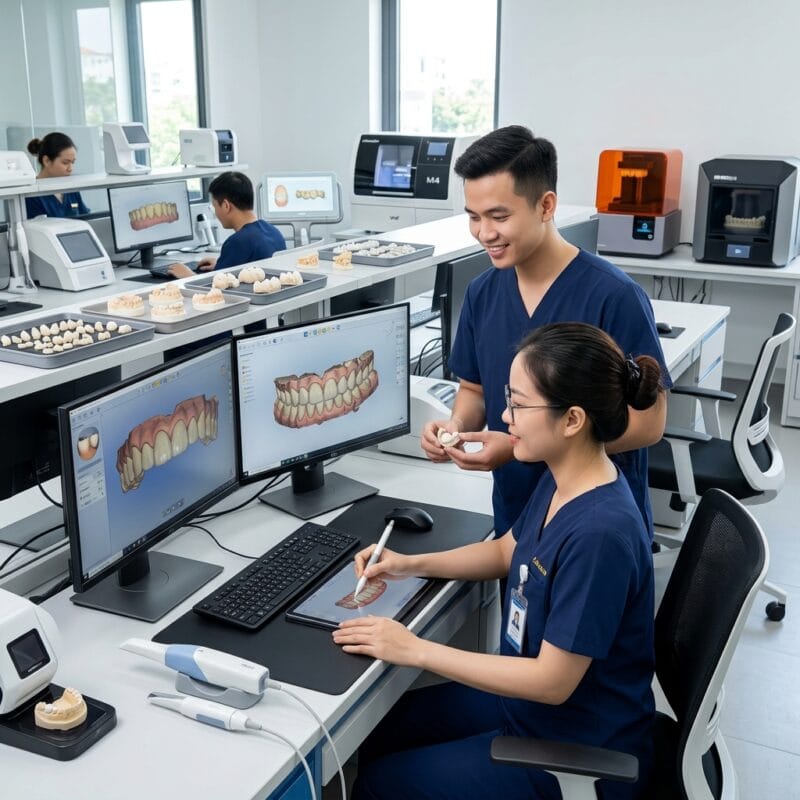
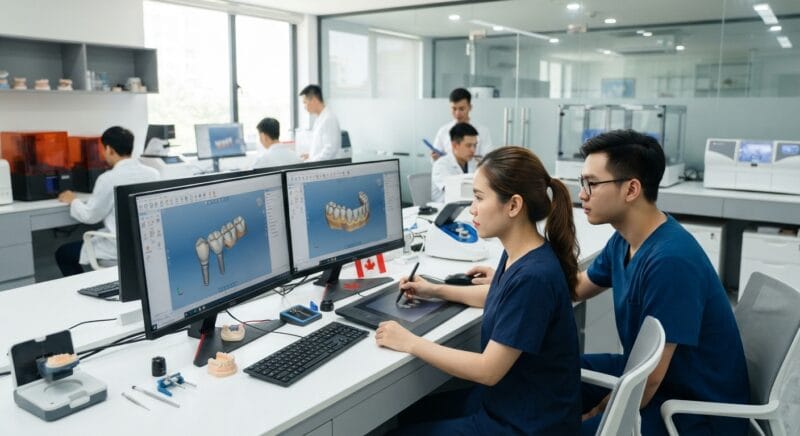
In traditional workflows, a clinic takes physical impressions and sends them via courier to a domestic lab, where a technician pours stone models, trims dies, hand-waxes restorations, and casts or presses materials. In a fully digitized, outsourced workflow, the clinical team captures an intraoral scan at chairside and transmits the dataset electronically to a remote design center. Expert CAD designers then generate precise 3D files for crowns, bridges, implant abutments, surgical guides, or removables using advanced CAD platforms such as exocad and 3Shape.
Once the design is complete, the digital file (CAM file or STL) is returned to the clinic or local production center for immediate manufacturing via high-precision milling or 3D printing. Understanding how Canadian dental clinics reduce lab costs through outsourcing in 2026 requires recognizing this operational shift: practices no longer need to fund every stage of technical labor in-house. By outsourcing the labor-intensive CAD design phase, clinics convert fixed labor overhead into predictable, variable, pay-per-case expenses.
Furthermore, digital outsourcing enables practices to operate on a 24-hour production cycle. Because design hubs operate across complementary time zones, a scan uploaded by a clinic in Toronto or Vancouver at the end of the business day can be completely designed, validated, and returned before the office opens the following morning. This accelerated turnaround time directly enhances patient care and practice cash flow, highlighting key reasons how Canadian dental clinics reduce lab costs through outsourcing in 2026.
How does digital crown design work?
Digital crown design works by capturing 3D intraoral scan data, importing it into CAD software like exocad or 3Shape, and precisely modeling the prosthetic restoration prior to automated milling or 3D printing.
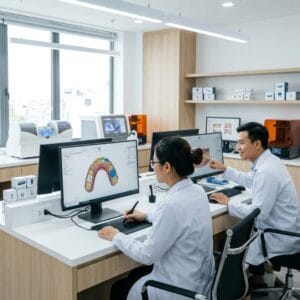
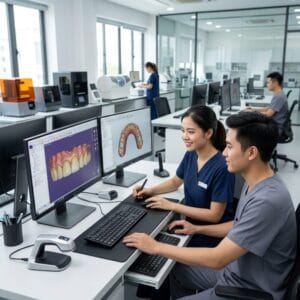
The process begins at chairside, where the clinician uses an intraoral scanner to capture the prepared tooth, adjacent teeth, soft tissue contours, and static/dynamic occlusal relationships. This scan data is exported as a 3D surface mesh file. When uploaded to an outsourced digital design hub, a dedicated CAD specialist opens the case within a specialized software suite to establish the orientation, path of insertion, and margin lines.
The software’s automated algorithms suggest an initial anatomy based on natural tooth libraries, which the designer then fine-tunes. The designer adjusts occlusal contact intensity, proximal contact tightness, cement gap distance (typically set between 30 to 50 microns depending on the restorative material and cement type), and emergent profile contours to match natural anatomy. Analyzing how Canadian dental clinics reduce lab costs through outsourcing in 2026 involves seeing how these specialized design procedures eliminate clinical seat-time adjustments, saving valuable chair time for the dentist.
After the CAD file passes quality control checks, it is exported as an open STL file for fabrication. The clinic can mill the restoration in-office using monolithic zirconia or lithium disilicate, or forward the file to a domestic manufacturing center. Because the design process is standardized through software protocols, remake rates drop dramatically, emphasizing how Canadian dental clinics reduce lab costs through outsourcing in 2026 by eliminating costly impression remakes and remilling cycles.
How Canadian Dental Clinics Reduce Lab Costs Through Outsourcing in 2026 Across Key Specialties
The application of remote digital CAD design spans every major clinical discipline in modern dentistry. By examining individual dental specialties, practice owners can better understand how Canadian dental clinics reduce lab costs through outsourcing in 2026 while maintaining or improving clinical outcomes.
Crown & Bridge Design
Single crowns, multi-unit fixed partial dentures, and full-arch bridge restorations form the core financial engine of most general practices. Traditionally, physical lab bills for crown and bridge cases represented significant overhead, especially when incorporating high-end ceramic or zirconia materials. Through digital design outsourcing, clinics upload their intraoral scans directly to expert designers who specialize exclusively in fixed prosthodontics.
Digital designers utilize advanced virtual articulators to evaluate canine guidance, anterior group function, and excursive movements. They adjust contact points down to the micron level, ensuring that when the restoration is milled and sintered, minimal chairside adjustments are required. This high level of accuracy illustrates how Canadian dental clinics reduce lab costs through outsourcing in 2026, as reduced chairside seat time translates directly into higher hourly clinic profitability.
Moreover, for multi-unit bridge restorations, software tools evaluate the path of insertion across multiple prepared abutments, automatically highlighting undercuts and suggesting adjustments before any physical material is cut. This proactive digital verification is a core component of how Canadian dental clinics reduce lab costs through outsourcing in 2026, protecting practices from material wastage and expensive re-preparations.
Implant Abutments and Screw-Retained Restorations
Implant dentistry carries significant laboratory expense due to component costs and complex design requirements. Whether restoring a single tooth using a custom titanium base (Ti-base) or fabricating a full-arch screw-retained hybrid restoration, precision fit is critical to avoid biological and mechanical complications like screw loosening or peri-implantitis.
Outsourcing implant CAD design enables practices to access skilled implant technicians who understand scan body alignment, emergency profile management, and subgingival margin positioning. Designers verify that scan bodies are properly aligned against digital library geometries. They craft soft tissue emergence profiles that support interdental papillae and maintain cleansability. This precision approach is a primary driver of how Canadian dental clinics reduce lab costs through outsourcing in 2026, replacing expensive stock abutment modifications with optimized, digitally generated custom solutions.
For complex full-arch restorative cases (such as All-on-X treatment plans), remote design specialists coordinate the digital integration of facial scans, CBCT bone data, and intraoral scans to create passive-fitting titanium frameworks or monolithic zirconia arches. Leveraging external expertise for complex implant design highlights how Canadian dental clinics reduce lab costs through outsourcing in 2026 while expanding full-arch service offerings without incurring additional specialized staff salaries.
Digital Dentures and Removable Prosthetics
Removable prosthetics have historically been labor-intensive, requiring multiple clinical appointments for preliminary impressions, final impression trays, wax rims, bite registrations, tooth try-ins, and final processing. This extensive manual labor made removable prosthetics less margin-attractive for busy clinics.
The introduction of digital denture design services has transformed removable prosthodontics. Intraoral border molding scans or digitized wash impressions are uploaded to remote design centers, where technicians utilize advanced software modules to set up digital tooth arrangements, design gingival contours, and optimize base retention. Clinics can then 3D print or mill trial dentures in-house for quick clinical verification.
By streamlining the denture workflow into fewer appointments and eliminating manual wax try-ins, practices achieve significant operational efficiencies. This reduction in clinical visits demonstrates how Canadian dental clinics reduce lab costs through outsourcing in 2026 while delivering precise, comfortable complete and partial dentures to patients under compressed treatment timelines.
Surgical Guides and Implant Planning
Guided implant surgery increases surgical predictability, reduces intraoperative complications, and optimizes prosthetic placement. However, dedicated surgical planning software and experienced clinical planning technicians represent significant overhead for an individual dental office.
By utilizing 3D printed surgical guide design, practices combine CBCT DICOM files with intraoral optical scans to outsource the treatment planning and guide design process. External surgical CAD specialists merge the datasets, align nerve pathways, evaluate bone density, position virtual implant fixtures relative to the planned restoration, and generate precise drill guide geometries compatible with specific surgical kit master sleeves.
Once the clinician reviews and approves the digital surgical proposal, the STL file for the surgical guide is downloaded and printed on an in-office 3D printer using bio-compatible resin. This streamlined process illustrates how Canadian dental clinics reduce lab costs through outsourcing in 2026, allowing practices to perform guided surgeries at a fraction of the cost charged by traditional external implant labs.
Orthodontic Aligners and Splint/Night Guard Fabrication
Preventive and interceptive therapies such as night guards, occlusal splints, and clear orthodontic aligners represent rapidly growing revenue streams for Canadian clinics. However, manual fabrication of thermoformed splints requires model pouring, trimming, vacuum forming, and manual occlusal grinding.
Through digital design outsourcing, clinics capture intraoral scans of the arch and send them to CAD centers specialized in splint and clear aligner staging. For night guards, designers establish precise occlusal contact, adjust flat-plane ramps or canine guidance, and set uniform material thickness (e.g., 2.0 mm) across the arch. The resulting STL file is 3D printed directly using clear, flexible, biocompatible resins, requiring minimal post-processing.
For clear aligners, remote CAD technicians execute tooth segmentation and stage sequential micro-movements according to clinical protocols. The practice can then print the sequential models in-house or outsource thermoforming, drastically reducing per-aligner costs compared to turn-key aligner brands. This autonomy in orthodontic and splint manufacturing is a powerful example of how Canadian dental clinics reduce lab costs through outsourcing in 2026.
Why are Canadian DSOs and private clinics shifting to off-site CAD design?
Canadian DSOs and private clinics shift to off-site CAD design to eliminate expensive software licensing fees, bypass local skilled technician shortages, and optimize profit margins under updated reimbursement frameworks.
The business model of modern dental practices requires strict control over fixed capital expenditures and labor costs. Maintaining an in-house lab team requires paying competitive technician salaries, benefits, and workplace insurance, as well as providing physical lab space and investing in expensive CAD software licenses, annual update fees, and high-performance computing hardware. By outsourcing design tasks to dedicated digital design centers, clinics turn fixed labor and software investments into variable expenses that scale precisely with patient volume.
In addition, the Canadian dental industry faces a structural shortage of experienced dental laboratory technicians. As senior technicians retire, fewer new graduates enter the field with advanced expertise across all digital modalities. Outsourcing bridges this talent gap by granting immediate access to global teams of certified CAD designers who focus exclusively on digital restoration design day in and day out. This strategy illustrates how Canadian dental clinics reduce lab costs through outsourcing in 2026 without compromising on complex case execution.
Finally, for Dental Service Organizations managing multiple clinical locations across provinces, centralized digital design outsourcing provides operational standardization. Every clinic within the DSO network utilizes the same design parameters, material specifications, and quality control checks, ensuring uniform patient outcomes and centralized cost tracking. This operational consistency reinforces how Canadian dental clinics reduce lab costs through outsourcing in 2026 across corporate and group practice environments.
Operational Impact of CDCP and Economic Pressures on Canadian Dental Practices
The roll-out and expansion of the Canadian Dental Care Plan (CDCP) has reshaped practice economics across the nation. While the plan significantly increases access to care for millions of uninsured Canadians, it also introduces standardized fee structures that may differ from provincial dental association fee guides. To treat CDCP patients sustainably, clinic managers must examine overhead structures and trim operational expenses where possible.
Laboratory expenses typically represent 8% to 12% of a practice’s gross revenue. In a traditional operational setup, fixed lab costs can compress net margins when fee schedules are capped. Exploring how Canadian dental clinics reduce lab costs through outsourcing in 2026 provides a clear solution: lowering per-case lab overhead allows practices to comfortably accept public fee schedule reimbursements while maintaining target profit margins.
In addition to public plan dynamics, broader economic pressures such as commercial rent increases, staff wage adjustments, and inflation on dental consumables require careful cost management. Outsourcing digital CAD design provides an immediate, actionable reduction in operating expense without requiring capital investment in new facility infrastructure. The economic clarity provided by fixed per-case design pricing demonstrates how Canadian dental clinics reduce lab costs through outsourcing in 2026 while stabilizing practice cash flow.
Detailed Cost Analysis: In-House Production vs. Traditional Labs vs. Digital Outsourcing
To fully understand how Canadian dental clinics reduce lab costs through outsourcing in 2026, practice leaders should conduct a comparative financial evaluation across the three main production models: traditional full-service domestic labs, complete in-house lab production, and the hybrid digital outsourcing model.
The following analysis illustrates typical cost structures associated with a single-unit zirconia or lithium disilicate crown case in the current Canadian marketplace:
- Traditional Full-Service Local Laboratory: The clinic takes a physical or digital impression and sends it to a local laboratory. The average complete lab fee for a monolithic zirconia crown ranges from $180 to $260 CAD, which includes physical model fabrication, labor, material, shipping, and lab profit margin. While convenient, this pricing limits practice margins under capped reimbursement fee schedules.
- Complete In-House CAD/CAM Production: The clinic purchases intraoral scanners, CAD software licenses ($3,000 to $6,000 annually per module), a chairside milling machine ($40,000 to $100,000 CAD), a sintering furnace, and ceramic finishing kits. Additionally, the clinic must employ a trained in-house technician or train dental assistants to complete CAD designs. When accounting for equipment depreciation, maintenance contracts, software upgrades, material blocks, and staff labor hours spent designing, the effective cost per unit ranges from $90 to $140 CAD (depending heavily on monthly case volume).
- Hybrid Digital CAD Design Outsourcing Model: The clinic uses an intraoral scanner to capture digital impressions. The scan file is uploaded to a remote CAD design hub at a fixed fee of approximately $10 to $20 CAD per single crown design. The clinic or a local milling center then mills the restoration using open-system equipment. Material blocks, milling bur wear, and finishing account for $15 to $25 CAD. The total unit cost averages between $30 and $50 CAD.
Comparing these models clearly illustrates how Canadian dental clinics reduce lab costs through outsourcing in 2026. By adopting a hybrid model—outsourcing CAD design and executing milling or 3D printing locally or in-house—practices save between 60% and 75% per restorative case compared to traditional full-service lab invoices. Over the course of a year, a practice placing 50 crowns per month can realize tens of thousands of dollars in direct bottom-line savings, showing how Canadian dental clinics reduce lab costs through outsourcing in 2026.
Turnaround Times, Quality Assurance, and Workflow Integration with IOS Scanners
A common historical concern regarding outsourced lab services was the potential for prolonged turnarounds and uncertain quality control. However, modern digital communication platforms and cloud-based management portals have rendered geographical distance irrelevant, turning digital speed into a primary reason how Canadian dental clinics reduce lab costs through outsourcing in 2026.
The integration between popular intraoral scanners—such as Medit, Dentsply Sirona Primescan, and Align iTero—and remote design networks is seamless. When a clinician completes an intraoral scan, the 3D mesh is instantly uploaded to a secure cloud platform. Within minutes, remote CAD specialists access the file, review the scan quality, and begin design work. The following key operational elements safeguard quality and turnaround times:
- Overnight Design Turnaround: Due to time-zone efficiencies, cases uploaded during late afternoon clinic hours are designed overnight and ready for review or immediate local milling by the following morning.
- Standardized Quality Control Protocols: Professional CAD design centers utilize rigid quality assurance checkpoints. Designs are evaluated for minimum material thickness, margin integrity, occlusal clearance, and contact tightness before release.
- Real-Time Digital Collaboration: Clinicians and design technicians communicate directly through online portals or chat tools. If a margin line is unclear due to soft tissue interference or subgingival blood, the designer highlights the precise 3D coordinate and requests instant clarification before production begins, preventing costly remakes.
- Consistency Across Patient Cases: Digital software saves doctor-specific preferences (such as preferred cement gap, contact pressure, and occlusion style) in user profiles. Every case is designed to match the clinician’s exact clinical parameters, driving consistency and showing how Canadian dental clinics reduce lab costs through outsourcing in 2026.
This automated, highly structured workflow eliminates physical transit delays, minimizes shipping expenses, and drastically reduces patient waiting times. The efficiency of cloud-based design workflows is a central foundation of how Canadian dental clinics reduce lab costs through outsourcing in 2026.
Steps to Implement a Hybrid or Fully Outsourced CAD/CAM Workflow
Transitioning a dental practice or DSO network from traditional lab workflows to an outsourced digital CAD design model requires structured planning. To assist practice owners, the following steps outline how Canadian dental clinics reduce lab costs through outsourcing in 2026 by adopting a systematic implementation framework:
Step 1: Audit Current Lab Fees and Case Mix
Begin by analyzing past laboratory invoices over a 6 to 12 month period. Categorize cases into fixed prosthodontics (crowns, bridges), removable prosthetics (dentures, night guards), implant restorations, and orthodontic/surgical appliances. Calculate your average lab cost per case and overall percentage of revenue spent on technical fabrication. This baseline data provides a benchmark to measure how Canadian dental clinics reduce lab costs through outsourcing in 2026 within your specific practice.
Step 2: Optimize Intraoral Scanning Infrastructure
Ensure that all clinical operatories are equipped with modern intraoral scanners capable of exporting open STL, PLY, or OBJ files. Train clinical staff and associates on proper scanning protocols, emphasizing proper soft tissue management, moisture control, and clear subgingival margin isolation. High-quality digital impressions are essential to maximizing the benefits of remote CAD design, illustrating how Canadian dental clinics reduce lab costs through outsourcing in 2026 through clinical precision.
Step 3: Select a Specialized Digital CAD Design Partner
Partner with an established, high-volume CAD design service provider that supports open software formats (exocad, 3Shape) and employs experienced technicians across all clinical disciplines. Evaluate potential partners based on design fees, turnaround guarantees, quality control checks, secure data privacy compliance, and communication responsiveness. Setting up custom design profiles ensures your technical preferences are applied automatically to every case.
Step 4: Establish Local In-House or Hub Manufacturing Options
Determine how physical restorations will be manufactured once the CAD files are completed. Practices can choose to invest in compact, highly automated chairside mills and 3D printers for fast, in-office fabrication, or establish relationships with centralized domestic milling centers for complex metal casting, laser sintering, or high-volume monolithic zirconia milling. Balancing in-office 3D printing with external milling flexibility demonstrates how Canadian dental clinics reduce lab costs through outsourcing in 2026 across diverse case types.
Step 5: Train Staff and Monitor Clinical Outcomes
Integrate the digital workflow into daily clinical operations. Train clinical team members to handle digital file transfers, cloud communications, and post-processing steps (such as washing, curing 3D printed night guards, or sintering and glazing zirconia crowns). Track key performance indicators over time, including seat-time adjustments, remakes, turnaround days, and net financial savings. Monitoring these metrics will validate how Canadian dental clinics reduce lab costs through outsourcing in 2026 in your daily practice performance.
Strategic Outlook: Digital Dentistry and Lab Outsourcing in 2026 and Beyond
As digital dentistry continues to advance, the distinction between local physical labs and global digital design centers will shift further toward remote digital specialization. Technological innovations such as artificial intelligence (AI) tooth proposal generators, automated margin line detection, and continuous cloud collaboration are further accelerating design speeds and lowering costs. However, human expertise remains vital for evaluating complex occlusal schemes, aesthetic smile designs, and advanced surgical implant plans.
For Canadian dentists, adopting remote digital CAD design services is no longer just a trend—it is a core business strategy. Practice owners who embrace digital design outsourcing benefit from reduced overhead, higher profit margins, faster patient turnarounds, and complete control over their manufacturing processes. Understanding how Canadian dental clinics reduce lab costs through outsourcing in 2026 provides a clear blueprint for building a resilient, highly profitable, and patient-centered dental practice in today’s modern healthcare market.
By leveraging digital workflows, keeping capital expenses predictable, and utilizing expert design talent on demand, Canadian practices can meet economic challenges head-on. The ongoing digital revolution empowers practices to focus on what matters most: delivering outstanding, efficient, and accessible oral healthcare to patients across Canada.
Ready to lower your lab overhead and elevate your clinic’s digital CAD workflow? Contact our expert dental CAD design team today to start your free trial and experience fast, precise design services!