The dental technology landscape across Australasia is undergoing a massive transformation. For dental technicians, clinicians, and entrepreneurial investors, understanding how to start a dental lab in New Zealand in 2026 has become a priority as the industry shifts away from traditional stone models and manual wax-ups toward 100% digital workflows. With intraoral scanners becoming standard equipment in dental practices from Auckland to Dunedin, launching a modern dental laboratory requires a strategic blend of regulatory awareness, cutting-edge software, and lean operational design.
Historically, establishing a full-service dental laboratory required hundreds of thousands of dollars in heavy machinery, physical real estate, and extensive in-house technician teams. However, learning how to start a dental lab in New Zealand in 2026 reveals a far more efficient model. By leveraging cloud-based CAD/CAM technology, precision 3D printing, and high-quality offshore design partners, new lab owners can launch with significantly lower capital expenditure while delivering superior precision to local dentists and Dental Service Organizations (DSOs).
Whether your goal is to specialize in crown and bridge restorations, surgical guides, full-arch removable dentures, night guards, or orthodontic clear aligners, having a clear blueprint on how to start a dental lab in New Zealand in 2026 is essential for long-term commercial success. This comprehensive guide details the regulatory environment, financial considerations, equipment selection, and operational workflows needed to build a profitable Kiwi dental laboratory in today’s digital era.
What regulations apply when learning how to start a dental lab in New Zealand in 2026?
To open a dental laboratory in New Zealand in 2026, business owners must comply with Medsafe custom-made medical device guidelines, the Dental Council of New Zealand standards, and local commercial business registration rules.
When exploring how to start a dental lab in New Zealand in 2026, regulatory compliance must be your foundational step. In New Zealand, dental prosthetics and appliances are categorized as medical devices or custom-made medical devices governed by Medsafe (the New Zealand Medicines and Medical Devices Safety Authority), operating under the Ministry of Health. Any entity manufacturing or custom-designing restorations, splints, or aligners for patient use must ensure full compliance with raw material safety, biocompatibility standards, and traceability protocols.
A key aspect of how to start a dental lab in New Zealand in 2026 involves registering your business entity through the New Zealand Companies Office. You will need a New Zealand Business Number (NZBN) and a clear tax structure via Inland Revenue (IRD). Furthermore, if your lab employs registered Clinical Dental Technicians (CDTs) or Dental Technicians who interact directly with patients for shade matching or prosthodontic fittings, those professionals must maintain active registration and annual practising certificates with the Dental Council of New Zealand (DCNZ).
Anyone investigating how to start a dental lab in New Zealand in 2026 should also consult workplace health and safety frameworks under WorkSafe New Zealand. Even in a modern, digitally focused lab, handling biocompatible resins, milling dust, and ceramic polishing agents requires adequate ventilation, personal protective equipment (PPE), and strict infection control standards to protect staff and maintain a hygienic processing facility.
Business Planning and Financial Models for Modern Dental Labs
When formulating your business plan for how to start a dental lab in New Zealand in 2026, capital allocation is one of your most critical decisions. Traditional lab models required heavy upfront investment in porcelain furnaces, casting machinery, physical lathe stations, and extensive storage space. In contrast, the modern digital hybrid model allows you to launch faster with lower initial debt.
A modern strategy for how to start a dental lab in New Zealand in 2026 centers on digital intake and hybrid production. Instead of manufacturing every restoration completely in-house from day one, many new laboratories focus on digital file acquisition, quality control, local finishing, and client communication, while outsourcing labor-intensive CAD design and complex framework milling to specialized offshore design partners. This drastically reduces initial machinery overhead and labor expenses.
If you analyze how to start a dental lab in New Zealand in 2026 from a cost perspective, your initial budget should account for several core expense buckets:
- Digital Infrastructure: High-performance workstations, secure cloud storage, high-speed broadband, and CAD design software licenses.
- Production Machinery: Desktop 3D printers for resin models and splints, light-curing units, and optional compact 5-axis milling machines.
- Facility Overhead: Commercial lease, ergonomic benching, dust extraction systems, and infection control sanitation stations.
- Working Capital: Operational cash runway for marketing, initial material inventory, business insurance, and compliance licensing.
Software and Hardware Investment Considerations
Part of knowing how to start a dental lab in New Zealand in 2026 includes choosing software platforms that seamlessly integrate with your clinical clients’ intraoral scanners. Today’s dental practices utilize systems like Medit, 3Shape TRIOS, iTero, and Dentsply Sirona Primescan. Your lab must be capable of receiving STL, PLY, or OBJ files smoothly through an open-architecture pipeline.
Software platforms like exocad digital dental software provide open modular suites that allow new laboratories to handle crown and bridge cases, implant abutments, surgical guides, and removable prosthetics within a single ecosystem. Selecting open CAD software prevents vendor lock-in and gives your laboratory maximum flexibility when receiving digital impressions from various dental clinics across New Zealand.
How does digital CAD design outsourcing benefit a new dental lab?
Digital CAD design outsourcing allows new dental labs to scale production, reduce initial equipment overhead, and maintain consistent prosthetic quality without hiring full-time in-house digital technicians.
When mapping out how to start a dental lab in New Zealand in 2026, leveraging offshore design expertise is one of the most effective ways to achieve immediate profitability. Hiring experienced CAD designers locally in New Zealand can be challenging and costly, especially during the early growth phase when daily case volume fluctuates. Outsourcing design work to dedicated B2B dental design centers solves this operational bottleneck.
Practically speaking, how to start a dental lab in New Zealand in 2026 without high fixed overhead involves outsourcing specialized design tasks like surgical guide design and complex implant bridges. While your lab retains local clinical oversight, quality assurance, and final staining or glazing, remote CAD specialists handle the labor-intensive virtual design steps overnight. This strategy grants your laboratory 24-hour production cycles, enabling you to deliver restored cases to Kiwi dentists faster than conventional competing labs.
This lean model is vital when deciding how to start a dental lab in New Zealand in 2026 successfully. By converting fixed technician salary costs into variable per-case design fees, your business maintains healthy profit margins during slower weeks while seamlessly handling large volume spikes without staffing bottlenecks.
Key Technology Stack and Equipment Infrastructure
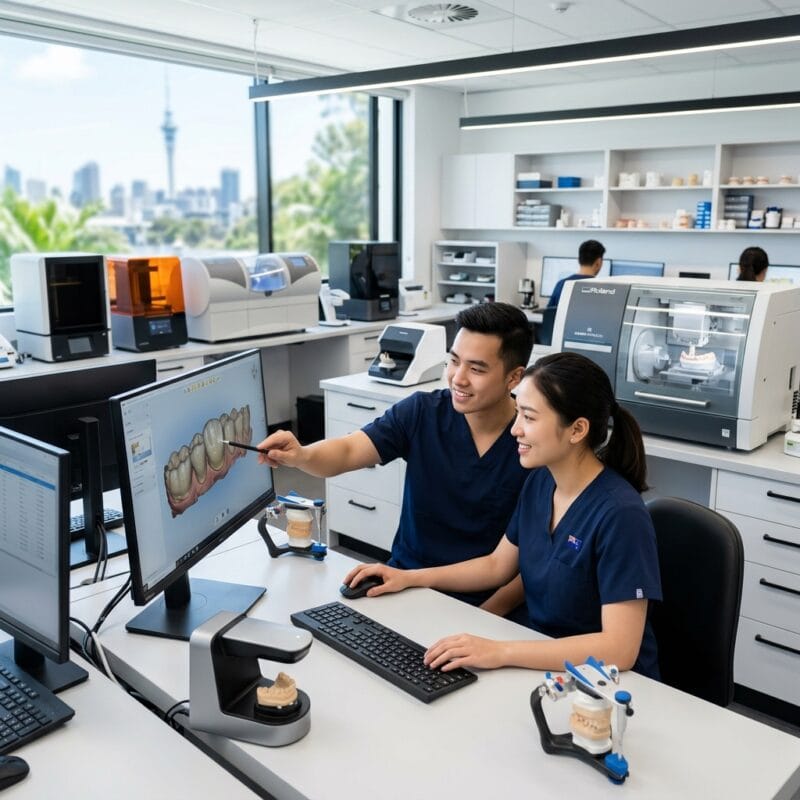
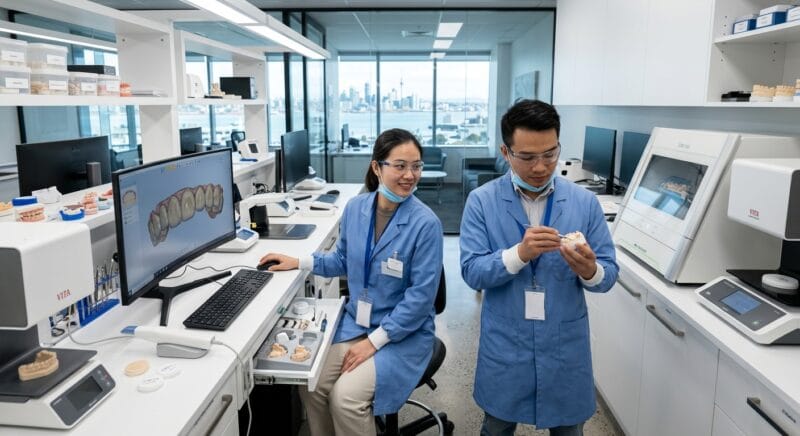
Another crucial phase of how to start a dental lab in New Zealand in 2026 involves establishing a flexible technology stack. A digital-first laboratory setup generally consists of three main operational zones: File Intake & CAD, CAM & Manufacturing, and Finishing & Quality Control.
As you refine your approach to how to start a dental lab in New Zealand in 2026, investing in systems like 3Shape CAD software or open exocad licenses allows you to build standard operating procedures (SOPs) around digital file verification. When a dental practice sends an intraoral scan, your team checks the scan quality, margin clarity, and bite clearance before committing the case to design.
Every laboratory owner researching how to start a dental lab in New Zealand in 2026 must optimize their equipment choices based on their core service offerings. The table below outlines key hardware requirements based on target product lines:
| Product Focus | Essential Hardware | Key Materials / Resins | Outsourcing Advantage |
|---|---|---|---|
| Crown & Bridge | 5-axis wet/dry mill, sintering furnace, ceramic stain kit | Zirconia, PMMA, Lithium Disilicate | High daily volume designed overnight by CAD experts |
| Surgical Guides | Precision desktop 3D printer, UV curing unit | Biocompatible Class IIa surgical guide resin | Complex implant planning executed with high precision |
| Night Guards & Splints | High-speed 3D printer or compact mill | Flexible/hard splint resins, light-cure stains | Rapid digital iteration without manual waxing |
| Dentures & Removables | 3D printer, washing/curing station, tooth milling unit | Denture base resin, cross-linked PMMA teeth | Complex arch design simplified via expert digital outsourcing |
| Orthodontic Aligners | High-capacity 3D printer, vacuum thermoformer, automated trimmer | Model resin, thermoforming aligner sheets | Staged tooth movement sequences generated efficiently |
Building Relationships with Kiwi Dentists and DSOs
Building strong client relationships is a fundamental part of how to start a dental lab in New Zealand in 2026. Dental practices in Auckland, Wellington, Christchurch, and regional centers value consistency, rapid communication, and precise margins above all else. Winning market share in New Zealand requires demonstrating that your lab can deliver reliable turnarounds with minimal chairside adjustments.
When pitching to dental service organizations (DSOs), understanding how to start a dental lab in New Zealand in 2026 with fast turnaround times gives you a competitive edge. DSOs operate large multi-chair practices that demand standardized quality, clear digital tracking, and predictable pricing structures. Offering dedicated online portals where practice staff can upload intraoral scans, track case progress in real time, and download completed CAD previews creates a smooth client experience that drives practice loyalty.
A modern blueprint for how to start a dental lab in New Zealand in 2026 relies on automated workflows that keep clinicians informed at every stage. For example, sending automated SMS or email notifications when a case is received, approved, printed, and dispatched via local courier services builds deep trust with busy clinical teams.
What are the primary operational steps in learning how to start a dental lab in New Zealand in 2026?
The primary operational steps involve securing business registration, establishing a digital file intake workflow, sourcing reliable production equipment or CAD partners, and implementing rigorous quality assurance protocols.
Executing these steps properly is the cornerstone of how to start a dental lab in New Zealand in 2026. Below is a structured step-by-step breakdown to guide your laboratory launch from initial concept to commercial operation:
- Step 1: Conduct Regional Market Research. Identify supply gaps in your target region, such as a shortage of fast-turnaround local night guard providers or high demand for guided implant surgery solutions.
- Step 2: Formalize Business Registration & Insurance. Complete your NZBN registration, set up IRD tax accounts, and secure comprehensive general liability and professional indemnity insurance.
- Step 3: Establish Your Digital Intake Pipeline. Set up accounts on major scanner communication portals (3Shape Communicate, Medit Link, iTero Connect) to receive digital impressions instantly from dentists.
- Step 4: Partner with Expert Design Specialists. Connect with reliable B2B digital CAD design services to cover your design workload for crown & bridge, splints, surgical guides, and aligners.
- Step 5: Acquire In-House Manufacturing Tools. Equip your facility with high-precision 3D printers, wash/cure stations, post-processing tools, and finishing supplies.
- Step 6: Implement Quality Control (QC) SOPs. Establish strict inspection checklists where every 3D printed model or milled restoration is verified against high-resolution digital scans prior to courier dispatch.
- Step 7: Launch Targeted Local Marketing. Visit local dental practices, offer introductory trial cases, and present digital workflow educational sessions to showcase your precision and fast delivery turnaround.
From clear aligners to complex cases like digital denture design, mastering operational flow defines how to start a dental lab in New Zealand in 2026 with sustainable margins. Systemizing file reception, digital inspection, design verification, and local courier logistics ensures your laboratory runs predictably without unnecessary delays.
In practical terms, how to start a dental lab in New Zealand in 2026 requires balancing local manufacturing with external design support. By maintaining rigorous QC protocols in your physical New Zealand location while utilizing scalable offshore design capacity, you ensure every crown, bridge, or appliance fits perfectly on delivery day.
Financial Benchmarks and Long-Term Scaling Strategy
Analyzing long-term profitability is essential when examining how to start a dental lab in New Zealand in 2026. Traditional dental labs often suffered from narrow profit margins due to high manual labor costs, material waste, and costly remakes resulting from physical impression distortions. Digital workflows significantly reduce remake rates to under 1-2% when proper scanning and CAD protocols are followed.
Labor costs in major New Zealand cities are high, which is why how to start a dental lab in New Zealand in 2026 often involves hybrid staffing models. Instead of employing four full-time in-house CAD technicians from day one, an emerging lab can operate with one master technician who handles quality control and customer support, relying on specialized CAD outsourcing services for daily file design work. This approach cuts fixed overhead significantly while maintaining full capacity to process dozens of cases daily.
Ultimately, learning how to start a dental lab in New Zealand in 2026 is about maximizing output per unit of investment. By leveraging 3D printing for fast local production and outsourcing CAD design, your laboratory can scale revenue from initial launch to high daily volume rapidly without proportional increases in overhead expenses.
Conclusion and Next Steps for Kiwi Dental Entrepreneurs
In summary, understanding how to start a dental lab in New Zealand in 2026 provides a clear pathway to establishing a thriving digital laboratory business. The shift toward digital dentistry presents unprecedented opportunities for forward-thinking entrepreneurs to build agile, customer-focused labs with minimal physical footprint and exceptional profitability.
By following this strategic guide on how to start a dental lab in New Zealand in 2026, you can build a resilient, scalable, and highly profitable enterprise that serves dentists and DSOs across the nation with outstanding quality and speed.
Ready to streamline your new laboratory’s workflow and maximize profit margins? Contact our expert CAD design team today to discuss your digital outsourcing strategy.