The dental sector across the United Kingdom is undergoing a significant transformation driven by rapid technological advancements and changing workforce demographics. As clinical practices transition from traditional physical impressions to high-precision intraoral optical scanners, the demand for skilled computer-aided design (CAD) technicians has reached an all-time high. However, the supply of qualified dental laboratory technicians in the UK has not kept pace with this digital revolution. Exploring how UK dental clinics solve staffing shortages through outsourcing in 2026 has become a priority for clinic owners, practice managers, and dental service organizations (DSOs) seeking to sustain operational efficiency and clinical growth.
Compounded by regulatory changes, an aging workforce, and shifting economic conditions, local dental laboratories are struggling to maintain rapid turnaround times for custom prosthetics. Understanding how UK dental clinics solve staffing shortages through outsourcing in 2026 provides critical insights into modern operational strategies that bypass traditional recruitment bottlenecks while preserving diagnostic and restorative precision.
Why are UK dental practices facing technician shortages in 2026?
UK dental practices face technician shortages in 2026 primarily due to an aging workforce, reduced UK training program enrollments, and increased demand for complex digital prosthetics.
For several years, the General Dental Council (GDC) registration data has highlighted a steady decline in the total number of registered dental technicians across England, Scotland, Wales, and Northern Ireland. As senior technicians retire, fewer young professionals are entering formal dental technology educational pathways. At the same time, the rapid adoption of intraoral scanners such as Medit, Trios, and Primescan has generated massive volumes of digital impression files requiring sophisticated CAD processing.
When analyzing how UK dental clinics solve staffing shortages through outsourcing in 2026, industry experts point to the structural mismatch between daily scan volume and available bench-side CAD talent. Rather than turning down restorative cases or delaying patient treatments, practices are turning toward dedicated offshore CAD design partners to maintain continuous workflow continuity.
What is digital dental lab outsourcing?
Digital dental lab outsourcing is the practice of sending intraoral digital scan files to specialized offsite CAD technicians who handle the virtual design of prosthetics, aligners, and surgical guides.
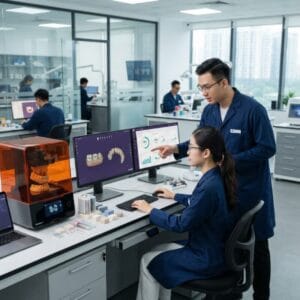
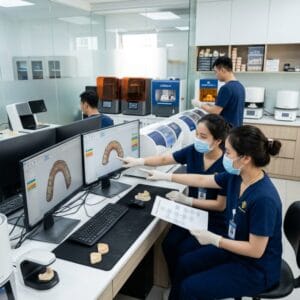
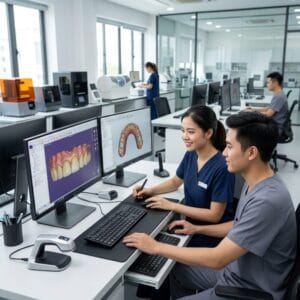
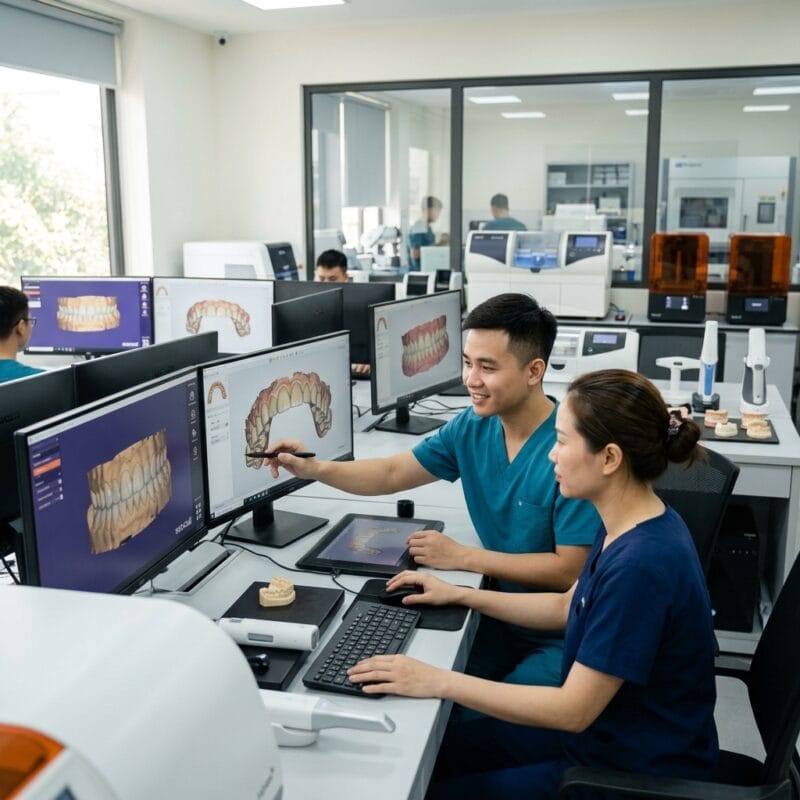
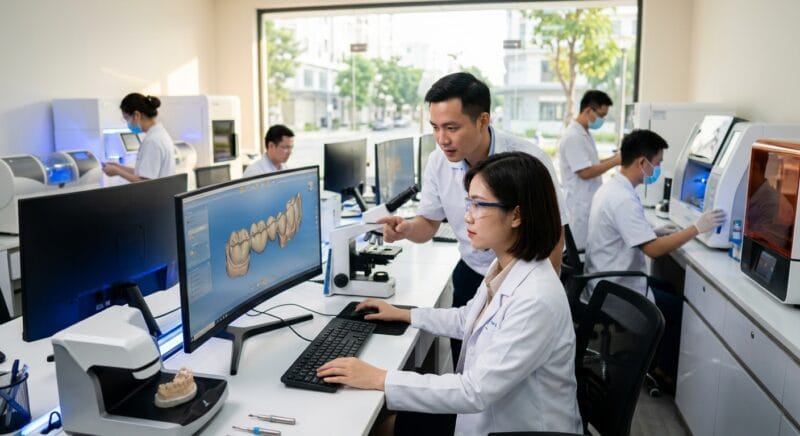
In a digital workflow, the clinical team captures an intraoral scan of the patient’s dentition and exports open format files (typically STL, PLY, or OBJ). Instead of relying on an in-house technician or a localized lab with limited capacity, the file is uploaded to a secure digital cloud platform. Remote CAD designers utilize advanced design suites such as exocad DentalCAD and 3Shape Dental System to generate anatomically precise virtual restorations.
Once the remote design process is complete, the finalized CAD files are sent back to the clinic or local milling center for immediate 3D printing or milling. Examining how UK dental clinics solve staffing shortages through outsourcing in 2026 demonstrates that digital outsourcing is not merely a stopgap measure, but a sophisticated, permanent structural model for modern dentistry.
Key Strategies: How UK Dental Clinics Solve Staffing Shortages Through Outsourcing in 2026
The decision to transition from local in-house design to remote CAD services involves several tactical adjustments. Evaluating how UK dental clinics solve staffing shortages through outsourcing in 2026 reveals several primary mechanisms that enable practices to thrive despite domestic recruitment challenges.
1. Overcoming Local Recruitment Delays
Recruiting a skilled dental technician in major cities like London, Manchester, or Birmingham can take months and involves substantial recruitment fees, high salary expectations, and ongoing training expenses. Practice directors researching how UK dental clinics solve staffing shortages through outsourcing in 2026 find that remote design centers offer instant access to dozens of experienced CAD specialists without HR overhead or long ramp-up periods.
2. Capitalizing on Time Zone Advantages for Overnight Turnaround
A crucial factor in how UK dental clinics solve staffing shortages through outsourcing in 2026 is the tactical use of time zone differentials. When a UK clinician finishes a full day of clinical procedures at 5:00 PM GMT and uploads intraoral scans to the cloud, offshore CAD design teams in Asian or European hubs receive those files during their core working hours. By 8:00 AM the following morning, completed design files are ready for local review, printing, or milling. This overnight workflow eliminates design backlogs and drastically reduces total patient treatment turnaround times.
Indeed, understanding how UK dental clinics solve staffing shortages through outsourcing in 2026 helps practice managers realize that global design networks operate effectively as a 24-hour back-office workforce.
3. Reducing Software License and Hardware Capital Costs
Maintaining high-end CAD software licenses, dedicated graphic workstations, and ongoing module updates imposes a heavy financial burden on independent practices. In studying how UK dental clinics solve staffing shortages through outsourcing in 2026, practice financial directors consistently note the significant reduction in capital expenditure achieved by shifting design costs from fixed overhead to a predictable per-case operational expense.
Crown and Bridge Restorations: Streamlining Monolithic Zirconia and E.max Designs
Crown and bridge prosthetics remain the financial bedrock of standard restorative practice. In discussing how UK dental clinics solve staffing shortages through outsourcing in 2026, crown and bridge workflows serve as a prime example of high-volume efficiency.
Whether designing single-unit monolithic zirconia crowns, multi-unit anterior bridges, or lithium disilicate (e.max) inlays and onlays, dedicated remote designers ensure precise margin line placement, ideal proximal contact strength, and proper occlusal clearance. Clinicians studying how UK dental clinics solve staffing shortages through outsourcing in 2026 benefit from strict adherence to anatomical parameters customized to their specific preparation preferences.
By delegating time-consuming virtual margin tracing and contouring to external specialists, internal clinical staff can focus entirely on patient care, chairside preparation, and final crown seating. This efficient division of labor illustrates how UK dental clinics solve staffing shortages through outsourcing in 2026 without compromising clinical precision.
Implant Abutments and Surgical Guide Design Integration
Implantology demands extreme spatial accuracy and strict anatomical compliance. Practice owners who examine how UK dental clinics solve staffing shortages through outsourcing in 2026 often focus on complex implant prosthetics and guided surgery planning.
Remote CAD engineers integrate cone-beam computed tomography (CBCT) DICOM files with surface intraoral STL scans to plan implant placement relative to bone density, nerve pathways, and final prosthetic outcomes. They craft accurate drill sleeves and fully guided templates alongside custom titanium bases or one-piece zirconia abutments. Integrating surgical guide design outsourcing allows general practices and specialist implant centers to offer safe, predictable implant procedures without hiring dedicated in-house surgical planning technicians.
Demonstrating how UK dental clinics solve staffing shortages through outsourcing in 2026, outsourced implant design enables practices to handle sophisticated full-arch hybrid restorations, All-on-X planning, and custom healing abutments seamlessly.
Expanding Removable Prosthetics and Orthodontic Services
The digital revolution is no longer limited to fixed prosthetics; digital dentures, removable partial dentures (RPDs), clear aligners, and occlusal splints have fully entered the digital space. Analyzing how UK dental clinics solve staffing shortages through outsourcing in 2026 shows how practices are broadening their service menus despite internal labor constraints.
Digital Dentures and Flexible Frameworks
Traditional removable denture fabrication requires intensive manual labor, including wax rim adjustments, tooth setup, and flasking. In contrast, how UK dental clinics solve staffing shortages through outsourcing in 2026 involves digital denture design using algorithms that auto-suggest arch setups, occlusal planes, and gingival stippling based on facial landmarks.
Remote designers generate STL files for 3D printed denture bases and milled tooth arches, as well as cobalt-chromium partial denture frameworks with perfectly calibrated clasp retention. This transition demonstrates how UK dental clinics solve staffing shortages through outsourcing in 2026 while reducing clinical try-in appointments.
Clear Aligner Staging and Treatment Planning
Orthodontic aligner therapy requires careful step-by-step tooth movement planning and attachment positioning. When evaluating how UK dental clinics solve staffing shortages through outsourcing in 2026, orthodontic treatment planning stands out as a key growth driver. Specialized orthodontic CAD technicians execute precise tooth segmentation, collision management, and movement velocity staging, returning a complete treatment plan setup to the UK dentist for approval before thermoforming or direct aligner printing takes place.
Night Guards and Occlusal Splints
Night guards, bruxism splints, and sleep apnea devices represent high-demand preventive care items. Utilizing specialized services for 3D printed night guard design illustrates how UK dental clinics solve staffing shortages through outsourcing in 2026 to scale preventative treatments without adding administrative strain.
How does remote CAD CAM dental design maintain quality control?
Remote CAD CAM dental design maintains quality control through standardized digital scan evaluation protocols, strict design parameter presets, and continuous feedback loops between clinicians and remote technicians.
A primary concern among UK clinical directors considering digital outsourcing revolves around consistency and regulatory oversight. To ensure that every restoration complies with UK standards, outsourced CAD providers establish rigorous, multi-tiered quality assurance checks.
First, incoming digital impressions are analyzed for clarity, prep margin definition, and adequate occlusal bite registration. If a scan contains distortion or insufficient clearance, the clinical team is notified immediately before design begins. Second, remote technicians work under customized user profiles that save the specific preferences of each UK clinician—such as preferred cement gap thickness (e.g., 50 microns), contact tight parameters, and marginal extension limits.
Furthermore, evaluating how UK dental clinics solve staffing shortages through outsourcing in 2026 highlights the importance of real-time communication tools. Secure chat applications, visual annotation tools, and 3D web viewers allow clinicians and CAD technicians to review and adjust complex designs prior to production. This collaborative feedback loop explains how UK dental clinics solve staffing shortages through outsourcing in 2026 while meeting stringent Medicines and Healthcare products Regulatory Agency (MHRA) quality standards.
Financial Impact: Analyzing Cost Structures and Profitability in 2026
Beyond solving operational bottlenecks, outsourcing dental design delivers compelling economic benefits. Financial comparisons illustrating how UK dental clinics solve staffing shortages through outsourcing in 2026 demonstrate a clear shift from fixed labor liabilities to flexible variable costs.
Consider the total cost of maintaining an in-house CAD technician in the UK:
- Direct Salary & Pensions: Competitive annual salary, National Insurance contributions, and mandatory workplace pension contributions.
- Software & Hardware Overhead: CAD annual seat licensing fees, software updates, module add-ons, and high-performance workstation maintenance.
- Non-Productive Time: Paid holiday leave, sick leave, training days, and idle bench time during seasonal volume dips.
Conversely, assessing how UK dental clinics solve staffing shortages through outsourcing in 2026 through a pay-per-design model reveals that practices only pay for completed, validated CAD files. During peak periods, capacity scales instantly without overtime costs; during slower periods, design expenses naturally contract. This dynamic cost structure confirms how UK dental clinics solve staffing shortages through outsourcing in 2026 while stabilizing practice margins.
Step-by-Step Implementation Guide for UK Practices and Labs
For dental practices and DSOs seeking to adopt this model, implementing an efficient remote design pipeline requires a structured approach. Reviewing how UK dental clinics solve staffing shortages through outsourcing in 2026 reveals a clear roadmap for success:
- Audit Current Scan Volume and Bottlenecks: Calculate the monthly volume of digital crown, bridge, implant, aligner, and night guard scans, identifying where internal delays occur.
- Establish Standardized Digital Impression Protocols: Train chairside clinical staff to take crisp intraoral scans with clear margins and accurate bite registrations.
- Select an Offshore CAD Partner with Proven Experience: Partner with a dedicated CAD lab that utilizes industry-leading software like exocad and 3Shape, and offers certified quality control workflows.
- Create Detailed Doctor Preference Profiles: Document specific clinical requirements regarding contact tightness, occlusal relief, cement space, and aesthetic contours.
- Integrate Cloud Integration and Automated Uploads: Establish direct digital file transfer pipelines between intraoral scanners and the CAD provider’s cloud portal for seamless daily uploads.
- Monitor Turnaround Times and Review Cases: Continuously evaluate fit, aesthetics, and seating times to refine parameters over initial cases.
Following this system shows how UK dental clinics solve staffing shortages through outsourcing in 2026 smoothly and securely.
Future Outlook: Sustainable Practice Growth Through Global CAD Collaboration
As digital dentistry continues to advance, the distinction between local and remote design will become increasingly blurred. Looking ahead, how UK dental clinics solve staffing shortages through outsourcing in 2026 offers a clear blueprint for sustainable, future-proof dental practice management.
By blending local clinical expertise with high-speed offshore CAD design capability, UK practices can expand their service offerings, shorten patient wait times, reduce operational stress, and increase overall profitability. Ultimately, how UK dental clinics solve staffing shortages through outsourcing in 2026 represents a fundamental evolution toward a connected, global dental healthcare ecosystem.
Ready to scale your dental practice capacity and eliminate CAD design backlogs? Contact our team of expert CAD designers today to streamline your digital workflow with fast, high-precision crown, implant, and aligner designs.