Navigating Dental Lab Startup Costs in Germany 2026
The dental laboratory industry across Germany, Austria, and Switzerland is undergoing a profound digital transformation. As dental practices shift rapidly toward intraoral scanning and fully digital restorative workflows, prospective laboratory owners, master technicians (Zahntechnikermeister), and Dental Service Organizations (DSOs) must carefully analyze dental lab startup costs in Germany 2026 before making capital commitments. Establishing a modern dental laboratory requires balancing traditional craftsmanship with cutting-edge digital CAD/CAM technology, rigorous European Union regulations, and rising operational expenses.
Historically, opening a traditional dental lab focused heavily on casting furnaces, ceramic bench setups, and manual wax-up tables. However, evaluating dental lab startup costs in Germany 2026 requires a comprehensive look at digital investments. Modern laboratories rely on 5-axis dry and wet milling machines, high-precision DLP 3D printers, optical desktop scanners, specialized CAD design software licenses, and strict Medical Device Regulation (MDR) compliance protocols. Understanding these mandatory investments allows entrepreneurs to properly structure financing, secure commercial loans, and build a sustainable business model.
Furthermore, evaluating dental lab startup costs in Germany 2026 reveals that capital expenditures (CapEx) can vary drastically based on operational strategy. Founders must decide whether to build a full-production facility capable of in-house design, milling, printing, and hand-finishing, or to adopt a hybrid model that leverages digital design outsourcing to minimize physical overhead. This financial guide breaks down every capital requirement, recurring operational expense, and regulatory cost involved in launching a successful dental laboratory in Germany in 2026.
Regulatory Compliance and Legal Registration Requirements
In Germany, starting a dental laboratory is subject to stringent regulatory frameworks that directly influence your financial planning. When calculating dental lab startup costs in Germany 2026, regulatory registration, statutory insurance, and trade association fees represent immediate upfront expenses before producing a single restorative unit.
First, the German Crafts Code (Handwerksordnung) mandates that a commercial dental laboratory operate under the supervision of a certified master technician under the Meisterpflicht rule. If the founder is not a certified Zahntechnikermeister, they must hire a qualified master technician as a technical director (fachlicher Leiter). This administrative setup directly increases initial salary obligations and contract preparation costs within the total dental lab startup costs in Germany 2026.
Key Regulatory Expenses to Budget
- Handwerkskammer (HWK) Registration: Formal entry into the Craftsmen’s Register (Handwerksrolle) typically costs between €300 and €800, depending on the regional chamber jurisdiction.
- Trade Association Membership (BG ETEM): Mandatory registration with the Berufsgenossenschaft Energie Textil Elektro Medienerzeugnisse covers workplace safety and accident insurance initialization, adding €500 to €1,200 in preliminary administrative setup fees.
- Commercial Legal Setup and Notary Fees: Structuring the business as a GmbH (limited liability company) requires minimum share capital of €25,000 (with at least €12,500 deposited upfront), plus notary and commercial register (Handelsregister) filing fees ranging from €1,200 to €2,500.
- Medical Device Regulation (MDR) Auditing and Software: Under European Regulation (EU) 2017/745 on medical devices, dental laboratories are classified as custom device manufacturers. Implementing a compliant Quality Management System (QMS) and traceability software adds €4,000 to €12,000 to your dental lab startup costs in Germany 2026.
What are the primary dental lab startup costs in Germany 2026?
The primary dental lab startup costs in Germany 2026 include commercial facility leases and specialized ventilation, advanced CAD/CAM milling hardware and 3D printers, software licensing, and master technician payroll, totaling between €150,000 and €550,000 for a fully equipped modern facility.
A detailed evaluation reveals that these primary expenditures are divided into initial fixed physical assets, digital technological infrastructure, regulatory setup, and initial working capital reserves. Commercial real estate for dental laboratories requires specialized industrial renovation, including heavy-duty electrical outlets, centralized compressed air supply (6 to 8 bar), dedicated suction and dust extraction systems for zirconia and metal, and specialized plumbing for wet milling filtration. Renovating a standard 100 to 200 square meter commercial space in a major German metropolitan region like Munich, Frankfurt, or Hamburg often costs between €35,000 and €85,000 before equipment installation even begins.
Equipment acquisition forms the single largest line item in dental lab startup costs in Germany 2026. A complete hardware fleet includes desktop laboratory scanners, 5-axis dry milling units for zirconia and PMMA, 4-axis or 5-axis wet milling units for titanium custom abutments and glass ceramics, high-temperature zirconia sintering furnaces, ceramic firing ovens, and resin 3D printers for working models and surgical guides. Material inventory—including raw zirconia discs, PMMA blanks, titanium milling premilled blanks, cobalt-chromium alloys, light-curing resins, and staining kits—requires an initial working stock investment of €15,000 to €30,000.
Hardware Equipment Breakdown for a Digital Dental Lab
To accurately calculate dental lab startup costs in Germany 2026, founders must evaluate hardware options based on target product lines, such as crown and bridge, implant prosthetics, removables, or orthodontic aligners. Investing in industrial-grade machinery ensures precision and longevity, but significantly increases upfront capital demands.
1. Digital Scanners and Input Devices
High-precision desktop lab scanners are necessary to digitize conventional physical impressions, master stone models, and bite registrations sent by clinical clients. Leading optical laboratory scanners utilize blue light LED technology and multi-camera arrays to achieve scanning tolerances under 4 microns. Acquiring premium scanning hardware adds roughly €8,000 to €18,000 to total dental lab startup costs in Germany 2026.
2. CAD/CAM Milling Units and Sintering Ovens
Milling hardware represents a massive portion of initial capital outlay. A modern digital laboratory requires high-stability milling equipment to handle diverse restorative materials:
- 5-Axis Dry Milling Machine: Essential for milling zirconia, PMMA, and wax. High-end German and international brands cost between €28,000 and €55,000.
- Wet Milling / Grinding Unit: Required for glass ceramics (lithium disilicate), composite blocks, and titanium custom abutments. Costs range from €22,000 to €45,000.
- High-Temperature Zirconia Sintering Furnace: High-speed and conventional sintering furnaces capable of reaching 1,600°C cost between €8,000 and €18,000 per unit.
- Porcelain Ceramic Ovens: Vacuum ceramic firing ovens for manual glazing, staining, and veneering cost approximately €4,500 to €9,500 each.
3. Additive Manufacturing (3D Printing Setup)
3D printing has become non-negotiable for producing master models, try-ins, splints, and casting patterns. High-precision Digital Light Processing (DLP) or Stereolithography (SLA) 3D printers engineered specifically for dental applications cost between €5,000 and €20,000 per printer. Supporting post-processing equipment—including automated isopropyl alcohol washing stations and ultraviolet curing chambers—adds another €2,500 to €6,000 to dental lab startup costs in Germany 2026.
CAD Software Licensing and Digital Infrastructure Expenses
Digital design software serves as the central nervous system of any modern dental laboratory. However, perpetual software licenses, annual upgrade service contracts, and high-performance computing hardware contribute substantial expenses to dental lab startup costs in Germany 2026.
Core CAD Design Software Platforms
To design crowns, bridges, custom implant abutments, removable partial dentures, and night guards, labs must license open-architecture software solutions. Leading software options such as exocad DentalCAD or 3Shape Dental System require standalone module purchases or annual subscription packages.
A fully loaded CAD software setup including base crown and bridge modules, implant modules, denture design modules, model builders, and bite splint add-ons typically carries an initial license cost of €8,000 to €16,000 per workstation. Furthermore, annual software mandatory maintenance and upgrade fees (software renewal licenses) range from €1,500 to €3,500 per seat annually. When multiplied across multiple workstations, software licensing becomes a dominant recurring component of dental lab startup costs in Germany 2026.
IT Infrastructure and Data Security
Under German data protection standards (DSGVO / GDPR), digital dental labs handling patient DICOM data, intraoral scans, and clinical photos must maintain secure local network architecture. High-performance CAD workstations equipped with high-end GPUs, multi-core CPUs, and 64GB RAM cost around €2,500 to €4,000 per computer. Encrypted cloud storage solutions, local NAS backup servers, physical firewalls, and data protection compliance software add an initial €5,000 to €10,000 into dental lab startup costs in Germany 2026.
Building specialized internal digital design capabilities across diverse indications—such as complex surgical guide design services or full-arch implant bridges—demands extensive software module expansions that further inflate upfront budget requirements.
Facility Fit-Out, Ergonomics, and Occupational Safety
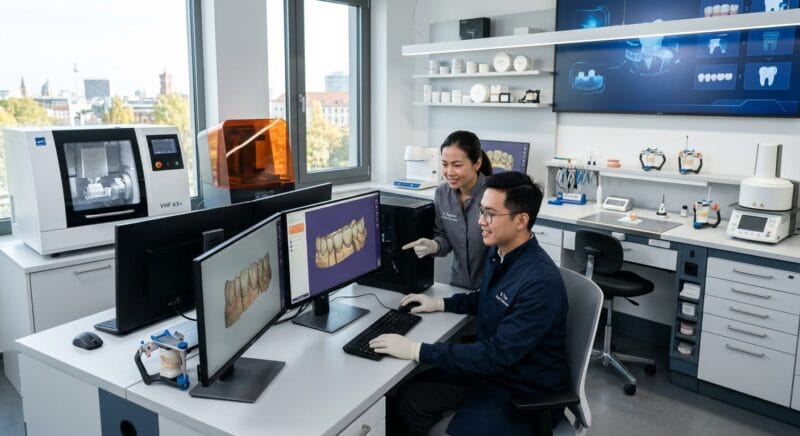
Setting up a physical workplace in Germany requires strict adherence to workplace regulations set by the German Social Accident Insurance (DGUV). Failure to comply with noise control, ergonomic seating, and air filtration standards can lead to costly retrofits during municipal inspections, expanding unexpected dental lab startup costs in Germany 2026.
Facility Investment Costs Overview
The table below outlines typical facility, utility, and safety installation expenses required when opening a mid-sized (3 to 5 bench technicians) dental laboratory in Germany:
| Expense Category | Description & Infrastructure Requirements | Estimated Cost Range (€) |
|---|---|---|
| Dust Extraction & HVAC | Centralized fine-dust extraction systems for zirconia, gypsum, and metal sandblasting units. | €12,000 – €28,000 |
| Compressor & Air Distribution | Oil-free medical grade air compressors with desiccant air dryers and soundproof cabinets. | €6,000 – €14,000 |
| Ergonomic Laboratory Benches | Specialized technician workstations with integrated gas, air, vacuum, LED lighting, and armrests. | €3,500 – €6,500 per bench |
| Plumbing & Sedimentation | Plaster traps, water filtration, and wet-grinding waste fluid treatment compliance. | €3,000 – €7,000 |
| Electrical Upgrade & UPS | 3-phase heavy current installation and Uninterruptible Power Supply (UPS) units for milling protection. | €5,000 – €12,000 |
Accounting for these infrastructure elements is vital because omitting adequate dust extraction or electrical stabilization can void equipment warranties or breach health regulations, drastically raising true dental lab startup costs in Germany 2026.
Labor, Staffing, and Initial Operating Cash Flow
Human capital represents the largest continuous operational expense for dental laboratories in Western Europe. In Germany, skilled labor shortages mean highly competent digital technicians and master technicians command competitive salaries, heavily impacting overall dental lab startup costs in Germany 2026.
Labor Cost Realities in 2026
When calculating working capital requirements for the first 6 to 12 months of operation, founders must account for full employer payroll burdens. Employer contributions to German social security (health insurance, nursing care, pension, and unemployment insurance) add roughly 20% to 22% on top of the gross employee salary.
- Zahntechnikermeister (Master Technician): Gross salary ranges from €55,000 to €80,000 annually, translating to a total employer cost of €67,000 to €97,000 per year.
- Experienced CAD/CAM Technician: Gross salary ranges from €38,000 to €52,000 annually, totaling €46,000 to €63,000 in employer burden.
- Ceramicist / Finishing Specialist: Gross salary ranges from €35,000 to €48,000 annually.
Because dental practices typically negotiate 30-to-90-day payment terms (or pay via billing clearing houses like Health AG or DZR), a startup lab must maintain at least 3 to 6 months of liquid cash reserves to cover staff payroll and vendor bills. Maintaining this liquidity buffer directly increases effective dental lab startup costs in Germany 2026 by an additional €50,000 to €120,000.
How can CAD/CAM design outsourcing lower dental lab startup costs in Germany 2026?
CAD/CAM design outsourcing lowers dental lab startup costs in Germany 2026 by eliminating the need for expensive in-house CAD design stations, specialized software licensing fees, and full-time senior technician salaries during initial launch phases.
By partnering with a reliable offshore or specialized digital design outsourcing service, new lab owners can radically alter their financial model. Instead of committing massive upfront capital toward software seats, specialized design module add-ons, and full-time CAD design staff, lab owners convert fixed overhead into variable per-unit operating costs. This shift enables laboratories to launch lean, maintain exceptional cash flow flexibility, and achieve profitability significantly faster.
1. Reduction in Initial Hardware and Software Capital Expenditure
Outsourcing dental CAD design directly addresses the core components of dental lab startup costs in Germany 2026. Purchasing multiple CAD software licenses, dedicated design workstations, and high-performance graphics monitors quickly demands €30,000 to €60,000 in upfront capital. By delegating digital restoration design—including crown and bridge, custom implant abutments, night guards, and removables—to an expert digital design service, new labs require only basic scanning equipment and output milling/printing machines. The lab avoids buying multiple design modules and eliminates annual software update subscription fees entirely.
2. Eliminating Fixed Payroll Burdens and Labor Bottlenecks
Finding experienced CAD designers in Germany is difficult and expensive. Hiring a full-time CAD technician creates a permanent fixed payroll commitment regardless of daily order volume. When evaluating dental lab startup costs in Germany 2026, outsourcing design work offers dynamic scalability: during slow initial launch months, design expenses remain low because you only pay per completed design file. As order volume scales up from local dental practices, the external design team seamlessly absorbs the surge without requiring you to recruit, train, or pay social security benefits for additional internal design personnel.
3. Access to Specialized Design Expertise Across All Indications
Modern clinical practices expect dental laboratories to provide comprehensive restorative offerings from day one. Designing complex cases like removable partial dentures, surgical guides, clear aligners, or full arch denture design requires specialized technical training and expensive niche CAD modules. Utilizing an established CAD/CAM design partner allows a newly formed lab to immediately offer these high-margin, complex restorations without investing thousands of Euros in staff training or software upgrades, keeping initial dental lab startup costs in Germany 2026 manageable.
Leading implant and material manufacturers like Straumann emphasize seamless digital workflows; leveraging specialized outsourcing centers ensures that your digital restoration files perfectly align with premium material milling protocols without necessitating costly trial-and-error periods in-house.
Comparing Financial Models: Traditional Full-In-House vs. Outsourced Hybrid Lab
To demonstrate the dramatic impact that operational structure has on dental lab startup costs in Germany 2026, let us compare two primary startup approaches for a 3-person lab setup.
Model A: Fully Autonomous In-House CAD/CAM Setup
In a traditional in-house model, the startup lab purchases all scanning, CAD design, milling, 3D printing, and finishing equipment, while hiring internal design and technical staff:
- Facility Lease & Technical Infrastructure Renovations: €55,000
- Full Scanner, Milling, Printing & Sintering Hardware Suite: €140,000
- Multiple CAD Software Licenses & Module Upgrades: €22,000
- Initial Materials & Consumable Stock: €25,000
- Regulatory Compliance, QMS & Legal/Notary Fees: €15,000
- 3 Months Operating Working Capital Reserve (Salaries + Rent): €75,000
- Total Estimated Model A Startup Cost: €332,000
Model B: Lean Hybrid Setup (Milling/Finishing In-House, Design Outsourced)
In a lean hybrid model, the startup lab focuses core capital on internal milling, 3D printing, and hand-finishing ceramics, while sending digital intraoral and desktop scan files to a specialized CAD design partner:
- Facility Lease & Essential Infrastructure Renovations: €35,000
- Core Milling, Sintering & Printing Hardware Fleet: €85,000
- Basic Scanner & Minimal CAD Utility License: €8,000
- Initial Materials & Consumable Stock: €15,000
- Regulatory Compliance, QMS & Legal Fees: €12,000
- 3 Months Operating Working Capital Reserve (Lower Payroll Burden): €45,000
- Total Estimated Model B Startup Cost: €200,000
By adopting a hybrid outsourced design model, founders reduce their initial dental lab startup costs in Germany 2026 by over €130,000 (a capital expenditure savings of nearly 40%). This capital preservation significantly decreases business loan dependence, lowers monthly debt service payments, and shortens the timeframe to achieve net break-even operations.
What is the average timeline to recover dental lab startup costs in Germany 2026?
The average timeline to recover dental lab startup costs in Germany 2026 ranges between 36 and 60 months, depending heavily on initial capital expenditure, client acquisition speed, and operational lean strategies like outsourcing.
Achieving a complete return on investment (ROI) within this timeframe requires strict oversight of overhead expenses and efficient capacity utilization. Laboratories that heavily invest in expensive internal design workstations and full-time specialized CAD technicians often experience longer ROI horizons (48 to 60 months) due to high fixed monthly operational expenses (OpEx). Conversely, labs utilizing a hybrid design model significantly streamline dental lab startup costs in Germany 2026, allowing them to lower their monthly break-even threshold and achieve full capital recovery in as little as 24 to 36 months.
Key drivers influencing the ROI timeline include:
- Client Acquisition Velocity: Securing recurring clinical accounts (dentists, DSOs, oral surgeons) within the first 6 months of launch.
- Average Gross Margin Per Unit: High-value digital restorations such as custom implant abutments, zirconia bridges, and night guards yield significantly higher profit margins than simple monolithic crowns.
- Rejection and Remake Rates: Achieving low remake rates (under 2.5%) through precise outsourced CAD design minimizes material waste and preserves profit margins.
Strategic Recommendations for Launching a Dental Lab in 2026
Successfully navigating dental lab startup costs in Germany 2026 requires a disciplined business strategy that balances clinical excellence with modern financial planning. Prospective lab founders should adopt the following strategic steps during their launch roadmap:
1. Conduct a Detailed Local Market Analysis
Before securing financing, analyze the competitive landscape within your target German region (Landkreis or metropolitan area). Determine whether local dental clinics are underserved in specific categories, such as implant prosthetics, aligners, or rapid-turnaround crown and bridge work. Tailor your hardware investments directly to those market demands to prevent over-purchasing machinery that sits idle.
2. Secure Government Grants and Subsidized Loans
Germany offers attractive public funding programs for business startups and technological innovations. Program options such as the KfW StartGeld or regional Gründungszuschuss subsidies provide low-interest business loans and capital grants designed to support digital technology adoption. Utilizing public funding instruments reduces private financial risk when managing overall dental lab startup costs in Germany 2026.
3. Implement a Scalable Hybrid CAD Workflow from Day One
Do not let software licensing and design staff recruitment become a barrier to launching your business. By establishing a partnership with a professional dental CAD design service, your lab gains instant access to a massive team of experienced digital designers expert in exocad and 3Shape platforms. You can accept complex clinical cases immediately, maintain rapid turnaround times, deliver exceptional marginal fit, and keep your initial dental lab startup costs in Germany 2026 within a safe, highly profitable baseline.
Ready to launch your dental laboratory with minimal capital risk and maximum design precision? Contact our expert CAD design team today to streamline your workflow and optimize your digital laboratory startup strategy.