Navigating the Regulatory Landscape for Canadian Dental Laboratories in 2026
The Canadian dental laboratory sector is undergoing an unprecedented convergence of rapid technological adoption and heightened regulatory oversight. As digital workflows replace conventional physical impressions and manual wax-ups, facility owners must remain vigilant regarding dental lab licensing requirements in Canada 2026. Staying fully compliant across all operational channels is essential for owner-operators, dental service organizations (DSOs), and commercial laboratory managers who seek to protect their business investments and clinical reputation.
The evolution of digital restorative dentistry has streamlined crown and bridge fabrication, full-arch implant restorations, removable prosthetics, surgical guides, and orthodontic aligners. However, digital transformation also introduces complex jurisdictional questions regarding software validation, data transfer, raw material traceability, and cross-border design services. Understanding the complete framework of dental lab licensing requirements in Canada 2026 helps laboratory directors establish robust quality management systems while maximizing operational efficiency.
In this comprehensive analysis, we will unpack how federal legislation under Health Canada intersects with provincial regulatory colleges to define the contemporary standard for commercial dental production. Furthermore, we will examine how strategic CAD/CAM design outsourcing fits seamlessly into this compliance landscape, enabling Canadian laboratories to scale capacity without compromising quality or violating mandatory statutory standards.
What are the key dental lab licensing requirements in Canada 2026?
The key dental lab licensing requirements in Canada 2026 encompass provincial college registration for Registered Dental Technologists (RDTs) alongside federal Health Canada compliance for custom-made medical devices and CAD/CAM manufacturing workflows. Meeting these dual standards requires systematic tracking of dental devices, strict operational oversight, and certified quality controls at every stage of production.
At the federal level, Health Canada oversees the safety, efficacy, and quality of medical devices distributed throughout the country under the Food and Drugs Act. Custom-made medical devices, such as patient-specific dental crowns, bridges, night guards, and surgical guides, fall under specific regulatory provisions. Dental laboratories operating within Canada must ensure that their fabrication equipment, raw materials, and digital design tools comply with federal standards. Understanding these dual layers is critical when reviewing dental lab licensing requirements in Canada 2026.
Provincially, the practice of dental technology is regulated by designated regulatory colleges established by provincial legislation. For example, in Ontario, the College of Dental Technologists of Ontario (CDTO) governs registered members, while in British Columbia, Alberta, and Quebec, similar regulatory bodies oversee professional standards. Laboratories operating within these jurisdictions must maintain designated supervising staff—specifically Registered Dental Technologists (RDTs) or equivalent certified professionals—to authorize work and supervise production. Failing to meet these dental lab licensing requirements in Canada 2026 can lead to severe operational penalties, administrative fines, or business closure.
Federal Regulations: Health Canada and Medical Device Establishment Licensing
When evaluating federal guidelines, laboratory executives must determine whether their facilities require a Medical Device Establishment License (MDEL) or if their activities fall under Class I custom-made device exemptions. Under the established regulations, devices fabricated specifically according to a licensed dentist’s or prosthodontist’s written prescription are classified as custom-made medical devices. Compliance with dental lab licensing requirements in Canada 2026 mandates that laboratories keep meticulous records of all incoming prescriptions, batch numbers of raw materials, and digital design parameters.
Furthermore, if a commercial laboratory imports finished or semi-finished medical prosthetics, surgical guides, or orthodontic appliances from foreign locations, the importer of record must maintain an active MDEL. This requirement underscores the distinction between importing physical medical devices and utilizing remote digital design services. When a Canadian laboratory receives outsourced digital CAD files (such as STL, OBJ, or PLY files) and subsequently mills or prints the physical restoration in-house using Health Canada-approved materials and equipment, the local lab remains the physical manufacturer of record, adhering strictly to dental lab licensing requirements in Canada 2026.
Software utilized in the design process, including industry-leading CAD suites like exocad, must be legitimately licensed and properly validated within the lab’s quality management system. Using cracked or unverified software tools violates federal intellectual property laws and invalidates regulatory compliance under dental lab licensing requirements in Canada 2026.
How do dental lab licensing requirements in Canada 2026 affect digital design outsourcing?
Dental lab licensing requirements in Canada 2026 mandate that digital design files created by third-party outsourcing partners adhere strictly to certified CAD parameters and RDT-supervised clinical specifications. When digital design is handled offshore or through external specialized centers, the local Canadian lab retains ultimate responsibility for approving the design parameters prior to physical fabrication.
Outsourcing digital design work has become a preferred growth model for modern Canadian dental laboratories seeking to mitigate local labor shortages, reduce overhead, and manage volume spikes. Because digital CAD files represent electronic data rather than physical medical devices, foreign CAD design services do not require a Health Canada Medical Device Establishment License to generate computer files. However, the physical laboratory in Canada that receives these files and manufactures the final restoration must ensure that all operational steps satisfy dental lab licensing requirements in Canada 2026.
To ensure total compliance, Canadian laboratories must maintain strict internal verification processes. Before sending CAD files to production machinery, a qualified technician or RDT must review and sign off on the digital design. This includes verifying critical clinical factors:
- Margin clearance and fit: Ensuring margin lines match intraoral scan boundaries with precision tolerances (typically 20 to 40 microns).
- Occlusal and interproximal contact intensity: Adjusting contact points based on clinician preferences and anatomical reality.
- Material thickness compliance: Verifying minimum material thickness for monolithic zirconia, lithium disilicate, or PMMA as specified by material manufacturers.
- Emergence profile and anatomical contouring: Protecting soft-tissue health around implant platforms and natural abutments.
By enforcing rigorous internal review protocols, commercial facilities successfully maintain complete harmony with dental lab licensing requirements in Canada 2026 while taking full advantage of global digital design efficiencies. This strategy allows labs to scale high-demand services like outsourced crown and bridge design without exceeding local capacity or risking regulatory non-compliance.
Supervision and RDT Sign-Off in the Digital Era
Provincial regulatory colleges emphasize that automation and digital workflows do not relieve Registered Dental Technologists of their ethical and legal duties. In every province with regulated dental technology, an RDT or designated licensed professional must oversee the technical operations of the laboratory. Compliance with dental lab licensing requirements in Canada 2026 requires that every restorative appliance leaving the facility undergo final inspection and authorization by a qualified professional.
In practice, this means that even when a high-precision digital design is produced by an overseas CAD expert, the local licensed technician must review the virtual model. The digital signature or physical release form generated by the supervising RDT serves as formal verification that the restoration satisfies all prescribed anatomical, mechanical, and safety criteria required under provincial dental lab licensing requirements in Canada 2026.
Breakdown of Licensing and Operational Requirements by Province
While federal legislation sets baseline standards for medical device distribution, provincial authorities establish operational rules for laboratory facilities, staff qualifications, and public protection. Commercial lab owners must analyze the specific rules applicable to their primary location as well as any province into which they ship finished prosthetics.
Ontario: College of Dental Technologists of Ontario (CDTO)
In Ontario, the Regulated Health Professions Act, 1991, and the Dental Technology Act, 1991, govern the industry. A commercial dental laboratory operating in Ontario must employ or be supervised by a practicing member of the CDTO. Under dental lab licensing requirements in Canada 2026, Ontario laboratories are subjected to routine supervision audits, patient record retention rules (minimum 10 years), and strict infection control guidelines. Digital files, raw material batch tracking, and CAD design records fall squarely under these mandatory auditing requirements.
British Columbia: College of Dental Surgeons of BC and Allied Oversight
British Columbia maintains stringent regulations governing dental technicians and dental laboratory operations. Facilities must register with regulatory authorities, ensure all practicing technicians hold valid registration, and maintain rigorous quality control logs. Adhering to dental lab licensing requirements in Canada 2026 in British Columbia means ensuring that all digital manufacturing machinery—such as 3D printers producing surgical guides or aligner models—is calibrated according to verified medical-grade specifications.
Alberta: College of Dental Technologists of Alberta (CDTA)
Alberta’s Health Professions Act grants the CDTA the mandate to regulate dental technologists and corporate laboratory practice. Under Alberta’s implementation of dental lab licensing requirements in Canada 2026, laboratories must demonstrate ongoing professional development, maintain structured quality assurance logs, and ensure clear chain-of-custody documentation for all outsourced design components and physical sub-assemblies.
Quebec and Atlantic Provinces
In Quebec, the Ordre des technologistes dentaires du Québec (OTDQ) oversees the professional scope of practice, requiring strict language compliance, localized record-keeping, and specific technical certifications. Similarly, Nova Scotia, New Brunswick, Newfoundland and Labrador, and Prince Edward Island enforce specialized provincial rules. No matter where a lab is situated, adherence to dental lab licensing requirements in Canada 2026 remains non-negotiable for long-term operational viability.
Detailed Analysis Across Key Restorative and Specialty Workflow Categories
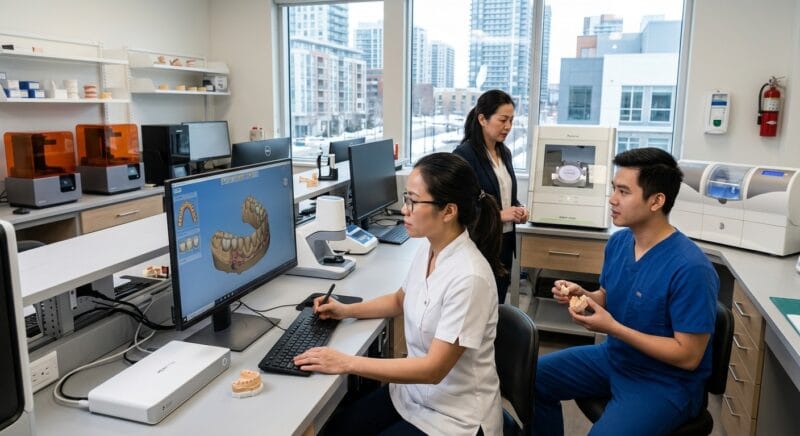
To fully grasp how dental lab licensing requirements in Canada 2026 impact day-to-day bench operations, it is helpful to examine major clinical workflow categories individually. Each product line carries distinct material requirements, design considerations, and compliance challenges.
1. Crown & Bridge Restorations
Fixed prosthetics remain the backbone of commercial lab production. Whether fabricating monolithic zirconia crowns, layered porcelain-fused-to-zirconia, or lithium disilicate restorations, digital impression accuracy is paramount. Laboratories using scanner hardware from manufacturers such as 3Shape must maintain calibrated scanning environments to capture sub-gingival margins accurately.
Under dental lab licensing requirements in Canada 2026, CAD design files for crown and bridge cases must incorporate specified die spacer gaps, minimum wall thicknesses, and anatomically correct occlusal schemes. When outsourcing digital design, the laboratory must ensure the CAD technician applies exact library settings matching the physical milling machine’s bur tolerances and sintering shrinkage factors. This guarantees structural integrity and prevents premature restorative failure in the patient’s mouth.
2. Implant Abutments and Full-Arch Restorations
Implant prosthetics represent higher clinical risk due to direct contact with peri-implant soft tissues and osseointegrated fixture platforms. Federal device regulations classify custom implant abutments and multi-unit screw-retained bridges as high-precision components requiring exact mechanical fit.
Compliance with dental lab licensing requirements in Canada 2026 dictates that all titanium bases, pre-milled blanks, and prosthetic screws be sourced from medical-grade suppliers possessing valid Canadian device clearances. When generating CAD files for complex restorative work such as full arch denture design or all-on-x titanium frameworks, digital design engineers must maintain strict screw-channel angles, adequate platform seating clearance, and optimal tissue emergence profiles to prevent biological and mechanical complications.
3. Guided Surgery and 3D Printed Surgical Guides
Computer-guided implant placement relies heavily on the integration of intraoral surface scans (STL) and cone-beam computed tomography (CBCT DICOM) files. Because surgical guides directly dictate surgical osteotomy location, depth, and trajectory, they are scrutinized closely under dental lab licensing requirements in Canada 2026.
Laboratories that offer surgical guide design and printing services must fulfill rigorous manufacturing protocols:
- Software Validation: CAD guide design must occur within FDA-cleared and Health Canada-compliant surgical planning software.
- Sleeve Fit Precision: Drill sleeve offsets and guide cylinder dimensions must match the specific surgical kit prescribed by the clinician.
- Resin Safety and Biocompatibility: Surgical guide resins must be Class IIa biocompatible materials, fully cured and autoclaved or sanitized according to manufacturer instructions.
- Traceability Logs: Every printed guide must be tied to a specific resin lot number and printer calibration log to satisfy dental lab licensing requirements in Canada 2026.
4. Removable Prosthetics and Digital Dentures
The traditional removable market is shifting rapidly toward digital denture workflows. From digital try-in setups to milled PMMA bases and 3D-printed monolithic dentures, digital design software allows for reproducible tooth arrangements and optimized tissue adaptation. Dental lab licensing requirements in Canada 2026 require laboratories to maintain accurate material tracking for all PMMA pucks, denture teeth, and liquid resins utilized in removable manufacturing.
5. Orthodontic Aligners and Retention Appliances
Clear aligners involve sequential tooth movement planned through digital staging software. Because aligners apply active biomechanical forces to dentoalveolar structures, they fall under controlled regulatory classification. Under dental lab licensing requirements in Canada 2026, laboratories producing in-house aligner solutions must ensure that staging protocols are validated by licensed dental clinicians and that thermoforming foils carry appropriate medical-grade certifications.
6. Night Guards and Occlusal Splints
Occlusal guards, hard/soft splints, and sleep appliances represent high-volume production lines for modern labs. Designing an effective night guard requires careful management of occlusal plane balancing, anterior guidance ramps, and retention relief gaps. Proper adherence to dental lab licensing requirements in Canada 2026 ensures that 3D-printed splint materials comply with biocompatibility standards to prevent chemical leaching or mucosal reactions during long-term intraoral exposure.
Why is compliance with dental lab licensing requirements in Canada 2026 necessary for growth?
Compliance with dental lab licensing requirements in Canada 2026 is necessary for growth because it protects laboratories against costly regulatory liabilities, safeguards clinical outcomes, and establishes strong trust with dental practices and DSOs. Commercial facilities that embrace regulatory compliance as a core operational strategy build sustainable, highly scalable businesses.
In today’s competitive commercial marketplace, large dental service organizations (DSOs) and high-volume clinical practices perform extensive due diligence before partnering with a primary dental laboratory. They require explicit proof that their laboratory partner complies fully with dental lab licensing requirements in Canada 2026. Demonstrating total regulatory compliance—including complete batch traceability, certified CAD workflows, valid software licenses, and registered RDT supervision—gives commercial facilities a significant market advantage during contract negotiations.
Conversely, failing to keep pace with dental lab licensing requirements in Canada 2026 introduces operational vulnerabilities. Unannounced audits by provincial colleges or Health Canada inspectors can result in mandatory recall notices, public disciplinary actions, loss of professional operating licenses, and devastating financial damage. Investing in strong compliance frameworks and reliable outsourcing partnerships is a direct investment in business resilience.
Data Privacy, Security, and Electronic Health Information Standards
As dental design moves entirely into the cloud, data protection has become a fundamental aspect of regulatory oversight. Canadian laboratories handling intraoral scans and patient records must comply with the Personal Information Protection and Electronic Documents Act (PIPEDA) at the federal level, alongside equivalent provincial health data protection statutes (such as PHIPA in Ontario or PIPA in Alberta and British Columbia).
When transmitting digital files to offshore CAD design centers or cloud storage servers, laboratory directors must ensure that all patient health information (PHI) is adequately secured. Compliance with dental lab licensing requirements in Canada 2026 involves implementing robust data safety protocols:
- Patient De-identification: Removing patient names and sensitive personal identifying information from STL design files prior to external transmission.
- Encrypted Transfer Protocols: Utilizing secure, 256-bit SSL encrypted file portals or cloud networks for uploading and downloading CAD files.
- Secure Cloud Hosting: Storing backup records on servers that adhere to international ISO/IEC 27001 data security standards.
- Access Control: Restricting access to internal digital design servers to authorized staff members equipped with multi-factor authentication.
By embedding data privacy directly into operational routines, Canadian dental laboratories successfully meet both provincial health data mandates and dental lab licensing requirements in Canada 2026.
Optimizing Lab Economics Through Digital Design Outsourcing
Maintaining full regulatory compliance while managing operating costs presents a continuous balancing act for laboratory executives. Skilled CAD designers in Canada command competitive salaries, and local talent shortages often prevent laboratories from expanding their daily case capacity. This economic reality makes high-quality CAD outsourcing an attractive strategy for modern laboratories seeking to balance performance and profitability while satisfying dental lab licensing requirements in Canada 2026.
| Operational Metric | In-House CAD Design Only | Hybrid Model with CAD Outsourcing |
|---|---|---|
| Fixed Overhead Costs | High (Software licenses, workstation hardware, salaries, benefits) | Low (Pay-per-design model, minimal local hardware investment) |
| Scalability & Capacity | Limited by local staff hours and physical bench availability | Virtually unlimited 24/7 capacity to handle volume fluctuations |
| Turnaround Speed | Dependent on internal queue and daytime working hours | Overnight design delivery for seamless morning milling schedules |
| Regulatory Oversight | Requires internal manager oversight of technical staff | Supervising RDT verifies outsourced CAD files prior to production |
| Compliance Risks | Software license non-compliance risks if unvalidated tools are used | Fully compliant when utilizing validated, licensed digital partners |
By integrating a specialized CAD design service into your daily workflow, your domestic team can redirect its focus toward final seating, intricate staining and glazing, custom characterization, customer service, and local client relationship management. This hybrid approach optimizes labor utilization while preserving complete alignment with dental lab licensing requirements in Canada 2026.
Step-by-Step Compliance Checklist for Canadian Dental Labs in 2026
To assist laboratory owners, managers, and DSO directors in auditing their current operations, we have compiled a quick step-by-step compliance checklist reflecting current regulatory demands.
Step 1: Verify Provincial College Registrations. Ensure that all supervising technologists hold active, unrestricted registrations with your provincial regulatory body (e.g., CDTO, CDTA, CCTCBC, OTDQ) and that mandatory continuing education requirements are up to date.
Step 2: Audit Equipment and Software Licensing. Confirm that all physical equipment (scanners, mills, 3D printers, sintering furnaces) and CAD design software suites are fully licensed, updated, and validated within your facility logbooks as mandated by dental lab licensing requirements in Canada 2026.
Step 3: Establish Clear Material Traceability Protocols. Maintain detailed inventory logs connecting raw material lot numbers (zirconia discs, liquid resins, titanium bases) directly to individual patient prescription forms and invoice records.
Step 4: Secure Data Transmission and Cloud Pipelines. Verify that all intraoral scan files shared with external partners are properly de-identified and transferred via encrypted cloud channels in compliance with PIPEDA and provincial health data regulations.
Step 5: Enforce Formal RDT Quality Control and File Verification. Implement a mandatory sign-off step where an RDT or certified technician inspects and approves every outsourced CAD file prior to milling or 3D printing, upholding dental lab licensing requirements in Canada 2026.
Strategic Outlook: The Future of Canadian Dental Laboratory Regulation
Looking ahead past 2026, regulatory scrutiny over automated dental production and artificial intelligence design algorithms will continue to increase. Health Canada and global regulatory agencies are actively studying the integration of AI-assisted design models in custom prosthetic manufacturing. As automated design engines become standard features across top CAD packages, regulatory bodies will place greater emphasis on human verification and clinical oversight.
Dental laboratories that establish disciplined regulatory habits today will be uniquely positioned to thrive as the industry evolves. Staying informed regarding dental lab licensing requirements in Canada 2026 guarantees that your facility avoids legal bottlenecks, maintains strong relationships with clinicians, and scales profitability sustainably into the future.
Partnering with an experienced, quality-driven CAD design center allows your laboratory to harness modern digital workflows with confidence. By delegating complex digital design tasks to certified CAD experts while maintaining local RDT supervision and physical production control, Canadian dental labs achieve the optimal combination of clinical excellence, business efficiency, and total regulatory compliance under dental lab licensing requirements in Canada 2026.
Streamline Your CAD Workflow Today
Ready to streamline your CAD workflow while staying compliant? Contact our expert digital design team today to discover how our outsourcing solutions support your lab’s growth.