Introduction: The Australian Dental Lab Landscape in 2026
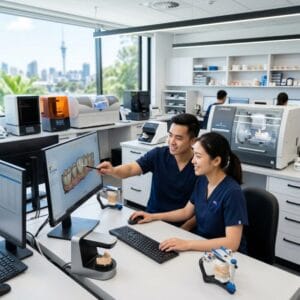
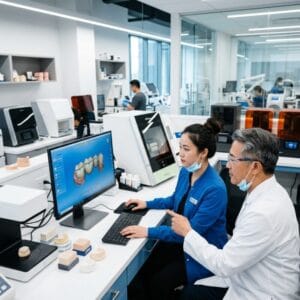
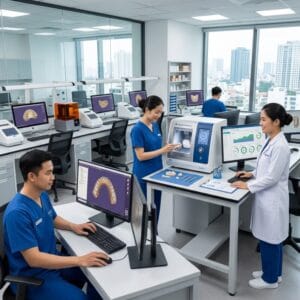
The Australian dental industry is undergoing a monumental shift driven by rapid technological advancements, evolving regulatory demands, and changing clinician expectations. As dental practices and Dental Service Organisations (DSOs) transition entirely away from physical impression materials toward intraoral optical scanners, understanding how to start a dental lab in Australia in 2026 has become a vital strategic exercise for dental technicians, clinicians, and industry entrepreneurs alike. The traditional laboratory setup filled with plaster benches, vacuum mixers, and casting furnaces is rapidly being replaced by streamlined digital facilities focused on computer-aided design (CAD) and computer-aided manufacturing (CAM).
However, entering the market requires more than just buying a high-end 3D printer or a five-axis milling machine. Modern laboratory owners must navigate tight regulatory oversight from the Therapeutic Goods Administration (TGA), establish bulletproof quality management systems (QMS), and compete in an environment where speed and accuracy are non-negotiable. Anyone researching how to start a dental lab in Australia in 2026 must account for these regulatory shifts, particularly surrounding personalised medical devices, which have rewritten the rules for manufacturing dental prosthetics, custom implant abutments, surgical guides, and aligners within Australia.
This comprehensive operational roadmap explores every step required to build a thriving, compliant, and highly profitable dental laboratory business in Australia. From establishing core business structures and managing capital expenditure to implementing cutting-edge digital CAD workflows and leveraging global design outsourcing, this guide provides the practical strategies you need to launch with confidence in 2026.
Section 1: Market Dynamics & Feasibility Analysis for 2026
Before investing capital into leased premises or equipment, you must evaluate the market forces shaping Australian dentistry. The demand for restorative, cosmetic, and orthodontic dental appliances across New South Wales, Victoria, Queensland, Western Australia, South Australia, and Tasmania continues to reach historic highs. Driven by an aging population requiring complex implant reconstructions and a younger demographic demanding clear aligners and cosmetic veneers, the appetite for high-quality prosthetic work is immense.
When analyzing how to start a dental lab in Australia in 2026, one must consider the rapid consolidation of independent dental practices into corporate DSOs. DSOs operate with strict requirements regarding turnaround times, digital integration, pricing consistency, and trackable quality assurance. Independent single-chair practices, on the other hand, often seek collaborative partnerships with local labs that offer specialized clinical support and seamless digital communication.
Market research must identify your core target audience. Will your laboratory serve local general dentists with everyday crown and bridge restorations, or will you specialize in high-margin niches such as full-arch implant rehabilitations, sleep appliances, or digital removable prosthetics? Early planning around how to start a dental lab in Australia in 2026 must define your unique value proposition (UVP). Whether your advantage is ultra-fast turnaround times, local clinical consulting, or unmatched precision in complex aesthetic cases, defining your niche determines your machinery needs, software licenses, and operational workflow.
What regulatory approvals are needed for how to start a dental lab in Australia in 2026?
Starting a dental laboratory in Australia requires compliance with the Therapeutic Goods Administration (TGA) framework for custom-made medical devices, local business registration, and adherence to Australian infection control standards.
Navigating Australian law is the single most critical phase when studying how to start a dental lab in Australia in 2026. Under the TGA framework, dental prostheses—including crowns, bridges, dentures, orthodontic aligners, and bite splints—are categorized as custom-made medical devices or personalized medical devices. Recent regulatory updates enforced by the Australian Government require laboratory operators to meet stringent compliance standards, maintain detailed technical documentation, and implement robust Quality Management Systems (QMS) equivalent to ISO 13485 standards.
Key regulatory requirements include:
- TGA Business Notification & ARTG Inclusion: Every Australian entity manufacturing custom-made dental medical devices must formally notify the TGA and adhere to the Personalised Medical Devices Framework. Ensure your laboratory records every material batch number, resin lot, and raw zirconia block used for each patient case.
- Statement of Conformity: Laboratories must generate and provide a formal Statement of Conformity for every custom-made device delivered to a dentist. This document details the exact materials used, origin of manufacture, and compliance with Essential Principles.
- Infection Control & Workplace Safety: Australian dental labs must satisfy national infection control guidelines established by bodies like the Australian Dental Association and state health authorities. In addition, premises must conform to AS/NZS 4187 standards for reprocessing and sterilizing reusable medical devices, along with Work Safe state mandates regarding chemical handling, dust extraction, and ergonomic safety.
- Business Structures & Licensing: Registering an Australian Business Number (ABN), Australian Company Number (ACN), Goods and Services Tax (GST) registration with the ATO, and securing appropriate commercial leases zoned for light industrial or commercial medical laboratory operations are fundamental early steps in how to start a dental lab in Australia in 2026.
Section 3: Defining Your Business Model – Traditional, Digital, or Hybrid?
Historically, establishing a dental laboratory meant equipping a large physical space with plaster rooms, heavy burn-out ovens, alloy casting machines, and ceramic porcelain departments. In 2026, entrepreneurs exploring how to start a dental lab in Australia in 2026 have three distinct structural pathways to consider:
1. The Traditional Analogue Laboratory
Relying on physical alginate and silicone impressions, hand-waxing, lost-wax casting, and manual porcelain layering. While traditional artistic skills remain highly valued for high-end anterior aesthetics, building a purely analogue laboratory in 2026 is financially risky due to high labor costs, slower turnarounds, and declining physical impression volumes from dental clinics.
2. The Fully Integrated In-House Digital Laboratory
Receiving digital intraoral scans via cloud portals, designing restorations on local CAD workstations, and manufacturing appliances in-house using 5-axis milling machines and high-speed resin 3D printers. This operational model delivers complete production control but requires massive initial capital expenditure for hardware, software licensing, continuous maintenance, and skilled CAD technicians.
3. The Modern Lean Digital Laboratory (Hybrid + CAD Outsourcing)
Receiving digital intraoral scans, performing basic intake, and relying on specialized CAD/CAM design outsourcing partners to produce precise 3D design files (STL/CAM files) overnight. The local lab then executes quick in-house 3D printing, milling, sintering, characterization, and quality control. This lean model is rapidly becoming the gold standard for anyone planning how to start a dental lab in Australia in 2026 because it minimizes fixed payroll costs, eliminates production bottlenecks, and maximizes daily output from day one.
What software and hardware are required when planning how to start a dental lab in Australia in 2026?
A modern Australian digital dental lab requires CAD design software, high-precision desktop scanners or intraoral file receivers, wet or dry milling machines, and 3D resin printers paired with validated curing units.
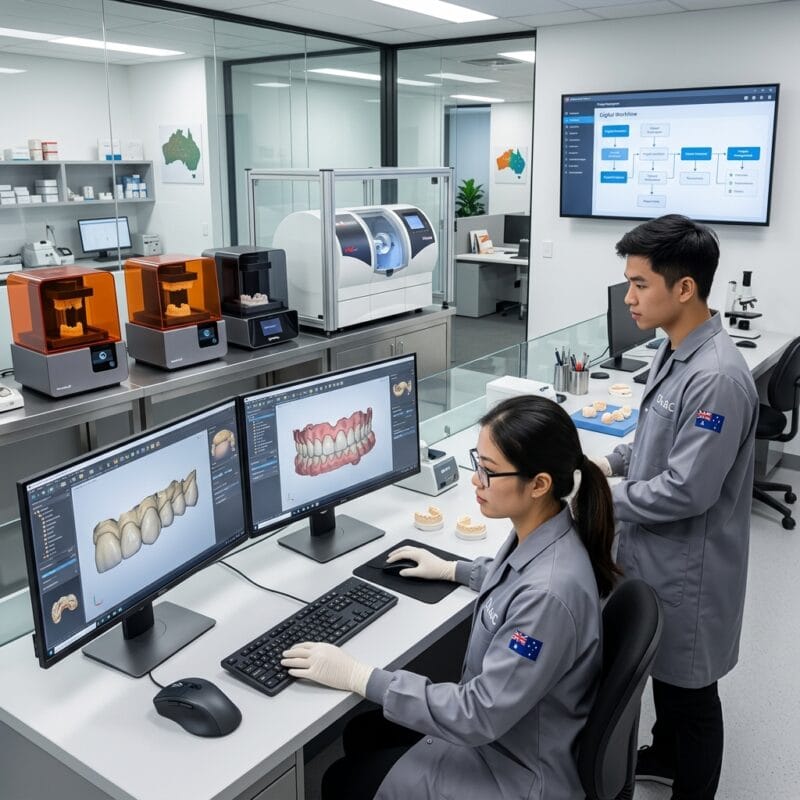
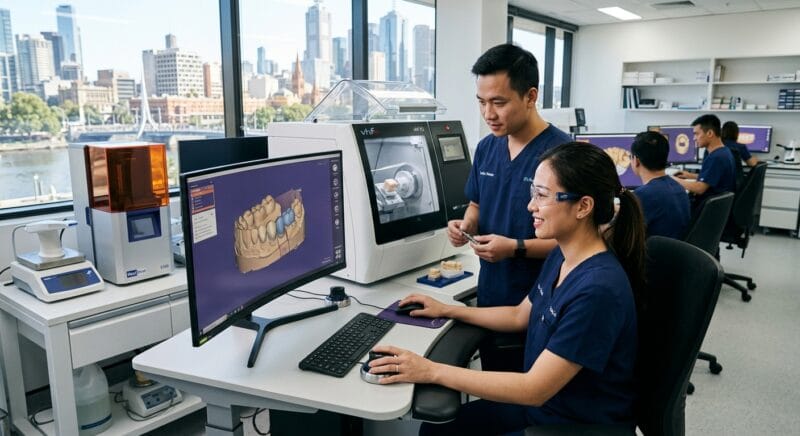
Equipment selection directly dictates your capabilities, speed, and profitability. When designing your operational layout while investigating how to start a dental lab in Australia in 2026, balance long-term scalability with initial capital limits. The mandatory technological stack includes:
1. High-Precision Scanners & Intake Systems
Even in a digital-first era, dental labs occasionally receive physical impression trays or master plaster models for complex implant or full-arch cases. Investing in a high-accuracy desktop optical lab scanner—such as those engineered by 3Shape or Medit—allows you to digitize physical models instantly into high-resolution open-format STL or PLY files for CAD processing.
2. CAD Design Software Suites
Industry-standard CAD software like exocad DentalCAD or 3Shape Dental System forms the backbone of digital restorative dentistry. These platforms allow technicians to design everything from single-unit crown & bridge restorations to complex custom implant abutments, full-arch zirconia bridges, night guards, surgical guides, and removable partial dentures.
3. CAM Nesting Software & Milling Units
To convert CAD design files into physical restorations, you need Computer-Aided Manufacturing (CAM) nesting software paired with robust dental milling machines. Dry 5-axis mills excel at carving disc-based materials like zirconia, PMMA, and wax, while wet milling machines are dedicated to grinding glass-ceramics (lithium disilicate) and titanium custom abutments.
4. Medical-Grade 3D Printers & Post-Processing Units
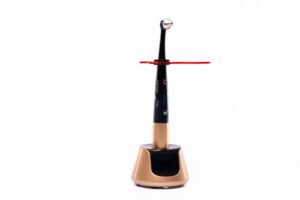
Digital light processing (DLP) and stereolithography (SLA) 3D printers are mandatory for modern labs. They produce working study models, die-replaceable models, occlusal splints, surgical guides, aligner stages, and castable resin patterns. Remember that TGA compliance requires using validated resin systems paired with matching UV post-curing light chambers to ensure biocompatibility.
5. High-Temperature Sintering Furnaces & Ceramics Workstations
High-speed zirconia sintering furnaces capable of reaching 1500°C to 1600°C are necessary for transforming pre-sintered green-state zirconia into dense, durable, aesthetic restorations. Additionally, ceramic glazing benches equipped with vacuum porcelain furnaces allow technicians to perform final stain, glaze, and hand-layering touches.
By mapping out your equipment stack early in your execution strategy for how to start a dental lab in Australia in 2026, you avoid over-purchasing redundant gear while ensuring seamless hardware-software interoperability.
Section 5: Financial Planning, Budgeting, and Capital Allocation
Capital management determines whether a newly established laboratory survives its first 12 to 24 months. Understanding how to start a dental lab in Australia in 2026 requires building a granular financial matrix encompassing initial startup costs, ongoing overhead, variable material expenditures, and projected cash flow.
Below is an estimated capital allocation outline for setting up a medium-sized digital dental laboratory in metropolitan Australia in 2026:
- Commercial Fit-Out & Facilities: $25,000 – $60,000 (Includes clean electrical infrastructure, heavy-duty suction/dust extraction systems, compressed air lines, soundproofing, and ergonomic technical workstations).
- Hardware & Machinery: $70,000 – $180,000 (Desktop scanners, 5-axis dry mill, wet mill, high-temperature sintering furnace, dual 3D printers, and post-curing units).
- Software Licensing & Workstations: $12,000 – $25,000 (High-performance CAD computer rigs, perpetual or subscription-based exocad/3Shape CAD modules, CAM nesting licenses).
- Initial Material Inventory: $10,000 – $20,000 (Multi-layer zirconia discs, PMMA blocks, titanium pre-milled blanks, 3D printing resins, porcelain stains, laboratory articulation systems).
- Regulatory Compliance, TGA & Legal: $5,000 – $15,000 (Quality Management System setup, legal business structuring, TGA registration fees, insurance policies).
- Working Capital Reserve: $30,000 – $70,000 (Covering operational expenses, marketing, and cash flow buffers during initial client acquisition phases).
To reduce upfront hardware investments, smart operators establishing a business under the guidance of how to start a dental lab in Australia in 2026 utilize equipment leasing programs, commercial chattel mortgages, and targeted outsourcing to lower initial capital expenditure requirements significantly.
How does digital crown design outsourcing reduce setup costs when learning how to start a dental lab in Australia in 2026?
Digital crown design outsourcing eliminates the need for expensive dedicated design staff and software licenses, allowing new Australian dental labs to scale production without high upfront capital expenditure.
One of the largest hidden operational costs when mastering how to start a dental lab in Australia in 2026 is the acquisition and retention of senior CAD technicians. High demand for experienced dental designers in Australia has driven annual salaries to historic levels. For a startup lab, employing multiple full-time, in-house CAD specialists before establishing stable case volume creates severe financial strain.
This is where strategic CAD/CAM design outsourcing becomes a major competitive advantage. By partnering with a dedicated, professional digital design outsourcing provider, your Australian laboratory can process digital intraoral scans instantly without maintaining massive internal design departments. Here is how this dynamic transforms startup economics:
1. Direct Reduction in Payroll Overhead
Instead of incurring fixed monthly salaries, superannuation payments, work cover insurance, and continuous software training costs for multiple designers, design outsourcing converts fixed payroll costs into variable, per-case expenses. You only pay for design work when you receive active orders from your dentists.
2. 24/7 Workflow and Overnight Turnaround
Time zone advantages allow Australian laboratories to send incoming intraoral scan files (STL/PLY format) at the end of the Australian business day. Overseas design teams process, model, and return high-precision design files overnight. When your laboratory opens the next morning, your CAM nesting queues are pre-loaded with completed crown, bridge, implant, splint, or denture designs ready for immediate 3D printing or milling.
3. Instant Access to Specialized Expertise
A new lab owner researching how to start a dental lab in Australia in 2026 may excel at crown and bridge finishing but lack experience in surgical guide design or complex full-arch implant bar constructions. Leveraging an expert CAD outsourcing service gives you instant access to specialized CAD technicians who design custom implant abutments, surgical guides, cobalt-chromium frameworks, clear aligners, night guards, and full dentures across exocad, 3Shape, and Dental Wings software platforms without requiring in-house training.
4. Unlimited Scalability Without Bottlenecks
When your sales team secures a major DSO account or several busy dental clinics, internal design capacity can quickly become overwhelmed, causing production delays. Outsourced CAD design acts as an elastic, scalable engine that handles 5 cases a day or 500 cases a day without compromising accuracy or turnaround times.
Section 7: Step-by-Step Production Workflows for Key Restorative Indications
A central pillar of learning how to start a dental lab in Australia in 2026 is establishing standardized operating procedures (SOPs) for every restorative indication you offer. Below is an overview of how efficient, modern digital workflows function when combining local manufacturing with CAD design outsourcing:
Crown & Bridge Restorations (Zirconia & Lithium Disilicate)
- Digital Impression Intake: The dental clinic transmits an intraoral scan file via an open portal (e.g., Medit Link, 3Shape Communicate, or iTero).
- Case Inspection & Order Setup: The lab technician checks margin clarity, occlusal clearance, and prescription details before uploading the STL file to the CAD design partner.
- Overnight CAD Design: Skilled CAD designers model the crown anatomy adhering to anatomical parameters, minimum material thickness rules, and contact point calibrations.
- Validation & CAM Milling: The lab reviews the completed design file, nests the file into a multi-layered zirconia disc, and executes 5-axis milling.
- Sintering, Staining, & Glazing: The milled restoration is sintered in a high-temperature furnace, stained to match VITA shade guides, glazed, polished, and subjected to final quality control under magnification.
Implant Prosthetics & Custom Abutments
Implant restorations require strict precision to preserve tissue health and ensure long-term mechanical stability. Collaborating with major implant manufacturers like Straumann and Nobel Biocare guarantees that your library components, scan bodies, and titanium interface bases meet exact tolerances. Combining scan body alignment software with dedicated CAD design outsourcing ensures that custom titanium abutments and screw-retained zirconia crowns maintain optimal emergence profiles and accurate passive fit.
Surgical Guides & Orthodontic Aligners
Digital dentistry has dramatically expanded non-traditional lab revenue streams. Utilizing custom implant abutment design processes alongside surgical guide design enables your lab to supply complete guided surgery kits—including printed biocompatible surgical templates, master sleeves, and temporary prostheses—directly to implant dentists. Similarly, clear aligner manufacturing uses CAD design software to stage orthodontic tooth movements, generating sequentially printed models for thermoforming clear aligner sheets.
Removable Prosthetics & Night Guards
Traditional removable prosthetics involved labor-intensive, dirty flasking and acrylic packing processes. In 2026, progressive labs master how to start a dental lab in Australia in 2026 by adopting digital denture design and milled or printed 3D night guards. Digital occlusal splints designed via CAD are 3D printed using flexible, impact-resistant biocompatible resins, drastically cutting chairside adjustments for dentists while maximizing patient comfort.
Section 8: Implementing Quality Management Systems (QMS) & TGA Compliance
Operational compliance is a continuous process rather than a single registration step. To protect your business against regulatory liability when planning how to start a dental lab in Australia in 2026, establish a comprehensive Quality Management System (QMS) that captures every stage of the manufacturing cycle.
Your internal QMS software must document:
- Material Batch Traceability: Linking raw material batch numbers (e.g., zirconia disc lot numbers, resin bottle codes, alloy heat numbers) to specific patient case numbers and clinician prescriptions.
- Equipment Calibration Logs: Documenting maintenance cycles, optical scanner calibrations, milling spindle hours, resin vat replacements, and sintering furnace temperature calibrations.
- Non-Conformance & Adverse Event Reporting: Establishing clear protocols for managing remakes, handling material defects, and reporting adverse patient reactions to the TGA in compliance with Australian statutory obligations.
- Staff Competency Records: Maintaining records of ongoing technical training, infection control certificates, and software competency qualifications for all laboratory staff.
Having a robust QMS in place safeguards your business against legal liability and provides a major selling point when pitching your services to corporate DSOs and risk-averse dental practices across Australia.
Section 9: Marketing, Client Acquisition, and DSO Growth Strategies
Even the most technologically advanced laboratory will fail without a continuous flow of incoming cases. Once you understand how to start a dental lab in Australia in 2026 from an operational perspective, you must build a proactive sales engine tailored to the Australian dental sector.
1. Optimizing Digital Connectors and Cloud Portals
Ensure your dental lab is registered on all major intraoral scanner portals, including Medit Link, 3Shape Communicate, Dentsply Sirona Connect, Align Connect (iTero), and Carestream CS Connect. Making it simple for dentists to select your lab from a drop-down menu on their scanner setup reduces friction when onboarding new clinics.
2. Direct Clinical Outreach and Educational Marketing
Dentists do not buy dental restorations based on advertising; they build relationships with trusted technical partners. Conduct lunch-and-learn presentations at local dental practices. Educate clinicians on digital scanning protocols, shade selection techniques, material choices (such as high-translucency zirconia vs. lithium disilicate), and guided surgery workflows. Positioning your lab as a trusted clinical consultant builds long-term client loyalty.
3. Winning DSO Contracts and Multi-Site Accounts
To win large-scale DSO accounts, demonstrate high production capacity, transparent pricing models, strict TGA compliance documentation, and rapid, consistent turnaround times. Utilizing CAD design outsourcing allows a newly launched Australian lab to pitch for high-volume corporate contracts confidently, knowing that design bandwidth can scale instantly without operational friction.
4. Leveraging Digital Marketing and Local SEO
Establish a professional web presence detailing your laboratory services, supported materials, TGA compliance statements, and digital file submission guides. Utilizing targeted local SEO strategies ensures that dentists searching for custom prosthetic manufacturing in Sydney, Melbourne, Brisbane, Perth, Adelaide, or regional hubs can easily find your business.
Section 10: Human Resources, Talent Acquisition, and Workplace Culture
While digital automation handles CAD modeling and CAM manufacturing, human skill remains essential for final hand-finishing, ceramic glazing, characterization, and customer service. As you evaluate how to start a dental lab in Australia in 2026, design an agile staffing structure that pairs highly skilled master technicians with efficient laboratory technicians.
Key roles within a modern Australian digital laboratory include:
- Laboratory Director / Technical Lead: Overseas clinical case consultations, complex shade matching, final quality control checks, and high-end aesthetic ceramic hand-layering.
- Digital Workflow / CAD Administrator: Manages intraoral scan file intake, reviews incoming scan quality, communicates with CAD design outsourcing partners, and assigns output files to CAM nesting software.
- CAM & Production Technician: Operates milling machines, manages 3D printer resin beds, oversees green-state zirconia finishing, handles sintering cycles, and maintains equipment.
- Client Experience & Logistics Coordinator: Manages local courier networks, handles clinician phone inquiries, tracks turnaround deadlines, and processes invoicing through lab management software.
By relying on trusted CAD design outsourcing for initial modeling tasks, your internal team can focus on client communication, rapid local order fulfillment, and flawless physical finishing.
Section 11: Future-Proofing Your Australian Dental Lab Beyond 2026
The dental technology sector evolves at an incredible pace. What is cutting-edge today will become baseline industry expectation tomorrow. Long-term success for anyone evaluating how to start a dental lab in Australia in 2026 depends on building an adaptable business architecture capable of integrating future innovations.
Emerging trends that will shape the dental laboratory landscape over the next decade include:
- Artificial Intelligence (AI) Design Augmentation: AI algorithms embedded within CAD platforms are speeding up margin detection, tooth proposal generation, and occlusal clearance adjustments. Partnering with forward-thinking CAD outsourcing centers ensures your lab stays at the forefront of AI-assisted design technologies without requiring constant, expensive software upgrades.
- Direct Metal 3D Printing (SLM/DMLS): Metal 3D printing for cobalt-chromium partial denture frameworks and titanium implant structures is rapidly replacing traditional casting and subtractive milling, delivering higher accuracy while drastically reducing raw material waste.
- Fully Printed Monolithic Multilayer Dentures: Multi-material 3D printers capable of printing tooth aesthetics and pink gingival base materials in a single seamless print cycle will redefine removable prosthetics, eliminating traditional bond failures between denture teeth and acrylic bases.
- Predictive Quality Assurance: Closed-loop CAM milling systems equipped with integrated optical sensors will automatically inspect milled surfaces during production, flagging micro-defects before restorations leave the milling chamber.
By establishing a agile operational structure built around open-system technology, cloud workflows, and strategic outsourcing partnerships, your business will stay competitive and profitable for decades to come.
Section 12: Comprehensive Launch Checklist for 2026
To summarize the practical execution steps required when finalizing your plan for how to start a dental lab in Australia in 2026, follow this structured launch checklist:
Phase 1: Planning & Setup (Months 1–2)
- Complete competitive market research and establish your core business focus.
- Register your Australian business structure (ABN/ACN, GST, Business Name).
- Secure suitable commercial premises with adequate power, suction, and ventilation.
- Obtain business, professional indemnity, and public liability insurance policies.
Phase 2: Compliance & Infrastructure (Months 3–4)
- Set up your TGA compliance framework, QMS documentation, and Statement of Conformity templates.
- Purchase or lease optical scanners, CAD software workstations, 3D printers, mills, and sintering furnaces.
- Establish clean compressed air lines, heavy dust extraction, and ergonomic benching.
- Integrate specialized dental lab management software for digital case tracking and billing.
Phase 3: Operational Integration & Testing (Month 5)
- Establish formal partnerships with trusted CAD design outsourcing services for digital crown, bridge, implant, splint, and denture design support.
- Set up connection profiles across all major intraoral scanner communication portals (Medit Link, 3Shape Communicate, iTero, Dentsply Sirona).
- Run test cases across milling, 3D printing, sintering, and glazing workflows to validate fit parameters and material shrink factors.
Phase 4: Launch & Expansion (Month 6 Onward)
- Launch targeted marketing campaigns and conduct direct clinical outreach to local dental clinics and DSOs.
- Onboard initial clinical accounts, utilizing overnight CAD design workflows to guarantee rapid delivery times.
- Monitor internal QMS metrics, refine production workflows, and scale your daily output seamlessly.
Understanding how to start a dental lab in Australia in 2026 comes down to embracing modern digital realities. By combining local regulatory compliance, modern desktop manufacturing hardware, and elastic CAD/CAM design outsourcing, you can launch a resilient, highly profitable Australian dental laboratory built to succeed in 2026 and beyond.
Partner with Our Expert CAD/CAM Design Team Today
Ready to scale your Australian dental laboratory with reliable, high-precision digital design support? Contact our CAD/CAM design specialists today to integrate seamless overnight design workflows into your laboratory operations.