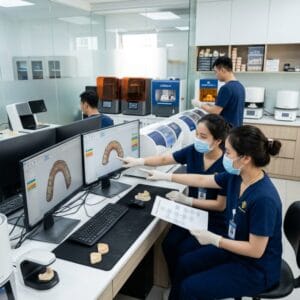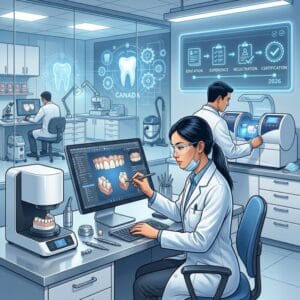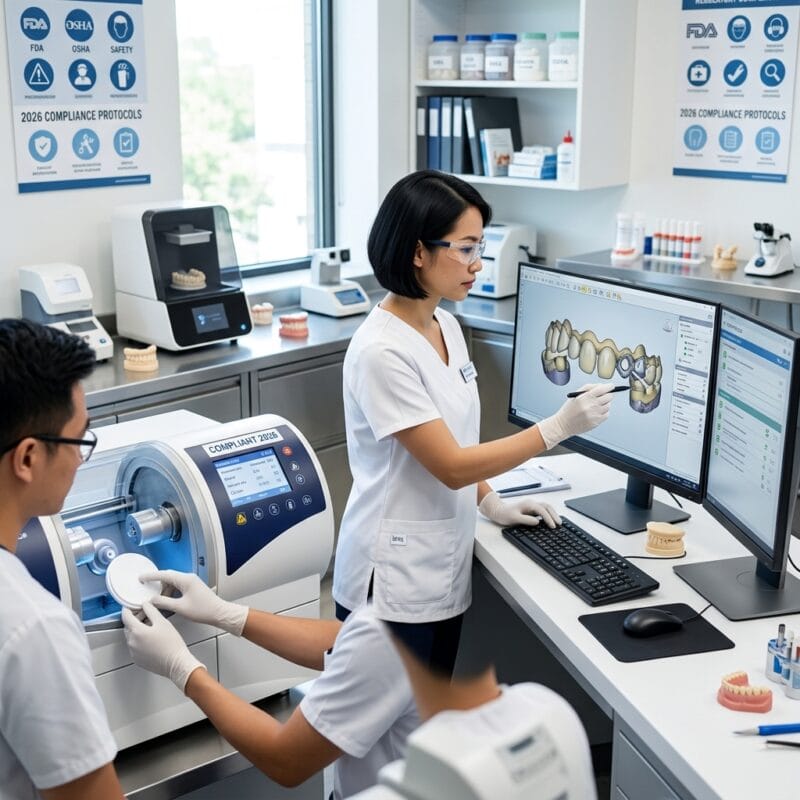
The dental laboratory industry is undergoing a structural transformation driven by rapid digitisation, advanced additive manufacturing, and heightened federal regulatory oversight. Navigating dental lab compliance regulations in the USA 2026 requires dental laboratory owners, operational managers, and Dental Service Organizations (DSOs) to systematically evaluate their quality systems, data governance, and partner networks. As the boundary between traditional restorative craftsmanship and software-driven medical device manufacturing blurs, regulatory agencies have updated their frameworks to ensure patient safety, material traceability, and cybersecurity.
Historically, commercial dental laboratories operated within a relatively flexible regulatory framework, largely characterized by state-by-state registration requirements and basic oversight of prescription-based custom devices. However, the operational environment has changed. Under modern guidelines, dental lab compliance regulations in the USA 2026 encompass not only the physical manufacturing of crowns, bridges, dentures, and implants, but also the digital design files, software platforms, and offshore CAD/CAM outsourcing workflows that power the modern dental supply chain.
Understanding these shifts is essential for commercial dental laboratories seeking to mitigate legal risk, maintain profitability, and deliver superior clinical outcomes. Whether your facility produces custom zirconia restorations in-house or relies on third-party CAD design partners, staying ahead of dental lab compliance regulations in the USA 2026 is now a core business imperative.
What Are Dental Lab Compliance Regulations in the USA 2026?
Dental lab compliance regulations in the USA 2026 are the mandatory federal, state, and industry legal standards that govern medical device classification, quality management systems, patient data privacy, and material traceability for dental laboratories and digital design providers.
At the federal level, the United States Food and Drug Administration (FDA) regulates dental prostheses, restorative components, surgical guides, and orthodontic appliances as medical devices under the Federal Food, Drug, and Cosmetic Act (FD&C Act). While custom dental devices built pursuant to a licensed dentist’s written prescription have historically enjoyed specific exemptions from certain premarket notification requirements—such as 510(k) clearances—the expansion of digital dentistry has modified how these exemptions are applied.
In addition to FDA oversight, dental lab compliance regulations in the USA 2026 require adherence to the Health Insurance Portability and Accountability Act (HIPAA) and the Health Information Technology for Economic and Clinical Health (HITECH) Act. Because digital dental workflows rely on intraoral scans containing Protected Health Information (PHI), dental laboratories and their external CAD software design partners are legally classified as Business Associates. This classification requires formal contractual agreements, stringent data encryption, and robust access controls across all digital design communication channels.
Key Federal Regulatory Drivers Impacting Dental Labs in 2026
To fully grasp how dental lab compliance regulations in the USA 2026 impact day-to-day operations, laboratories must examine the key regulatory pillars established by federal oversight bodies. The transition toward total digital integration has prompted regulators to focus heavily on four main areas: Quality Management System (QMS) modernization, Software as a Medical Device (SaMD), material safety, and vendor risk management.
1. FDA Quality System Modernization (QMSR Alignment)
The FDA has finalized the transition of its Quality System Regulation (21 CFR Part 820) into the Quality Management System Regulation (QMSR), explicitly aligning federal oversight with international standards, specifically ISO 13485:2016. This harmonization represents a foundational pivot in dental lab compliance regulations in the USA 2026. Dental labs are no longer evaluated solely on finished product inspection; they must demonstrate comprehensive, risk-based quality management throughout the entire production lifecycle.
Key components of QMSR compliance for dental labs include:
- Risk Management Frameworks: Documenting potential hazards associated with design, material selection, milling, 3D printing, and post-processing.
- Design Controls for Digital Assets: Standardizing CAD parameter validations, margin detection rules, and minimum thickness thresholds for materials like zirconia, lithium disilicate, and cobalt-chrome.
- Device History Records (DHR): Maintaining digital audit trails that link patient prescriptions, raw material lot numbers, software design files, technician signatures, and final quality control checks.
2. Software as a Medical Device (SaMD) and CAD/CAM Platforms
In the contemporary digital workflow, design software is no longer viewed merely as a drafting tool. Under dental lab compliance regulations in the USA 2026, CAD software applications used to design custom implants, abutments, surgical guides, and aligners are subjected to strict SaMD evaluation. While general crown and bridge design software operates under specific custom device parameters, design software for implant surgical guides and clear aligners frequently requires direct 510(k) clearance.
Laboratories using software platforms such as exocad or 3Shape must ensure that their software licenses are fully validated, regularly updated, and operated within cleared parameters. Utilizing cracked, unvalidated, or modified software invalidates regulatory compliance and exposes the lab to severe enforcement actions, including warning letters and mandatory product recalls.
How Does CAD/CAM Design Outsourcing Impact Legal Compliance for Dental Labs?
CAD/CAM design outsourcing impacts legal compliance by transferring operational design execution to third-party entities while leaving full regulatory, legal, and quality accountability with the primary dental laboratory of record.
As workload volume increases and skilled CAD technicians become harder to recruit locally, hundreds of domestic laboratories outsource their design workflows to specialized digital design centers. However, dental lab compliance regulations in the USA 2026 make it explicitly clear that outsourcing the design phase does not outsource regulatory responsibility. Primary laboratories remain legally liable for ensuring that every restoration produced meets FDA requirements and dentist prescription specifications.
When incorporating external digital design services—such as high-volume crown and bridge design services—laboratories must implement strict third-party vendor management controls. This includes auditing external design centers for technical competency, software license compliance, data security infrastructure, and quality assurance verification.
Managing Foreign and Domestic Subcontractors
Many digital design centers operate overseas in regions such as Southeast Asia, India, or Eastern Europe. When utilizing international CAD design partners, dental lab compliance regulations in the USA 2026 dictate that all cross-border transfers of patient data must comply with US federal data privacy laws. Laboratories cannot transfer unencrypted STL files containing patient names, scan dates, or clinical notes without robust safeguards.
To remain compliant when working with global CAD partners, primary dental labs must:
- Execute mandatory Business Associate Agreements (BAAs) with all outsourced service providers handling PHI.
- Anonymize digital scan files prior to cloud transmission whenever feasible.
- Verify that third-party design technicians utilize legitimate, licensed versions of professional dental CAD platforms.
- Conduct regular quality audits comparing delivered CAD design files against physical or digital master models.
HIPAA and Data Security Requirements for Digital Workflows
Data privacy has become one of the most rigorously enforced aspects of dental lab compliance regulations in the USA 2026. Historically, paper prescriptions and stone models presented localized data security concerns. Modern intraoral scanners, cloud portal transfers, and digital design repositories process vast amounts of sensitive health data daily.
According to guidelines backed by organizations like the American Dental Association, dental labs must maintain administrative, physical, and technical safeguards to protect electronic Protected Health Information (ePHI).
Technical Safeguards for Dental Data
Under current standards, dental labs must establish technical protocols to protect their digital infrastructure against data breaches, ransomware, and unauthorized access. Compliance expectations include:
End-to-End Encryption: All digital files transmitted between dental practices, labs, and outsourcing design hubs must use high-grade encryption protocols (such as AES 256-bit encryption) both in transit and at rest.
Access Controls and User Authentication: Lab management software and CAD design portals must enforce strict role-based access control (RBAC) and multi-factor authentication (MFA) to limit data visibility to authorized personnel only.
Audit Logging: Systems must automatically log every instance of file viewing, modification, export, or deletion. Audit logs must be retained to support regulatory compliance verification in the event of an audit or security incident.
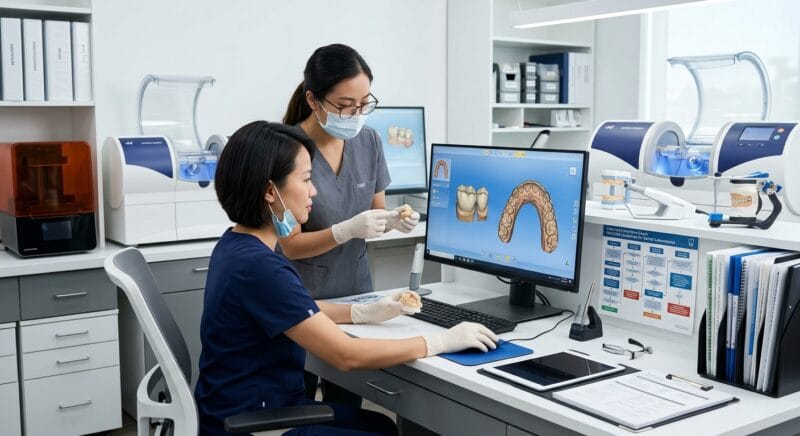
Why Are Dental Lab Compliance Regulations in the USA 2026 Shifting Toward Risk-Based Quality Systems?
Dental lab compliance regulations in the USA 2026 are shifting toward risk-based quality systems to align domestic medical device oversight with global standards like ISO 13485, ensuring patient safety as complex digital workflows and 3D printing replace traditional manual manufacturing processes.
Risk management lies at the core of the updated FDA QMSR framework. Rather than applying a static, one-size-fits-all checklist to every laboratory operational step, dental lab compliance regulations in the USA 2026 mandate that labs evaluate the specific risk profile of each device category they produce or outsource. For example, a non-invasive temporary crown carries a lower risk profile than an implant-supported full-arch bridge or an intermediate surgical guide used during invasive bone recontouring.
Categorizing Risk Across Dental Device Portfolios
Laboratories must document risk management activities across their entire product range. The depth of design controls, material validation, and testing depends directly on the clinical risk class of the final device:
Class I Devices (Low Risk): Standard single-unit crowns, fixed bridges, and full or partial acrylic dentures. Compliance focuses primarily on material safety, clean manufacturing conditions, accurate prescription matching, and proper disclosure of material contents.
Class II Devices (Moderate Risk): Custom implant abutments, surgical guides, night guards, and orthodontic aligners. Compliance requires strict validation of digital design inputs, tight manufacturing tolerances, mechanical stress testing, and adherence to approved material resin parameters. Incorporating digitally designed surgical guides into a lab’s workflow necessitates verifying that design software output strictly matches the implant placement plan.
Material Biocompatibility and Traceability: Under risk-based compliance, every material utilized in production—from zirconia pucks to 3D printing resins, staining liquid, and ceramic glazes—must feature full lot-number traceability. Labs must store Material Safety Data Sheets (MSDS) or Safety Data Sheets (SDS) and ensure that raw inputs are sourced from FDA-registered medical device suppliers.
State-Level Dental Laboratory Regulations and Material Disclosures
While federal regulations establish baseline standards for medical devices and data security, individual state boards of dentistry enforce localized rules that form a critical layer of dental lab compliance regulations in the USA 2026. State regulations vary significantly, making it essential for dental labs serving multi-state clinical clients to maintain compliance across state lines.
State Registration and Certification Mandates
A growing number of states require commercial dental laboratories to register annually with the state board of dentistry or a dedicated laboratory oversight council. Key state-level compliance trends include:
- Certified Dental Technicians (CDTs): States such as Texas, Kentucky, South Carolina, and Florida enforce mandates requiring commercial dental labs to employ at least one Certified Dental Technician (CDT) on-site or maintain specific ratio requirements for certified supervisory personnel.
- Point-of-Origin Disclosure: Multiple states require dental laboratories to provide written point-of-origin documentation for every case. This disclosure must explicitly inform the prescribing dentist where the restoration was manufactured, whether any portion of the design or fabrication was outsourced, and the exact origin of materials used.
- Material Composition Certificates: Laboratories are increasingly required to provide detailed material disclosure statements along with the final case delivery. These certificates list every chemical component, alloy percentage, or ceramic formulation present in the prosthesis.
For DSOs operating nationwide, partnering with dental laboratories and CAD outsourcing providers that maintain standardized, multi-state compliance systems is essential for preventing regulatory non-compliance across regional branches.
Detailed Compliance Analysis by Device Category
To successfully fulfill dental lab compliance regulations in the USA 2026, laboratories must apply specific quality checks tailored to individual prosthetic workflows. Below is an operational breakdown across core product lines.
Crown and Bridge Restorations
For custom fixed prosthetics (zirconia, lithium disilicate, porcelain-fused-to-metal), compliance centers on structural integrity, margin fidelity, and biocompatibility. Digital CAD files must maintain minimum wall thickness limits specified by material manufacturers to prevent intraoral fracture. When design files are outsourced, primary labs must run automated collision and thickness checks before sending files to milling equipment.
Implant Abutments and Prostheses
Implant-supported restorations carry elevated regulatory scrutiny due to their direct interface with bone and soft tissue. Under dental lab compliance regulations in the USA 2026, titanium bases (Ti-bases), premilled abutment blanks, and prosthetic screws must feature precise manufacturer compatibility validations. Design software must utilize verified implant library geometry provided directly by authorized implant manufacturers to avoid misfitting components that could induce peri-implantitis or screw loosening.
Removable Dentures and Occlusal Splints
Digital denture design and additive manufacturing (3D printing) have streamlined removable prosthetics. However, compliance mandates that all 3D printing resins used for denture bases, teeth, and night guards hold clear FDA 510(k) status or Class I medical device listing. Furthermore, UV curing units must be calibrated according to resin manufacturer instructions to ensure complete monomer conversion, eliminating potential cytotoxicity risks for patients.
Orthodontic Aligners and Surgical Guides
Digital treatment planning for clear aligners and guided surgery represents the highest-risk digital workflow within a general dental laboratory. Software tools used to perform tooth movement sequencing or nerve location planning for surgical guides must be validated. Laboratories producing clear aligners must maintain design verification protocols to ensure that force vectors match prescribed clinical movements safely.
Implementation Checklist: Building a Compliant Dental Lab Workflow in 2026
To help lab owners, operational directors, and DSO executives systematically review their operational readiness, the following checklist outlines key steps for satisfying dental lab compliance regulations in the USA 2026.
1. Administrative & Quality System Audit
- Review current QMS documentation to ensure full alignment with ISO 13485:2016 and FDA QMSR mandates.
- Appoint a dedicated Quality Manager responsible for internal audits, corrective action plans (CAPA), and regulatory reporting.
- Confirm active state laboratory registrations across all jurisdictions where cases are received or delivered.
- Verify that supervisory CDTs hold active, unencumbered certifications where mandated by state law.
2. Vendor Management & CAD Outsourcing Controls
- Execute formal, signed Business Associate Agreements (BAAs) with all external digital design service providers.
- Audit CAD outsourcing partners for software license legitimacy, data encryption standards, and turnaround SLAs.
- Establish a formal Incoming File Inspection process for all third-party CAD designs prior to production milling or printing.
- Document all design adjustments and maintain design file version histories within secure local or cloud storage.
3. Data Protection & HIPAA Compliance
- Implement mandatory multi-factor authentication (MFA) across all laboratory management systems, email portals, and CAD cloud platforms.
- Ensure all intraoral scan files and patient records stored at rest or in transit utilize AES 256-bit encryption.
- Conduct annual employee HIPAA training covering ePHI handling, phishing defense, and secure file sharing protocols.
- Establish a formal Incident Response Plan detailing mandatory notification procedures in the event of a suspected data breach.
4. Production Quality & Material Traceability
- Create automated digital Device History Records (DHR) linking patient prescriptions to material lot numbers, machine logs, and QC sign-offs.
- Maintain an up-to-date repository of Safety Data Sheets (SDS) for all raw materials, liquids, resins, and burs used in production.
- Include point-of-origin and material composition disclosures with every outgoing restoration package.
- Calibrate 3D printers, milling machines, and sintering ovens on a fixed schedule, retaining calibration logs for regulatory review.
Overcoming Common Compliance Challenges in Dental CAD/CAM Workflows
Implementing continuous regulatory compliance presents practical challenges, particularly for small-to-midsize laboratories facing labor shortages and margin pressures. By identifying common compliance pitfalls early, laboratory leadership can prevent operational bottlenecks and legal exposure under dental lab compliance regulations in the USA 2026.
Pitfall 1: Relying on Unsecure Transfer Methods: Many dental practices and labs still exchange STL files and prescriptions via standard email or non-encrypted consumer file-sharing platforms. This practice violates HIPAA technical safeguards. Replacing ad-hoc sharing with secure, dedicated lab portals guarantees compliance while streamlining workflow communication.
Pitfall 2: Neglecting Software License Management: Operating unlicensed CAD software modules or using pirated add-ons to process complex cases creates severe legal liabilities. Laboratories must audit software licenses regularly to confirm that all workstations run legal, fully supported design software releases.
Pitfall 3: Inadequate Verification of Outsourced Designs: Assuming that outsourced CAD files are always production-ready without internal review can lead to remakes, poor marginal fit, and clinical failures. Laboratories must establish clear acceptance criteria, requiring trained quality control technicians to inspect every outsourced CAD file before sending it to CAM equipment.
Future Trends in Dental Regulation Beyond 2026
As artificial intelligence (AI) and automated CAD design algorithms become integral to modern dental design platforms, regulatory oversight will continue to evolve. Future iterations of dental lab compliance regulations in the USA 2026 and beyond will likely introduce specialized validation standards for AI-driven margin detection, automatic occlusal adjustment, and generative restorative designs.
Laboratories that invest today in robust quality management systems, secure data infrastructure, and compliant outsourcing partnerships will be best positioned to adopt next-generation technologies safely and profitably. By establishing a culture of compliance, dental labs protect patient health, earn long-term trust from clinical clients, and secure a sustainable competitive advantage in the rapidly changing digital dental market.
Partner with our FDA-compliant digital CAD design center to streamline your lab’s workflow and ensure absolute regulatory compliance. Contact our team today to get started with secure, high-precision CAD design services!