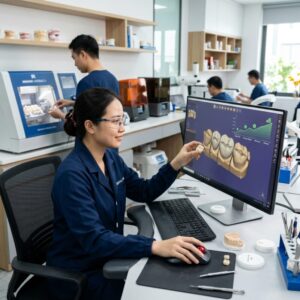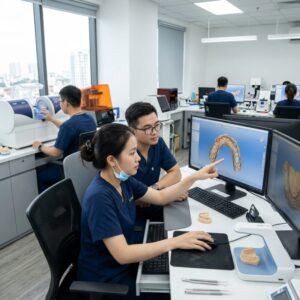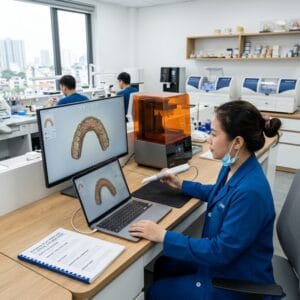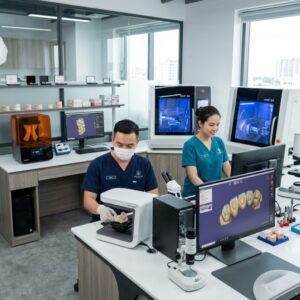
Introduction: The Business Landscape for Dental Lab Owners in 2026
The dental laboratory industry in 2026 stands at a transformative operational inflection point. Driven by rapid adoption of intraoral scanners, high-speed 5-axis milling machines, and high-precision resin 3D printers, digital dentistry is no longer a futuristic option—it is the baseline baseline requirement for commercial survival. However, for commercial dental lab owners, enterprise Dental Service Organizations (DSOs), and private practice dental laboratories, acquiring advanced hardware is only half the battle. The true operational bottleneck has shifted decisively from hardware capability to software expertise and qualified human capital. Calculating the true ROI of outsourcing CAD CAM dental design for lab owners in 2026 has consequently become an essential executive priority for lab managers seeking sustained profitability.
Labor dynamics in 2026 present acute financial challenges. Skilled dental CAD designers command historically high salaries, substantial benefit packages, and continuous technical training to keep pace with evolving software updates. When a key in-house designer calls in sick, takes vacation, or departs for another position, lab throughput grinds to an abrupt halt, stranding capital investment in milling units and 3D printers. In this demanding climate, evaluating the direct ROI of outsourcing CAD CAM dental design for lab owners in 2026 allows forward-thinking executives to transform fixed payroll liabilities into flexible, variable operating expenses. By leveraging offshore and specialized design teams, dental labs can scale production instantly without incurring capital risk.
Furthermore, clinical demands from dentist clients have intensified. Clinicians expect rapid turnarounds—often within 24 to 48 hours—alongside flawless marginal fit, ideal contact points, and natural anatomical contours. Meeting these standards across diverse indications, including crown and bridge restorations, custom implant abutments, surgical guides, full dentures, clear aligners, and occlusal splints, requires deep mastery of specialized software modules. By analyzing the net financial impact and ROI of outsourcing CAD CAM dental design for lab owners in 2026, lab executives can build high-margin business models that thrive despite macro-economic pressures and labor market volatility.
What is the ROI of outsourcing CAD CAM dental design for lab owners in 2026?
The ROI of outsourcing CAD CAM dental design for lab owners in 2026 is primarily driven by an average 40% to 65% reduction in fixed design labor overhead, direct elimination of expensive software licensing bottlenecks, and a 300% increase in total daily case capacity.
To fully grasp the ROI of outsourcing CAD CAM dental design for lab owners in 2026, owners must look beyond surface-level unit costs and perform a comprehensive financial audit of their design operations. Traditional in-house design centers carry massive hidden overhead expenses. Beyond gross hourly wages, full-time technicians require health insurance, tax contributions, retirement benefits, paid leave, workstation hardware upgrades, and recurring annual license fees for platforms such as exocad and 3Shape. When design volume fluctuates during seasonal lulls, these fixed costs continue to erode monthly net profit margins.
In contrast, a pay-per-unit CAD outsourcing model converts fixed overhead into a direct variable expense tied strictly to billable revenue. When case volume drops, operating costs automatically drop in tandem; when volume spikes, capacity expands instantly without recruiting delays or capital expenditure. Calculating the financial ROI of outsourcing CAD CAM dental design for lab owners in 2026 demonstrates that external design services yield an immediate boost to net margins by removing idle labor capacity and maximizing hardware production uptime. Modern labs leveraging external design partners typically realize positive financial returns within the very first month of transition.
Consider the structural shift in cash flow: instead of allocating $70,000 to $105,000 annually per senior designer, a laboratory owner pays only for validated, mill-ready or print-ready design files. This pay-as-you-go methodology dramatically lowers the financial breakeven threshold for new labs and enables established facilities to fund capital investments in advanced production equipment. Consequently, analyzing the ROI of outsourcing CAD CAM dental design for lab owners in 2026 provides a clear roadmap for sustainable capital allocation and aggressive market expansion.
Evaluating the Cost Structure: In-House CAD Staffing vs. Outsourcing
A rigorous examination of operational expenditures highlights the deep fiscal contrast between internal staffing and strategic outsourcing. In-house CAD design requires substantial upfront capital and ongoing financial commitments. Setting up a single high-performance design station requires advanced graphic computing hardware, high-resolution calibrated monitors, commercial CAD software dongles, specialized module add-ons (such as implant, bar, splint, and partial framework modules), and continuous technical support contracts. These non-negotiable costs accumulate before a single restorative case is ever designed.
When assessing the holistic ROI of outsourcing CAD CAM dental design for lab owners in 2026, lab managers must account for the full labor lifecycle. Recruiting certified dental technicians in 2026 is an expensive, drawn-out endeavor often involving recruitment fees, signing bonuses, and months of onboarding. Moreover, employee turnover creates severe production risks; losing a primary designer can freeze production lines, alienate clinical clients, and force owners into costly overtime arrangements. Conversely, outsourcing mitigates labor risk completely by transferring technical staffing responsibilities to a dedicated global design center.
The variable cost structure of outsourced CAD design provides total cost predictability. Operating costs correlate perfectly with monthly sales, protecting cash flow during unpredictable market cycles. When evaluating the overall ROI of outsourcing CAD CAM dental design for lab owners in 2026, owners quickly realize that eliminating idle wage hours directly inflates gross margins across all product categories—from simple single-unit zirconia crowns to highly complex full-arch implant restorations.
How does digital crown design outsourcing impact daily lab workflow?
Digital crown design outsourcing streamlines daily dental lab workflows by transforming fixed in-house design bottlenecks into an automated, 24-hour continuous production cycle that accepts intraoral scans at close of business and delivers mill-ready files before morning production begins.
Integrating outsourced CAD design into a laboratory’s daily operations modernizes the production timeline. In a traditional workflow, intraoral digital scans uploaded by clinicians late in the afternoon sit in a queue until in-house technicians arrive the following morning. This creates a severe morning bottleneck, delaying milling units and 3D printers until mid-day. By taking advantage of global time zone dynamics, the ROI of outsourcing CAD CAM dental design for lab owners in 2026 is realized through a seamless overnight design cycle that keeps production equipment running during normal morning hours.
The digital file workflow is remarkably straightforward and fully standardized:
- Step 1 (Scan Capture): The dental clinic captures an intraoral scan (.STL, .PLY, or .OBJ format) and submits the digital case order via the laboratory’s portal or portal integration.
- Step 2 (Case Transfer): The lab validates order parameters and automatically routes the digital file set to the specialized external CAD design team.
- Step 3 (Expert CAD Design): Master CAD designers craft the digital restoration using exact clinical parameters, adjusting contact tightness, occlusion, emergence profiles, and cement gaps according to specific doctor preferences.
- Step 4 (Quality Control & Approval): Quality control supervisors inspect the completed design against rigorous clinical benchmarks before returning approved files to the lab.
- Step 5 (Production & Finishing): Morning lab staff download mill-ready or print-ready files immediately upon arrival, nesting them into manufacturing software for immediate production.
This streamlined digital flow demonstrates how the strong ROI of outsourcing CAD CAM dental design for lab owners in 2026 drastically condenses turnaround times, allowing labs to offer 48-hour total turnaround guarantees to clinicians without forcing staff to work stressful late-night shifts.
Comparative Breakdown: In-House Design, On-Demand Freelancers, and Dedicated Outsourcing Partners
To select the optimal operational model, dental lab decision-makers must evaluate the three distinct approaches to CAD design capacity: maintaining an fully in-house team, hiring gig-economy freelancers, or establishing a long-term contract with a dedicated dental CAD design partner. Each strategy carries unique implications for financial performance and overall operational risk.
When calculating the precise ROI of outsourcing CAD CAM dental design for lab owners in 2026, comparing these models across critical operational benchmarks reveals distinct strategic advantages:
| Evaluation Metrics | In-House CAD Team | On-Demand Freelancers | Dedicated CAD Design Partner |
|---|---|---|---|
| Fixed Monthly Overhead | Very High (Salaries, Benefits, Software) | None (Pay-per-case) | None or Low Base (Pay-per-case / Volume tiers) |
| Scalability & Capacity | Low (Constrained by local headcount) | Moderate (Subject to individual availability) | Uncapped (Instant multi-designer scaling) |
| Quality Consistency | High (Direct internal oversight) | Variable (Inconsistent designer techniques) | Very High (Standardized QA & customized profiles) |
| Overnight Turnaround | Requires expensive night shifts | Unpredictable depending on freelancer | Guaranteed 8-to-12 hour overnight delivery |
| Complex Case Capability | Depends on specific staff training | Hit-or-miss technical expertise | High (Specialized teams per indication) |
To further assist lab owners, DSOs, and private practices in choosing the best route for their specific needs, let us examine the detailed profiles, strengths, and limitations of each model.
Option 1: In-House CAD Design Technicians
Maintaining an internal design team grants maximum physical proximity and hands-on control, making it a traditional favorite for custom high-aesthetic cases requiring face-to-face consultation.
- Best For: High-margin boutique aesthetic laboratories that require in-person shade matching and real-time physical interaction between bench technicians and designers.
- Strengths: Immediate real-time communication on site, complete control over design nuances, and direct physical proximity to master ceramists.
- Limitations: Extremely high fixed operational cost, severe vulnerability to staff turnover, limited night/weekend capacity, and high software licensing expense.
Option 2: On-Demand Gig-Economy Freelancers
Freelance platforms connect labs with independent gig-economy CAD operators across the globe on an ad-hoc basis.
- Best For: Micro-labs with highly sporadic, low-volume case flow needing occasional backup support during localized surges.
- Strengths: Zero fixed monthly costs, wide selection of independent operators, and immediate flexibility for basic single-unit cases.
- Limitations: Inconsistent design quality, lack of standardized quality control, severe security risks regarding patient data, and unreliable turnarounds during peak periods.
Option 3: Dedicated B2B CAD Design Outsourcing Partner
A professional, enterprise-grade B2B design provider acts as an invisible, fully integrated digital extension of the laboratory’s internal production team.
- Best For: Growing commercial dental laboratories, high-volume production facilities, single-dentist digital practices, and expanding enterprise DSOs seeking maximum scale and predictable margins.
- Strengths: Uncapped production capacity, rigorous multi-stage quality control, custom dental doctor profile retention, guaranteed overnight turnarounds, and lowest total cost per designed unit.
- Limitations: Requires initial workflow alignment and standardized digital communication protocols during early onboarding.
Analyzing these structured options highlights why the ultimate ROI of outsourcing CAD CAM dental design for lab owners in 2026 is most effectively realized through formal partnerships with established B2B design services rather than unorganized gig networks.
Analyzing Product-Specific Returns: Crown & Bridge, Implants, and Surgical Guides
The financial dynamic of outsourcing varies depending on the technical complexity of the restoration. High-volume, standard restorations like single-unit monolithic zirconia crowns or multi-unit bridges represent the foundation of daily laboratory cash flow. Standardizing these designs through an external partner unlocks immense economies of scale. By utilizing specialized surgical guide design services and streamlined crown workflows, lab owners protect core margins while freeing internal staff to focus on high-touch finishing work.
The ROI of outsourcing CAD CAM dental design for lab owners in 2026 is especially apparent when examining high-complexity restorative categories:
1. Single-Unit and Multi-Unit Crown & Bridge: Standardizing crown design externally allows a laboratory to process hundreds of units daily without adding a single internal workstation. Direct unit savings range from 50% to 70% compared to in-house labor costs, significantly lowering overall manufacturing expenses.
2. Custom Abutments and Implant Restorations: Implant design demands precise emergency profile management, correct screw-hole angling, and deep knowledge of specific manufacturer titanium bases (ti-bases). Specialized external implant designers eliminate costly design errors, misfits, and remakes, driving up the net ROI of outsourcing CAD CAM dental design for lab owners in 2026 across complex implant cases.
3. Guided Surgery and Implant Planning: Designing accurate implant placement guides requires merging CBCT DICOM files with optical intraoral scan .STL files. Outsourcing surgical guide design eliminates the need to purchase dedicated $3,000–$8,000 surgical planning software modules and saves hours of painstaking anatomical segmentation work.
Expanding into High-Growth Modalities: Dentures, Removables, and Orthodontic Aligners
The rapid evolution of 3D printing materials in 2026 has made digital removable prosthetics—such as 3D printed full dentures, partial frameworks, night guards, and clear aligners—the fastest-growing profit sector in dental technology. However, mastering digital removable design requires a steep learning curve and complex software tools. Attempting to train traditional wax-up technicians on advanced digital denture software often leads to lost productivity and inconsistent results.
By leveraging specialized external expertise, the ROI of outsourcing CAD CAM dental design for lab owners in 2026 becomes a major growth catalyst. External design centers employ master technicians who specialize exclusively in digital removable design, ensuring optimal tissue relief, accurate occlusal schemes, and precise boundary definitions. Leveraging specialized external teams for night guard design services and removable appliances allows lab owners to launch entire new product lines overnight with zero initial software investment.
Consider clear aligner manufacturing: designing progressive orthodontic movements requires specialized biomechanical software expertise and clinical setup oversight. By outsourcing aligner staging and attachment placement to experienced CAD specialists, labs and DSOs can offer private-label aligner solutions to clinician clients at a fraction of the cost charged by major aligner brands. This operational agility directly amplifies the total ROI of outsourcing CAD CAM dental design for lab owners in 2026, opening lucrative enterprise revenue channels without increasing operational overhead.
Why are dental labs turning to remote CAD designers?
Dental labs are turning to remote CAD designers to overcome severe regional technician shortages while instantly accessing specialized expertise across complex prosthetics like full-arch surgical guides, custom implant abutments, and printable dentures without adding fixed payroll costs.
The systemic shortage of certified dental technicians (CDTs) has created an unprecedented labor bottleneck across North America and Europe. Educational institutions are graduating fewer traditional dental technicians each year, while senior technicians are reaching retirement age in record numbers. This labor dynamic makes recruiting top-tier in-house CAD talent exceptionally expensive and highly competitive. Consequently, examining the operational ROI of outsourcing CAD CAM dental design for lab owners in 2026 offers a practical solution to this structural labor crisis.
Remote CAD design centers aggregate world-class technical talent in centralized hubs, providing instant access to master designers who specialize in specific indication sub-specialties. Rather than relying on a single in-house designer to master crowns, custom abutments, partial frameworks, and surgical guides simultaneously, lab owners tap into a organized network of focused specialists. Every single case is routed to an expert who designs that specific product type all day, every day.
Furthermore, remote CAD teams provide structural operational redundancy. If an internal designer falls ill, leaves the company, or requires extended personal leave, an in-house lab faces immediate production shortfalls and missed client deadlines. Partnering with a dedicated external CAD organization insulates lab owners from labor risk entirely. The design center absorbs all staffing fluctuations, ensuring consistent daily throughput and preserving the lab’s market reputation. This stability reinforces why the strategic ROI of outsourcing CAD CAM dental design for lab owners in 2026 extends far beyond pure financial savings to encompass complete business resilience.
Risk Management and Quality Assurance in CAD CAM Outsourcing
A common concern among laboratory owners considering digital design outsourcing is maintaining strict quality control and protecting clinician trust. In dentistry, a improperly designed crown or misaligned implant bridge damages the laboratory’s reputation, alienates dental practices, and creates costly remake expenses that destroy unit margins. Therefore, robust risk management protocols are central to maximizing the financial ROI of outsourcing CAD CAM dental design for lab owners in 2026.
Professional CAD design partners mitigate risk through rigorous multi-layered quality control systems:
1. Standardized Doctor Preferences: Professional design centers create dedicated, highly detailed digital profiles for every clinician client served by the lab. These profiles record exact parameters for occlusal clearance (e.g., -30 microns), interproximal contact tightness, cement space gaps, emergence contours, and anatomical style preferences. Every design is generated strictly according to these recorded parameters.
2. Multi-Stage Quality Auditing: Before any design file is delivered back to the laboratory, it undergoes mandatory review by a senior quality control supervisor. The supervisor inspects critical parameters using specialized measurement tools to verify margin integrity, path of insertion, minimum material thickness for strength, and contact points.
3. Comprehensive HIPAA & GDPR Data Security: Leading B2B design services utilize end-to-end encrypted file transfers, secure cloud storage architectures, and strict non-disclosure protocols to guarantee patient data privacy and total regulatory compliance.
By enforcing these standardized quality controls, external design partners maintain remake rates below 1.5%—often outperforming internal in-house design departments. Minimizing remakes directly safeguards profit margins, demonstrating that the bottom-line ROI of outsourcing CAD CAM dental design for lab owners in 2026 delivers consistent clinical excellence alongside structural cost savings.
Strategic Scaling for DSOs and Multi-Site Dental Laboratories
Dental Service Organizations (DSOs) and enterprise multi-site laboratory networks face unique operational challenges. Standardizing restoration quality, managing unpredictable patient volume spikes across regions, and eliminating redundant capital investments across dozens of clinic locations require centralized digital infrastructure. For executive teams managing large dental networks, evaluating the macroeconomic ROI of outsourcing CAD CAM dental design for lab owners in 2026 provides a clear path to scalable corporate growth.
Instead of purchasing dedicated CAD workstations, software licenses, and hiring designers for every individual lab facility or clinical office, enterprise DSOs can centralize their entire digital design workflow through a single outsourced CAD partner. Intraoral scans captured at any clinic location are routed instantly to the centralized design network, which processes files overnight and distributes production-ready code back to local 3D printers or milling units located at regional hubs.
This distributed digital architecture yields unmatched financial efficiency:
- Capital Expenditure Reduction: DSOs save hundreds of thousands of dollars in upfront hardware and software software fees across their network.
- Uncapped Production Scalability: Enterprise case volume can double or triple during promotional periods or practice acquisitions without triggering labor constraints.
- Uniform Quality Benchmarks: Restoration aesthetics, occlusion standards, and margin fits remain perfectly consistent across all clinical locations, regardless of local geography.
For executive leadership tracking enterprise EBITDA performance, maximizing the ROI of outsourcing CAD CAM dental design for lab owners in 2026 serves as an operational force multiplier, driving corporate profitability while ensuring predictable clinical standards across the entire network.
Calculating Total Cost of Ownership (TCO) and Profit Margins
To mathematically quantify the financial impact on your bottom line, let us evaluate a real-world scenario comparing an in-house design department against a B2B design outsourcing partnership for a mid-sized commercial laboratory producing 600 units per month (primarily crowns, bridges, and implant abutments).
Scenario A: In-House CAD Department (2 Full-Time Designers)
- Base Wages ($38/hr average including overtime): $13,170/month ($158,040/year)
- Taxes, Benefits, Healthcare, Insurance (25% burden): $3,292/month ($39,510/year)
- Software Licenses, Upgrades, & Modules (2 Dongles): $850/month ($10,200/year)
- Hardware Amortization & IT Maintenance: $400/month ($4,800/year)
- Total In-House Design Operating Cost: $17,712/month
- Effective Design Cost Per Unit (600 units): $29.52 per unit
Scenario B: Outsourced B2B CAD Design Partnership
- Average Blended Design Cost per Unit: $7.50 per unit
- Monthly Cost for 600 units: $4,500/month ($54,000/year)
- Software License Overhead: $0
- Hardware Amortization & IT Maintenance: $0
- Total Outsourced Design Operating Cost: $4,500/month
- Effective Design Cost Per Unit (600 units): $7.50 per unit
Net Monthly Savings: $13,212 per month | Net Annual Savings: $158,544 per year
This direct financial comparison illustrates why calculating the true ROI of outsourcing CAD CAM dental design for lab owners in 2026 is so compelling. By shifting to a professional external design partner, this mid-sized laboratory instantly redirects over $158,000 annually back to net profit, equipment investments, or client acquisition marketing. These stark financial figures highlight why outsourcing CAD design is no longer just a cost-cutting tactical measure, but a primary strategic growth engine for forward-thinking dental laboratories.
Do you need design capacity for your new equipment?
Investing in advanced 5-axis milling machines or high-speed resin 3D printers without adequate CAD design capacity leads to underutilized capital equipment and delayed payback periods. Our specialized dental CAD design outsourcing service allows your practice, lab, or DSO to run high-volume production machinery at maximum capacity without the burden of hiring, training, or managing full-time in-house designers. Partner with our team of expert master CAD technicians today to instantly unlock 24/7 file processing, guaranteed 8-to-12 hour overnight turnarounds, and flawless clinical quality tailored to your exact doctor preferences. Contact us now to claim your trial case designs and discover how seamlessly our professional design team integrates into your daily workflow.
Conclusion and Strategic Next Steps
Ready to maximize your operational margins and scale production effortlessly in 2026? Contact our expert CAD design team today to start your risk-free trial and experience seamless digital design support!