The Shifting Economics of the UK Dental Laboratory Sector
The UK dental laboratory industry is undergoing a structural economic shift. As we navigate 2026, laboratory owners, commercial directors, and Dental Service Organisations (DSOs) across England, Scotland, Wales, and Northern Ireland face unprecedented margin pressures. High utility expenses, escalating real estate rents, severe technical labor shortages, and increasing regulatory compliance costs under the MHRA (Medicines and Healthcare products Regulatory Agency) have compressed profitability across traditional restorative workflows. Understanding how UK dental labs use outsourcing to cut costs in 2026 has evolved from an optional growth tactic into an essential operational strategy for long-term commercial viability.
In recent years, the adoption of intraoral scanners (IOS) by UK dental practices has surged dramatically. Clinics expect rapid turnarounds, lower unit costs, and absolute precision. However, maintaining a full team of in-house CAD/CAM technicians to process incoming digital impression files requires massive fixed overhead. High salaries for experienced senior designers, coupled with continuous software license renewals and hardware upgrades, create financial strain during seasonal lulls or sudden spikes in volume. Consequently, analyzing how UK dental labs use outsourcing to cut costs in 2026 reveals that replacing fixed wage bills with predictable, pay-per-case digital design models allows business leaders to protect their bottom line while expanding operational capacity.
By delegating time-consuming CAD design tasks—such as single-unit zirconia crowns, complex multi-unit implant bridges, full-arch digital dentures, clear aligner staging, and surgical guides—to external specialized design partners, UK labs can reallocate internal resources toward high-margin finishing, porcelain stacking, quality control, and client relationship management. This comprehensive analysis explores the specific mechanisms of how UK dental labs use outsourcing to cut costs in 2026, examining real-world financial metrics, software economics, labor dynamics, and turn-key digital workflows.
What is dental lab CAD design outsourcing?
Dental lab CAD design outsourcing is the practice of delegating digital restoration design—such as crowns, implants, dentures, and aligners—to specialized external dental technicians using CAD software.
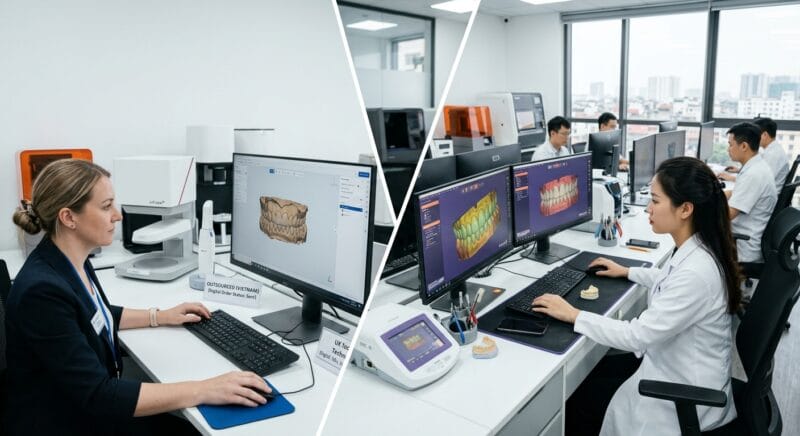
Rather than designing every incoming digital scan in-house, a laboratory receives open intraoral scan files (STL, PLY, or OBJ formats) from dental clinics and securely uploads them to an external digital design service provider. These offsite design teams utilize advanced computer-aided design systems, including software platforms like exocad and 3Shape, to construct highly accurate 3D anatomical models, substructures, or full-contour restorations according to the lab’s exact technical preferences and prescriptions.
Once the digital design is finalized, the ready-to-mill or ready-to-print file (CAM file or STL output) is transmitted back to the primary UK dental laboratory. The local laboratory retains full ownership of the clinical workflow, executing the physical production using their in-house 5-axis milling machines or high-precision 3D resin printers. Understanding how UK dental labs use outsourcing to cut costs in 2026 requires recognizing that outsourcing is not about replacing local physical manufacturing; rather, it is about decentralizing the labor-intensive digital design step to reduce per-unit overhead and boost total throughput.
Rising Labor Overhead and the Technician Shortage in the UK
The primary driver behind how UK dental labs use outsourcing to cut costs in 2026 is the acute crisis in skilled technical labor. Over the past decade, a significant percentage of qualified GDC-registered dental technicians in the UK have reached retirement age, while the pipeline of new graduates entering dental technology training programs has not kept pace with industry demand. This supply-demand mismatch has driven up technician wages across the UK, making full-time, experienced digital designers exceptionally expensive to employ.
When evaluating full-time employee expenditure, lab owners must account for more than just base salaries. Total labor overhead includes National Insurance contributions, statutory workplace pension contributions, paid annual leave, sick pay, training costs, and workstation hardware expenditure. When an in-house designer experiences downtime during low-volume periods, the fixed operational cost per case rises dramatically. Evaluating how UK dental labs use outsourcing to cut costs in 2026 highlights how shifting from fixed payroll to a variable cost structure mitigates financial risk.
- Fixed vs. Variable Cost Conversion: Paying a fixed fee per completed design file transforms a rigid monthly overhead expense into a dynamic variable cost that scales perfectly with actual laboratory revenue.
- Elimination of Idle Overhead: During bank holidays, seasonal lulls, or staff sickness, the laboratory incurs zero design costs when utilizing an on-demand external team.
- Access to Specialist Expertise: Specialized design partners employ dedicated experts in complex disciplines like full-arch implant bridge design or surgical guide design workflows, eliminating the need to recruit high-salaried specialists for niche cases.
- Uninterrupted Production Cycles: By leveraging global time zone differentials, external design teams can process files overnight, allowing UK labs to start milling first thing in the morning.
How does digital crown design outsourcing work?
Digital crown design outsourcing works by sending intraoral or desktop scan files (STL/PLY) to an offsite design team, who process the restorations in software like exocad and return production-ready files within hours.
The operational framework relies on automated cloud storage and standardized technical protocols. When a UK dentist submits a digital impression for a crown or bridge, the UK laboratory receives the optical scan and conducts an initial quality check to confirm margin clarity and bite registration. The lab then uploads the dataset to an encrypted cloud platform or portal operated by the CAD design service provider, attaching specific instructions regarding anatomical occlusion, contacts, cement space, and material choices.
Upon receipt, experienced digital technicians create the restoration model based on the lab’s pre-configured design preferences (such as minimal material thickness, contact tightness, and marginal offset). Once complete, the system notifies the UK lab manager, who can review the 3D design via an interactive web viewer or download the CAM-ready file directly into their nesting software for immediate milling. Analyzing how UK dental labs use outsourcing to cut costs in 2026 shows that this frictionless exchange minimizes internal handling time, allowing technicians to focus strictly on post-processing, staining, glazing, and fitting.
Financial Breakdown: In-House CAD Staff vs. Digital Outsourcing in 2026
To fully grasp how UK dental labs use outsourcing to cut costs in 2026, a detailed examination of financial metrics is essential. Consider a medium-sized UK dental laboratory producing approximately 500 crown and bridge units per month alongside restorative implant and removable cases. Below is a realistic financial comparison between maintaining an all-internal design team versus utilizing a hybrid or fully outsourced digital CAD workflow.
In-House Design Team Financial Profile
To comfortably design 500 units per month along with handling rework, margin marking, and complex cases, a lab typically requires at least two full-time CAD designers. In 2026, average compensation and software package expenses in the UK look as follows:
- Two Senior CAD Technicians (Combined Base Salary): £76,000 – £90,000 annually
- Employer National Insurance & Pension Contributions (approx. 13.8% + pension): £11,500 – £13,500 annually
- CAD Software Annual Licenses (2 Modules with advanced add-ons): £4,000 – £6,500 annually
- High-End Workstation Hardware Upgrades & IT Support: £2,500 – £3,500 annually
- Total Annual In-House CAD Overhead: ~£94,000 – £113,500
- Average Design Cost Per Unit (at 500 units/month = 6,000 units/year): approximately £15.66 to £18.91 per unit
Outsourced Digital CAD Design Financial Profile
By contrast, studying how UK dental labs use outsourcing to cut costs in 2026 demonstrates the stark difference when adopting a dedicated pay-per-design model:
- Average Fee per Single-Unit Crown/Bridge CAD File: £3.50 – £5.50
- Annual Design Spend (6,000 units at average £4.50): £27,000
- Software License Retention (1 active baseline seat for QA/adjustments): £2,500
- Total Annual CAD Design Overhead: ~£29,500
- Net Annual Cost Savings: £64,500 – £84,000 per year
- Cost Reduction Percentage: Over 65% savings on CAD design operational expenses.
This financial disparity explains precisely how UK dental labs use outsourcing to cut costs in 2026 to protect profit margins against inflation, higher energy prices, and increasing material fees.
Why are UK dental labs outsourcing CAD/CAM work in 2026?
UK dental labs are outsourcing CAD/CAM work in 2026 primarily to manage surging operational overhead, solve skilled technician shortages, and rapidly scale output without capital expenditure.
The combination of macroeconomic pressures and rapid technological advancement has created a landscape where managing all digital design internally is no longer cost-effective for most commercial laboratories. By partnering with external design centers, labs reduce capital expenditure on continuous software and hardware upgrades while unlocking 24/7 turnaround capabilities. This allows lab owners to scale case capacity overnight without incurring the financial risks associated with hiring full-time staff, purchasing extra software seats, or expanding physical facility footprints.
Detailed Application Across Indications: Maximizing Savings per Specialty
A key aspect of how UK dental labs use outsourcing to cut costs in 2026 is applying targeted design strategies across distinct dental indications. Cost dynamics, complexity, and designer time requirements vary significantly across crown & bridge, implant prosthetics, removables, and orthodontics.
1. Crown & Bridge Restorations
Crown and bridge work represents the core volume for most UK commercial dental laboratories. Designing monolithic zirconia crowns, lithium disilicate inlays, or multi-unit posterior bridges requires consistent attention to anatomical contacts and occlusion parameters. When examining how UK dental labs use outsourcing to cut costs in 2026 within crown and bridge departments, volume speed is paramount. Outsourcing routine single units frees up internal ceramists to concentrate on high-value aesthetic anterior cases, custom staining, and clinical consultations.
2. Implant Abutments and Screw-Retained Crowns
Implant design demands extreme technical precision, deep familiarity with various titanium base platforms, emergency profile management, and anti-rotational timing. Acquiring and maintaining extensive digital library databases for multiple implant manufacturers requires continuous software updates and technician training. Analyzing how UK dental labs use outsourcing to cut costs in 2026 shows that offloading complex custom abutments and screw-retained crowns to specialized design experts avoids expensive manufacturing errors, re-milling waste, and misaligned screw channels.
3. Digital Dentures and Removable Prosthetics
Digital removables have matured rapidly by 2026. Designing partial denture frameworks, full arch bite blocks, custom impression trays, and 3D printed full dentures requires specialized CAD skillsets distinct from traditional crown and bridge design. Incorporating digital denture CAD workflows through external design services permits UK laboratories to accept complex denture cases from local clinics without investing tens of thousands of pounds in dedicated denture design modules or specialized staff training. This flexibility forms a major component of how UK dental labs use outsourcing to cut costs in 2026.
4. Surgical Guides and Implant Planning
Implantology relies heavily on CBCT (Cone Beam Computed Tomography) fused with optical intraoral scans to create highly accurate guided surgery templates. Designing surgical guides involves careful nerve tracing, bone density evaluation, drill sleeve offset configuration, and anatomical inspection. Understanding how UK dental labs use outsourcing to cut costs in 2026 highlights how outsourcing implant planning and surgical guide generation allows laboratories to offer sophisticated clinical support services without needing a full-time implant radiologist or specialized technician on staff.
5. Clear Aligners and Orthodontic Staging
Orthodontic clear aligner production requires digital tooth segmentation, staging of micro-movements, collision checking, and attachment placement. The software modules for orthodontic staging carry high subscription fees and steep learning curves. Reviewing how UK dental labs use outsourcing to cut costs in 2026 demonstrates that leveraging expert orthodontic CAD designers enables UK labs to supply turn-key clear aligner packages to their prescribing dentists at a fraction of the cost charged by large multinational aligner brands.
Software and Hardware Cost Mitigation in 2026
Maintaining a modern digital laboratory requires significant capital investment in software ecosystem licenses, dongles, updates, and specialized hardware. A major factor in how UK dental labs use outsourcing to cut costs in 2026 involves optimizing these infrastructure expenditures.
Eliminating Multi-Seat Software License Creep
Major software developers enforce annual subscription fees, module add-on charges, and mandatory upgrade contracts per workstation seat. When a laboratory expands its internal team from two to five designers, software overhead scales linearly. By utilizing CAD design outsourcing, the lab can maintain a single core software license for local checks, adjustments, and final CAM nesting while external partners absorb the ongoing software licensing overhead across hundreds of design workstations.
Hardware Longevity and IT Burden Reduction
3D CAD rendering demands high-performance graphic processing units (GPUs), fast processors, extensive RAM, and secure server architecture. High-performance design computers require replacement or upgrading every 24 to 36 months to run the latest software releases smoothly. Observing how UK dental labs use outsourcing to cut costs in 2026 reveals that offloading processing-heavy design tasks drastically reduces local hardware wear, extends IT infrastructure lifespans, and lowers off-site data backup overhead.
Scaling Capacity Without Financial Risk
Dental laboratory workloads are inherently subject to cyclical fluctuations. Volume often spikes before holidays and drops during summer vacation periods. Managing fluctuating case loads with full-time internal staff creates operational inefficiency during downturns and severe strain during volume surges. Understanding how UK dental labs use outsourcing to cut costs in 2026 underscores the strategic value of elasticity.
With outsourced CAD design, a laboratory’s design capacity becomes virtually infinite. Whether a lab receives 20 intraoral scan files on Monday or 150 files on Thursday after a major DSO client onboarding, the digital design partner absorbs the volume seamlessly. There is no need to hire temporary staff, pay expensive overtime rates, or turn away new clinical accounts due to capacity bottlenecks. This agility represents a central pillar of how UK dental labs use outsourcing to cut costs in 2026 while aggressively growing market share.
Quality Control, Standardization, and Re-Work Reduction
A common misconception among laboratory managers considering CAD outsourcing is that offsite design leads to quality inconsistency. In reality, examining how UK dental labs use outsourcing to cut costs in 2026 proves that establishing standardized digital design protocols significantly lowers remake rates compared to purely manual or inconsistently designed internal cases.
Standardized Digital Profiles (Standard Operating Procedures)
Professional CAD design services work with UK labs to establish detailed master profiles. These profiles define exact technical specifications across every restoration type:
- Occlusal Clearance: Precise distance offsets (e.g., -30 microns for active occlusion) tailored to specific restorative materials like high-translucency zirconia.
- Interproximal Contacts: Custom contact tightness parameters (e.g., +20 microns) optimized to match local dentist preferences and minimize chairside adjustment time.
- Cement Gap and Margin Design: Configured cement space starting distances and marginal boundary thickener values to guarantee perfect seating on physical dies.
- Anatomical Morphologies: Specific library selections ranging from youth-like deep fissures to age-appropriate worn morphology profiles.
By enforcing these digital parameters consistently across every design, remakes caused by human error or inconsistent technician style are virtually eliminated. Reducing material waste (zirconia discs, milling burs, printing resins) directly improves bottom-line profitability, serving as another clear example of how UK dental labs use outsourcing to cut costs in 2026.
Turnaround Speed and Overnight Workflow Advantages
In the competitive UK dental market, speed is a primary differentiator. Practices routinely demand 3-to-5-day turnarounds for standard crowns and implants. Analyzing how UK dental labs use outsourcing to cut costs in 2026 shows how global operational alignment creates a seamless 24-hour manufacturing cycle.
When a UK dental clinic submits an intraoral scan late in the afternoon (e.g., 5:00 PM GMT), an internal designer would not process the file until 8:30 AM the following morning. By contrast, uploading the file to an outsourced design partner allows the case to be designed overnight. When the UK laboratory team opens its doors at 7:30 AM, the CAM-ready design files are already waiting in the inbox. Milling machines and 3D printers can begin production immediately, effectively shaving 24 to 48 hours off total turnaround times without requiring staff night shifts or paying unsociable hours premiums. This operational advantage illustrates how UK dental labs use outsourcing to cut costs in 2026 while simultaneously improving customer satisfaction.
Integrating Modern Scanners with External CAD Workflows
The seamless integration between modern intraoral scanners and external design centers has made CAD design outsourcing easier than ever before. Clinics using systems from leading manufacturers like Medit, 3Shape TRIOS, or Dentsply Sirona can automatically direct open-format scan files straight to the laboratory’s cloud storage. Understanding how UK dental labs use outsourcing to cut costs in 2026 requires recognizing that modern cloud architecture makes an offsite design technician feel as accessible as someone sitting at the next desk.
With real-time 3D web viewers, lab managers can inspect proposed CAD models on mobile devices or desktop browsers, requesting minor adjustments with a single click before approving the file for physical manufacturing. This level of communication ensures absolute design fidelity while eliminating administrative friction, reinforcing how UK dental labs use outsourcing to cut costs in 2026 across diverse laboratory business models.
Step-by-Step Implementation Guide for UK Labs
To successfully implement digital CAD design outsourcing and capture the associated cost benefits, UK laboratory managers should follow a structured, phased transition plan:
Phase 1: Workflow and Cost Audit
Calculate your current fully loaded cost per designed unit (including salaries, software, hardware depreciation, and rework overhead). Identify core high-volume cases suitable for immediate transition, such as posterior monolithic zirconia crowns and single-unit implant restorations.
Phase 2: Partner Selection and Profile Setup
Select an experienced dental CAD design provider capable of supporting your required software formats and volume commitments. Work closely with their senior technical leads to build custom design profiles, specifying exact contact tightness, occlusal clearance, and margin parameters.
Phase 3: Pilot Testing and Calibration
Send a test batch of 20 to 50 historical or parallel cases to calibrate design preferences. Mill or print the test cases, check fit on dies or models, and refine the digital parameters until the output perfectly matches your laboratory’s quality standards.
Phase 4: Full Production Integration and Staff Redeployment
Transition core digital case volume to the external design service. Redeploy internal technical staff away from screen-bound design tasks toward higher-value physical processes: aesthetic ceramics, custom staining, quality assurance checks, complex implant bench work, and client-facing communication.
Following this structured pathway ensures a seamless transition, highlighting how UK dental labs use outsourcing to cut costs in 2026 while maintaining uncompromised quality standards for prescribing clinicians.
Future Outlook: Strategic Advantages in the 2026 Dental Market
As digital dentistry continues to advance, the gap between laboratories relying on traditional overhead structures and those employing streamlined digital workflows will widen further. Understanding how UK dental labs use outsourcing to cut costs in 2026 equips laboratory directors with the strategic insight required to outpace competitors, secure DSO contracts, and deliver exceptional clinical products at attractive price points.
By eliminating software lock-in, neutralizing the impacts of the dental technician labor shortage, converting fixed overhead into agile variable costs, and dramatically accelerating turnaround times, outsourcing CAD design is the definitive operational strategy for modern UK dental laboratories. Evaluating how UK dental labs use outsourcing to cut costs in 2026 reinforces that digital design outsourcing is not merely a cost-cutting tactic, but a foundation for scalable, high-margin business growth.
Ready to streamline your CAD/CAM workflow and reduce overhead costs? Contact our expert digital design team today to start your free 5-case design trial.