Introduction: The 2026 Technician Shortage Challenge in Australian Dental Labs
In 2026, Australian dental labs faced an unprecedented technician shortage that threatened to delay prosthetic deliveries and compromise service quality. This shortage was driven by an aging workforce, fewer new technicians entering the field, and increased demand for complex dental restorations. Understanding how Australian dental labs cut turnaround times during the technician shortage in 2026 provides valuable insights for labs worldwide aiming to maintain efficiency amid workforce challenges.
By integrating advanced CAD/CAM technology and outsourcing digital design services, many labs successfully minimized delivery delays for crowns, bridges, implants, dentures, surgical guides, orthodontic aligners, and night guards. This article details the specific strategies and technologies that facilitated these improvements.
What is dental lab CAD/CAM digital design outsourcing?
Dental lab CAD/CAM digital design outsourcing is a service where dental labs delegate the digital design of prosthetics to specialized external providers using computer-aided design and manufacturing technology.
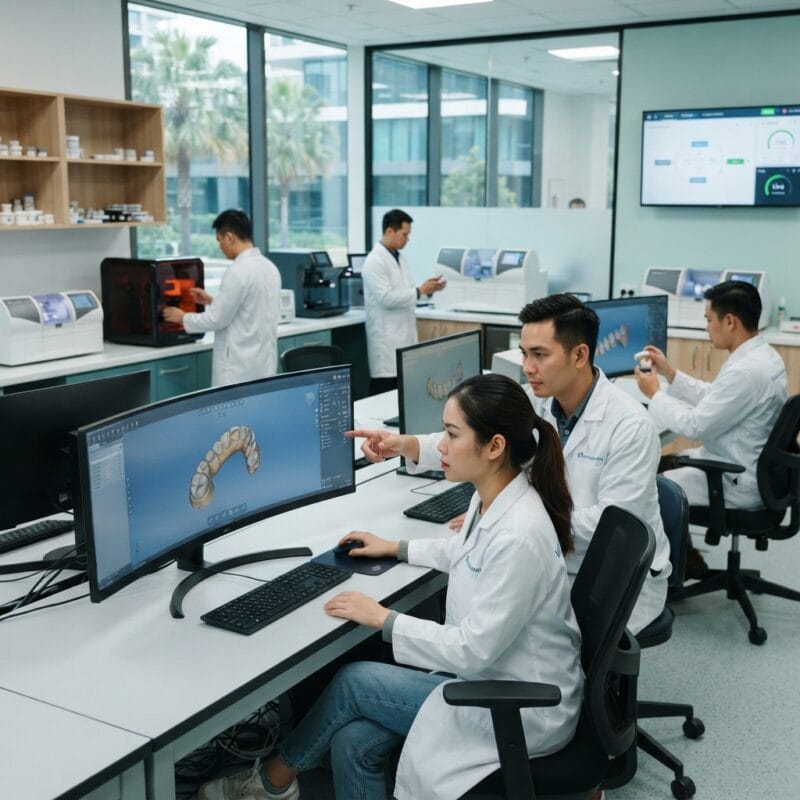
This approach allows labs to overcome internal capacity constraints caused by technician shortages, as external experts handle the design work remotely, ensuring faster turnaround without sacrificing quality. Outsourcing partners typically use advanced software platforms such as 3Shape and exocad to create precise digital models for crowns, bridges, implants, and other devices. By adopting this model, Australian dental labs could scale their production flexibly, reduce in-house workload, and focus on finishing and quality control.
Why did Australian dental labs experience a technician shortage in 2026?
The technician shortage in 2026 arose from multiple converging factors.
- Demographic shifts: A significant portion of experienced dental technicians reached retirement age, creating a vacuum in skilled labor.
- Training bottlenecks: Limited enrolment in dental technology programs and lengthy certification processes slowed the influx of new technicians.
- Increased demand: Advances in dental treatments and higher patient expectations led to more complex cases requiring skilled technicians.
These factors combined to create a supply-demand imbalance, forcing labs to seek alternative solutions such as outsourcing and automation.
How Australian dental labs cut turnaround times during the technician shortage in 2026 using digital workflows
Digital workflows played a pivotal role in enabling Australian dental labs to reduce turnaround times during the technician shortage in 2026.
By adopting intraoral scanners, digital impression transmission, and cloud-based design collaboration, labs eliminated delays inherent in traditional analog processes. For instance, scans captured chairside were instantly sent to outsourced digital design teams, who could begin work immediately without waiting for physical models to arrive.
This real-time data exchange sped up the design phase dramatically. Additionally, many labs integrated automated quality checks within their CAD software, reducing revision cycles and ensuring prosthetics were ready for milling or 3D printing faster.
Through these digital transformations, turnaround times were cut by up to 30% compared to pre-shortage periods, demonstrating the effectiveness of technology-driven solutions.
Which CAD/CAM technologies were most effective during the 2026 shortage?
The most effective CAD/CAM technologies included:
- Cloud-based design platforms: Enabled remote collaboration between labs and outsourced designers, facilitating faster revisions and approvals.
- Automated design algorithms: Streamlined the creation of crowns, bridges, and surgical guides, reducing manual input.
- Integration with milling and 3D printing: Allowed seamless transition from design to fabrication without time-consuming manual steps.
- Advanced implant planning software: Tools from companies like Nobel Biocare and Straumann optimized implant surgical guide design, cutting turnaround times significantly.
How does outsourcing digital crown and bridge design help labs manage shortages?
Outsourcing digital crown and bridge design helps labs manage shortages by leveraging external expertise to handle high-volume or complex cases efficiently.
This approach reduces the burden on in-house technicians, allowing labs to maintain or even improve turnaround times despite reduced staffing. Outsourced teams use specialized CAD software to produce designs that meet precise specifications, which can then be rapidly fabricated by the lab.
Moreover, outsourcing allows labs to scale their capacity dynamically, paying only for design services as needed rather than incurring fixed labor costs during shortages. This flexibility was essential for Australian labs navigating fluctuating demand in 2026.
The role of skilled technician upskilling and cross-training
Although technology and outsourcing played major roles, many Australian dental labs also invested in upskilling and cross-training their existing technicians to maximize available talent.
Technicians were trained to operate multiple CAD/CAM software platforms and manage both design and finishing tasks. This versatility reduced bottlenecks where specific skills were scarce. Labs also implemented mentorship programs pairing experienced technicians with newer staff to accelerate skill transfer.
Such internal strategies complemented outsourcing and digital adoption, creating a resilient workforce capable of maintaining fast turnaround times even during labor shortages.
What impact did supply chain innovations have on turnaround times in 2026?
Supply chain innovations had a significant impact by ensuring materials and components arrived on time, preventing fabrication delays.
Australian labs adopted just-in-time inventory management and partnered with local suppliers to reduce lead times. Some labs also integrated digital tracking systems to monitor shipments in real-time, allowing proactive scheduling adjustments.
These measures minimized downtime waiting for materials, which when combined with outsourced digital design, helped labs maintain rapid production cycles despite technician shortages.
How Australian dental labs cut turnaround times during the technician shortage in 2026 through collaboration with DSOs
Collaboration with Dental Service Organizations (DSOs) enabled labs to better forecast demand and streamline case management.
DSOs often centralized case submissions and shared digital impressions directly with outsourced design providers. This integration reduced communication errors and expedited approval workflows. Labs could prioritize urgent cases more effectively and allocate resources based on real-time demand data.
Such partnerships enhanced operational efficiency and contributed to faster overall turnaround times.
Case study: A mid-sized Australian lab’s success story
A mid-sized dental lab in Sydney faced a 25% reduction in in-house technician availability in early 2026. By rapidly adopting outsourced CAD/CAM design services and implementing cloud-based workflows, the lab reduced crown and bridge turnaround from 10 days to 7 days within three months.
The lab also cross-trained staff to handle digital finishing and quality control, further streamlining production. Their investment in local supply chain partners minimized material delays. This multi-pronged approach was central to their success in navigating the technician shortage while expanding their client base.
Their approach demonstrates practical applications of how Australian dental labs cut turnaround times during the technician shortage in 2026 by combining outsourcing, technology, and workforce development.

What are the best practices for dental labs considering CAD/CAM outsourcing?
The best practices include:
- Choosing experienced outsourcing partners: Providers with proven expertise in crown & bridge, implants, and orthodontic aligners design ensure quality and accuracy.
- Ensuring software compatibility: Aligning CAD software platforms between the lab and outsourcing partner reduces data translation errors and speeds workflows.
- Establishing clear communication protocols: Defined case submission guidelines and feedback loops prevent delays.
- Integrating digital design services with in-house production: Coordinating closely between design and fabrication teams maximizes efficiency.
Following these practices enables labs to leverage outsourcing effectively and sustain rapid turnaround even during workforce shortages.
How Australian dental labs cut turnaround times during the technician shortage in 2026 by leveraging automation and AI
Automation and artificial intelligence (AI) enhanced the capacity of dental labs by speeding up repetitive tasks such as margin detection, occlusal surface design, and fit analysis.
AI-driven software reduced manual adjustments, accelerated design completion, and improved consistency. Automation in milling and 3D printing further compressed the production timeline.
Some labs implemented AI-powered quality control tools that flagged design issues before fabrication, reducing rework and improving first-pass success rates. These technologies were integral to how Australian dental labs cut turnaround times during the technician shortage in 2026 while maintaining high standards.
How does digital design for surgical guides and orthodontic aligners contribute to faster turnaround?
Digital design for surgical guides and orthodontic aligners contributes to faster turnaround by enabling precise, customizable designs that can be quickly approved and fabricated.
Surgical guides benefit from highly accurate implant planning software that reduces manual adjustments and improves surgical outcomes. Orthodontic aligners, designed using digital scans and computer algorithms, can be produced in sequential batches with minimal technician intervention.
These streamlined processes reduce production time and enhance patient satisfaction. Outsourcing these design tasks further accelerates delivery, demonstrating another facet of how Australian dental labs cut turnaround times during the technician shortage in 2026 effectively.
What role do quality assurance and customer communication play in maintaining turnaround times?
Quality assurance and transparent customer communication are critical to sustaining rapid turnaround without sacrificing product quality.
Labs implemented standardized QA protocols embedded in digital workflows to catch errors early. This proactive approach reduced remakes and expedited case finalization.
Clear communication channels with dentists and DSOs ensured expectations were managed, and any issues were resolved promptly. These factors prevented delays caused by misunderstandings or last-minute corrections.
How Australian dental labs cut turnaround times during the technician shortage in 2026: Summary and insights
In summary, how Australian dental labs cut turnaround times during the technician shortage in 2026 can be attributed to a combination of:
- Strategic adoption of CAD/CAM digital design outsourcing for crowns, bridges, implants, dentures, and orthodontic devices.
- Implementation of cloud-based, integrated digital workflows enabling real-time collaboration.
- Investment in technician upskilling and cross-training to maximize internal capacity.
- Utilization of AI and automation tools to accelerate design and fabrication.
- Improved supply chain coordination and partnerships with DSOs for demand forecasting.
- Robust quality assurance systems and transparent communication with clients.
These strategies collectively empowered Australian dental labs to maintain competitive turnaround times despite workforce challenges, setting a benchmark for the global dental lab industry.
For further reading on digital dental technologies, visit Dentsply Sirona and explore detailed CAD/CAM resources at Medit.
This approach also works well alongside surgical guide design services and supports efficient production of orthodontic aligners and night guards.
Conclusion: Staying competitive through innovation and collaboration
The technician shortage of 2026 was a pivotal moment for Australian dental labs. Those that embraced digital transformation, CAD/CAM outsourcing, and workforce development not only survived but thrived by cutting turnaround times and delivering exceptional prosthetics.
By continuing to innovate and collaborate with outsourcing partners and DSOs, dental labs can future-proof their operations against ongoing workforce fluctuations.
Contact us today to learn how our expert CAD/CAM digital design outsourcing can help your lab reduce turnaround times and overcome technician shortages with ease.