Introduction to Straumann CARES vs Dentsply Sirona Atlantis implant abutments 2026
The dental industry continues to advance rapidly with the integration of digital workflows, particularly in implant abutment design. The comparison of Straumann CARES vs Dentsply Sirona Atlantis implant abutments 2026 reflects a critical decision point for dental labs, DSOs, and practices looking to optimize their CAD/CAM digital design outsourcing strategies. Both Straumann and Dentsply Sirona are leaders in implant abutment technology, offering platforms that integrate design precision with workflow efficiency.
Understanding the nuances between these two systems is essential for selecting the right solution that aligns with your case volume, design complexity, and integration needs. This article provides a comprehensive, detailed comparison to guide purchasing decisions for 2026 and beyond.
What are Straumann CARES and Dentsply Sirona Atlantis implant abutments?
Straumann CARES and Dentsply Sirona Atlantis are two leading CAD/CAM platforms that provide custom implant abutment design and manufacturing solutions for dental professionals. Straumann CARES is a digital workflow platform that integrates with Straumann implants, offering high precision and a wide range of abutment materials. Dentsply Sirona Atlantis provides a similarly comprehensive solution with a focus on customization and broad implant compatibility through its Atlantis Custom Abutment system.
Both systems support crown & bridge, implants, surgical guides, dentures, orthodontic aligners, and night guards design workflows, but their focus and workflow integrations cater to slightly different user profiles and clinical requirements.
How does the digital design process differ between Straumann CARES and Dentsply Sirona Atlantis?
The digital design process for both Straumann CARES and Dentsply Sirona Atlantis implant abutments starts with intraoral scanning or model scanning, followed by CAD design of abutments tailored to the patient’s anatomy. The key difference lies in platform integration and design software capabilities.
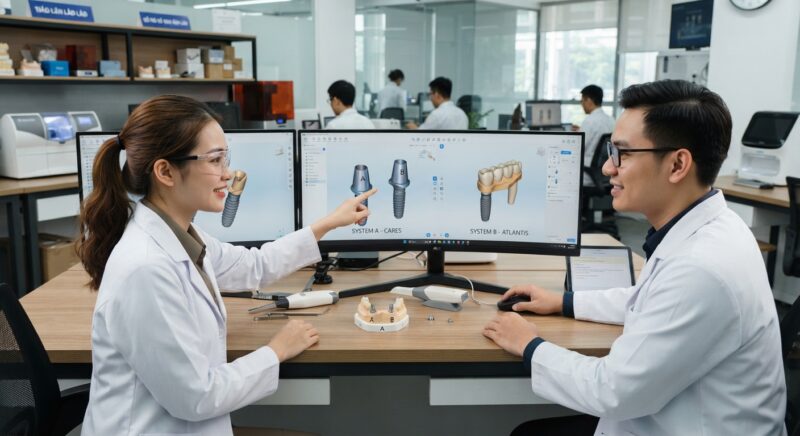
Straumann CARES utilizes its proprietary CAD software integrated into the CARES digital ecosystem, which is optimized for Straumann implants and components, allowing seamless communication from scan to milling. In contrast, Dentsply Sirona Atlantis uses the Atlantis WebOrder and Atlantis Design Studio software, which is implant-agnostic and supports a broad range of implant brands, providing more flexibility for labs working with multiple implant systems.
These differences impact workflow efficiency, design customization, and case turnaround times, factors critical in high-volume dental labs and DSOs.
What are the key technical features to compare in Straumann CARES vs Dentsply Sirona Atlantis implant abutments 2026?
Key technical features to evaluate include implant compatibility, material options, design flexibility, software usability, and integration with milling or 3D printing equipment.
- Implant Compatibility: Straumann CARES is primarily designed for Straumann implants, ensuring optimized fit and precision. Atlantis offers a wider compatibility range with over 100 implant systems.
- Material Options: Both platforms support titanium, zirconia, and hybrid materials; material availability may vary by region and should be confirmed with manufacturers.
- Design Flexibility: Atlantis provides extensive customization options, including angulation correction and emergence profile design. Straumann CARES offers streamlined design tools focused on efficiency.
- Software Usability: Straumann CARES CAD software is known for its user-friendly interface tailored to Straumann workflows. Atlantis Design Studio offers advanced customization features but may require more training.
- Integration: Both systems integrate with leading milling and 3D printing technologies, but Straumann CARES is optimized for Straumann’s own milling centers, while Atlantis works well with a variety of lab equipment.
How do Straumann CARES and Dentsply Sirona Atlantis impact lab workflow and turnaround times?
Workflow impact is significant when choosing between Straumann CARES and Dentsply Sirona Atlantis implant abutments in 2026. Straumann CARES, with its proprietary ecosystem, offers streamlined workflows that reduce design time and simplify case management for labs focused on Straumann implants.
Dentsply Sirona Atlantis, due to its implant-agnostic approach, requires slightly more time for case setup but compensates by allowing labs to handle diverse implant brands without switching platforms. Labs prioritizing flexibility and multi-brand workflows often favor Atlantis for this reason.
Turnaround times depend on lab infrastructure, outsourcing strategies, and the complexity of cases. Both platforms support fast milling and printing but choosing the right outsourcing partner can further optimize delivery schedules.
Who benefits most from Straumann CARES vs Dentsply Sirona Atlantis implant abutments 2026?
The choice between Straumann CARES and Dentsply Sirona Atlantis abutments depends on the user’s clinical and operational profile.
- Straumann CARES is best for:
- Dental labs specializing in Straumann implant cases
- DSOs with standardized implant protocols
- Clinics prioritizing rapid case turnaround and integrated workflows
- Dentsply Sirona Atlantis is best for:
- Labs or DSOs managing multiple implant brands
- Practices requiring high customization and design flexibility
- Facilities investing in diverse CAD/CAM workflows
What are the cost considerations in Straumann CARES vs Dentsply Sirona Atlantis implant abutments 2026?
Cost is a crucial factor when evaluating Straumann CARES vs Dentsply Sirona Atlantis implant abutments in 2026. Pricing structures differ based on licensing, software subscriptions, and per-case fees.
Straumann CARES often involves upfront investment in proprietary hardware and software, with costs balanced by integration efficiency and reduced labor. Dentsply Sirona Atlantis typically operates on a per-case pricing model with no hardware lock-in, appealing to labs avoiding capital expenditures.
Total cost of ownership includes training, software updates, and integration with milling or printing equipment. Regional pricing variability and contract terms should be clarified directly with Straumann and Dentsply Sirona.
Technical comparison table: Straumann CARES vs Dentsply Sirona Atlantis implant abutments 2026
| Feature | Straumann CARES | Dentsply Sirona Atlantis | Best For |
|---|---|---|---|
| Implant Compatibility | Primarily Straumann implants | Wide range of implant brands (100+) | Standardized vs multi-brand workflows |
| Design Software | CARES CAD software, proprietary | Atlantis Design Studio, implant-agnostic | User experience preferences |
| Material Options | Titanium, zirconia, hybrid | Titanium, zirconia, hybrid | Material choice flexibility |
| Workflow Integration | Optimized for Straumann milling centers | Compatible with various milling/printing systems | Lab equipment diversity |
| Pricing Model | Upfront investment + subscription | Per-case pricing, no hardware lock-in | Cost structure preferences |
| Customization | Efficient, streamlined design | Highly customizable, angulation control | Case complexity |
What are the strengths and limitations of Straumann CARES implant abutments?
- Best for: Labs focused on Straumann implants, DSOs with standardized implant protocols, clinics requiring fast, integrated workflows
- Strengths: Seamless integration with Straumann implants, user-friendly CAD software, strong manufacturer support, high precision and reliability
- Limitations: Limited implant brand compatibility, higher upfront costs, less flexibility for complex customization
What are the strengths and limitations of Dentsply Sirona Atlantis implant abutments?
- Best for: Labs handling diverse implant brands, DSOs with multi-brand workflows, practices requiring high design flexibility
- Strengths: Broad implant compatibility, advanced customization options, no hardware lock-in, flexible pricing model
- Limitations: Longer learning curve, potential increased design time, dependent on external milling or printing systems
How do Straumann CARES and Dentsply Sirona Atlantis support surgical guides and other prosthetics?
Both Straumann CARES and Dentsply Sirona Atlantis platforms extend their digital capabilities beyond implant abutments to surgical guides, dentures, orthodontic aligners, and night guards, integrating comprehensive prosthetic workflows.
Straumann CARES offers surgical guide design tightly coupled with its implant planning software, delivering streamlined case coordination. Atlantis supports surgical guide design with wide implant compatibility and robust customization, favored by labs managing diverse case types.
These platforms complement outsourcing services for digital design, enabling labs and DSOs to scale production without investing heavily in design staffing or new software licenses.
How do these platforms fit into dental lab outsourcing strategies?
Dental labs and DSOs increasingly rely on outsourcing CAD/CAM design to enhance capacity and reduce operational costs. The choice between Straumann CARES vs Dentsply Sirona Atlantis implant abutments 2026 influences how labs integrate outsourced design services.
Straumann CARES’ proprietary nature may require outsourcing partners with direct access to Straumann systems, while Atlantis’ implant-agnostic approach allows broader outsourcing opportunities across implant brands. Both platforms support cloud-based order management, facilitating efficient remote collaboration.
Outsourcing also helps labs manage peak workloads, reduce training requirements, and focus capital investment on milling or printing equipment rather than in-house design staff.
What innovations are expected in Straumann CARES vs Dentsply Sirona Atlantis implant abutments in 2026?
Looking ahead to 2026, both Straumann CARES and Dentsply Sirona Atlantis are expected to evolve with enhanced AI-driven design tools, improved material science integration, and faster digital workflows.
Emerging trends include automated design suggestions based on patient anatomy, augmented reality integration for case visualization, and expanded compatibility with novel implant materials. Both manufacturers are investing in cloud-based platforms to streamline case submission and tracking.
Labs and DSOs should monitor updates from manufacturers and consider partnering with technology-forward outsourcing providers to remain competitive.
What role does software compatibility play in Straumann CARES vs Dentsply Sirona Atlantis implant abutments 2026?
Software compatibility is a decisive factor in the choice between Straumann CARES and Dentsply Sirona Atlantis implant abutments. Straumann CARES integrates tightly with Straumann’s digital ecosystem, including its intraoral scanners and milling centers, ensuring a frictionless workflow.
Atlantis offers compatibility with multiple scanners and milling devices, including third-party equipment, which benefits labs with diverse technology portfolios. Both platforms support standard file formats like STL and proprietary extensions for enhanced design data.
Understanding software interoperability reduces integration challenges and supports smooth transition between scanning, design, and manufacturing.
Do you need design capacity for your new equipment?
If your lab or clinic invests in milling or 3D printing equipment but lacks in-house CAD design resources, outsourcing your implant abutment design to experts can maximize your technology’s potential. Our dental lab CAD/CAM digital design outsourcing service offers tailored, high-quality designs compatible with both Straumann CARES and Dentsply Sirona Atlantis workflows. This service lets you leverage new equipment efficiently without hiring additional staff.
Step-by-Step Guidance for Integrating Straumann CARES and Dentsply Sirona Atlantis in Your Dental Lab Workflow
Adopting a new implant abutment system, whether Straumann CARES or Dentsply Sirona Atlantis, requires careful planning and execution to maximize efficiency and product quality. Below is a detailed, practical step-by-step guide to smoothly integrate these platforms into your dental lab’s digital workflow.
1. Preliminary Assessment and Staff Training
- Evaluate existing digital capabilities: Review your current CAD/CAM equipment, software versions, and scanning devices to ensure compatibility with the chosen platform.
- Identify training needs: Organize training sessions for design technicians and lab managers focused on platform-specific software tools, design protocols, and troubleshooting common issues.
2. Digital Scanning and Data Preparation
- Optimize scan quality: Use high-resolution intraoral or model scanners to capture implant and soft tissue details accurately, as both Straumann CARES and Atlantis require precise data for custom abutment design.
- Data validation: Check STL files for errors such as holes or overlapping meshes that may compromise design accuracy.
- Standardize file formats: Confirm the platform’s preferred data formats (e.g., STL, PLY) and ensure your scanning software exports accordingly.
3. Design and Customization
- Start with platform-specific design software: Use Straumann CARES Visual or Atlantis WebOrder depending on your choice, following the built-in design guides for margin lines, emergence profiles, and occlusion.
- Leverage design libraries: Both platforms offer extensive implant libraries and abutment options—select models that meet clinical and esthetic requirements.
- Collaborate with clinicians: Share digital designs for feedback and modifications before finalizing, reducing remakes and chairside adjustments.
4. Manufacturing and Quality Control
- Choose manufacturing methods: Both systems support milling and 3D printing; select the one that aligns with your lab’s equipment and material preferences.
- Implement inspection protocols: Use digital microscopes or optical comparators to verify critical dimensions and surface finish against design specifications.
- Document quality data: Maintain detailed records of batch inspections, material lot numbers, and process parameters for traceability.
5. Delivery and Post-Delivery Follow-Up
- Package with clear labeling: Include implant system details, abutment type, and patient identifiers to assist clinicians during prosthetic placement.
- Gather clinician feedback: Establish regular communication channels to understand clinical outcomes and identify any adjustment needs.
- Continuous improvement: Use feedback to refine design parameters, material choices, or workflow steps for future cases.
Common Mistakes to Avoid When Using Straumann CARES and Dentsply Sirona Atlantis Implant Abutments
While these platforms offer sophisticated digital solutions, several pitfalls can undermine their benefits. Awareness of these common mistakes can safeguard your lab’s productivity and client satisfaction.
1. Incomplete or Poor-Quality Scan Data
Insufficient scan resolution or incomplete capture of implant geometry and soft tissue contours often leads to ill-fitting abutments. Avoid rushing the scanning process; ensure proper isolation and use scanning sprays or powders if recommended.
2. Ignoring Software Updates and Calibration
Both Straumann CARES and Atlantis frequently release software updates that improve design algorithms and implant libraries. Not updating software or neglecting to calibrate milling machines can cause compatibility issues and reduce precision.
3. Underestimating Material and Manufacturing Compatibility
Using materials not validated for either platform’s manufacturing method can lead to failures like poor bonding, chipping, or improper fit. Always adhere to manufacturer-recommended materials and validate new suppliers before full adoption.
4. Insufficient Communication with Clinicians
Without clear and ongoing communication, critical clinical considerations such as gingival biotype, esthetic zone demands, or occlusal scheme may be overlooked. Facilitate regular case discussions and share digital design previews for approval.
5. Neglecting Post-Processing and Finishing Steps
Both systems require appropriate polishing, heat treatments, or coating applications depending on material choice. Skipping or inadequately performing these steps can compromise long-term durability and esthetics.
Cost and Quality Considerations: Balancing Investment and Value
Choosing between Straumann CARES and Dentsply Sirona Atlantis implant abutments involves more than upfront costs. Understanding the total cost of ownership and quality outcomes is critical for sustainable lab operations.
Initial Investment and Setup Costs
- Hardware and software licenses: Straumann CARES often requires specific milling machines and proprietary software licenses, which can involve significant initial capital.
- Subscription and per-case fees: Dentsply Sirona Atlantis generally operates with a web-based ordering system with per-abutment charges, potentially lowering initial investment but increasing variable costs.
- Training and integration: Both platforms demand staff training and potential workflow redesign, adding indirect costs.
Material and Manufacturing Costs
- Material compatibility: Straumann CARES is tailored to Straumann implant materials, generally titanium and zirconia, which may affect material costs depending on supplier contracts.
- Outsourced vs in-house production: Labs with in-house milling can reduce per-unit costs but must factor equipment depreciation and maintenance.
- Waste and remakes: High-quality digital design reduces remakes, but initial trial runs and learning curves can temporarily increase material waste.
Quality and Clinical Outcomes
- Precision fit reduces chairside adjustments: Custom abutments from both platforms offer superior fit compared to stock options, improving patient satisfaction and reducing clinical time.
- Longevity and biocompatibility: Both companies invest heavily in R&D to ensure materials and designs promote osseointegration and soft tissue health, although clinical studies may show subtle differences in performance.
- Esthetic customization: Atlantis’s extensive customization options may deliver higher esthetic outcomes in anterior cases, potentially justifying higher costs.
Balancing Cost and Quality
Dental labs and practices should carefully analyze typical case volumes, clinician preferences, and patient demographics to determine which platform offers the best return on investment. For high-volume practices, upfront investment in Straumann CARES may reduce per-unit costs over time. Smaller labs or those prioritizing esthetic customization might prefer the flexibility of Atlantis despite higher per-case fees.
Navigating Market Specifics: Regional and Practice Type Considerations
Market dynamics and regional factors significantly influence the choice between Straumann CARES and Dentsply Sirona Atlantis implant abutments. Understanding these nuances helps labs and practices tailor their approach to local demands and regulatory environments.
Regulatory and Certification Requirements
- Regional approvals: Check if the implant and abutment systems are approved by local regulatory bodies such as the FDA, CE Mark, or other country-specific agencies.
- Material traceability and documentation: Certain markets demand strict documentation for implant components; both platforms provide detailed traceability, but workflows may differ.
Reimbursement and Pricing Structures
- Insurance coverage: The level of insurance reimbursement for custom abutments varies by country and insurer, affecting patient affordability and practice pricing strategies.
- Market pricing competition: In highly competitive markets, cost sensitivity may drive labs to prefer one system over another based on pricing flexibility.
Practice Type and Patient Demographics
- Specialty practices: Prosthodontists and oral surgeons may prioritize high precision and esthetic customization, favoring platforms that offer advanced design capabilities like Atlantis.
- General dental practices: Practices focusing on efficiency and straightforward restorative cases might lean toward Straumann CARES for streamlined workflows and faster turnaround.
- Geographic patient expectations: Urban markets with higher esthetic demands may benefit from the extensive customization options of Atlantis, while rural or cost-sensitive areas may value the predictability and cost control of CARES.
Supplier and Technical Support Availability
Local availability of technical support, training, and spare parts is essential for minimizing downtime. Labs should assess the presence of authorized service centers and certified trainers for both Straumann and Dentsply Sirona in their region before committing.
Contact us today to learn how we can support your implant abutment design needs and optimize your digital dental workflows.