Understanding the Basics: What Are 3D Printed Crowns and Milled Crowns?
3D printed crowns and milled crowns are two primary digital fabrication methods used in modern dental prosthetics manufacturing. 3D printed crowns are created layer by layer using resin-based or ceramic materials through additive manufacturing technology, while milled crowns are carved from solid blocks of ceramic or composite materials using subtractive milling machines.
The choice between these technologies affects not just the manufacturing process but also the final crown’s durability, aesthetics, and cost-effectiveness. Dental labs and DSOs must understand these differences to optimize workflow and patient outcomes.
What is the comparative durability of 3D printed crowns vs milled crowns durability 2026?
The durability of 3D printed crowns in 2026 is approaching that of milled crowns but still varies by material and post-processing. Milled crowns traditionally use highly dense ceramic blocks like zirconia or lithium disilicate, known for superior mechanical strength and long-term wear resistance.
Conversely, 3D printed crowns rely on photopolymer resins or ceramic-filled resins, which have improved substantially due to advances in printer technology and material science. However, their layer-by-layer construction may introduce microstructural weaknesses that milling avoids.
Recent studies and manufacturer data indicate that while 3D printed crowns are now suitable for temporary and some permanent restorations, milled crowns remain the gold standard for high-load areas requiring maximum durability.
How does the choice between 3D printed and milled crowns impact dental lab workflow?
The choice between 3D printed and milled crowns significantly influences lab workflow efficiency and turnaround times. Milling offers predictable production times with automated finishing but requires substantial initial investment in milling machinery and consumables.
3D printing allows for batch production of multiple crowns simultaneously, reducing per-unit fabrication time for high-volume labs. The post-processing steps like cleaning and curing do add time, but ongoing advances in printer speed and automation are closing this gap.
Digital design outsourcing services can enhance workflow flexibility by providing expert CAD design files compatible with both milling and printing platforms, allowing labs and DSOs to focus on production and patient care.
What materials are commonly used for 3D printed and milled crowns in 2026?
Milled crowns primarily use pre-sintered or fully sintered zirconia and lithium disilicate blocks, offering exceptional strength and esthetics. These materials provide proven biocompatibility and wear resistance, essential for long-term clinical success.
In contrast, 3D printed crowns in 2026 predominantly utilize high-performance photopolymer resins, some reinforced with ceramic particles, which improve mechanical properties and translucency. Pure ceramic 3D printing is emerging but still less common.
Material choice depends on clinical indication, patient-specific factors, and lab capabilities. For example, high-strength zirconia milled crowns remain preferred for posterior restorations, while printed crowns suit anterior or temporary applications.
Comparing Total Cost of Ownership: 3D Printed Crowns vs Milled Crowns Durability 2026
When evaluating 3D printed crowns vs milled crowns durability 2026, total cost of ownership (TCO) is a critical factor for labs and DSOs. Milling equipment involves significant upfront costs, including the milling unit, software licenses, and maintenance. Milling consumables like ceramic blocks are relatively expensive but provide consistent quality.
3D printers generally have lower initial equipment costs, and resin materials are often less expensive per unit. However, the cost of post-processing units and consumables can add up. Additionally, the learning curve and potential material waste must be considered.
Choosing the right system depends on lab volume and the types of restorations produced. High-volume labs may find milling cost-effective long term, while smaller labs or DSOs may benefit from the scalability of 3D printing.
How do clinical outcomes compare between 3D printed crowns and milled crowns?
Clinical outcomes for 3D printed crowns vs milled crowns durability 2026 vary depending on restoration location, load, and patient-specific factors. Milled crowns have a long-established track record for durability, marginal fit, and esthetics, contributing to high patient satisfaction and fewer remakes.
Recent clinical trials show that 3D printed crowns achieve comparable fit and esthetic results for anterior crowns and provisional restorations. However, long-term durability data beyond 5 years remains limited.
Understanding these nuances helps dental labs and DSOs recommend the optimal fabrication method for each case, balancing cost, speed, and patient outcomes. For more clinical guidelines, consult the American Dental Association.
What are the workflow considerations for integrating 3D printing or milling into a dental lab?
Integrating 3D printing or milling requires careful workflow planning to maximize efficiency and product quality. Milling demands precise material handling, machine calibration, and post-sintering processes for zirconia crowns, necessitating skilled operators and space allocation.
3D printing workflows involve digital file preparation, printer calibration, resin handling, cleaning, curing, and occasional support removal. These steps require additional labor but can be automated to some extent.
Dental labs should evaluate their staff expertise, production volume, and space constraints before investing. Digital design outsourcing can alleviate internal resource burdens by delivering print-ready or mill-ready files, streamlining this integration.
3D printed crowns vs milled crowns durability 2026: How do different dental practice types benefit?
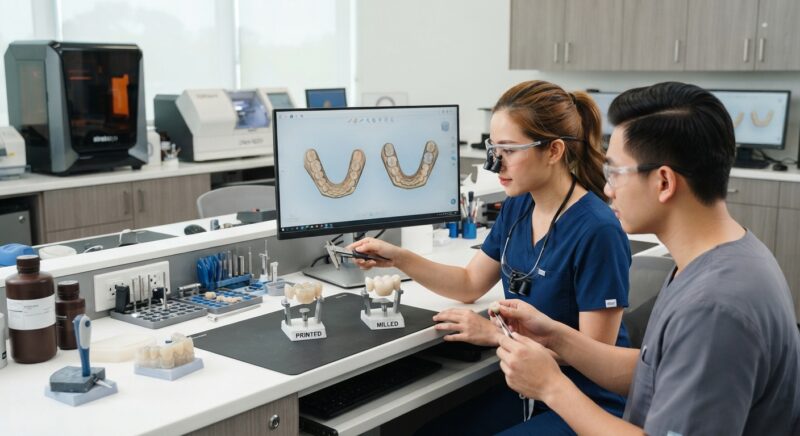
Different dental practice models benefit uniquely from 3D printed crowns vs milled crowns durability 2026. Large DSOs with high patient throughput may favor milling for its consistent quality and established durability, especially for crowns subject to high occlusal loads.
Smaller single-dentist practices or specialized cosmetic clinics might prioritize 3D printing for its lower upfront costs, faster turnaround on anterior esthetic crowns, and flexibility in producing temporary prosthetics.
Dental labs supplying multiple clinics and DSOs should consider hybrid workflows leveraging both technologies to meet diverse clinical demands efficiently. Outsourcing CAD design supports these models seamlessly.
Comparison Table: Key Criteria for 3D Printed vs Milled Crowns in 2026
| Criteria | 3D Printed Crowns | Milled Crowns |
|---|---|---|
| Material Options | Photopolymer resins, ceramic-filled resins | Zirconia, lithium disilicate, composite blocks |
| Durability | Good for temporaries and some permanents; improving | Excellent long-term wear resistance and strength |
| Initial Equipment Cost | Lower cost printers and post-processors | Higher cost milling units and sintering furnaces |
| Production Speed | Batch printing multiple units simultaneously | Single unit milling per cycle; longer sintering times |
| Best For | Temporary crowns, small labs, esthetic anterior cases | High-load posterior crowns, large labs, DSOs |
What are the strengths and limitations of each fabrication method?
3D Printed Crowns
- Best For: Temporary restorations, esthetic anterior crowns, labs with limited capital investment
- Strengths: Lower equipment costs, batch production capability, rapid iteration
- Limitations: Material strength lower than milled ceramics, longer post-processing, evolving clinical validation
Milled Crowns
- Best For: Permanent posterior crowns, DSOs, high-volume labs
- Strengths: High durability, excellent esthetics, mature technology
- Limitations: High initial capital, slower single-unit production, material waste
How do advancements in CAD/CAM design influence 3D printed crowns vs milled crowns durability 2026?
Advances in CAD/CAM digital design software have enhanced the precision and customization of both 3D printed and milled crowns, directly impacting durability and fit. Sophisticated algorithms allow for optimized crown morphology, reducing stress points and improving occlusal load distribution.
Outsourcing CAD design to expert services ensures access to the latest design protocols compatible with both printing and milling machines, reducing remakes and improving patient satisfaction. Leading software providers like 3Shape and exocad continuously update their platforms to support these workflows.
Do you need design capacity for your new equipment?
If your clinic or lab invests in new milling or 3D printing equipment, outsourced CAD design services can provide expert, scalable digital design support without hiring full-time staff. This ensures optimal crown designs compatible with your chosen technology, improving overall production quality and efficiency.
Partner with us to streamline your digital workflows and enhance your prosthetic outcomes.
Conclusion: Making the Right Choice for Your Dental Lab or DSO
Deciding between 3D printed crowns vs milled crowns durability 2026 involves evaluating material properties, clinical requirements, workflow integration, and cost implications. Milled crowns remain the benchmark for long-term durability and proven clinical success, especially in high-load applications.
However, 3D printed crowns are rapidly advancing, offering flexibility and cost-effective solutions for specific indications and smaller labs. Combining both methods with expert CAD design outsourcing provides an adaptable, future-proof approach for labs and DSOs navigating the evolving digital dentistry landscape.
Practical Implementation: Step-by-Step Guide to Integrating 3D Printing and Milling in Dental Labs
Transitioning to digital fabrication methods such as 3D printing and milling requires careful planning and execution. Dental labs aiming to adopt or optimize these technologies should follow a structured approach to ensure smooth integration, quality outcomes, and cost control.
Step 1: Assess Your Current Capabilities and Workflow
- Evaluate existing equipment: Identify which analog or digital tools you currently use and their compatibility with new fabrication technologies.
- Staff skill level: Gauge the expertise of your technicians in CAD/CAM design, digital scanning, and machine operation.
- Workflow bottlenecks: Map out your current production timeline to spot inefficiencies that digital methods can address.
Step 2: Choose the Right Technology Based on Your Lab’s Needs
- Volume demands: High-volume labs may benefit from faster milling units with multi-cup holders, while lower volume labs might find 3D printing more cost-effective.
- Material preferences: Consider what materials you want to work with—zirconia, lithium disilicate, or newer resin composites—and which technology supports them best.
- Budget constraints: Factor in initial investment, maintenance, and consumables costs.
Step 3: Select and Acquire Equipment
- Machine selection: Compare specifications such as build volume, resolution, milling precision, and speed.
- Vendor support and training: Opt for vendors that offer comprehensive training and technical support.
- Space planning: Allocate dedicated areas for equipment, ensuring proper ventilation and dust control for milling units.
Step 4: Train Your Team
- CAD/CAM software: Provide in-depth training on design software to create accurate crown models.
- Machine operation: Technicians should learn machine setup, calibration, maintenance, and troubleshooting.
- Quality control protocols: Establish checkpoints to verify fit, surface finish, and occlusion before delivery.
Step 5: Pilot Production and Quality Validation
- Run test cases: Produce sample crowns and evaluate for fit, strength, and aesthetics.
- Gather feedback: Collaborate with partner dental practices to assess clinical fit and patient satisfaction.
- Refine processes: Adjust machine parameters, material selection, or design files based on test outcomes.
Step 6: Scale and Optimize
- Increase production volume: Gradually expand the number of cases handled digitally as confidence grows.
- Implement automation: Integrate automated cleaning, post-curing (for 3D printing), or sintering for efficiency.
- Continuous training: Update staff regularly on new materials, software updates, and best practices.
Common Pitfalls and Mistakes in Fabricating 3D Printed and Milled Crowns
Despite the many advantages of digital crown fabrication, dental labs and practices often encounter challenges that can compromise outcomes. Understanding these pitfalls can help prevent costly errors.
1. Inadequate Design File Preparation
Errors in digital impressions or CAD design files, such as improper margin delineation or inaccurate occlusal anatomy, lead to poor crown fit and patient discomfort. Labs must enforce rigorous inspection of digital files before manufacturing.
2. Poor Material Handling
For both 3D printing and milling, improper storage and handling of materials can degrade their properties. For example, resins may absorb moisture or contaminants, and ceramic blocks must be kept free of dust and damage.
3. Insufficient Machine Maintenance
Milling burs dull quickly and need regular replacement, while 3D printers require cleaning of vats and calibration of laser or projector systems. Neglecting maintenance results in imprecise crowns and increased waste.
4. Overlooking Post-Processing Protocols
3D printed crowns often require post-curing under UV light to achieve full polymerization and strength. Similarly, milled zirconia crowns must be sintered in high-temperature furnaces to develop optimal mechanical properties. Skipping or shortening these steps compromises durability.
5. Ignoring Material Compatibility and Indications
Not all materials are suitable for every clinical case. For example, some 3D printable resins may be best suited for temporary crowns rather than permanent restorations. Labs must adhere strictly to manufacturers’ guidelines and clinical indications.
6. Underestimating Costs of Consumables
While 3D printers may have lower initial costs, resin cartridges and post-processing supplies can add substantially to operating expenses. Milling machines require frequent bur replacement and ceramic blocks, which vary in price and waste. Accurate cost tracking helps avoid budget overruns.
Market-Specific Considerations: Tailoring Fabrication Choices to Regional and Practice Type Needs
The choice between 3D printed and milled crowns is also influenced by market factors and the specific needs of different types of dental practices and labs.
Urban vs Rural Dental Labs and Practices
- Urban centers: High patient volume and diverse case complexity favor advanced milling systems capable of producing durable zirconia crowns rapidly. Urban labs may also benefit from faster turnaround times demanded by busy DSOs.
- Rural or remote areas: Limited access to technical support and supply chains make 3D printing attractive due to lower equipment cost and easier material procurement. Portable desktop printers can enable in-house fabrication with minimal footprint.
Small Independent Practices vs Large DSOs
- Small practices: Tend to prefer 3D printing for its modularity, lower capital investment, and ability to produce temporary crowns or models on-demand. Outsourcing definitive crowns to labs remains common.
- Large DSOs and multi-location labs: Invest heavily in milling centers with automated workflows to handle bulk cases efficiently. Integration with centralized digital design and case tracking software supports standardized quality and faster delivery.
Specialty Practices and Complex Cases
Specialists such as prosthodontists or implantologists often require crowns with very high esthetic and functional demands. Milling with multi-layered zirconia or lithium disilicate blocks offers superior translucency and strength. Conversely, 3D printing serves well for surgical guides, temporaries, and customized abutments where rapid iteration is essential.
Regulatory and Reimbursement Landscape
Some regions have specific regulations governing the use of additive manufacturing in medical devices, including dental prosthetics. Compliance with FDA or CE marking requirements affects material choices and fabrication methods. Additionally, reimbursement policies by insurers or government programs may incentivize one technology over another based on cost-effectiveness data.
Cost and Quality Trade-Offs: A Detailed Checklist for Decision-Makers
To aid dental labs and practices in selecting the appropriate fabrication technology, the following checklist compares critical cost and quality factors.
- Initial Capital Investment:
- 3D Printer: Generally lower upfront cost; desktop models start under $20,000, industrial units can be higher.
- Milling Machine: Typically higher initial cost, especially for multi-axis, multi-spindle machines; can exceed $100,000.
- Consumables and Maintenance:
- 3D Printing: Resin cartridges, cleaning solvents, post-curing equipment; resin waste can be significant.
- Milling: Ceramic or composite blocks, milling burs (replace after 10-20 crowns), machine calibration and dust extraction filters.
- Production Speed and Capacity:
- 3D Printing: Build time depends on layer thickness and object size; batch printing multiple crowns possible but may take several hours.
- Milling: Single crown milling time ranges from 10 to 30 minutes; multi-holder machines increase throughput.
- Material Options and Quality:
- 3D Printing: Increasingly diverse resins and ceramics available; generally used for temporary or provisional crowns, some permanent materials emerging.
- Milling: Wide range of high-strength materials including zirconia, lithium disilicate, and hybrid composites with proven clinical longevity.
- Fit and Accuracy:
- 3D Printing: Prone to layer lines and post-processing shrinkage; requires precise calibration and well-controlled environmental conditions.
- Milling: High precision due to subtractive process; smoother surfaces and excellent marginal fit achievable.
- Labor and Expertise Required:
- 3D Printing: Requires knowledge in digital design, post-processing, and resin handling.
- Milling: Demands operator skill in machine setup, tool changes, and finishing techniques.
- Environmental Impact:
- 3D Printing: Generates resin waste and requires chemical solvents; energy use varies by printer type.
- Milling: Produces ceramic dust and waste blocks; requires dust extraction systems.
Using this checklist, labs and practices can systematically evaluate their priorities—whether rapid turnaround, material strength, cost control, or scalability—and select the fabrication method best aligned with their operational goals and patient care standards.
Contact us today to discuss how our dental lab CAD/CAM digital design outsourcing services can optimize your crown production workflow and improve patient outcomes.