The dental laboratory industry is undergoing unprecedented technological acceleration, moving from conventional analog craftsmanship to fully integrated CAD/CAM digital production ecosystems. As restorative workflows become increasingly digital, quality management standards must evolve alongside them. For dental laboratories and Dental Support Organizations (DSOs), maintaining strict quality control while managing rising operational costs requires a thorough understanding of regulatory frameworks. Key among these frameworks is the Dental Appliance Manufacturing Audit System (DAMAS). Navigating the DAMAS accreditation requirements 2026 is essential for any laboratory owner, manager, or DSO executive seeking to prove manufacturing excellence, ensure patient safety, and scale digital production safely.
Originally modeled after ISO quality standards but tailored specifically for custom dental prosthetics, DAMAS provides a structured framework that verifies a laboratory’s commitment to safety, material traceability, and continuous improvement. As we approach 2026, regulatory scrutiny from global health authorities and national boards is tightening around digital file integrity, custom medical device manufacturing, and third-party design outsourcing. Understanding how to align your internal procedures and external partners with the DAMAS accreditation requirements 2026 is no longer just an operational advantage—it is a baseline necessity for long-term commercial viability.
In this comprehensive guide, we will analyze every facet of the updated standards, break down how digital CAD/CAM workflows intersect with audit criteria, and explore how strategic design outsourcing can actually strengthen your compliance posture when managed correctly.
Understanding the Evolution of DAMAS in the Digital Dentistry Era
To fully grasp the core directives behind the DAMAS accreditation requirements 2026, one must first look at how dental manufacturing has shifted over the past decade. Traditionally, dental laboratories relied on physical impressions, lost-wax casting, manual porcelain buildup, and localized quality checks. DAMAS was established to bring order, repeatability, and formal documentation to these analog procedures. It guaranteed that raw materials—such as precious alloys, dental acrylics, and ceramics—were properly tracked from supplier receipt to final delivery at the dental clinic.
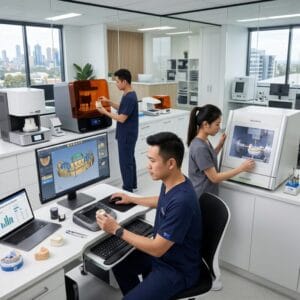
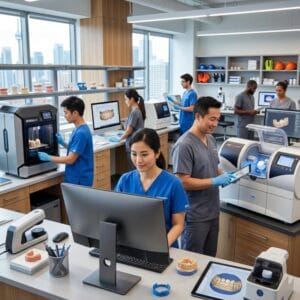
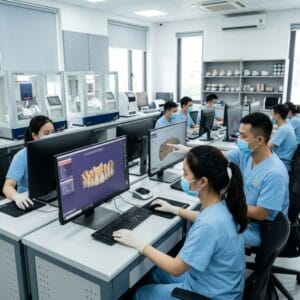
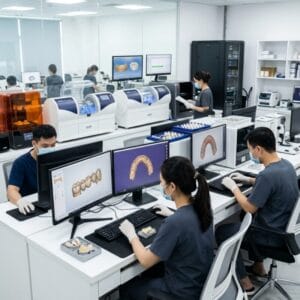
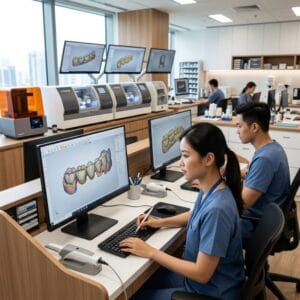
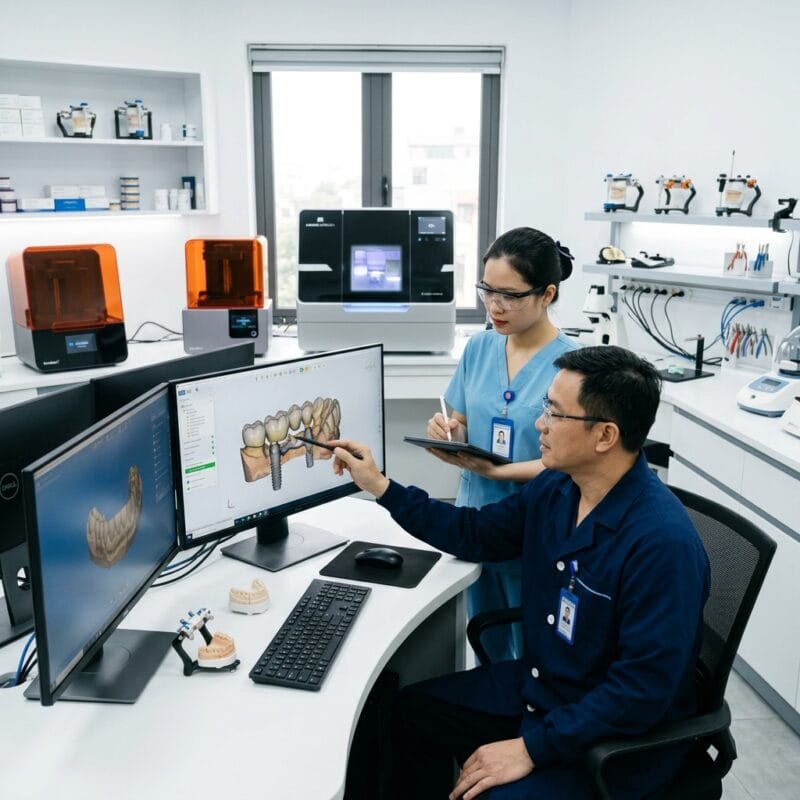
However, today’s dental laboratory looks drastically different. Digital intraoral scans have replaced alginate and PVS impressions, open-architecture software programs like exocad and 3Shape drive complex restorative designs, and 5-axis milling machines or high-precision 3D printers fabricate everything from single zirconia crowns to full-arch implant restorations. While these digital innovations dramatically enhance precision and turnaround times, they introduce new compliance risks—such as digital file corruption, improper software calibration, untracked design modifications, and fragmented third-party data handoffs.
The updated DAMAS accreditation requirements 2026 explicitly address these modern technological reality gaps. Auditors evaluating laboratories in 2026 will look beyond physical bench cleanliness and basic invoice tracking. They will perform detailed inspections of digital file governance, validated CAD design pathways, software version controls, automated nesting parameters, and the formal verification of external digital outsourcing partners.
What are the DAMAS accreditation requirements 2026 for digital dental labs?
The DAMAS accreditation requirements 2026 for digital dental labs represent a comprehensive framework of quality management, material traceability, and standardized operating procedures designed to guarantee the safety, consistency, and regulatory compliance of custom dental prosthetics. Meeting these guidelines requires dental laboratories to demonstrate complete operational oversight across both physical and digital workflows.
Under the enhanced 2026 framework, compliance is categorized into core areas that every lab director must address:
- Quality Policy and Documentation Control: Laboratories must establish a clear, documented Quality Manual that defines quality objectives, staff responsibilities, and procedural standards for every restoration type—including crown and bridge, custom implant abutments, surgical guides, full and partial dentures, clear aligners, and night guards.
- Personnel Training and Competency: Demonstrating that technicians, CAD designers, and quality inspectors possess documented, ongoing training on current software platforms, milling equipment, and safety standards.
- Material Traceability and Lot Control: Maintaining an unbroken record linking every raw material lot number—such as zirconia discs, titanium bases, 3D printing resins, and PMMA blanks—directly to specific patient cases and clinical prescriptions.
- Equipment Maintenance and Calibration: Establishing rigorous, preventive maintenance schedules for all hardware, including intraoral scanner calibration, 3D printer light-engine calibration, sintering furnace heat profiling, and milling machine spindle maintenance.
- Subcontractor and Outsourcing Partner Validation: Formally auditing and verifying that all third-party vendors—whether physical milling centers or remote CAD design services—comply with equivalent quality standards and file security protocols.
- Contract Review and Prescriptive Compliance: Ensuring every incoming clinical order, whether physical impression or digital STL/PLY scan file, is systematically reviewed against clinician instructions before design and production begin.
- Corrective and Preventive Action (CAPA): Implementing formal root-cause analysis procedures when non-conformances, remakes, or design errors occur, preventing repeat issues across future orders.
By embedding the DAMAS accreditation requirements 2026 directly into daily operational habits, laboratories create a continuous feedback loop that eliminates operational friction, reduces costly remakes, and safeguards patient outcomes.
Core Pillars of the DAMAS Accreditation Framework
To successfully pass a DAMAS audit in 2026, a dental laboratory must build its operational infrastructure upon several fundamental pillars. These pillars ensure that quality is built into every step of the manufacturing cycle rather than being assessed as an afterthought prior to shipping.
1. Standard Operating Procedures (SOPs) for Digital and Analog Workflows
An central requirement within the DAMAS accreditation requirements 2026 is the presence of documented Standard Operating Procedures for every task conducted in the facility. A common vulnerability for growing labs is relying on tribal knowledge—where senior technicians hold critical procedural insights in their heads without written records. DAMAS auditors strictly prohibit this practice.
For modern digital workflows, written SOPs must clearly outline parameters such as:
- Minimum thickness thresholds for various restorative materials (e.g., high-translucency zirconia vs. monolithic lithium disilicate).
- Standard cement gap spacing and margin design rules tailored to specific milling unit tolerances.
- Proper file naming conventions and cloud storage backup procedures for clinical CAD files.
- Standardized workflow trees for specialized products like custom digital crown design and complex implant-supported prosthetics.
When every technician and CAD operator follows the exact same written standard, output consistency rises dramatically, directly fulfilling key DAMAS accreditation requirements 2026 mandates.
2. Contract Review and Order Management
Every custom medical device produced by a dental laboratory begins with a prescription from a licensed dentist. Under the DAMAS accreditation requirements 2026, the laboratory must enforce a formal contract review protocol for every incoming case. This means the lab must verify that:
- The clinician’s prescription is unambiguous, complete, and signed.
- The provided impression or intraoral scan contains sufficient detail, clear margins, and an accurate bite registration.
- The requested material is bio-compatible and appropriate for the clinical indication specified.
- Any discrepancies or missing clinical data are logged and clarified with the dental office before active production or digital CAD modeling begins.
Implementing strict intake gates prevents costly downstream errors and fulfills critical audit requirements regarding prescriptive control.
Material Traceability in the Digital Age
Perhaps no section of the audit carries greater weight than material batch and lot tracking. In the event of a material recall—such as a defective batch of implant components or contaminated dental resin—a laboratory must be capable of identifying every single patient who received a restoration fabricated from that specific batch within hours.
Adhering to the DAMAS accreditation requirements 2026 means updating your material management system to accommodate hybrid production lines. While traditional labs tracked bags of alloy or bottles of liquid monomer, modern CAD/CAM operations must track digital materials across complex nesting operations.
Managing Zirconia, PMMA, and Resin Lots
When a laboratory mills a disk containing fifteen individual crown units across ten different patient cases, the software nesting record becomes an essential component of the regulatory compliance file. Under the DAMAS accreditation requirements 2026, your lab must maintain a searchable cross-reference linking:
- The specific disk lot number and manufacturer certificate of analysis.
- The digital nesting file (.construction or .nest file) identifying unit placements on that disk.
- The final patient case IDs associated with each milled restoration.
Similarly, for additive manufacturing processes like 3D printed night guards, surgical guides, or denture bases, the lab must track resin bottle lot numbers, vat usage logs, post-curing cycle times, and ultraviolet light intensity metrics. Demonstrating this rigorous level of digital-to-physical tracking satisfies fundamental DAMAS accreditation requirements 2026 criteria during an on-site or virtual audit.
Equipment Calibration and Software Maintenance Protocols
In a fully manual lab, tool maintenance consisted of dressing grinding wheels and inspecting handpieces. Today, modern dental laboratories operate high-precision subtractive milling machines, sensitive optical intraoral and desktop scanners, sintering furnaces reaching temperatures over 1500°C, and industrial-grade 3D printers. The DAMAS accreditation requirements 2026 place significant emphasis on equipment validation and preventive maintenance.
Hardware Calibration Logs
To comply with DAMAS accreditation requirements 2026, labs must establish scheduled preventive maintenance logs for all critical production machinery. Key requirements include:
- Optical Scanners: Regular calibration using dedicated optical test blocks to ensure point-cloud accuracy within micron tolerances.
- Sintering Furnaces: Periodic thermal profiling using diagnostic calibration rings (such as PTC rings) to verify that target sintering temperatures match actual chamber conditions, ensuring proper zirconia phase transformation and flexural strength.
- Milling Units: Scheduled spindle replacement, axis calibration, tool wear tracking, and coolant filtration system changes to prevent micro-chipping and margin degradation.
- 3D Printers: Systematic radiometric intensity checks of UV light sources, LCD/DLP screen replacements, and vat film inspection logs.
Software Version Control and File Integrity
Software is as vital to modern dental manufacturing as physical machinery. The DAMAS accreditation requirements 2026 recognize this by scrutinizing software version control. Unannounced software updates can alter default cement gaps, anatomical library morphing rules, or post-processing parameters without operator awareness.
Labs must document all software updates across CAD design suites, CAM nesting engines, and printer slicing software. Before deploying new software versions to live production, the lab must run validation test cases to verify that output dimensions remain within accepted engineering tolerances. Keeping detailed software validation records is a core requirement for satisfying the DAMAS accreditation requirements 2026.
How do digital CAD design partners affect DAMAS accreditation requirements 2026 compliance?
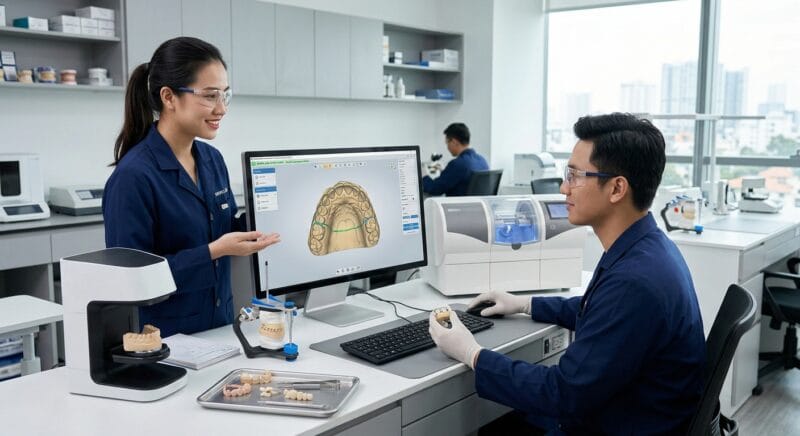
Digital CAD design partners directly influence DAMAS accreditation requirements 2026 compliance by providing validated, traceable design files that must seamlessly integrate into the primary lab’s quality management system and audit documentation. Laboratories that outsource CAD design functions remain fully responsible for the quality, safety, and regulatory compliance of the final medical device delivered to the clinician.
Outsourcing CAD design has become a primary strategy for dental laboratories and DSOs seeking to scale production, manage labor shortages, and handle peak volume without increasing fixed overhead. However, relying on third-party design services introduces external operational touchpoints that auditors will scrutinize. To maintain full compliance with the DAMAS accreditation requirements 2026, laboratories must treat their external design partners as integrated extensions of their internal technical team rather than detached vendor services.
1. Subcontractor Qualification and Vendor Management
Under the DAMAS accreditation requirements 2026, any third-party provider contributing to the creation of a custom medical device must undergo a formal vendor qualification process. Laboratories cannot simply send digital scans to an unverified online design service without maintaining regulatory documentation. Your vendor management folder must contain:
- A formal Vendor Assessment Questionnaire detailing the design service’s internal quality control procedures.
- Certifications proving that external designers hold appropriate qualifications and undergo structured training on platforms like exocad and 3Shape.
- Documented Quality Agreements defining clear technical parameters, acceptance criteria, and turnaround time benchmarks.
- Evidence of secure data transmission protocols that comply with patient privacy regulations like HIPAA and GDPR.
2. Design Validation and Quality Inspection Gates
Even when using an expert offshore or nearshore design partner, the domestic laboratory retains ultimate responsibility for design accuracy. The DAMAS accreditation requirements 2026 mandate that labs implement formal design verification steps before digital CAD files are released to physical production.
This verification process requires an internal technician or trained quality supervisor to review incoming STL or 3Shape design files against the original clinical prescription. Checkpoints must include:
- Verifying correct anatomical contours, contact points, and occlusal clearance relative to opposing dentition.
- Confirming that minimum material thickness parameters specified by material manufacturers are strictly preserved throughout the design file.
- Checking emergence profiles and custom margin placements for implant abutments and implant-supported bridges.
- Ensuring that outsourced surgical guide design files accurately incorporate guided surgery sleeve parameters and diagnostic CT/CBCT scan alignments.
By logging these design acceptance reviews inside your laboratory management system, you generate clear audit trails demonstrating full compliance with the DAMAS accreditation requirements 2026.
Standardizing SOPs Across Diverse Product Offerings
A central challenge in meeting the DAMAS accreditation requirements 2026 lies in managing diverse product categories within a single quality management framework. A full-service lab may produce crown and bridge restorations, custom titanium implant abutments, 3D printed surgical guides, full arch digital dentures, clear orthodontic aligners, and protective night guards. Each indication presents unique manufacturing risks that must be controlled through specialized SOPs.
Crown & Bridge and Implant Prosthetics
For crown and bridge restorations, design parameter consistency is paramount. SOPs must document exact parameters for parameters such as drill compensation size, cement gap distances (e.g., 30 microns starting 1mm above the margin), and connector cross-sectional area requirements for multi-unit bridges (e.g., minimum 9mm² for anterior, 12mm² for posterior zirconia bridges). Documenting these specific design rules helps satisfy the DAMAS accreditation requirements 2026 by eliminating operator variation during CAD modeling.
For implant prosthetics, SOPs must govern interface seating checks, screw-channel design angles, and titanium base bonding procedures. Traceability protocols must log the specific bonding resin batch, primer lot, and torque verification values applied during final assembly.
Surgical Guides and Orthodontic Aligners
3D printed medical devices like surgical guides and orthodontic aligners carry strict regulatory classifications due to direct tissue contact and surgical planning implications. To meet the DAMAS accreditation requirements 2026, your SOPs for surgical guide fabrication must mandate:
- Dual-inspection of digital implant placement plans against clinician-approved treatment proposals.
- Verification of drill sleeve retention and mechanical retention fit post-printing.
- Documented bio-compatibility protocols, verifying that printed resins are fully cured according to the resin manufacturer’s exact light and thermal cycles.
For aligner production, SOPs must track stage-by-stage model printing accuracy, thermoforming pressure and temperature controls, and edge-trimming smoothness evaluations. Maintaining rigorous documentation across these specialized lines guarantees that your facility fully satisfies all DAMAS accreditation requirements 2026 criteria.
Removable Dentures and Night Guards
Digital dentures and night guards represent one of the fastest-growing sectors in laboratory dentistry. Whether utilizing subtractive milling of high-density PMMA blocks or additive 3D printing of light-cured resins, the DAMAS accreditation requirements 2026 require clear operational documentation. Labs must track monomer residual levels through validated curing cycles, document teeth setup verification protocols, and maintain strict material lot linkage for all denture base and tooth materials used.
How can dental labs efficiently prepare for DAMAS accreditation requirements 2026 audits?
Dental labs can efficiently prepare for DAMAS accreditation requirements 2026 audits by conducting thorough internal quality reviews, maintaining meticulous batch records for all CAD/CAM workflows, and verifying supplier compliance across every digital workflow step. Taking a proactive approach transforms the audit process from a stressful event into a routine validation of daily operational excellence.
Preparing for an upcoming DAMAS audit requires a systematic approach. The following roadmap outlines practical steps laboratory management should take to ensure full readiness under the DAMAS accreditation requirements 2026 guidelines.
Step 1: Conduct a Gap Analysis
Begin by comparing your current laboratory practices against the latest 2026 audit checklist. Walk through every department—from initial case entry and digital file intake to CAD design, milling, printing, finishing, quality control, and shipping. Identify areas where documentation is missing, batch tracking is incomplete, or SOPs have not been updated to reflect current digital equipment.
Step 2: Update and Centralize Quality Systems
Consolidate your Quality Management System into an easily accessible digital repository. Ensure that all technicians and administrative staff can quickly reference current SOPs, equipment maintenance logs, and safety data sheets (SDS). Transitioning from paper binder systems to cloud-based QMS management platforms simplifies record retrieval and demonstrates modern governance during an audit, fulfilling key modern DAMAS accreditation requirements 2026 expectations.
Step 3: Perform Internal Mock Audits
Select a sample of past completed cases across various product lines (e.g., 5 zirconia crowns, 3 implant abutments, 2 surgical guides, 2 printed night guards) and conduct a complete trace-back exercise. Attempt to pull up:
- The original clinical prescription and intake review log.
- The exact CAD design file and software version history.
- The CAM nesting log and corresponding raw material lot number (zirconia disk, resin batch, ti-base lot).
- Equipment calibration logs for the machinery used on those specific production dates.
- Final quality inspection sign-off records and shipping manifests.
If your team can instantly retrieve all interconnected records for any given patient case, your laboratory meets the high standards of material and operational traceability demanded by the DAMAS accreditation requirements 2026.
Step 4: Audit External Design and Subcontracting Partners
Reach out to your third-party CAD design partners and external milling centers to secure updated compliance documentation. Confirm that your design partners adhere to strict quality control, maintain secure data handling, and provide complete design validation metrics. Demonstrating robust control over third-party design inputs ensures that external digital partnerships enhance—rather than compromise—your compliance standing relative to the DAMAS accreditation requirements 2026.
The Business Benefits of Aligning with DAMAS 2026 Standards
While preparing for regulatory audits requires time, energy, and administrative focus, fulfilling the DAMAS accreditation requirements 2026 yields immense strategic and commercial benefits for modern dental laboratories and DSOs. Accreditation should not be viewed merely as a defensive obligation, but as a powerful driver of enterprise value and brand reputation.
1. Substantial Reduction in Remake Rates
Remakes are one of the single largest profit drains in the dental laboratory industry. Remakes waste expensive materials, consume valuable milling machine time, disrupt schedules, and irritate clinical clients. The standardized operating procedures and mandatory quality control checkpoints enforced by the DAMAS accreditation requirements 2026 directly systematically address the root causes of remakes. By standardizing CAD design parameters, enforcing margin inspections, and maintaining calibrated equipment, laboratories drastically lower internal and external remake percentages.
2. Enhanced Clinical Reputation and Client Retention
Modern dental practitioners and DSO procurement directors face increasing pressure regarding material safety, medical device compliance, and clinical predictability. When a laboratory holds certified accreditation under the DAMAS accreditation requirements 2026, it provides immediate third-party verification of manufacturing excellence. Clinicians gain total confidence that every crown, bridge, denture, or night guard shipped from your facility is crafted from fully traceable, bio-compatible materials adhering to strict technical standards.
3. Scalability and Seamless DSO Integration
For growing laboratories seeking to partner with large regional or national Dental Support Organizations, quality system standardization is non-negotiable. DSOs managing dozens or hundreds of clinical locations require consistent product quality and unified operational reporting across all corporate locations. Demonstrating compliance with the DAMAS accreditation requirements 2026 positions your lab as an enterprise-ready partner capable of scaling volume without sacrificing quality control or regulatory safety.
4. Optimized Collaboration with Design Outsourcing Services
When your laboratory operates within a structured DAMAS framework, integrating high-capacity digital design outsourcing services becomes seamless. Because your internal quality standards, design parameter preferences, and validation protocols are cleanly documented, external CAD design teams can plug directly into your production queue. They can deliver precision CAD files for crown and bridge, implant abutments, surgical guides, aligners, and removable prosthetics that match your exact specs every time. This symbiotic relationship enables your lab to scale production output almost limitlessly while staying fully compliant with the DAMAS accreditation requirements 2026.
Key Metrics and Quality Auditing Matrix
To help guide your lab’s internal quality team, the following summary matrix outlines the key operational domains covered under the DAMAS accreditation requirements 2026 and the core documentation required for each:
1. Document Control & SOPs
Focus Area: Written protocols for all analog & digital production stages.
Required Documentation: Quality Manual, CAD parameter guidelines, material handling SOPs, software update logs.
Audit Metric: 100% written coverage for active restoration types.
2. Material Traceability
Focus Area: Unbroken linkage from raw material receipt to final shipped device.
Required Documentation: Material invoices, lot/batch tracking records, CAM nesting files, 3D printing resin logs.
Audit Metric: Rapid trace-back of any patient case to material lot numbers in under 2 hours.
3. Equipment Maintenance
Focus Area: Calibration and routine preventive care of production hardware.
Required Documentation: Scanner test block logs, furnace temp profiles, mill spindle logs, printer UV intensity records.
Audit Metric: Completed, signed logs reflecting recommended manufacturer maintenance intervals.
4. Vendor & Outsourcing Oversight
Focus Area: Verification of third-party design centers and material suppliers.
Required Documentation: Vendor qualification forms, CAD design quality agreements, data security certificates.
Audit Metric: Documented audit/review files for all active external digital design partners.
5. Corrective Action (CAPA)
Focus Area: Systematic logging and resolution of non-conformances and remakes.
Required Documentation: Remake root-cause analysis forms, process modification logs, staff re-training records.
Audit Metric: Evidence of active CAPA reviews closing recurring operational errors.
Mastering Compliance with Strategic Digital Partners
As the dental industry moves firmly into 2026, the intersection of digital efficiency and regulatory quality management will separate market leaders from struggling operations. Meeting the DAMAS accreditation requirements 2026 requires commitment, organized documentation, and a clear operational vision. However, compliance does not mean sacrificing speed or growth. By formalizing your QMS, maintaining rigorous material traceability across CAD/CAM systems, and leveraging qualified digital design outsourcing partners, your laboratory can build a rock-solid foundation for scalable commercial success.
When digital CAD files are designed by qualified specialists who understand your exact parameters, your internal team can concentrate on fine-tuning finishing, mastering complex custom aesthetics, and building stronger clinical relationships. Adhering to the DAMAS accreditation requirements 2026 ultimately empowers your laboratory to deliver superior medical devices that protect patient safety, satisfy clinical partners, and elevate your business standing across the modern dental landscape.
Ready to scale your lab’s capacity while maintaining flawless CAD design quality and regulatory compliance? Contact our team of expert digital dental design specialists today to integrate seamless, high-precision CAD workflows into your laboratory production!