The dental laboratory industry in the United States is undergoing a profound structural shift. Driven by rapid advances in intraoral scanning, additive manufacturing, and artificial intelligence, the traditional friction between clinical dentistry and laboratory manufacturing has fundamentally changed. If you are researching how to start a dental lab in the USA in 2026, you are entering the market at a moment of unparalleled opportunity. The transition from physical impression materials to fully digitized workflows allows new laboratory owners to operate with significantly higher efficiency, lower physical footprints, and lower overhead than was possible a decade ago.
However, understanding how to start a dental lab in the USA in 2026 also means navigating a highly competitive landscape shaped by industry consolidation, acute shortages of experienced bench technicians, and evolving regulatory expectations. To build a resilient and profitable commercial business, prospective lab owners must look beyond basic manufacturing techniques. Success in 2026 requires a comprehensive business plan that integrates modern digital infrastructure, lean operational frameworks, and strategic CAD/CAM design partnerships.
Whether you are an experienced Certified Dental Technician (CDT) seeking independence, a clinician looking to bring restorative workflows in-house, or an entrepreneur eyeing the booming Dental Support Organization (DSO) marketplace, this guide delivers a step-by-step masterclass on how to start a dental lab in the USA in 2026. From legal formation and FDA compliance to CAD software integration and capacity scaling, here is everything you need to know to launch a successful dental laboratory enterprise.
Why is 2026 an ideal time to launch a dental lab in the USA?
The year 2026 presents an ideal opportunity to launch a U.S. dental lab due to the widespread adoption of intraoral scanners across dental clinics, creating high demand for rapid, digital-first prosthetic production. Over 70% of general dental practices and prosthodontists across the United States now utilize intraoral scanners as their primary impression tool. For anyone exploring how to start a dental lab in the USA in 2026, this digital ubiquity eliminates the geographic limitations that historically restricted local labs, allowing new operators to serve clinicians nationwide from day one via cloud file transfers.
In addition, patient demographics continue to drive unprecedented demand for advanced restorative procedures. An aging baby-boomer population requiring implant therapy, full-arch rehabilitations, and crown and bridge work, paired with a rising youth demand for cosmetic clear aligners and night guards, ensures a constant influx of clinical cases. Anyone evaluating how to start a dental lab in the USA in 2026 will notice that restorative dentistry is no longer purely corrective; it is increasingly preventative and aesthetic, broadening the scope of high-margin services a modern lab can offer.
Furthermore, understanding how to start a dental lab in the USA in 2026 means recognizing the shift toward decentralized manufacturing. While offshore mass manufacturing once dominated low-cost crown production, domestic clinicians and DSOs now prioritize fast turnarounds, precise marginal fit, and transparent material traceability. By establishing a modern, technology-driven U.S. lab, you position yourself to capture clinicians who value immediate digital communication, rapid local remakes, and strict adherence to American safety standards.
What is required to open a digital dental laboratory in 2026?
To open a digital dental laboratory in 2026, an entrepreneur must establish a legal business entity, register with regulatory bodies such as the FDA if manufacturing medical devices, acquire CAD/CAM infrastructure or design outsourcing partners, and secure client relationships with practicing dentists or Dental Support Organizations (DSOs). In researching how to start a dental lab in the USA in 2026, business owners must comply with both federal regulations and state-specific dental board mandates regarding custom medical device manufacturing.
At the federal level, custom prosthetics—including crowns, bridges, surgical guides, full dentures, and clear aligners—are classified as medical devices governed by the Food and Drug Administration (FDA). Knowing how to start a dental lab in the USA in 2026 involves securing proper state licenses, understanding FDA 21 CFR Part 820 Quality System Regulations (QSR), and ensuring that all raw materials (such as zirconia discs, PMMA resin, and cobalt-chrome alloys) carry cleared 510(k) status. If your laboratory plans to manufacture class II devices such as clear aligners or surgical guides, formal FDA facility registration is mandatory.
At the state level, requirements vary widely across the country. Several states require at least one active Certified Dental Technician (CDT) on staff or registered with the state dental board, while others require commercial facility permits and strict hazardous waste disposal protocols. For founders studying how to start a dental lab in the USA in 2026, insurance liability is another critical foundational element. Securing robust general liability, commercial property, and product liability insurance tailored for dental device manufacturing protects your enterprise against potential malpractice litigation or material performance claims.
- Legal Entity Formation: Establish an LLC, S-Corp, or C-Corp based on tax strategy and investment structure.
- Federal & State Registration: Register with the FDA (if required for class II devices) and obtain state laboratory licenses.
- Quality Management System (QMS): Implement standard operating procedures (SOPs) for material tracking, lot number recording, and sanitation.
- Commercial Liability Protection: Obtain specialized product liability and property coverage for custom prosthetics manufacturing.
Choosing Your Business Model: Traditional, Fully In-House, or Hybrid Digital
When mapping out how to start a dental lab in the USA in 2026, selecting the right operational model dictates your upfront capital requirements, labor overhead, and long-term scalability. Historically, starting a full-service dental laboratory required hundreds of thousands of dollars in heavy equipment, stone plaster stations, burnout furnaces, casting rings, and extensive physical square footage. Today, digital technology offers far more flexible operational paths.
The traditional model relies heavily on manual plaster work, wax-ups, and physical casting. While this craft retains artistic merit, it is difficult to scale and vulnerable to the ongoing national shortage of master technicians. Conversely, a fully in-house digital lab model invests heavily in hardware—purchasing high-end 5-axis milling machines, industrial 3D printers, sintering ovens, intraoral scanners, and multiple CAD software licenses. While powerful, this model carries extreme capital expenditures (CapEx) that can strain cash flow during your launch phase.
The modern consensus on how to start a dental lab in the USA in 2026 points overwhelmingly toward the hybrid digital laboratory model. In a hybrid setup, your lab maintains local physical finishing, staining, glazing, quality control, and clinical customer service, while leveraging external digital CAD/CAM design specialists to handle the complex, time-consuming digital design work. The hybrid digital model is revolutionizing how to start a dental lab in the USA in 2026 by lowering capital risks, reducing fixed payroll costs, and allowing lab owners to process unlimited volume without hiring armies of in-house CAD technicians.
Consequently, learning how to start a dental lab in the USA in 2026 with an outsourcing partner allows you to focus on client acquisition, clinical communication, and fast local deliveries. You eliminate software bottlenecks, reduce physical space requirements, and maintain exceptional margins from day one. Indeed, mastering how to start a dental lab in the USA in 2026 comes down to overhead management: keeping fixed costs low while maintaining clinical accuracy.
Essential Technology, Software, and CAD/CAM Equipment
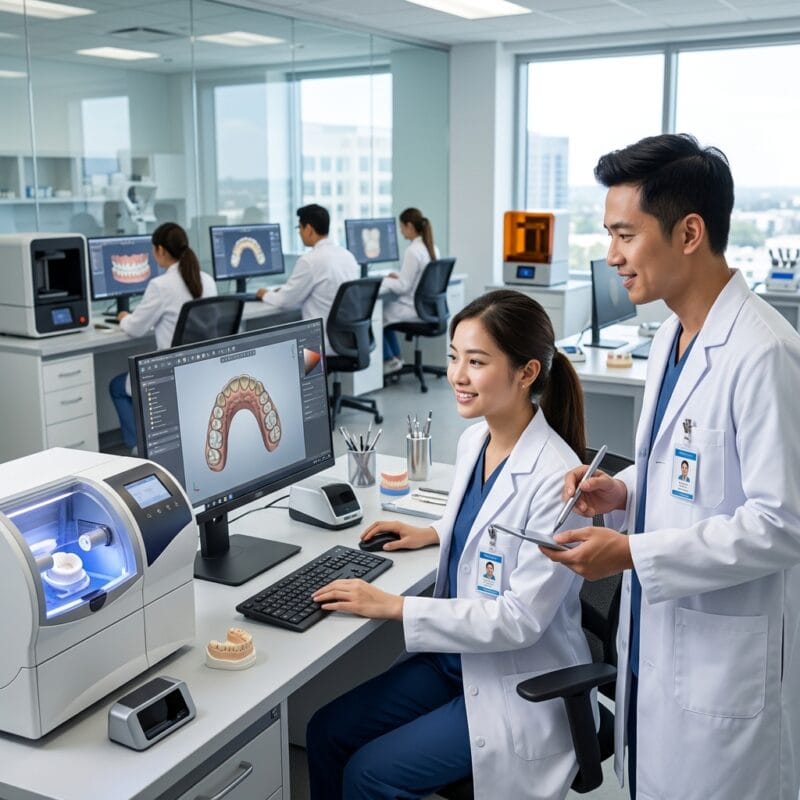
A core pillar of how to start a dental lab in the USA in 2026 is building a modern technological stack that seamlessly ingests digital impression files from any clinical intraoral scanner on the market (such as Medit, iTero, TRIOS, or Carestream). Your lab must establish secure cloud portals or FTP setups where clinicians can drop STL, PLY, or OBJ files alongside digital Rx prescriptions.
Software integration represents your operational brain. Open-architecture software platforms such as exocad have become industry standards for restorative CAD design, allowing dental labs to design everything from simple single-unit crowns to full-arch implant bridges, night guards, and custom abutments. Understanding how to start a dental lab in the USA in 2026 requires knowing which software modules (e.g., Crown & Bridge, Implant Module, Bite Splint, Denture Module) are essential for your planned service offerings.
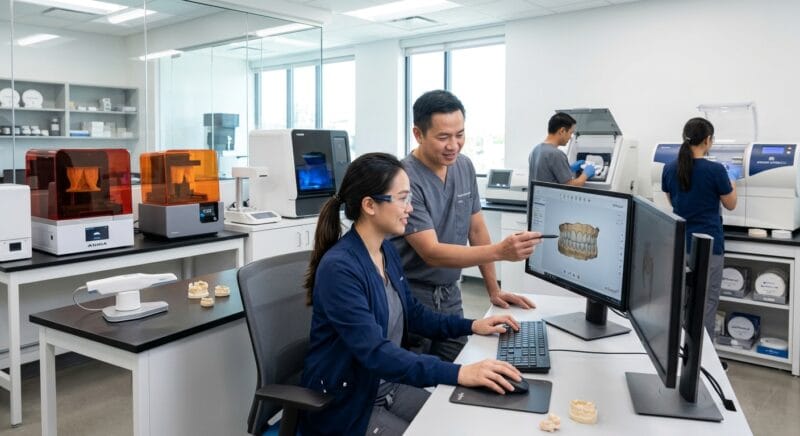
On the hardware side, manufacturing equipment should be matched carefully to your initial capital budget. Anyone analyzing how to start a dental lab in the USA in 2026 must budget for hardware based on production goals:
- 3D Printers: Desktop DLP or LCD resin 3D printers for manufacturing working models, surgical guides, diagnostic wax-ups, and flexible night guards.
- 5-Axis Milling Machines: Dry milling units for zirconia disc processing, and wet milling units for titanium custom abutments, glass ceramics, and PMMA temporaries.
- Sintering Furnaces: High-temperature firing ovens required to crystallize and sinter zirconia restorations to their full flexural strength.
- Finishing & Glazing Stations: Ergonomic bench stations equipped with high-speed handpieces, dust extraction, ceramic stain kits, and porcelain firing ovens.
How does CAD/CAM outsourcing reduce startup costs for new dental labs?
CAD/CAM design outsourcing reduces startup costs for new dental laboratories by eliminating the need to hire full-time internal digital designers and purchase expensive software licenses during early-stage operations. For an emerging business owner researching how to start a dental lab in the USA in 2026, staffing costs represent the single largest financial hurdle. Experienced CAD designers in the U.S. command substantial hourly wages, benefits, and ongoing training expenses, which can quickly drain working capital before case volume stabilizes.
Therefore, learning how to start a dental lab in the USA in 2026 through remote CAD design partnerships transforms a fixed overhead expense into a predictable, pay-per-case variable cost. Instead of paying a full-time designer regardless of daily file volume, you pay only when a clinical scan is received and designed. This model drastically lowers your financial break-even point and allows startup labs to operate profitably even with a modest initial roster of clinical clients.
When discovering how to start a dental lab in the USA in 2026, labor costs are a major barrier that outsourcing completely bypasses. Partnering with an expert CAD team grants your lab immediate access to master-level design capability across every dental discipline without the headache of recruitment and staff retention. Outsourcing crown and bridge, night guards, or full arch denture design gives you immediate scale. This tactic redefines how to start a dental lab in the USA in 2026 by reducing fixed costs while elevating clinical outcome precision.
In evaluating how to start a dental lab in the USA in 2026, handling complex custom implant abutment workflows requires expert CAD designers who understand emergency profiles, screw-retained library alignments, and tissue contours. By leveraging dedicated design specialists, a newly established dental lab can accept complex full-mouth reconstructions and surgical guide requests on day one, competing directly with established national laboratories on quality and design speed.
Navigating Regulatory Compliance and Quality Standards in 2026
For lab owners studying how to start a dental lab in the USA in 2026, quality control and compliance are non-negotiable foundations. Because dental prosthetics interact directly with human tissue, clinical regulatory enforcement has intensified. The U.S. market demands meticulous documentation of material origin, biocompatibility standards, and clinical turnarounds.
Organizations like the American Dental Association emphasize standard of care and material safety across restorative dentistry. Thus, knowing how to start a dental lab in the USA in 2026 requires strict traceability of all zirconia discs, PMMA resins, implant interface components, and ceramic stains back to FDA-cleared manufacturers. Installing a comprehensive Quality Management System (QMS) ensures that every restoration shipped from your laboratory includes a lot-tracked material certificate for the ordering dentist.
Documenting workflows is equally vital. A critical piece of how to start a dental lab in the USA in 2026 is building standard operating procedures (SOPs) for digital file validation, clinical margin checks, post-milling inspections, and final occlusion verification. Establishing standardized quality protocols prevents costly remakes, protects your reputation among local clinicians, and streamlines eventual certification through national bodies such as the National Board for Certification in Dental Laboratory Technology (NBC).
Building Relationships with Clinicians and DSOs
A vital aspect of how to start a dental lab in the USA in 2026 is securing long-term clinical clients through strategic marketing and value-driven sales relationships. The modern dentist does not simply want a supplier; they want an authoritative technical partner who can help solve clinical challenges, troubleshoot intraoral scans, and ensure predictable patient seating times.
Understanding how to start a dental lab in the USA in 2026 tailored for Dental Support Organizations (DSOs) requires offering scalable digital workflows and standardized pricing matrices.