Understanding the Economics of Modern Dental Manufacturing
The dental industry is undergoing a profound transformation as we navigate through 2026. One of the most critical financial considerations for laboratory owners and dental service organizations is the evolving relationship between labor cost vs material cost dental lab 2026. As technology advances, the traditional models of production are being challenged by new digital workflows that promise efficiency but require significant upfront investment. Understanding these dynamics is essential for anyone looking to maintain profitability in a competitive market.
When we analyze the financial structure of a typical dental lab, we see two dominant cost centers. The first is the labor required to design, mill, and finish restorations. The second is the raw materials used, such as zirconia, lithium disilicate, or titanium. Historically, labor has been the heavier burden due to the skilled technicians needed for hand-finishing. However, the rise of automation and AI-driven design is shifting this balance. This shift is central to the conversation around labor cost vs material cost dental lab 2026.
For many lab owners, the pressure to reduce overhead is immense. DSOs are demanding faster turnaround times and lower prices, which squeezes margins. To survive, labs must optimize every aspect of their operations. This includes re-evaluating how they source materials and how they manage their design teams. The decision to outsource digital design is often a direct response to these pressures. By moving design work to specialized partners, labs can convert fixed labor costs into variable costs, aligning expenses more closely with revenue.
The year 2026 brings specific challenges and opportunities. Supply chain stability has improved, but material prices remain volatile due to global economic factors. Meanwhile, labor shortages in skilled dental technology persist in many regions. This scarcity drives up wages for in-house designers, exacerbating the issue of labor cost vs material cost dental lab 2026. Consequently, many operators are looking toward offshore or remote design centers to access talent at competitive rates without compromising quality.
It is also important to consider the impact of regulatory changes. New standards for digital prescriptions and material safety are being implemented. These regulations often require more documentation and quality control steps, which can increase labor hours. If a lab relies heavily on manual processes, these new requirements can significantly inflate costs. Digital outsourcing partners often have systems in place to handle compliance efficiently, reducing the labor burden on the primary lab. This efficiency is a key factor when comparing labor cost vs material cost dental lab 2026.
Furthermore, the integration of artificial intelligence into design software is changing the skill set required. AI can now handle routine adjustments and margin line identification, reducing the time a human designer needs to spend on each case. This technological leap allows labs to process more cases with fewer staff members. However, it requires a strategic shift in how labor is valued. The focus moves from manual dexterity to oversight and complex problem-solving. This evolution is reshaping the labor cost vs material cost dental lab 2026 landscape.
Material costs are also becoming more sophisticated. New high-strength ceramics and polymers are entering the market. While these materials offer better clinical outcomes, they often come with higher price tags. Labs must weigh the benefit of premium materials against the increased expense. In some cases, the savings from reduced labor due to easier milling properties can offset the higher material cost. This trade-off is a central theme in the labor cost vs material cost dental lab 2026 analysis.
As we move deeper into the year, the data suggests that labs which embrace digital outsourcing are seeing better margins. They are able to scale production without proportionally increasing their labor headcount. This scalability is crucial for meeting the fluctuating demands of DSOs. The ability to ramp up design capacity quickly without hiring and training new staff is a significant advantage. This advantage directly impacts the ratio of labor cost vs material cost dental lab 2026.
Another factor to consider is the cost of errors. In a traditional workflow, a design error might not be caught until the restoration is milled and tried in the mouth. This results in remakes, which double the labor and material costs for that case. Outsourced design teams often use advanced verification tools to catch errors before production. This reduces the remake rate and protects the bottom line. Lowering the remake rate is an effective way to manage labor cost vs material cost dental lab 2026.
Training is another hidden labor cost. Keeping a team updated on the latest software and material trends requires time and money. Outsourcing partners invest heavily in training their designers to stay ahead of the curve. This means the client lab benefits from cutting-edge expertise without the direct training expense. This indirect savings contributes to the overall financial picture regarding labor cost vs material cost dental lab 2026.
Ultimately, the decision comes down to strategic alignment. Labs that view design as a core competency might keep it in-house. However, those focused on manufacturing efficiency often find outsourcing more beneficial. The key is to model the costs accurately. By tracking every hour and every gram of material, labs can see the true impact of their choices. This data-driven approach is necessary to navigate the complexities of labor cost vs material cost dental lab 2026.
As we examine specific case studies, the trends become even clearer. Large labs are consolidating design operations to central hubs. Smaller labs are partnering with multiple design firms to spread risk. Both strategies aim to optimize the financial equation. The result is a market where digital design is increasingly viewed as a commodity rather than a custom service. This commoditization drives prices down, further influencing the labor cost vs material cost dental lab 2026 dynamic.
What is the primary driver of lab expenses in 2026?
The primary driver of lab expenses in 2026 is the rising cost of skilled labor combined with the need for advanced digital infrastructure.
While material prices fluctuate, the human element remains the most consistent and growing expense. Technicians and designers require competitive salaries to retain talent in a tight market. Additionally, the software and hardware needed to support digital workflows represent a significant capital expenditure. When you add the cost of maintenance and updates, the total cost of ownership for in-house systems is high. This makes the comparison of labor cost vs material cost dental lab 2026 even more critical for budgeting.
Many labs find that the initial investment in scanners and mills is offset by the ongoing labor costs. A single high-end milling machine might cost tens of thousands of dollars, but it requires a skilled operator to run it effectively. If that operator is underutilized, the cost per unit skyrockets. Outsourcing allows labs to pay only for the design work they need, avoiding idle time. This flexibility helps manage the labor cost vs material cost dental lab 2026 equation more effectively.
Energy costs are also playing a role in the overall expense structure. Running multiple milling machines and furnaces consumes significant power. In some regions, energy prices have risen sharply, adding to the overhead. This operational cost is often grouped with labor in financial reports because it supports the production floor. As labs look to cut costs, they scrutinize every line item. This scrutiny brings the focus back to the balance of labor cost vs material cost dental lab 2026.
Waste management is another area where costs are accumulating. Disposal of chemical waste from polishing and finishing processes is regulated and expensive. Digital workflows reduce the need for some of these chemicals, but they do not eliminate them entirely. Labs that rely on analog finishing steps incur higher waste disposal fees. Transitioning to fully digital designs can reduce these fees, but it requires a shift in the production process. This shift impacts the overall calculation of labor cost vs material cost dental lab 2026.
Insurance and liability costs are also increasing. As digital prescriptions become the standard, the risk of transmission errors or software failures is a concern. Labs need coverage that protects against these digital risks. The premiums for such coverage are rising. This adds to the fixed costs that must be covered by each case. To maintain profitability, labs must either raise prices or reduce internal costs. Reducing internal costs often leads to a re-evaluation of labor cost vs material cost dental lab 2026.
Real estate is a major factor for physical labs. Rent and property taxes continue to rise in many urban areas where labs are located. Space is needed for equipment, storage, and staff. If a lab can reduce its physical footprint by outsourcing design, it can save on rent. This savings can be redirected to other areas of the business. This strategic move is a direct response to the pressures of labor cost vs material cost dental lab 2026.
Inventory management costs are also significant. Holding stock of various material blocks and consumables ties up capital. If materials expire or become obsolete, that capital is lost. Just-in-time inventory models are becoming more popular to mitigate this risk. Outsourcing partners often handle their own inventory, reducing the burden on the lab. This reduction in inventory overhead is a subtle but important factor in the labor cost vs material cost dental lab 2026 discussion.
Marketing and customer acquisition costs are rising as competition increases. Labs must spend more to attract new dentist clients. This cost is separate from production but affects the overall margin. To compensate, production costs must be kept low. This pressure forces labs to look closely at every expense. The most significant expenses are labor and materials. Therefore, the focus remains on labor cost vs material cost dental lab 2026.
Finally, the cost of compliance and certification is a growing expense. Labs must maintain accreditation to work with major insurance providers and DSOs. This requires regular audits and documentation. The staff time dedicated to maintaining compliance is a form of labor cost. If this time is diverted from production, it reduces capacity. Outsourcing design can free up staff to focus on compliance or other value-added tasks. This allocation of resources is key to managing labor cost vs material cost dental lab 2026.
How does outsourcing impact your bottom line?
Outsourcing impacts your bottom line by converting fixed labor costs into variable costs and reducing overhead associated with equipment and space.
When a lab outsources its digital design, it removes the need to hire full-time designers for every shift. Instead, it pays per case or per hour of design work. This change in cost structure makes the business more agile. During slow periods, the lab does not pay for unused design capacity. During peak periods, it can scale up without hiring. This flexibility directly improves the profitability ratio related to labor cost vs material cost dental lab 2026.
Additionally, outsourcing reduces the risk of obsolescence. Software updates happen frequently, and keeping a team trained on the latest versions is expensive. An outsourcing partner absorbs this cost. The lab benefits from the latest tools without the investment. This ensures that the design quality remains high without increasing the internal labor burden. This dynamic is a crucial element in the labor cost vs material cost dental lab 2026 strategy.
The speed of turnaround is another financial benefit. Faster design times mean faster production and faster delivery to the dentist. This allows the lab to take on more cases in the same amount of time. Increased volume without increased labor hours leads to higher margins. This efficiency gain is a direct positive impact on the labor cost vs material cost dental lab 2026 metric.
Quality consistency is also improved through outsourcing. Specialized design centers focus solely on design, leading to higher expertise levels. This reduces the number of design-related remakes. Fewer remakes mean less wasted material and less re-work labor. This savings compounds over thousands of cases. It is a significant factor in controlling labor cost vs material cost dental lab 2026.
There is also the benefit of focus. By outsourcing design, the lab can focus on milling and finishing. These are areas where physical presence and equipment are critical. This specialization allows for better utilization of physical assets. When assets are used more efficiently, the cost per unit drops. This reduction in unit cost helps balance the labor cost vs material cost dental lab 2026 equation.
Moreover, outsourcing can provide access to global talent. A lab in a high-cost region can access designers in regions with lower labor costs. This arbitrage is a powerful tool for cost reduction. It allows the lab to offer competitive prices to clients while maintaining margins. This strategy is a direct response to the challenges of labor cost vs material cost dental lab 2026.
However, it is important to manage the relationship carefully. Poor communication with an outsourcing partner can lead to errors and delays. Labs must establish clear protocols and quality checks. Investing in these processes is a form of labor cost, but it is often less than the cost of in-house staff. When managed well, the net effect is positive for the labor cost vs material cost dental lab 2026 analysis.
Financial forecasting becomes easier with outsourcing. Since design costs are variable, they are easier to predict based on case volume. This improves cash flow management. Labs can plan for slow months without worrying about fixed salary commitments. This financial stability is a long-term benefit that supports the overall business health. It reinforces the importance of analyzing labor cost vs material cost dental lab 2026.
Finally, outsourcing allows for rapid adoption of new technologies. If a new design algorithm or material is released, an outsourcing partner can integrate it quickly. The lab does not need to wait for internal training. This agility keeps the lab competitive. Staying competitive is essential for maintaining volume and margins. This competitive edge is tied to the efficiency gains from managing labor cost vs material cost dental lab 2026.
Why are DSOs shifting to digital design partners?
DSOs are shifting to digital design partners to standardize quality, reduce costs, and scale operations across multiple locations efficiently.
Dental Service Organizations operate on a model that requires consistency and efficiency. They manage many practices and need predictable outcomes. In-house design varies by location, leading to inconsistencies. Digital design partners provide a standardized workflow for all cases. This standardization reduces errors and improves patient satisfaction. For DSOs, this consistency is worth the investment. It helps them manage the labor cost vs material cost dental lab 2026 across their network.
Centralized design hubs allow DSOs to negotiate better rates. By consolidating design work, they gain leverage with providers. This leads to lower per-case costs. Lower costs mean higher margins for the DSO. This financial advantage is a primary reason for the shift. It aligns with the broader industry trend of optimizing labor cost vs material cost dental lab 2026.
DSOs also benefit from reduced training requirements. They do not need to train designers at every location. The partner handles the training and certification. This reduces the administrative burden on the DSO. It simplifies the management structure. This simplification contributes to the overall cost savings related to labor cost vs material cost dental lab 2026.
Furthermore, digital partners often offer analytics. They can provide data on case types, turnaround times, and error rates. This data helps DSOs make informed decisions. They can identify trends and optimize their workflows. Data-driven decisions lead to better financial performance. This performance is measured against the benchmarks of labor cost vs material cost dental lab 2026.
The shift also supports sustainability goals. Digital workflows reduce waste and energy consumption compared to traditional methods. DSOs are increasingly focused on environmental impact. Partnering with digital-first labs aligns with these goals. This alignment enhances the brand reputation. A strong reputation attracts more clients, which drives volume. Volume drives efficiency, which impacts labor cost vs material cost dental lab 2026.
Integration with practice management software is another driver. Digital partners often have APIs that connect directly to DSO systems. This seamless flow reduces manual data entry. Reduced data entry means less administrative labor. This reduction in admin time is a hidden saving. It adds to the total savings calculated in labor cost vs material cost dental lab 2026.
DSOs also face pressure from payers to lower costs. Insurance companies are demanding lower fees for restorations. To maintain profitability, DSOs must reduce their internal costs. Outsourcing design is a key strategy to achieve this. It allows them to meet payer demands without sacrificing quality. This strategy is central to the labor cost vs material cost dental lab 2026 narrative.
Scalability is perhaps the most important factor. As DSOs grow, they need to add capacity quickly. Hiring and training staff takes time. Outsourcing provides instant capacity. This allows for rapid expansion. Rapid expansion leads to market dominance. Market dominance leads to better pricing power. This cycle is fueled by the efficiency gains in labor cost vs material cost dental lab 2026.
Finally, risk management is improved. If a specific location has a design bottleneck, the partner can redirect work to another center. This flexibility prevents delays. Delays can cost money and damage relationships. Preventing delays protects the bottom line. This protection is a vital component of the labor cost vs material cost dental lab 2026 strategy.
What are the hidden costs of in-house design?
The hidden costs of in-house design include software licensing, equipment maintenance, staff turnover, and compliance training.
Software licenses for design programs are expensive and often renewed annually. These costs add up over time and are sometimes overlooked in budgeting. Equipment maintenance requires service contracts and spare parts. If a machine breaks down, production stops, leading to lost revenue. Staff turnover is high in technical roles, requiring constant recruitment and onboarding. Each new hire takes weeks to become fully productive. This downtime is a significant hidden cost.
Compliance training is another area. Staff must be trained on new regulations and safety protocols. This training takes time away from production. If not done correctly, it can lead to fines or legal issues. These risks have financial implications. All these hidden costs contribute to the total labor expense. They make the comparison of labor cost vs material cost dental lab 2026 more complex than it appears.
There is also the cost of opportunity. If a designer spends time on routine tasks, they cannot focus on complex cases. This limits the lab’s ability to take on high-margin work. Outsourcing routine work frees up internal staff for high-value tasks. This shift in focus can increase revenue. Increased revenue helps offset the costs of materials. This balance is key to the labor cost vs material cost dental lab 2026 equation.
Space utilization is another hidden factor. Design stations take up floor space. That space could be used for production or storage. If the lab has to rent more space to accommodate designers, that is an added cost. Outsourcing reduces the need for physical design stations. This reduction in space needs saves money. This savings is part of the broader financial picture of labor cost vs material cost dental lab 2026.
Utility costs are also higher with in-house design. Computers and servers consume electricity and generate heat. This increases cooling costs in the lab. Outsourcing removes this load from the lab’s facilities. Lower utility bills contribute to lower overhead. Lower overhead improves the margin. This improvement is a direct result of managing labor cost vs material cost dental lab 2026 effectively.
Finally, the cost of knowledge loss is significant. When a senior designer leaves, they take institutional knowledge with them. Replacing this knowledge takes time and effort. Outsourcing partners retain this knowledge within their organization. This continuity ensures consistent quality. Consistent quality reduces remakes. Fewer remakes save money. This saving is a critical component of the labor cost vs material cost dental lab 2026 analysis.
Strategic Planning for Future Cost Management
Strategic planning for future cost management requires a clear understanding of current workflows and a commitment to continuous improvement.
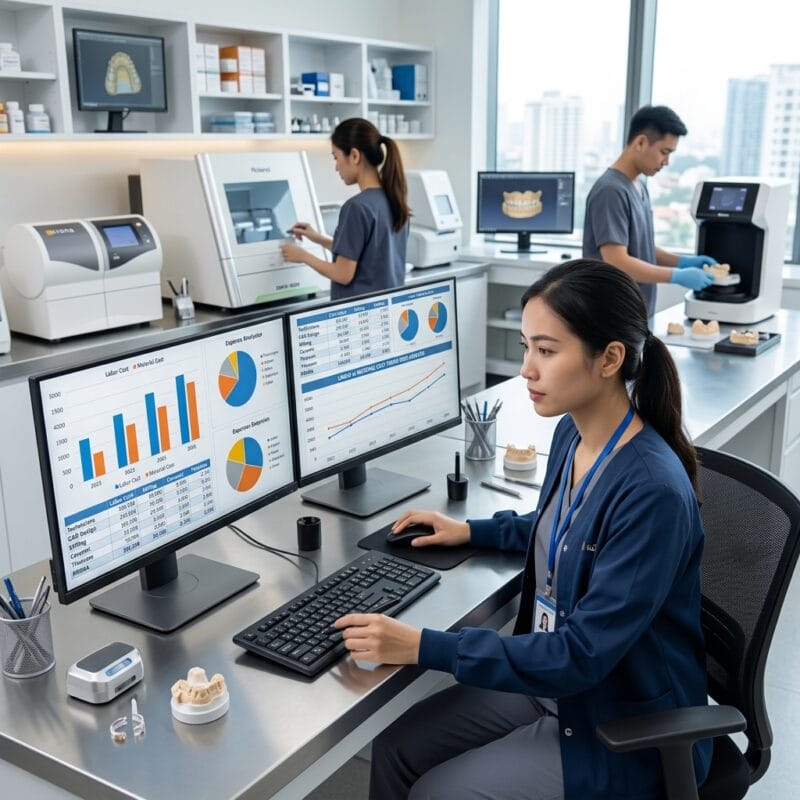
Labs must regularly review their financial data to identify inefficiencies. This review should include a breakdown of labor and material costs. By tracking these metrics over time, trends become visible. Trends help in forecasting future expenses. Accurate forecasting allows for better budgeting. Better budgeting prevents unexpected financial strain. This process is essential for managing labor cost vs material cost dental lab 2026.
Investing in automation is a key strategy. Automated workflows reduce the need for manual intervention. This reduces labor hours per case. While automation requires upfront investment, the long-term savings are significant. The return on investment should be calculated carefully. It should be compared to the cost of outsourcing. This comparison informs the decision on labor cost vs material cost dental lab 2026.
Collaboration with suppliers is also important. Working closely with material vendors can lead to better pricing. Suppliers may offer discounts for bulk orders or long-term contracts. These discounts reduce material costs. Lower material costs improve the margin. This improvement helps balance the labor costs. This balance is the core of labor cost vs material cost dental lab 2026.
Training staff on efficient workflows is another step. Even with the same tools, different techniques can save time. Training ensures that staff use the best methods. Efficient methods reduce labor hours. Reduced hours mean lower costs. This reduction is a direct impact on labor cost vs material cost dental lab 2026.
Finally, staying informed about industry trends is crucial. The market changes rapidly, and new solutions emerge regularly. Keeping up to date allows labs to adopt new technologies early. Early adoption can provide a competitive edge. This edge leads to better pricing and higher volume. Higher volume spreads fixed costs over more units. This spreading of costs is vital for the labor cost vs material cost dental lab 2026 strategy.
By following these strategies, labs can navigate the financial challenges of 2026. They can maintain profitability while delivering high-quality care. The key is to remain flexible and proactive. Proactive management prevents small issues from becoming big problems. This proactive approach is the best defense against rising costs. It ensures that the balance of labor cost vs material cost dental lab 2026 remains favorable.
For more information on digital workflows, you can visit the American Dental Association at https://www.ada.org to review their guidelines on digital dentistry.
Additionally, exploring the capabilities of modern design software can help you make informed decisions. Check out https://www.3shape.com to see how leading tools are shaping the industry.
As you consider these options, remember that every lab is unique. What works for one may not work for another. Customization is key to success. Tailoring your strategy to your specific needs will yield the best results. This customization ensures that you address the specific nuances of labor cost vs material cost dental lab 2026 in your context.
Many labs have found success by starting small. They outsource a portion of their design work to test the waters. If the results are positive, they increase the volume. This gradual approach minimizes risk. It allows for adjustment as needed. This flexibility is a hallmark of a well-managed lab. It supports the long-term goal of optimizing labor cost vs material cost dental lab 2026.
In conclusion, the landscape of dental lab economics is changing. Those who adapt will thrive. Those who resist may struggle. The tools are available to make this transition. The knowledge is there to guide you. Use these resources to build a sustainable business. A sustainable business is one that manages its resources wisely. This wisdom is the foundation of managing labor cost vs material cost dental lab 2026.
Whether you choose to outsource or keep work in-house, the goal is the same. You want to deliver value to your clients efficiently. Efficiency is the key to profitability. Profitability ensures your business can grow. Growth allows you to serve more patients. Serving more patients improves oral health. This cycle is the ultimate reward of managing labor cost vs material cost dental lab 2026.
We hope this analysis provides clarity on the current financial environment. It is our goal to support your journey. We are here to help you make the right choices. Contact us to discuss your specific needs.
Ready to optimize your lab economics? Contact our team today for a custom cost analysis and free consultation.