Navigating Dental Lab Startup Costs in the USA 2026
Entering the commercial dental laboratory market in the United States requires a clear understanding of evolving technology, real estate dynamics, material supply chains, and labor structures. As intraoral scanning becomes the universal standard across general practices and Dental Support Organizations (DSOs), the modern laboratory must be built from the ground up as a digital-first enterprise. Consequently, analyzing dental lab startup costs in the USA 2026 requires looking beyond traditional bench tools like plaster traps, articulators, and handpieces. Today’s commercial lab founders must account for sophisticated digital equipment, complex software licensing, specialized facility retrofitting, and high-performance computing hardware.
The economic landscape of 2026 presents unique financial parameters for dental laboratory entrepreneurs. While rapid advancements in additive manufacturing and automated milling lowered technical entry barriers, rising real estate commercial lease rates, inflation in raw ceramic and alloy materials, and intense competition for qualified dental technicians have reshaped initial capital requirements. Estimating prospective dental lab startup costs in the USA 2026 requires evaluating both traditional operational expenses and modern digital workflow investments. Whether building an enterprise-scale production facility or a specialized boutique laboratory, founders must carefully allocate capital between fixed capital expenditures (CapEx) and dynamic operational expenditures (OpEx).
A central challenge when evaluating modern dental lab startup costs in the USA 2026 is balancing initial machinery purchases with long-term profitability. Equipping a commercial lab with high-precision benchtop scanners, 5-axis milling units, zirconia sintering furnaces, high-speed 3D printers, and specialized software licenses demands significant capital upfront. However, strategic operational frameworks—such as integrating offsite digital design partners—allow new laboratories to reduce initial financial risks without sacrificing restoration quality or turn-around times. This comprehensive analysis breaks down every financial line item required to launch a competitive dental laboratory in the United States in 2026.
Facility Acquisition, Leasehold Improvements, and Environmental Infrastructure
Securing a physical location and tailoring it to meet medical device manufacturing standards represents one of the foundational financial obligations when planning dental lab startup costs in the USA 2026. While pure digital design studios can operate in smaller, commercial office spaces, production facilities that house wet/dry milling units, ceramic ovens, and 3D printing post-processing stations demand specialized mechanical, electrical, and plumbing (MEP) infrastructure.
Commercial lease agreements for light industrial or flex-office spaces suited for medical laboratories typically range from $18 to $35 per square foot annually, depending on the metropolitan area. A modest 1,500 to 2,500 square foot facility requires significant preliminary capital investment prior to processing its first case. Leasehold improvements represent a substantial portion of overall dental lab startup costs in the USA 2026, often encompassing:
- High-Capacity Electrical Upgrades: Commercial 5-axis milling machines, high-temperature sintering furnaces, and heavy-duty dust collection units require three-phase 220V/240V power infrastructure. Electrical panel upgrades and dedicated circuitry installation routinely cost between $8,000 and $18,000.
- Dedicated Compressed Air & Vacuum Systems: Digital milling equipment relies on clean, dry, oil-free compressed air running continuously at precise atmospheric pressures. Medical-grade rotary screw air compressors outfitted with desiccant air dryers cost between $6,000 and $14,000. Centralized dust extraction systems engineered to capture hazardous zirconia, ceramic, and PMMA micro-particulates range from $5,000 to $12,000.
- Plumbing and Environmental Controls: Wet milling machines require specialized water supply, filtration, and coolant drainage systems. Furthermore, city commercial building codes require dedicated plaster traps and hazardous waste management disposal setups, adding $4,000 to $9,000 to physical facility renovation budgets.
- HVAC and Climate Control: Precision milling machinery and 3D printing resins are sensitive to ambient room temperatures and humidity fluctuations. Upgrades to thermal management and air filtration systems contribute another $7,000 to $15,000 to your total baseline dental lab startup costs in the USA 2026.
Digital CAD/CAM Hardware Investment Requirements
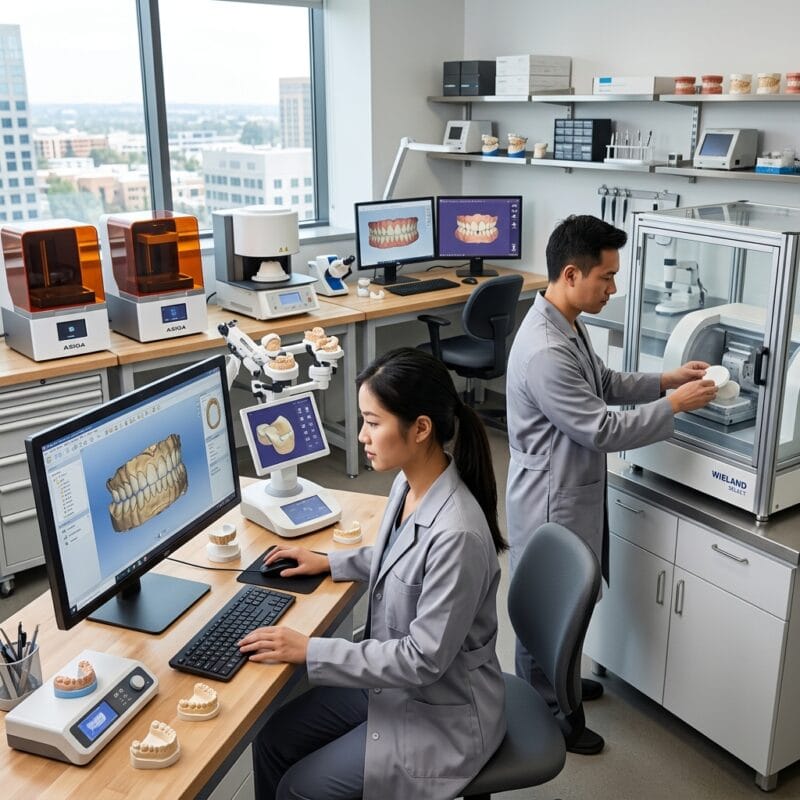
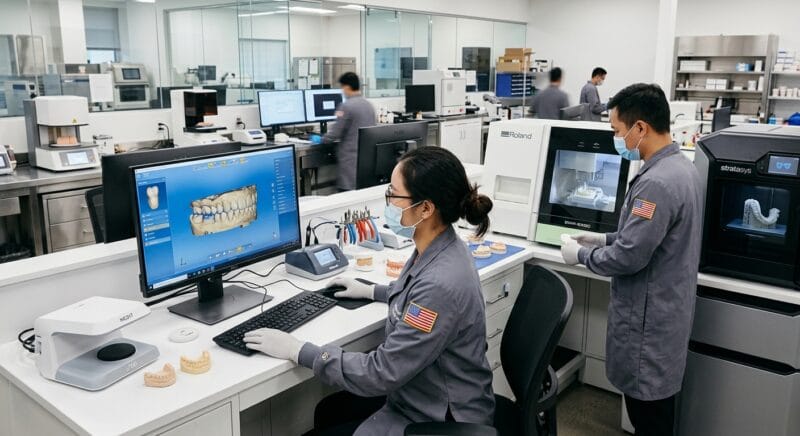
Hardware acquisition represents the largest single capital expenditure when calculating overall dental lab startup costs in the USA 2026. In a digital-first ecosystem, the mechanical hardware pipeline dictates both daily output capacities and the scope of clinical restoration types a laboratory can offer.
Benchtop Optical Laboratory Scanners
While clinicians submit intraoral digital scans via open formats, a laboratory still requires high-precision optical benchtop scanners to digitize traditional physical impressions, master stone models, bite registrations, and implant verification jigs. Highly accurate laboratory scanners equipped with multi-axis articulated arms and dual-camera blue light technology range between $8,000 and $22,000 per unit, depending on scan speed and resolution capabilities.
5-Axis CAD/CAM Milling Units
Production laboratories must decide between dry milling, wet milling, or hybrid dual-use units. Dry 5-axis milling units designed specifically for zirconia, PMMA, and wax discs cost between $25,000 and $55,000. Wet milling units designed to process glass-ceramics (lithium disilicate), titanium pre-milled abutments, and cobalt-chrome bridges range from $32,000 to $65,000. High-volume automated facilities often deploy standalone heavy-duty industrial units featuring automatic disc changers, pushing equipment costs beyond $90,000 per mill. These hardware investments form a core pillar of total dental lab startup costs in the USA 2026.
Sintering Furnaces and Porcelain Ovens
Zirconia restorations require specialized high-temperature sintering furnaces capable of reaching 1,600°C with precise thermal ramping profiles. High-speed sintering furnaces capable of processing bridge frameworks in under two hours cost between $9,000 and $22,000. Traditional ceramic porcelain ovens used for hand-layering, pressing lithium disilicate, and applying ceramic glazes cost between $4,500 and $11,000 each.
3D Printers and Automated Post-Processing Units
Additive manufacturing is indispensable for printing diagnostic models, surgical guides, night guards, try-ins, and flexible denture bases. Commercial DLP (Digital Light Processing) or SLA (Stereolithography) 3D printers engineered for high-precision dental applications cost between $3,500 and $16,000 per printer. Essential automated washing and UV light polymerization post-curing stations add an additional $1,500 to $4,000 per production line, making additive hardware a key line item in modern dental lab startup costs in the USA 2026.
CAD/CAM Software Licensing, IT Infrastructure, and Cybersecurity
Modern dental laboratory operations depend heavily on advanced software applications. Navigating software licensing models, graphic workstation hardware requirements, network security, and data storage solutions constitutes a significant operational expenditure in calculated dental lab startup costs in the USA 2026.
Dental computer-aided design (CAD) platforms typically operate under initial module purchasing fees paired with mandatory annual software updates and support contracts. Leading CAD suites like exocad offer powerful open-architecture modules for crown and bridge, custom implant abutments, removable partial dentures, and orthodontic applications. Perpetual licensing for full-featured design software suites ranges from $6,000 to $14,000 upfront, with recurring annual license renewal fees ranging from $1,500 to $3,200.
In addition to CAD software, computer-aided manufacturing (CAM) software (such as MillBox or HyperDENT) is required to translate 3D design files into multi-axis toolpaths for milling machines. CAM software license packages add $4,000 to $9,000 to initial software expenditures. Operating these intensive graphic packages requires specialized high-performance computer workstations equipped with multi-core processors, high-end graphics processing units (GPUs), and at least 32GB to 64GB of RAM, running $2,200 to $4,500 per design workstation.
Furthermore, secure laboratory management software (LMS) for case tracking, billing, digital file ingestion, and doctor communications costs between $150 and $500 monthly. Secure local server architecture paired with HIPAA-compliant cloud backup services for storing massive 3D STL, PLY, and DICOM files contributes an extra $3,000 to $7,000 to baseline technology setup costs within complete dental lab startup costs in the USA 2026 projections.
Consumable Inventory, Raw Materials, and Tooling Capital
Prior to accepting clinical cases, a new lab must build an adequate inventory of raw materials, milling burs, finishing abrasives, and dental laboratory supplies. Initial stock requirements scale directly with target production volume, representing a key variable when analyzing initial dental lab startup costs in the USA 2026.
Disc and Block Raw Material Stock
A comprehensive inventory of raw materials requires stocking diverse ceramic shade gradient zirconia discs (multi-layered highly translucent zirconia, high-strength structural zirconia), PMMA discs for long-term temporaries, wax discs for casting, and lithium disilicate blocks. Initial inventory stocking for a versatile medium-capacity facility costs between $8,000 and $18,000.
Implant Components and Titanium Stocks
Offering implant-supported restorations requires purchasing titanium stock bases (Ti-bases), pre-milled titanium abutment blanks, analog components, scanning bodies, and prosthetic screws across major clinical implant systems. An initial multi-brand implant component library inventory requires an investment of $6,000 to $15,000.
3D Printing Resins and Milling Tooling
Biocompatible Class IIa resins for night guards and surgical guides, alongside high-precision model resins, cost between $150 and $350 per liter disc pack. Specialized carbide and diamond-coated milling burs designed for specific mill spindles wear down quickly and require continuous replenishment; initial tooling stock demands $2,000 to $5,000. These inventory expenses must be built into total dental lab startup costs in the USA 2026 estimates.
Regulatory Compliance, FDA Registration, ISO Certification, and Legal Overhead
Operating a medical device manufacturing facility in the United States requires strict adherence to federal and state regulations. Commercial dental laboratories that manufacture custom prosthetic devices are regulated by federal safety frameworks, impacting overall dental lab startup costs in the USA 2026.
According to clinical and public health guidance provided by the American Dental Association, custom-made dental prosthetics must meet rigorous quality standards to guarantee patient safety and biocompatibility. Primary regulatory, legal, and risk-management compliance line items include:
- FDA Registration and Quality System Requirements: Laboratories that design or manufacture custom medical devices, surgical guides, or implant abutments must register annually with the U.S. Food and Drug Administration (FDA) as a medical device manufacturer. The annual FDA Establishment Registration fee for fiscal year 2026 is approximately $7,000 to $9,000. In addition, setting up an FDA-compliant Quality System Regulation (QSR 21 CFR Part 820) framework typically requires specialized legal or regulatory consulting services costing $5,000 to $12,000.
- State Licensing and Environmental Safety: State dental board registrations, hazardous material handling permits, and OSHA workplace air quality monitoring compliance add $1,500 to $4,000 in initial operational expenditures.
- Commercial and Professional Liability Insurance: Comprehensive general liability, commercial property coverage, cybersecurity risk insurance, and professional product liability coverage protect against clinical fitting errors or structural device failures. Comprehensive annual insurance policies cost between $4,000 and $10,000 for a start-up laboratory.
What are average dental lab startup costs in the USA 2026?
Average dental lab startup costs in the USA 2026 range from $85,000 for a streamlined digital design studio to upwards of $500,000 for a fully equipped, high-volume production facility with in-house milling and 3D printing. The actual figure depends on facility scale, hardware choices, software licensing models, and initial labor staffing levels.
How can outsourcing digital CAD design reduce dental lab startup costs in the USA 2026?
Outsourcing digital CAD design lowers initial capital expenditure by eliminating expensive software license fees, high-end design workstations, and master technician payroll overhead. By converting fixed software and labor expenses into a predictable per-case variable cost, new dental labs preserve capital for critical hardware, facility builds, and client acquisition.
What equipment is required to launch a digital dental lab in 2026?
A modern digital dental laboratory requires high-precision laboratory benchtop scanners, CAD/CAM design software, dry or wet 5-axis milling machines, zirconia sintering furnaces, 3D printers, and post-processing curing units. Additional necessary infrastructure includes commercial air compressors, centralized vacuum dust extraction systems, high-temperature porcelain ovens, and specialized handpieces.
Human Capital, Talent Acquisition, and Workforce Overhead
While automation has streamlined dental manufacturing, highly skilled technical labor remains essential for quality control, shade matching, anatomic characterization, and customer communication. Technical labor expenses constitute a significant ongoing operational commitment within projected dental lab startup costs in the USA 2026.
Recruiting experienced CAD design technicians and master ceramicists in the U.S. market is highly competitive. Experienced CAD designers command average annual salaries ranging from $65,000 to $95,000 plus benefits, while senior ceramists and laboratory managers frequently command salaries exceeding $80,000 to $110,000 annually. For a launching laboratory, maintaining full-time technical staff before achieving stable case volume can drastically deplete operational cash reserves.
Consequently, sound financial management dictates maintaining a lean, highly efficient in-house core team focused on final finishing, quality assurance, and client support, while leveraging flexible design support models for labor-intensive CAD design steps during initial growth phases.
Specialized Expense Profiles by Dental Lab Specialty Segment
The operational scope of a new dental laboratory directly dictates its baseline financial requirements. Different prosthetic disciplines demand different machinery, software modules, and raw material inputs. The following sections outline specialized dental lab startup costs in the USA 2026 across core industry sectors.
1. Crown & Bridge Laboratories
Crown and bridge production remains the core service offering for traditional and digital labs alike. A crown and bridge setup prioritizes high-precision 5-axis dry milling for monolithic zirconia, alongside high-speed sintering capability and porcelain staining stations. Baseline equipment capital requirements for a digital crown and bridge operation average $110,000 to $185,000, excluding real estate modifications. Software licensing costs focus heavily on crown and bridge modules, multi-layer ceramic shading kits, and specialized tooth libraries.
2. Implant & Surgical Guide Laboratories
Focusing on full-arch restoration, custom titanium abutments, and precision surgical planning requires specialized design modules and wet milling hardware. Incorporating advanced surgical guide design services demands high-accuracy 3D printing equipment, intraoral scan registration software, and DICOM surgical conversion packages. Startup equipment and software investments for a specialized implant laboratory range between $140,000 and $240,000.
3. Removables & Denture Laboratories
Digital dentures represent one of the fastest-growing sectors in dental technology. Establishing a modern removables laboratory involves digital impression processing, high-impact 3D printing or milling of denture bases, and specialized curing systems. Implementing an end-to-end workflow—including full arch denture CAD design capabilities—demands specialized software modules and high-precision resin printing units, running between $95,000 and $170,000 in startup capital expenditures.
4. Orthodontic & Clear Aligner Laboratories
Orthodontic laboratories emphasize high-volume additive manufacturing over subtractive milling. A clear aligner production facility relies heavily on automated thermoforming vacuum units, multi-printer DLP farms, digital model staging software, and automated edge-trimming milling units. Startup capital for an automated aligner manufacturing lab ranges from $120,000 to $210,000.
Financial Comparison Matrix: In-House Production vs. Hybrid CAD Outsourcing Model
To provide a clear financial roadmap, the matrix below details realistic financial metrics for launching a digital dental laboratory in 2026. It contrasts a fully in-house model—where all design and production hardware is owned—against an agile, hybrid model that leverages specialized CAD outsourcing for digital design workloads.
| Financial Cost Category | Fully In-House Production Setup (2026) | Hybrid Model (Outsourced CAD Design) |
|---|---|---|
| Facility & MEP Buildout | $35,000 – $75,000 | $15,000 – $30,000 |
| Benchtop Scanners & Workstations | $25,000 – $45,000 | $12,000 – $20,000 |
| CAD Software Licenses & Modules | $18,000 – $32,000 (Upfront) | $3,500 – $7,000 (Basic) |
| Milling Hardware (Dry & Wet) | $60,000 – $120,000 | $30,000 – $55,000 (Phase 1) |
| Sintering & Porcelain Furnaces | $18,000 – $35,000 | $12,000 – $22,000 |
| 3D Printing & Post-Curing Infrastructure | $12,000 – $25,000 | $6,000 – $12,000 |
| Initial Material & Component Stock | $15,000 – $30,000 | $8,000 – $15,000 |
| FDA, Insurance, Licensing & Legal | $14,000 – $22,000 | $10,000 – $15,000 |
| In-House CAD Designer Salary (Year 1) | $75,000 – $95,000 (Fixed CapEx/OpEx) | $0 (Pay-per-case variable expense) |
| ESTIMATED TOTAL STARTUP CAPITAL NEEDED | $272,000 – $479,000 | $94,500 – $186,000 |
As illustrated, choosing a hybrid operational model dramatically lowers baseline dental lab startup costs in the USA 2026. By outsourcing complex digital design steps to an expert external partner, new lab owners can cut initial setup capital requirements by over 50%, preserving crucial working capital for client acquisition and business development.
Strategic Roadmap: Optimizing Dental Lab Startup Costs in the USA 2026
Launching a profitable laboratory in 2026 demands a phased execution strategy designed to manage cash flow while building long-term operational capabilities. The following roadmap offers practical guidance for managing dental lab startup costs in the USA 2026 effectively.
Phase 1: Secure Core Digital Ingestion Infrastructure
Focus initial investments on acquiring high-speed digital file transfer capabilities, open-architecture benchtop optical scanners, and secure cloud storage infrastructure. Establishing seamless connections with clinical intraoral scanners ensures immediate compatibility with local dental practices and DSOs without requiring heavy initial hardware commitments.
Phase 2: Establish a Hybrid Digital Design Workflow
Rather than committing massive capital to full software license suites, high-end workstations, and senior designer payroll, partner with an established offsite digital CAD design service provider. This converts fixed overhead costs into predictable, variable, pay-per-case expenses. Your local team focuses on physical model preparation, material nesting, sintering, artistic hand-staining, and final quality control check points.
Phase 3: Scalable Capital Investment Based on Proven Case Volume
As monthly case volumes grow, reinvest profit margins directly into dedicated 5-axis milling units, high-capacity 3D printers, and expanded software modules. Scaling equipment purchases in response to actual case demand eliminates non-performing capital assets and protects cash flow during initial business operations.
Final Financial Outlook: Building a Modern Dental Lab in 2026
Evaluating dental lab startup costs in the USA 2026 requires looking beyond raw equipment expenses to build an agile, scalable operational strategy. While starting a full-service production laboratory requires significant financial backing—often exceeding $350,000—modern digital methodologies offer smarter, leaner pathways to entry. By adopting a hybrid design model, savvy laboratory entrepreneurs can cut upfront capital requirements to under $100,000 while maintaining rapid turnaround times and superior restoration quality. Managing initial fixed overhead allows new commercial laboratories to achieve profitability faster, adapt to market shifts easily, and deliver exceptional value to clinical clients nationwide.
Ready to reduce your dental lab startup costs in 2026? Contact our expert CAD design team today to scale your production with seamless, pay-per-case digital design services.