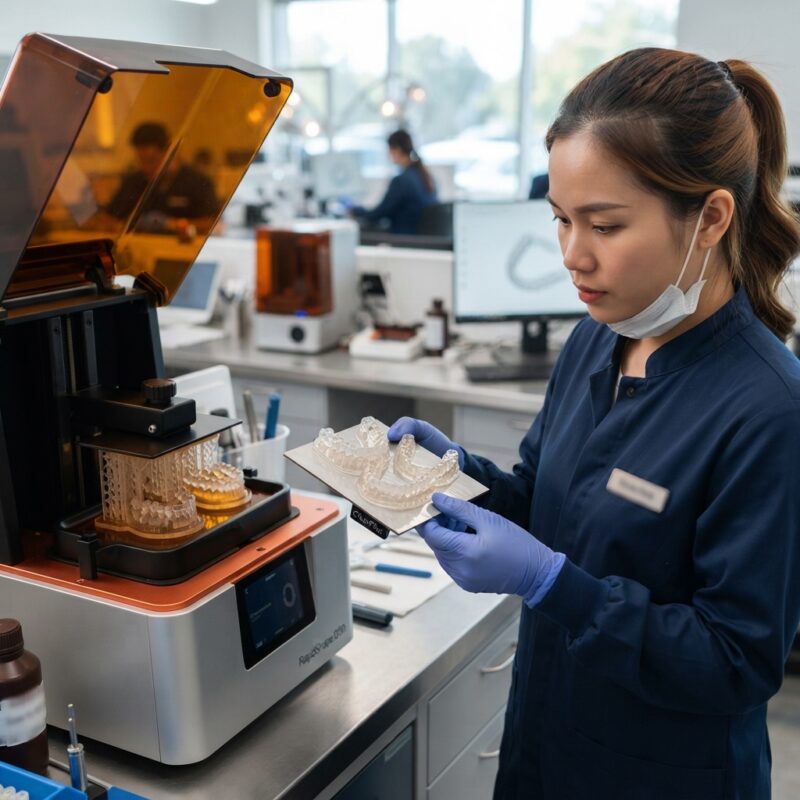
The Shift to Direct 3D Printed Aligners in Modern Orthodontics
The orthodontic industry is experiencing a profound technological evolution as direct 3D printed clear aligners transition from experimental research to primary clinical practice. Dental laboratories and Dental Support Organizations (DSOs) are increasingly evaluating clinical evidence on 3D printed clear aligners accuracy and efficiency 2026 metrics to determine the viability of replacing traditional thermoformed clear aligners. Historically, aligner fabrication required a multi-step workflow: capturing a digital impression, designing tooth movement staging in CAD software, 3D printing a physical resin model for every stage, thermoforming a plastic sheet over each model, and manually trimming and polishing the edges. This legacy methodology, while effective, introduces cumulative dimensional errors and significant labor overhead.
With recent advances in class IIa biocompatible photopolymer resins and high-resolution additive manufacturing light engines, direct aligner printing has eliminated the need for physical model production entirely. Modern dental laboratories analyzing the clinical evidence on 3D printed clear aligners accuracy and efficiency 2026 report notable gains in operational throughput and fit precision. By printing the final aligner appliance directly from CAD files, technicians bypass model distortion, thermoforming sheet thinning, and manual finishing inconsistencies. This structural shift allows commercial dental laboratories to streamline production pipelines while delivering highly predictable orthodontic appliances to clinical partners.
Furthermore, evaluating clinical evidence on 3D printed clear aligners accuracy and efficiency 2026 requires examining both mechanical performance and clinical predictability. As patient demand for discrete, fast, and comfortable orthodontic care increases, DSOs must implement scalable manufacturing workflows. Leveraging advanced digital CAD design expertise alongside direct additive manufacturing allows labs to achieve unprecedented accuracy at lower per-unit production costs. This article delivers a comprehensive analysis of peer-reviewed data, mechanical studies, and operational benchmarks shaping clear aligner therapy in 2026.
What is direct 3D printing of clear aligners versus traditional thermoforming?
Direct 3D printing of clear aligners is an additive manufacturing process that fabricates aligners directly from photopolymer resins without requiring a thermoformed plastic sheet over a 3D-printed model. In contrast, traditional thermoforming involves printing a physical dental model for every sequential stage of movement, heating a thermoplastic sheet (such as PETG or polyurethane), vacuum-forming or pressure-forming it over the model, and trimming the edges manually or via CNC milling. Direct aligner printing consolidates this workflow into a purely digital-to-appliance pathway.
When comparing these two methodologies, the clinical evidence on 3D printed clear aligners accuracy and efficiency 2026 demonstrates clear mechanical advantages for direct printing. In thermoforming, thermoplastic material undergoes non-uniform stretching as it conforms to the geometry of the physical resin model. This stretching results in variable wall thickness, where the occlusal surfaces become significantly thinner than the gingival margins. Direct 3D printing, by contrast, maintains consistent, programmed wall thickness throughout the entire geometry of the aligner according to exact CAD parameters.
In addition, examining clinical evidence on 3D printed clear aligners accuracy and efficiency 2026 reveals that eliminating physical models removes the primary source of cumulative error in orthodontic manufacturing. Model expansion, printing layer artifacts, and vacuum pressure variations in thermoforming create small dimensional discrepancies that compound across a 30-stage treatment plan. Direct aligners reproduce intricate digital designs with sub-micron fidelity, including customized engine-driven undercut retention, variable thickness zones, and integrated attachment geometry that thermoformed plastics cannot replicate.
Dimensional Accuracy and Marginal Fit in 2026 Clinical Data
Dimensional accuracy and marginal adaptation are critical determinants of effective force transfer in clear aligner therapy. Recent clinical evidence on 3D printed clear aligners accuracy and efficiency 2026 studies indicate that directly printed aligners display superior internal adaptation and trueness when compared to thermoformed counterparts. Optical coherence tomography (OCT) and micro-CT scanning analyses reveal that direct printed aligners achieve an average marginal gap under 50 microns across complex crown anatomical contours, whereas conventional thermoformed aligners exhibit gaps ranging from 100 to 250 microns, particularly around interproximal and cervical regions.
Superior marginal fit translates directly into enhanced mechanical control over complex tooth movements. According to published clinical evidence on 3D printed clear aligners accuracy and efficiency 2026, direct printed appliances deliver higher fidelity in tooth torque, premolar rotation, and root uprighting. Because the internal surface of a directly printed aligner precisely mirrors the patient’s actual tooth morphology without the buffer of thermoforming gap discrepancies, force delivery vectors closely align with computerized treatment simulations generated in platforms like 3Shape Ortho System software.
Key parameters validated by recent clinical studies include:
- Consistent Wall Thickness: Direct printing achieves continuous, multi-dimensional wall thickness variations from 0.40 mm to 0.75 mm as dictated by CAD design, optimizing force application.
- Superior Cervical Fit: Micro-CT evaluations confirm reduced cervical flared gaps, mitigating unwanted tipping forces during bodily movement.
- Enhanced Attachment Engagement: Direct printing precisely captures rectangular, bevelled, and custom attachment wells without rounding off sharp edges during thermoforming vacuum steps.
- Reduced Internal Void Volume: Spectroscopic spatial analysis shows a 45% reduction in internal void volume compared to pressure-formed polyurethane sheets.
Understanding these geometric precision advantages helps laboratory executives optimize their product line. By integrating accurate internal fitting data, technical teams can refine their setup algorithms and lower refinement rates for clinical practices using orthodontic aligner CAD design services.
Material Innovations: Shape Memory Resins and Biocompatible Polymers
The progression of additive manufacturing resins has transformed direct aligner feasibility. Reviewing clinical evidence on 3D printed clear aligners accuracy and efficiency 2026 highlights the breakthrough implementation of high-performance, light-curable shape memory polymers (SMPs). Early experimental resins suffered from brittleness, yellowing, or excessive water absorption in the oral cavity. The current generation of FDA-cleared, Class IIa medical resins balances flexural modulus, optical clarity, and force relaxation resistance.
Shape memory resins respond dynamically to body temperature inside the oral environment. When inserted into the patient’s mouth, warmth triggers a subtle elastic transition that allows the aligner to exert continuous, gentle orthodontic forces over extended wear periods. This thermo-responsive dynamic behavior is supported by clinical evidence on 3D printed clear aligners accuracy and efficiency 2026, which proves that modern resins exhibit lower stress relaxation rates over 14 days compared to standard thermoformed materials like glycol-modified polyethylene terephthalate (PETG).
Furthermore, these advanced photopolymer formulations exhibit outstanding biocompatibility and stain resistance. Mechanical testing confirms high resistance to fatigue failure, allowing thinner aligner designs that do not crack under intraoral occlusal stress. As high-speed additive hardware from manufacturers like SprintRay continues to advance, dental laboratories can process these advanced resins with rapid layer exposure cycles, high degree of conversion rates, and minimal residual monomer levels, ensuring both patient safety and long-term force consistency.
How do 3D printed clear aligners improve production efficiency for dental labs?
3D printed clear aligners improve production efficiency by eliminating physical model printing, thermoforming, and manual trimming steps, thereby reducing unit labor costs, material consumption, and overall turnaround time. By replacing a physical-digital hybrid workflow with an all-digital direct production pipeline, laboratories can increase daily unit throughput while drastically cutting physical footprint requirements and hazardous plastic waste streams.
A rigorous examination of clinical evidence on 3D printed clear aligners accuracy and efficiency 2026 reveals that direct aligner fabrication reduces hands-on laboratory labor time by up to 70% per aligner series. In traditional workflows, a technician must post-process individual models, operate thermoforming machines, trim perimeter borders with rotary burs or laser trimmers, and hand-polish rough edges. Direct 3D printing outputs pre-trimmed, smooth-bordered aligners directly from the print bed, requiring only automated wash and post-cure protocol cycles.
The practical efficiency gains for commercial dental laboratories include:
- Elimination of Model Resin Costs: Labs no longer consume hundreds of kilograms of model resin, directly lowering material inventory expenses.
- Automated Post-Processing: Automated wash stations and multi-wave UV curing ovens standardize production, eliminating human error in finishing.
- Reduced Machine Footprint: High-capacity DLP and LCD resin printers replace banks of individual model printers, thermoformers, and automated CNC edge trimmers.
- Faster Turnaround Times: Complete aligner series can be designed, printed, cured, and shipped within 24 to 48 hours of initial intraoral scan receipt.
In addition to labor reduction, clinical evidence on 3D printed clear aligners accuracy and efficiency 2026 highlights significant energy savings and waste reduction. Labs scaling up direct printed aligners lower their environmental footprint while protecting operating margins against rising raw material costs.
Clinical Evidence on 3D Printed Clear Aligners Accuracy and Efficiency 2026: Biomechanical Superiority
When assessing the clinical evidence on 3D printed clear aligners accuracy and efficiency 2026, biomechanical force delivery represents the most critical therapeutic upgrade over legacy systems. In thermoformed aligners, force decay occurs rapidly during the first 24 to 48 hours of wear, dropping off exponentially and leaving the remaining active period with sub-optimal force levels. Clinical studies published in 2026 confirm that directly printed shape memory polymers maintain a near-linear force distribution curve across the full wear cycle.
This sustained force delivery minimizes root resorption risks while facilitating predictable cellular bone remodeling. Synthesizing the clinical evidence on 3D printed clear aligners accuracy and efficiency 2026 reveals that direct printed aligners achieve higher efficiency in tracking difficult tooth movements, such as premolar derotation, molar distalization, and severe anterior intrusion. Because force application remains steady rather than fluctuating wildly between insertion and removal, patient discomfort is noticeably reduced, driving higher compliance rates.
To summarize key mechanical performance benchmarks established in 2026 literature:
- Force Retention: Direct printed aligners retain up to 82% of initial force vector output after 7 days of continuous simulated wear, compared to less than 50% in standard thermoformed polyurethanes.
- Targeted Thickness Control: Designers can selectively thicken aligner walls near anchor teeth while keeping active displacement zones flexible, a feature impossible with uniform sheet thermoforming.
- Reduction in Refinement Cases: Mid-treatment corrections and unexpected off-track movements drop by an estimated 35% when utilizing direct printed appliances supported by precision digital setups.
These findings demonstrate that direct printed aligners represent not merely a manufacturing shortcut, but a true biomechanical enhancement in clinical orthodontics.
Workflow Integration: Digital CAD Design Outsourcing for Clear Aligners
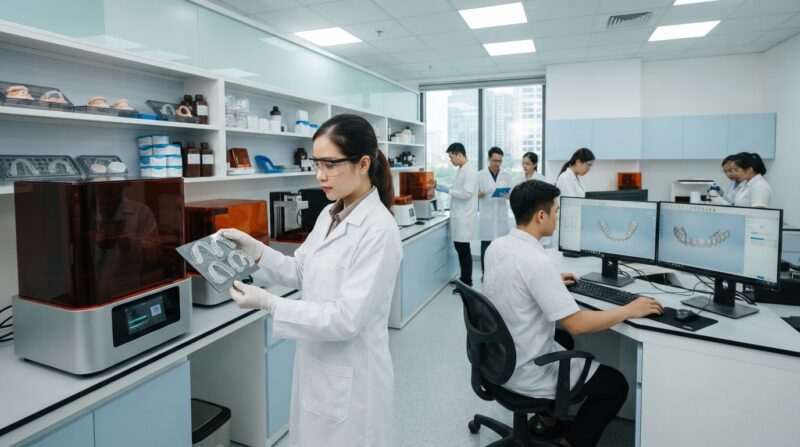
While direct printing hardware and resins solve the physical manufacturing equation, scaling clear aligner production requires vast digital CAD design capacity. Implementing clinical evidence on 3D printed clear aligners accuracy and efficiency 2026 in daily practice means dental laboratories must process complex orthodontic setups efficiently. Each case demands expert staging, attachment placement, collision detection, and anatomical segmentation before sent to high-speed 3D printers.
To manage fluctuating case volumes without inflating internal overhead, leading laboratories partner with specialized CAD design outsourcing services. According to clinical evidence on 3D printed clear aligners accuracy and efficiency 2026, outsourced design models allow dental labs to maintain strict turn-around guarantees while relying on expert orthodontic CAD technicians. Outsourcing eliminates workflow bottlenecks, allowing laboratory owners to focus capital expenditure on state-of-the-art direct printing and post-processing hardware.
Integrated workflow steps for direct aligner design outsourcing typically follow a streamlined digital path:
- Intraoral Scan Upload: The dental practice or lab uploads open STL/PLY files and treatment prescriptions to the secure outsourcing platform.
- CAD Segmentation & Movement Staging: Specialist technicians perform tooth segmentation, root axis alignment, and sequential movement planning following clinical guidelines.
- Selective Thickness & Border Customization: Designers configure variable wall thickness and smooth margin borders optimized specifically for direct printing resins.
- Lab Review & Digital Export: The lab reviews and approves the 3D setup, receiving pre-nested print-ready STL files ready for immediate additive fabrication.
This hybrid operational approach—combining outsourced digital design precision with in-house direct printing—enables labs of all sizes to scale operations rapidly without sacrificing quality control. Labs looking to expand their portfolio can seamlessly combine aligner setup services alongside digital crown design solutions to provide full-arch digital solutions.
Cost-Benefit Analysis: In-House Production vs. Outsourced CAD Design
Evaluating the financial impact of adopting direct printed clear aligners requires balancing hardware investments, resin consumption costs, labor wages, and software license fees. Analyzing clinical evidence on 3D printed clear aligners accuracy and efficiency 2026 financial models shows that direct printing slashes cost-per-aligner metrics substantially once operational scale is achieved. Eliminating physical models saves roughly $2.50 to $5.00 per aligner stage in raw model resin, thermoforming sheet material, and waste management costs alone.
However, maintaining an in-house team of certified orthodontic CAD designers represents a heavy fixed overhead cost for growing laboratories. Industry analysis incorporating clinical evidence on 3D printed clear aligners accuracy and efficiency 2026 demonstrates that outsourcing setup designs shifts variable operational costs into a predictable per-case expense. Labs avoid expensive annual software seat licenses, continuous staff training, and non-productive downtime during lower volume periods.
Consider the financial contrast between fully in-house and hybrid outsourced models:
- Fixed Labor & Software Costs: In-house teams require fixed salaries, benefits, and ongoing CAD software updates regardless of daily case volume fluctuations.
- Scalable Per-Case Pricing: Outsourcing CAD design transforms fixed overhead into flexible cost structures directly tied to active case revenue.
- Resource Allocation: In-house laboratory staff can be redirected from tedious software staging to high-value clinical support, quality assurance, and customer service.
- Capital Efficiency: Savings generated by design outsourcing can be reinvested directly into industrial direct-printing infrastructure and automated curing stations.
By assessing both operational efficiency and clinical data, commercial dental labs can achieve high gross margins while delivering premium, directly printed clear aligners to dental practices and DSO accounts.
How can dental labs maintain quality control when scaling direct printed aligner workflows?
Dental labs can maintain quality control by standardizing digital CAD design validation, automating resin calibration protocols, and outsourcing complex treatment planning to expert design technicians. Implementing robust quality management software and maintaining routine calibration routines ensures consistent product output as print volume increases across multiple direct printing systems.
Integrating clinical evidence on 3D printed clear aligners accuracy and efficiency 2026 protocol frameworks into daily quality assurance routines safeguards predictable treatment results. Direct printed aligners require strict adherence to post-processing wash times, solvent freshness, and post-curing UV wavelength density. Deviating from resin manufacturer validation guidelines can compromise monomer conversion rates, leading to altered flexural strength, cloudiness, or premature force decay in the clinical environment.
Essential quality assurance measures include:
- Routine Printer Light Engine Calibration: Regularly checking light intensity uniformity across build plates prevents localized under-curing and dimensional variance.
- Automated Solvent Renewal: Monitoring isopropyl alcohol or bio-based solvent purity ensures zero sticky uncured resin residue remains in critical intraoral spaces prior to final curing.
- Validated CAD Rule Sets: Establishing mandatory rules for minimum wall thickness, bevel angle tolerances, and displacement step maximums (e.g., 0.2 mm per stage).
- Double-Blind Staging Audits: Periodically auditing CAD treatment plans against actual tracking outcomes ensures digital setup accuracy aligns with real-world tooth movement.
By enforcing these standardized controls, laboratories can confidently scale direct aligner throughput while maintaining uniform precision across thousands of individual appliances.
Future Outlook: The Standard of Care in 2026 and Beyond
As the industry gathers further clinical evidence on 3D printed clear aligners accuracy and efficiency 2026 benchmarks, direct 3D printing is rapidly cementing its status as the definitive standard of care in digital orthodontics. The combined benefits of enhanced marginal adaptation, sustained force delivery, automated production pipelines, and reduced environmental plastic waste make thermoformed aligner workflows increasingly obsolete for forward-thinking facilities.
Looking ahead, future developments will integrate real-time artificial intelligence into CAD design platforms, allowing automated initial segmentation and force vector prediction. When combined with direct printing resins capable of multi-material extrusion—such as hard occlusal surfaces with flexible gingival margins—laboratories will produce custom appliances that were mechanically impossible just a decade ago. Dental laboratories and DSOs that act now to upgrade their CAD design capacity and direct printing workflows are strategically positioned to lead the market.
Ultimately, reviewing the empirical clinical evidence on 3D printed clear aligners accuracy and efficiency 2026 confirms that the modern digital workflow enhances both business profitability and clinical success. By pairing advanced additive hardware with expert CAD design outsourcing partners, dental laboratories can achieve rapid growth, superior appliance accuracy, and outstanding patient satisfaction across all orthodontic case types.
Scale Your Aligner CAD Production with Expert Outsourcing
Ready to streamline your clear aligner workflow and elevate design precision? Contact our expert CAD design team today to scale your laboratory capacity with fast, reliable, and cost-effective digital design outsourcing solutions.