Introduction to the Formlabs Form 4B for Dental Labs
The Formlabs Form 4B is a dedicated dental 3D printer designed to meet the demanding requirements of dental labs and dental service organizations (DSOs). In this Formlabs Form 4B review for dental labs 2026, we will provide an exhaustive analysis of its capabilities, workflow integration, and how it compares to other options in the digital dental design ecosystem.
With the growing adoption of CAD/CAM digital design outsourcing in the dental industry, selecting the right 3D printing equipment is crucial for labs focused on efficiency and precision. The Form 4B has been marketed as a solution tailored for dental applications such as crowns and bridges, implants, surgical guides, dentures, orthodontic aligners, and night guards. This review will help you decide if it fits your specific lab needs and business model.
What Is the Formlabs Form 4B and Its Core Features?
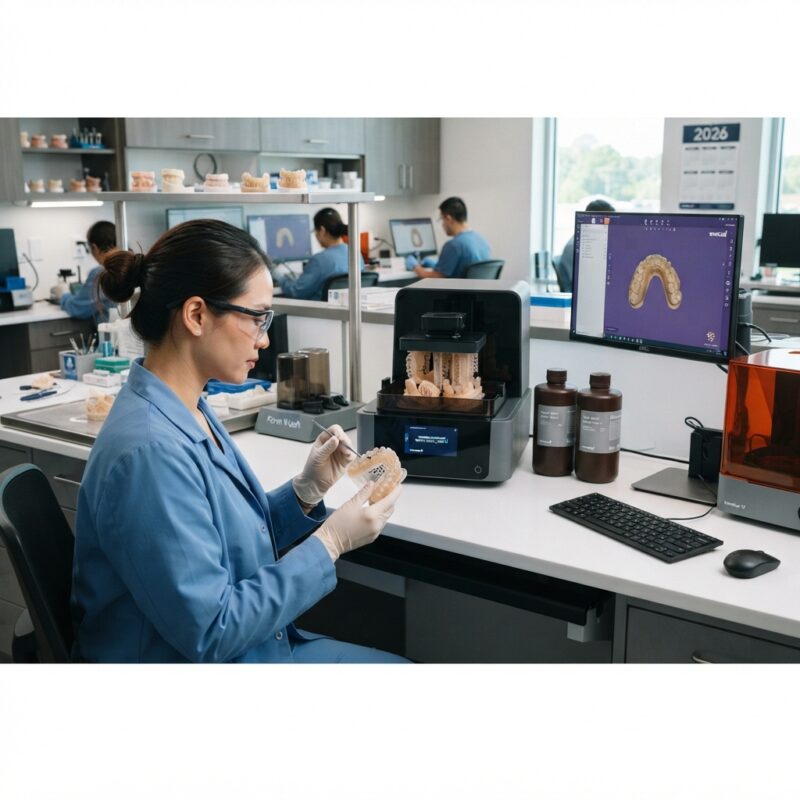
The Formlabs Form 4B is a stereolithography (SLA) 3D printer that uses a laser to cure photopolymer resin layer by layer, producing highly accurate dental models and devices.
Key features include:
- Dedicated Dental Materials: Compatible with Formlabs’ biocompatible resins, including surgical guide resin, denture base resin, and castable resin.
- High Resolution: 140-micron XY resolution with a 192 mm × 120 mm × 130 mm build volume suitable for multiple small to medium-sized dental appliances.
- Air Filtration: Integrated activated carbon filtration system reduces odors, making it suitable for clinical or lab environments.
- Automated Resin Handling: Cartridge-based resin management simplifies material changes and reduces contamination risks.
- Software Integration: Seamlessly integrates with Formlabs PreForm software, enabling easy print setup and support for standard dental file formats (STL).
How Does the Formlabs Form 4B Compare to Other Dental 3D Printers?
The Formlabs Form 4B offers a balance of precision, workflow integration, and cost-effectiveness, positioning it competitively among other dental 3D printers like the Asiga MAX and SprintRay Pro.
| Feature | Formlabs Form 4B | Asiga MAX | SprintRay Pro |
|---|---|---|---|
| Technology | SLA (Laser) | DLP (LED) | DLP (LED) |
| Build Volume (mm) | 192 × 120 × 130 | 119 × 67 × 75 | 124 × 70 × 130 |
| XY Resolution | 140 microns | 27 microns | 62 microns |
| Material Options | Wide dental biocompatible resins | Extensive dental resins | Varied dental resins |
| Price Range (Indicative) | ~$10,000 – $12,000 | ~$15,000 – $20,000 | ~$10,000 – $14,000 |
While the Form 4B’s laser SLA technology provides excellent surface finish and accuracy, DLP printers like the Asiga MAX offer higher XY resolution but generally smaller build volumes. The Form 4B’s integrated filtration system and cartridge resin delivery make it well-suited for labs prioritizing ease of use and safety.
What Types of Dental Labs Benefit Most from the Formlabs Form 4B?
The Formlabs Form 4B is ideal for small to medium-sized dental labs and DSOs that require versatile, reliable 3D printing for a range of dental applications.
- Best For: Labs producing crowns and bridges, surgical guides, dentures, and orthodontic devices with moderate to high throughput.
- Strengths: Ease of use, biocompatible resin options, consistent print quality, and smooth workflow integration.
- Limitations: Slightly lower resolution compared to some DLP printers, build volume may be limiting for very large batch production.
This printer is not typically recommended for extremely high-volume labs that require faster print speeds or ultra-high resolution for fine orthodontic aligners, where specialized DLP or multi-laser SLA systems may excel.
How Does the Formlabs Form 4B Support Crown & Bridge and Implant Workflows?
The Formlabs Form 4B review for dental labs 2026 highlights its ability to produce precise crown and bridge models and implant surgical guides with high accuracy and biocompatibility.
The printer supports specialized resins such as surgical guide resin, which meets ISO 10993 biocompatibility standards essential for clinical use. It allows fabrication of precise surgical guides with detailed features and smooth surfaces, critical for implant placement accuracy.
For crown and bridge workflows, the Form 4B can print highly detailed models that enable superior fit of crowns and bridges. Its compatibility with castable resins also supports the lost-wax casting process for metal frameworks.
When combined with leading dental CAD software like exocad or 3Shape, the Form 4B fits seamlessly into digital workflows, reducing turnaround times and improving predictability.
What Is the Total Cost of Ownership for the Formlabs Form 4B?
The total cost of ownership (TCO) for the Formlabs Form 4B extends beyond the purchase price and includes resin costs, maintenance, and labor.
- Initial Investment: Approximately $10,000 to $12,000 USD, depending on region and distributor pricing.
- Material Costs: Formlabs dental resins typically range between $150 to $300 per liter, with cartridge-based delivery reducing waste.
- Consumables & Maintenance: Regular replacement of resin tanks, build platforms, and cartridge filters is required; costs vary but are predictable.
- Labor: User-friendly software and automated workflows reduce technician training time and errors.
Compared to other printers, the Form 4B offers a competitive TCO, especially when factoring in its reliability and reduced downtime. However, labs should evaluate throughput demands and resin usage patterns to optimize cost efficiency.
How Does the Formlabs Form 4B Integrate with Digital Dental Design Outsourcing?
The Formlabs Form 4B review for dental labs 2026 recognizes that many dental labs and DSOs are turning to digital dental design outsourcing services to complement their 3D printing capabilities. Outsourcing CAD design allows labs to operate printers like the Form 4B without hiring dedicated in-house designers.
This hybrid approach improves flexibility, reduces payroll costs, and accelerates turnaround times. The Form 4B’s compatibility with common digital file formats (STL, OBJ) and cloud-based design platforms makes it easy to collaborate with external CAD/CAM providers.
For example, outsourcing aligner and night guard designs to a trusted partner can free up internal resources to focus on efficient printing and finishing. This workflow synergy enhances overall lab productivity and quality assurance.
What Are the Resin and Material Options Available for the Formlabs Form 4B?
The Formlabs Form 4B supports a robust portfolio of dental-specific resins tailored for various applications:
- Surgical Guide Resin: Biocompatible and sterilizable for implant guides.
- Denture Base Resin: Durable and esthetic for denture fabrication.
- Castable Resin: Ideal for wax-up patterns used in metal casting.
- Dental Model Resin: High accuracy and detail for diagnostic and restorative models.
- Night Guard Resin: Flexible and comfortable for occlusal guards and splints.
All materials are optimized for print speed and surface finish on the Form 4B, ensuring consistent, professional-quality results. Labs should check the manufacturer’s website for current resin certifications, prices, and regional availability.
What Are the Workflow Advantages and Challenges of the Formlabs Form 4B?
The Formlabs Form 4B integrates well into digital dental workflows, offering several advantages:
- Advantages: Automated resin handling reduces contamination risk; easy software interface; integrated air filtration improves lab environment; compact footprint suits small labs.
- Challenges: Print speeds are moderate compared to some DLP printers; post-processing requires cleaning and curing steps; build volume limits batch size for large production runs.
Additionally, integrating the Form 4B with established CAD/CAM software and outsourcing services can mitigate challenges by optimizing design-to-print turnaround and reducing in-house labor demands.
How Does the Formlabs Form 4B Compare in Printing Surgical Guides and Orthodontic Aligners?
The Formlabs Form 4B excels in surgical guide printing due to its biocompatible resin options and high accuracy, fulfilling clinical standards required for implant placement.
For orthodontic aligners, while the Form 4B can print models used to thermoform aligners, it is less suited for direct aligner printing compared to printers with higher resolution and faster speeds. Labs focusing heavily on orthodontics may consider complementary equipment or outsourcing aligner design and printing to specialists.
Overall, the Form 4B balances quality and cost for surgical guides and indirect aligner fabrication, making it a versatile tool within a multi-equipment environment.
What Are the Environmental and Operational Considerations for Using the Formlabs Form 4B?
The Formlabs Form 4B’s built-in activated carbon air filtration system reduces resin odor emissions, making it suitable for open lab spaces and clinical environments where ventilation may be limited.
Operationally, the printer requires a stable, level surface and controlled temperature conditions (typically 18-28°C) for optimal curing. Resin storage and handling protocols are important to maintain material integrity and safety, per manufacturer guidelines.
Waste resin and used cartridges should be disposed of according to local regulations for chemical waste. This aligns with the overall trend toward sustainable dental lab practices.
Do You Need Design Capacity for Your New Equipment?
Many dental labs and practices investing in the Formlabs Form 4B find that outsourcing CAD design services is a cost-effective way to maximize printer utilization without hiring full-time designers.
Outsourced design teams can provide expert crown and bridge, implant, surgical guide, denture, and orthodontic designs ready for immediate printing, reducing turnaround times and freeing your staff to focus on finishing and delivery. This approach also scales easily with demand fluctuations.
Our company specializes in CAD/CAM digital design outsourcing for dental labs and DSOs, ensuring your Form 4B printer runs at full capacity with expert-driven designs. Contact us today to learn how we can help optimize your digital dental workflow.
Conclusion: Is the Formlabs Form 4B the Right Choice for Dental Labs in 2026?
This Formlabs Form 4B review for dental labs 2026 demonstrates that the printer offers an excellent balance of precision, ease of use, and material versatility, making it a strong candidate for small to medium dental labs and DSOs.
Its compatibility with biocompatible resins, integrated safety features, and seamless software integration support a wide range of dental applications including crowns and bridges, implants, surgical guides, dentures, orthodontic appliances, and night guards.
Labs should consider their production volume, resolution requirements, and workflow integration needs when evaluating the Form 4B. For those looking to optimize CAD design processes further, partnering with a digital design outsourcing service can enhance efficiency and reduce overhead.
For more information on digital dental workflows and 3D printing technologies, visit the Formlabs official website or the American Dental Association.
The Formlabs Form 4B remains a competitive and reliable choice for labs moving toward fully digital dentistry in 2026 and beyond.
Additional Resources and Related Topics
Step-by-Step Guide to Implementing the Formlabs Form 4B in Your Dental Lab Workflow
Integrating a new 3D printer like the Formlabs Form 4B into your dental lab workflow requires careful planning and execution to maximize efficiency and ensure consistent quality. Below is a practical, step-by-step guide to help dental labs and practices adopt this technology smoothly.
Step 1: Assess Your Current Workflow and Identify Bottlenecks
Begin by mapping out your existing fabrication process, from digital design to final product delivery. Identify areas where delays, errors, or quality issues commonly occur. For example, if turnaround times for surgical guides or crowns are too long, or if outsourcing costs are high, these pain points highlight where the Form 4B can add value.
Step 2: Define Your Most Common Applications
Determine which dental applications will benefit most from the Form 4B. Whether it’s crown and bridge models, surgical guides, implant-oriented parts, or orthodontic appliances, knowing your focus helps tailor the printer settings, resin choices, and post-processing steps.
Step 3: Invest in Staff Training and Certification
Ensure your technicians and lab managers receive comprehensive training on the Formlabs ecosystem, including pre-print preparation software, printer maintenance, and post-processing protocols. Many labs have found that dedicating time upfront to training reduces errors and material waste significantly.
Step 4: Establish a Standard Operating Procedure (SOP)
Create an SOP that covers:
- File preparation and design checks
- Printer setup and resin loading
- Print scheduling and load balancing for multiple jobs
- Post-processing steps like washing and curing
- Quality control checkpoints
- Maintenance and troubleshooting protocols
Having a documented SOP ensures consistency, especially when scaling operations or onboarding new staff.
Step 5: Set Up a Quality Control Checklist
Develop a quality control checklist tailored to your common prints. For instance, check layer adhesion, surface finish, dimensional accuracy, and fit on dental dies. Include measurement tools like calipers or optical scanners to verify critical dimensions.
Step 6: Monitor Print Jobs and Adjust Settings
Track print success rates, resin consumption, and print times. Use this data to optimize print orientation, support structures, and layer thickness to reduce material usage and improve throughput.
Step 7: Continuously Evaluate and Iterate
Regularly solicit feedback from clinicians and technicians on the fit and finish of printed parts. Use this feedback to fine-tune printer settings, resin choices, and post-processing. Continuous improvement helps maintain competitive advantage.
Common Mistakes to Avoid When Using the Formlabs Form 4B
Even with a highly capable printer like the Form 4B, certain pitfalls can undermine quality and efficiency. Awareness of these common mistakes can save time and resources.
- Neglecting Regular Maintenance: Skipping routine cleaning of the resin tank and optical window can cause print failures and reduce part accuracy. Schedule maintenance based on usage hours rather than calendar days for best results.
- Using Expired or Improperly Stored Resin: Resin degradation leads to brittleness and poor layer adhesion. Always check resin expiration dates and store materials in a cool, dark environment.
- Ignoring Print Orientation and Support Design: Incorrect orientation or insufficient supports can cause warping or incomplete prints. Utilize the Formlabs PreForm software’s orientation recommendations and customize supports for complex geometries.
- Inadequate Post-Processing: Under-curing or improper washing can leave prints either too soft or with residual resin causing irritation or dimensional issues. Follow recommended wash and cure times strictly.
- Overlooking Calibration and Firmware Updates: Printer calibration drifts over time, and firmware updates often fix bugs and improve performance. Schedule periodic calibration checks and stay current with software releases.
- Failing to Validate Digital Files Before Printing: Sending unverified STL files with mesh errors or non-manifold edges can cause print failures. Use mesh repair tools and perform virtual simulations before printing.
Cost and Quality Considerations: Balancing Investment and Output
Understanding the financial and qualitative trade-offs when adopting the Formlabs Form 4B is essential for dental labs aiming to optimize both cost-efficiency and clinical outcomes.
Initial Investment and Setup Costs
The upfront cost of the Form 4B printer and necessary accessories (post-processing units, resin cartridges, build platforms) typically ranges from moderate to high compared to entry-level printers. However, this investment is justified by its dental-specific design, FDA-clearance for certain materials, and consistent output quality.
Material Costs and Resin Efficiency
Dental resins compatible with the Form 4B vary in price depending on the application—surgical guide resins tend to be more expensive than model or castable resins. Labs must account for resin wastage due to support structures and test prints. Efficient print nesting and orientation can reduce material consumption by up to 15% in real-world scenarios.
Labor Costs and Time Savings
While initial learning curves may increase labor time, many labs report a 30-40% reduction in turnaround time for crowns and surgical guides after full integration. Reduced manual finishing also lowers the need for highly skilled labor hours, allowing technicians to focus on higher-value tasks.
Quality Assurance and Cost of Reprints
Poor print quality leads to costly reprints and delays. Implementing strict quality control and using validated print profiles minimizes these costs. The Form 4B’s repeatable accuracy reduces the risk of remakes compared to less specialized printers.
Long-Term ROI and Scalability
Over 3-5 years, labs that leverage the Form 4B for high-demand workflows often see a positive ROI due to reduced outsourcing fees, faster case turnaround, and higher client satisfaction. Consider scalability by planning for additional units or print farms as demand grows.
Market-Specific Insights: Tailoring the Formlabs Form 4B Use in Different Dental Markets
The dental market varies significantly by region and practice type, influencing how the Formlabs Form 4B can be best utilized. Understanding these market specifics helps labs and DSOs maximize the printer’s benefits.
High-Volume Dental Service Organizations (DSOs)
DSOs typically require rapid, repeatable production of surgical guides, temporary crowns, and orthodontic appliances across multiple locations. The Form 4B’s ability to handle batch printing and network integration supports centralized manufacturing hubs, reducing turnaround times and logistics costs.
Small to Mid-Sized Dental Labs
For smaller labs, the Form 4B offers a balance of affordability and advanced features. It allows labs to bring digital manufacturing in-house, reducing reliance on third-party providers and enabling customized services like same-day crown fabrication.
Academic and Research Institutions
Universities and dental schools benefit from the Form 4B’s versatility for both educational purposes and clinical research. Its compatibility with a broad range of dental resins supports experimentation with new materials and techniques.
Geographical Market Nuances
- North America and Western Europe: High regulatory standards and demand for FDA/CE-approved materials make the Form 4B’s certification a strong advantage.
- Emerging Markets: Cost sensitivity may limit immediate adoption, but the printer’s modularity allows gradual integration as digital dentistry grows.
- Asia-Pacific: Rapidly expanding dental markets with strong interest in orthodontics and implantology find the Form 4B valuable for high-precision manufacturing.
Customization for Specialty Practices
Practices specializing in implantology or orthodontics can customize resin choices and print parameters on the Form 4B to optimize patient-specific devices, improving clinical outcomes and patient satisfaction.
For labs interested in enhancing their digital workflows, the Form 4B also works well alongside surgical guide design services and digital crown design solutions, enabling comprehensive in-house or outsourced digital production.