

Introduction to 3D Lab vs Traditional Dental Lab: Efficiency Comparison 2026
The landscape of dental prosthetics manufacturing is rapidly evolving, with 3D labs increasingly competing against traditional dental labs. The phrase 3D lab vs traditional dental lab: efficiency comparison 2026 captures this trend, emphasizing the need for dental labs and DSOs to understand how digital CAD/CAM outsourcing services can impact their workflows, costs, and output quality. This article provides an in-depth analysis to help decision-makers navigate this critical choice.
What is a 3D dental lab and how does it differ from a traditional dental lab?
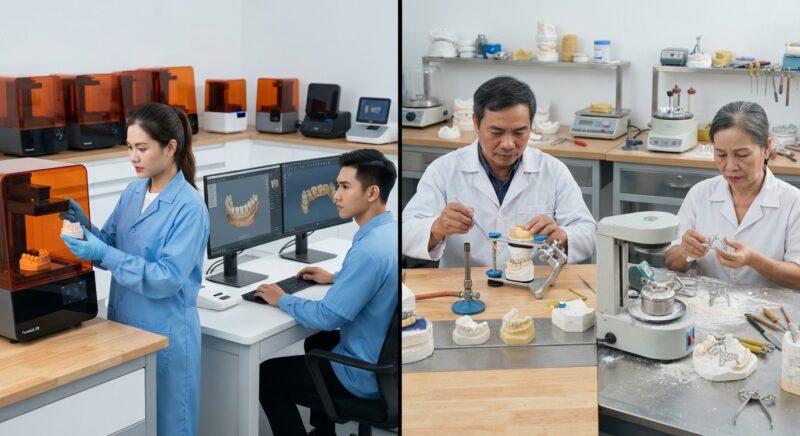
A 3D dental lab leverages digital technologies such as CAD/CAM software, 3D printing, and milling machines to design and manufacture dental prosthetics, whereas traditional labs rely primarily on manual techniques involving physical impressions and hand-crafted models.
3D labs utilize software platforms from leading providers like 3Shape and exocad to digitally design crowns, bridges, implants, surgical guides, dentures, orthodontic aligners, and night guards. These designs are then fabricated using 3D printers or milling machines, reducing turnaround times and improving precision. In contrast, traditional labs depend on technicians manually waxing, casting, and adjusting restorations, which increases labor intensity and introduces variability.
Efficiency factors in 3D labs versus traditional dental labs
When comparing efficiency, several factors influence the performance of 3D labs versus traditional dental labs. Key considerations include:
- Turnaround time: Digital workflows streamline design and manufacturing steps, often reducing total case completion time.
- Labor intensity: 3D labs automate repetitive tasks, allowing technicians to focus on quality control and complex adjustments.
- Material utilization: Additive manufacturing in 3D labs minimizes waste compared to subtractive milling and manual processes.
- Scalability: Automation enables higher throughput in 3D labs, benefiting high-volume DSOs and large labs.
These efficiency factors translate into cost savings, improved predictability, and the ability to handle complex cases more effectively.
How does CAD/CAM digital design outsourcing support dental labs and DSOs?
CAD/CAM digital design outsourcing provides dental labs and DSOs with expert digital design services without the need to invest in in-house design teams or software licenses.
Outsourcing partners specialize in digital design of crowns, bridges, implants, surgical guides, dentures, orthodontic aligners, and night guards, using state-of-the-art CAD software. This allows labs to leverage advanced technology and skilled designers while minimizing overhead. Outsourcing is particularly valuable for small labs or clinics transitioning to digital workflows, as well as DSOs managing multiple locations with variable design needs.
Cost comparison: total cost of ownership for 3D labs vs traditional labs
Evaluating the total cost of ownership (TCO) is critical when assessing 3D lab vs traditional dental lab efficiency in 2026. Key cost components include:
- Equipment investment: 3D labs require capital outlays for scanners, CAD software, 3D printers, or milling machines. Traditional labs invest more in manual tools and materials.
- Operating costs: Maintenance, materials (resins, ceramics), and software subscriptions factor into 3D lab expenses; traditional labs incur higher labor costs.
- Training and staffing: 3D labs need skilled CAD designers and technicians trained in digital workflows; traditional labs rely on experienced manual technicians.
- Outsourcing opportunities: Digital design outsourcing reduces in-house staffing needs and accelerates workflows, improving cost efficiency.
Indicative capital costs for mid-range 3D dental lab equipment (scanner + CAD software + printer/mill) typically range from $100,000 to $250,000 depending on configuration and region, while traditional lab setup costs vary widely. Ongoing costs and efficiencies must be carefully analyzed.
Who benefits most from 3D labs versus traditional dental labs?
Understanding the ideal users of each lab type helps clarify the 3D lab vs traditional dental lab: efficiency comparison 2026.
- 3D Labs: Best suited for high-volume labs, large DSOs, and practices seeking fast turnaround and complex case capabilities (e.g., implant surgical guides, orthodontic aligners).
- Traditional Labs: Suited for smaller labs and practices with lower volume, strong manual craftsmanship, or limited capital for digital upgrades.
3D labs excel where automation and digital precision are priorities, while traditional labs may maintain competitive advantage in artisanal restorations and low-volume custom work.
What are the workflow impacts of adopting 3D lab technology?
Adopting 3D lab technology fundamentally reshapes workflows by digitizing design and manufacturing stages, reducing manual steps, and enabling real-time collaboration between clinicians and technicians.
Digital impressions from intraoral scanners (such as those from iTero) feed directly into CAD software, eliminating the need for physical models. Designs can be reviewed and modified remotely, accelerating approvals. Automated milling or printing then fabricates restorations with consistent accuracy. This contrasts with the traditional process of taking impressions, shipping physical models, and performing labor-intensive manual adjustments.
Comparison table: 3D Lab vs Traditional Dental Lab Efficiency Metrics
| Criteria | 3D Lab | Traditional Lab | Typical Best Use |
|---|---|---|---|
| Turnaround Time | 24-72 hours | 5-14 days | High-volume, fast cases |
| Labor Intensity | Lower (automation) | Higher (manual labor) | Cost-sensitive, artisanal work |
| Material Waste | Minimal (additive) | Higher (subtractive and manual) | Precision-demanding cases |
| Capital Investment | High ($100K-$250K+) | Moderate to low | Large labs, DSOs |
| Scalability | High (automation) | Limited | Multiple-location DSOs |
| Training Requirements | Digital expertise needed | Traditional craftsmanship | Digital transition labs |
What are the limitations of 3D dental labs compared to traditional labs?
Despite considerable efficiency advantages, 3D dental labs also have limitations that affect their adoption:
- High upfront costs: Equipment and software investments can be prohibitive for small labs.
- Learning curve: Staff require training in digital design and manufacturing processes.
- Material restrictions: Certain restorative materials may not yet be fully compatible with all 3D printing or milling technologies.
- Dependence on technology: Equipment downtime or software issues can disrupt workflows.
Traditional labs retain advantages in artisanal customization and may not require the same capital or technical infrastructure.
How do 3D labs integrate with dental lab outsourcing services?
3D labs often partner with CAD/CAM digital design outsourcing services to expand capacity and accelerate turnaround times without expanding in-house teams.
Outsourcing CAD design services leverage cloud-based platforms and expert technicians to manage complex cases including implant surgical guides and orthodontic aligners. This integration allows labs to focus on milling, printing, or finishing while ensuring high-quality digital designs. It also mitigates staffing challenges and reduces training costs. Such partnerships are increasingly common among DSOs managing multiple labs and clinics.
What is the environmental impact of 3D labs vs traditional dental labs?
Environmental sustainability is an emerging consideration in dental lab decisions. 3D labs generally produce less waste due to additive manufacturing techniques that build prosthetics layer by layer, minimizing excess material. Traditional labs commonly rely on subtractive milling and manual processes that generate more scrap and chemical waste. Additionally, digital workflows reduce the need for physical shipping of molds and models, lowering carbon footprint.
However, energy consumption of 3D printers and milling units can be significant, and disposal of certain resins requires proper handling. Labs should evaluate environmental impact alongside efficiency when choosing their workflow.
How does the choice between 3D and traditional labs affect clinical outcomes?
Clinical outcomes can improve with a 3D lab due to increased precision, fit, and reproducibility of restorations. Digital design software allows for meticulous control over occlusion, margins, and anatomical detail, which reduces adjustments and remakes. Moreover, faster turnaround can enhance patient satisfaction and reduce chair time.
Traditional labs still deliver high-quality restorations, particularly when experienced technicians apply artisanal skills. However, variability in manual processes may lead to longer adjustment times. Many clinicians now prefer labs offering digital workflows for consistent, predictable results.
Decision criteria for dental labs and DSOs: 3D lab vs traditional dental lab: efficiency comparison 2026
Choosing between a 3D lab and a traditional dental lab depends on several factors:
- Volume: High-volume labs and DSOs benefit most from 3D automation.
- Case complexity: Surgical guides, implants, and orthodontic appliances favor digital workflows.
- Budget: Capital expenses and operating costs must align with financial capacity.
- Staff expertise: Availability of trained digital technicians or willingness to outsource design.
- Turnaround expectations: Faster delivery often mandates 3D lab capabilities.
Careful analysis and trial implementations can help labs transition smoothly.
Do you need design capacity for your new equipment?
If you plan to invest in milling or 3D printing equipment but lack in-house CAD design expertise, outsourcing your digital design needs is a practical solution. Our specialized CAD/CAM digital design outsourcing service enables your lab or clinic to operate efficiently without hiring full-time designers. This approach reduces overhead while providing high-quality designs tailored to your equipment.
Contact us today to learn how we can seamlessly integrate with your workflow and enhance your operational efficiency.
If you want to explore more about the integration of digital workflows, consider how 3D printing technology from Formlabs or milling solutions from Roland DG can further elevate your lab’s capabilities. Additionally, digital impression systems like those by iTero complement 3D labs by streamlining the data acquisition process.
In summary, the 3D lab vs traditional dental lab: efficiency comparison 2026 underscores that while 3D labs demand higher initial investment and training, their efficiency, scalability, and clinical advantages make them increasingly essential for modern dental labs and DSOs. Traditional labs retain value in specialized, low-volume, or artisanal contexts, but embracing digital transformation is key to staying competitive in the evolving dental industry.
Implementing 3D Lab Technology: Step-by-Step Guidance for Dental Labs
Transitioning from a traditional dental lab setup to a 3D lab environment involves several critical steps to ensure efficiency gains and quality outcomes. This implementation process requires careful planning, staff training, and technology integration. Below is a detailed step-by-step guide to help dental labs navigate this transformation effectively.
Step 1: Assess Current Capabilities and Needs
- Conduct a comprehensive audit of existing lab equipment, workflows, and staff skill sets.
- Identify key pain points such as turnaround times, material waste, and design bottlenecks.
- Define clear objectives for adopting 3D technology, e.g., faster production, improved accuracy, or expanded service offerings.
Step 2: Select Appropriate 3D Equipment and Software
- Evaluate scanners, printers, and milling machines based on lab volume, material compatibility, and maintenance requirements.
- Choose CAD/CAM software that integrates seamlessly with existing systems and offers user-friendly interfaces for technicians.
- Consider scalability to accommodate future growth or technology upgrades.
Step 3: Train Staff Thoroughly
- Provide hands-on training sessions for technicians on scanning, design, and digital manufacturing processes.
- Establish standard operating procedures (SOPs) for digital workflows to maintain consistency and quality control.
- Encourage continuous learning to keep pace with evolving technologies and software updates.
Step 4: Run Parallel Production
- Operate traditional and 3D workflows simultaneously during the initial phase to compare outcomes and troubleshoot issues.
- Gather feedback from technicians and clients to evaluate the efficiency and quality of 3D outputs.
Step 5: Optimize and Scale Up
- Analyze production data to identify bottlenecks or areas needing improvement.
- Adjust workflows based on real-world performance and client feedback.
- Plan for full integration of 3D technology once confidence and proficiency are established.
Common Mistakes to Avoid When Transitioning to a 3D Dental Lab
While the benefits of 3D dental labs are significant, many labs encounter avoidable pitfalls during the transition. Understanding these common mistakes can save time, money, and frustration.
Underestimating Training and Change Management
Many labs assume that their technicians can quickly adapt to new digital workflows without comprehensive training or support. This often leads to inconsistent results and frustration. Investing in structured education and change management programs is essential to ensure smooth adoption.
Overlooking Material Compatibility and Calibration
Not all materials used in traditional labs are compatible with 3D printing or milling equipment. Labs sometimes fail to calibrate machines correctly for new materials, impacting the fit and durability of prosthetics. A detailed review of material choices and machine settings is critical.
Neglecting Workflow Integration
Implementing 3D technology as a standalone process rather than integrating it into the overall lab workflow can cause inefficiencies. For example, digital designs must match the lab’s finishing processes; otherwise, rework and delays occur.
Failing to Budget for Maintenance and Upgrades
3D equipment requires regular maintenance, software updates, and occasional hardware upgrades. Labs that do not plan for these ongoing costs may experience downtime or degraded quality over time.
Ignoring Data Security and Backup Practices
Digital workflows generate valuable design data that must be securely stored and backed up. Labs often overlook implementing robust cybersecurity measures, risking data loss or breaches.
Quality Control and Assurance in 3D vs Traditional Dental Labs
Ensuring consistent quality is paramount for dental labs, whether they operate traditionally or use 3D technologies. The quality control (QC) processes differ but share the same goal: delivering accurate, functional, and durable dental prostheses.
Quality Control in Traditional Dental Labs
- Manual inspection: Skilled technicians visually and tactically inspect casts, wax-ups, and final restorations.
- Physical fitting tests: Models and prosthetics are physically tested on patient analogs or try-in sessions.
- Material consistency: Monitoring raw material batches and curing processes to prevent defects.
Quality Assurance in 3D Dental Labs
- Digital validation: CAD software includes built-in checks for design parameters such as thickness, undercuts, and fit tolerances.
- Automated calibration: Regular machine calibration ensures print accuracy and repeatability.
- In-process monitoring: Sensors and software track printing or milling progress, alerting operators to anomalies.
- Post-production inspection: Use of 3D scanners to verify the physical output matches the digital file within micron accuracy.
Checklist for Maintaining High Quality in 3D Dental Labs
- Verify scanner calibration weekly to avoid data inaccuracies.
- Implement routine printer maintenance schedules.
- Use standardized digital design protocols to minimize human error.
- Cross-check digital designs with traditional wax-ups or stone models when possible.
- Regularly update CAD/CAM software to benefit from improved algorithms and bug fixes.
- Maintain a clean, controlled environment to reduce contamination and material degradation.
Cost and Quality Considerations: Balancing Investment and Returns in 3D and Traditional Labs
Dental labs face a complex decision matrix when choosing between 3D and traditional methodologies, balancing upfront investment against ongoing operational costs and quality outcomes.
Upfront Capital Expenditure
3D labs require significant initial investment in scanners, printers, milling machines, and software licenses. In contrast, traditional labs invest more heavily in manual tools, casting ovens, and technician training. For example, a mid-sized lab may spend $150,000 to $300,000 upfront to outfit a basic 3D lab, whereas traditional setups might require less but need frequent replenishment of consumables.
Operational Costs
- 3D Labs: Ongoing expenses include material resins or milling blocks, machine maintenance, software subscriptions, and electricity.
- Traditional Labs: Costs are dominated by raw materials like wax, plaster, and metal alloys, technician labor hours, and physical storage space.
3D labs often reduce labor costs due to automation but may incur higher material costs per unit. Traditional labs have lower technology costs but higher labor intensity, influencing long-term profitability.
Impact on Quality and Client Satisfaction
While 3D labs typically deliver higher precision and reproducibility, traditional labs excel in nuanced craftsmanship and customization, especially for complex restorations. Labs must assess their client base and product mix to determine which approach aligns better with market expectations.
Return on Investment (ROI) Considerations
- Volume and throughput: High-volume labs benefit more from 3D automation, shortening turnaround times and increasing capacity.
- Complex cases: Labs specializing in intricate prosthetics may find traditional techniques more flexible and cost-effective.
- Market demand: Labs serving clients who prioritize digital workflows or faster delivery may justify higher 3D investments.
Example Cost-Benefit Scenario
A dental lab processing 500 cases monthly could see a 20-30% reduction in labor hours after full 3D integration, translating to annual savings of $100,000+ in wages. However, increased maintenance and material costs may offset some savings. A hybrid approach, leveraging 3D printing for standard crowns and traditional methods for complex cases, can optimize cost-efficiency and quality.
Our service also works well alongside surgical guide design and orthodontic aligner fabrication services, providing comprehensive support for your digital dental lab needs.


