Understanding In-house vs Outsourced CAD Design: What Does It Mean for Dental Labs?
The phrase in-house vs outsourced CAD design: cost calculator for dental labs in 2026 encapsulates a critical decision for dental labs and DSOs evaluating their digital design workflows. In-house CAD design means employing trained designers and investing in CAD software and hardware internally, while outsourced CAD design involves partnering with specialized external providers who deliver fully designed digital files ready for production.
Dental labs and dental service organizations increasingly rely on digital workflows for crown & bridge, implants, surgical guides, dentures, orthodontic aligners, and night guards. Choosing between in-house and outsourced CAD design impacts operational costs, turnaround times, and overall lab efficiency. This article explores these factors in depth, providing a practical cost calculator framework and workflow considerations specific to 2026 technologies and market trends.
What Are the Core Cost Components When Comparing In-house vs Outsourced CAD Design?
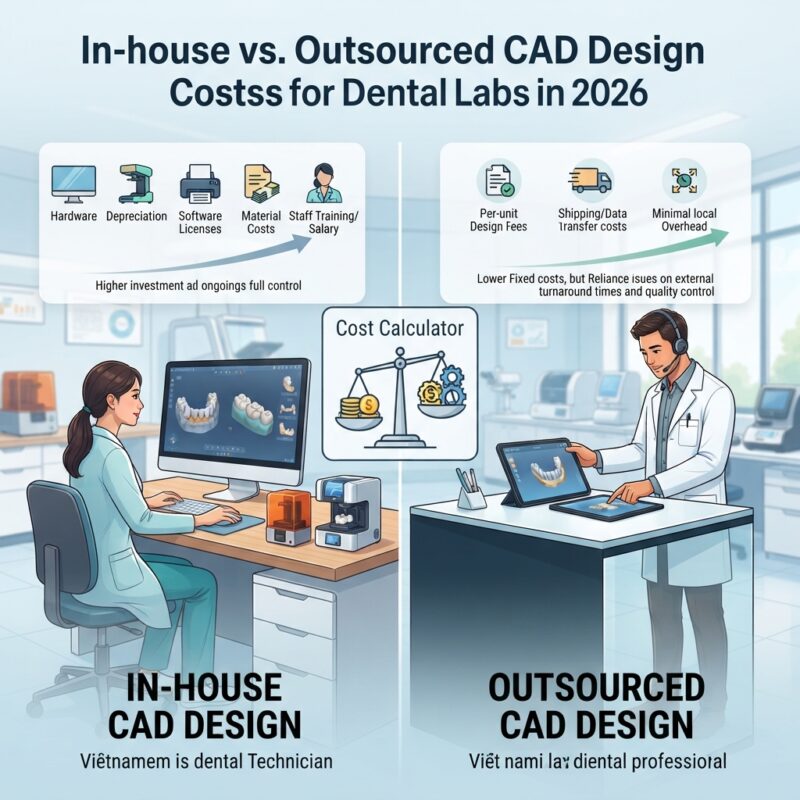
The core cost components for in-house vs outsourced CAD design: cost calculator for dental labs in 2026 encompass software licensing, hardware, personnel, training, and operational overheads for in-house setups, versus service fees and communication costs for outsourcing. Understanding each element is essential for accurate budgeting and ROI analysis.
- In-house Costs: CAD software licenses from providers like Exocad or 3Shape typically range from $10,000 to $30,000 annually depending on modules. CAD stations with high-performance graphics and processors cost $3,000 to $7,000 each. Skilled CAD designers command salaries from $50,000 to $90,000 annually, depending on experience and region. Training and continual software updates add to expenses.
- Outsourced Costs: Outsourcing fees for CAD design services vary by complexity and volume, often charged per case or monthly subscription. Typical fees range from $30 to $100 per design depending on the restoration type. No capital investment is needed, but communication and revision cycles can impact time and cost.
Other indirect costs like equipment maintenance, software upgrades, and opportunity costs of managing design workflows internally should be factored into the cost calculator for dental labs in 2026.
How Does Workflow Efficiency Differ Between In-house and Outsourced CAD Design?
Workflow efficiency varies significantly between in-house and outsourced CAD design, influencing turnaround times and case throughput.
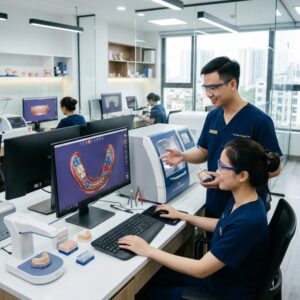
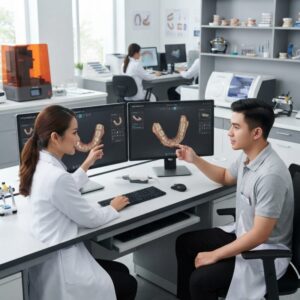
In-house CAD design allows greater control over the design process, enabling immediate communication between technicians and designers. This direct collaboration can expedite revisions for complex cases such as implant abutments or surgical guides. However, bottlenecks can arise if the design team is small or lacks capacity during peak demand periods.
Outsourcing CAD design shifts the burden of staffing and software management to a specialized provider, often with multiple designers available 24/7. This can enhance scalability and reduce delays caused by internal resource constraints. However, external communication channels require clear protocols to minimize misunderstandings and iteration cycles.
Both approaches benefit from integration with digital impression scanners and milling or 3D printing equipment, such as those from Dentsply Sirona or Straumann. Streamlined digital workflows reduce manual handling and errors, regardless of design source.
What Are the Strategic Benefits and Limitations of In-house CAD Design?
In-house CAD design offers dental labs and DSOs direct control over design quality, customization, and intellectual property.
- Best for: High-volume labs with steady case flow, DSOs wanting integrated control, labs with skilled CAD staff.
- Strengths: Immediate design iteration, better integration with production, proprietary design standards, no ongoing per-case fees.
- Limitations: High upfront costs, ongoing training and software upgrade expenses, staffing challenges, risk of underutilized capacity during slow periods.
Investments in CAD workstations and software must be carefully planned, considering typical case volume and complexity. For example, designing implant restorations and surgical guides requires advanced software modules and experienced designers, which increases costs but can enhance lab reputation and service offerings.
What Are the Advantages and Drawbacks of Outsourced CAD Design Services?
Outsourced CAD design provides flexibility and cost predictability by converting fixed costs into variable expenses.
- Best for: Small and medium labs, labs with fluctuating case volumes, startups, DSOs seeking rapid deployment without capital investment.
- Strengths: No capital expenditure on software/hardware, access to expert designers, scalable design capacity, reduced management overhead.
- Limitations: Less direct control, potential delays due to communication, confidentiality considerations, ongoing per-case fees.
Outsourcing can be especially valuable for dental labs embracing a hybrid workflow, using external CAD design alongside in-house milling or 3D printing capabilities. This approach optimizes capacity and allows labs to focus on production while leveraging expert design resources.
Cost Comparison Table: In-house vs Outsourced CAD Design for Dental Labs in 2026
| Criteria | In-house CAD Design | Outsourced CAD Design | Typical Cost Range | Suitability |
|---|---|---|---|---|
| Initial Investment | High (software, hardware, training) | Low (no capital expenditure) | $15,000 – $50,000 for setup vs $0 upfront | Large labs vs small/medium labs |
| Operational Costs | Salaries, updates, maintenance | Per-case or subscription fees | $50k+ annual salaries vs $30-$100 per design | Consistent volume vs variable volume |
| Turnaround Time | Potentially faster internal revisions | Dependent on vendor responsiveness | Hours to days | Labs with in-house control vs labs prioritizing flexibility |
| Scalability | Limited by staff capacity | Highly scalable on demand | Fixed vs variable cost model | Established labs vs growing/startup labs |
| Quality Control | Direct oversight | Vendor dependent | Consistent with trained staff vs variable | Labs wanting full control vs labs prioritizing convenience |
How to Use an In-house vs Outsourced CAD Design: Cost Calculator for Dental Labs in 2026?
The in-house vs outsourced CAD design: cost calculator for dental labs in 2026 helps lab managers quantify total cost of ownership and operational expenses for each option based on specific variables.
Key inputs include:
- Annual case volume by restoration type (crowns, bridges, implants, dentures, surgical guides, aligners, night guards)
- Software and hardware costs for in-house design
- Designer salaries and training expenses
- Outsourcing fees per case or monthly contract fees
- Turnaround time targets
- Quality and revision rates
By inputting these variables, labs can estimate breakeven points, ROI, and choose a solution that matches their operational model. For example, a high-volume lab may find in-house design more cost-efficient long term, while a startup lab with limited capital and fluctuating demand may benefit from outsourcing.
Many labs also find hybrid models beneficial—maintaining a core in-house design team supplemented by outsourced services during peak loads. This flexibility optimizes costs and ensures capacity without overstaffing.
What Are the Latest Trends and Technologies Influencing CAD Design Outsourcing in 2026?
Advances in AI-assisted design, cloud-based CAD platforms, and integration with intraoral scanners from iTero and other manufacturers are reshaping the CAD design landscape.
Cloud software enables remote collaboration and real-time case updates, reducing the friction traditionally associated with outsourced design services. Meanwhile, AI tools accelerate design workflows by automating margin detection, connector placement, and occlusal adjustments, improving both speed and accuracy.
Outsourced CAD providers increasingly leverage these technologies to deliver faster turnaround and consistent quality, making them attractive partners for labs and DSOs aiming to remain competitive.
Labs considering in-house solutions must ensure their software vendors support these advanced features and maintain compatibility with evolving digital impression hardware and production equipment.

Do You Need Design Capacity for Your New Equipment?
If you’re planning to invest in milling machines or 3D printers but lack the in-house CAD design expertise, outsourcing your digital design needs can let you run your production equipment at full capacity without hiring additional designers. Our CAD/CAM digital design outsourcing service delivers expertly crafted, production-ready designs for crowns, bridges, implants, surgical guides, dentures, orthodontic aligners, and night guards, tailored to your lab’s workflow.
Contact us today to optimize your digital workflow and reduce costs with scalable, reliable CAD design support.
Conclusion: Making the Right Choice for Your Dental Lab in 2026
Choosing between in-house and outsourced CAD design requires a comprehensive understanding of cost implications, workflow efficiency, quality control, and scalability. The in-house vs outsourced CAD design: cost calculator for dental labs in 2026 is a vital tool to guide this decision, helping labs and DSOs align their digital strategy with business goals.
High-volume dental labs with steady demand and invested in long-term growth typically benefit from in-house CAD design, gaining control and customization. Conversely, small to medium labs, startups, and DSOs with variable case loads may find outsourcing more cost-effective and flexible.
Consider hybrid approaches to balance control with scalability. Always factor in latest technological trends such as AI-assisted design and cloud collaboration to future-proof your workflow.
For detailed consultation and custom pricing tailored to your lab’s needs, reach out to our expert team specializing in dental lab CAD/CAM digital design outsourcing services.
Step-by-Step Implementation Guide for Transitioning to In-house or Outsourced CAD Design
Whether a dental lab decides to adopt in-house CAD design or outsource it to a specialized provider, a clear, structured implementation plan helps ensure a smooth transition and minimizes disruption to daily operations. Here’s a practical, step-by-step guide for labs considering either option:
1. Conduct a Needs Assessment
- Evaluate Current Workload: Analyze your lab’s case volume, complexity, and turnaround times to estimate design capacity requirements.
- Identify Skill Gaps: Determine if your current team has the expertise for CAD design or if hiring/training is needed.
- Technology Audit: Review the existing hardware, software, scanners, and production equipment compatibility with CAD workflows.
2. Define Budget and ROI Expectations
- Calculate Initial Investment: For in-house, include costs for software licenses, workstations, training, and hiring; for outsourcing, evaluate service contracts and per-case fees.
- Estimate Ongoing Costs: Factor in maintenance, upgrades, labor costs, and potential downtime.
- Set ROI Benchmarks: Define what success looks like in terms of cost savings, faster turnaround, improved quality, or customer satisfaction.
3. Select Vendors or Hire Talent
- Outsourcing: Research and vet multiple CAD service providers based on turnaround time, design quality, communication, and pricing.
- In-house: Recruit CAD designers with dental industry experience or train existing staff. Partner with software vendors offering robust support and training programs.
4. Pilot and Test the Workflow
- Trial Runs: For outsourcing, start with a small batch of cases to evaluate quality and communication. For in-house, run parallel workflows before full transition.
- Feedback Loop: Collect input from technicians, clinicians, and customers to spot bottlenecks or quality concerns early.
5. Full Integration and Continuous Improvement
- Standardize Protocols: Document design specifications, quality standards, and file transfer processes.
- Monitor KPIs: Track turnaround times, cost per case, revision rates, and customer satisfaction.
- Adapt and Optimize: Use data insights to identify areas for training, technology upgrades, or renegotiation of outsourcing terms.
Common Mistakes to Avoid When Choosing Between In-house and Outsourced CAD Design
Selecting the right CAD design model is complex and costly. Avoiding these frequent pitfalls can save dental labs from costly delays and suboptimal outcomes:
- Underestimating Training Needs: Many labs assume CAD software is intuitive, but without comprehensive training, design quality and productivity suffer.
- Ignoring Hidden Costs: Beyond sticker price, consider IT support, software updates, lost productivity during onboarding, and quality control expenses.
- Overlooking Scalability: Choosing in-house design without anticipating future case growth may lead to capacity bottlenecks, while outsourcing contracts without flexibility can limit expansion.
- Neglecting Communication Protocols: Poorly defined channels between outsourced designers and lab technicians cause delays and increased revisions.
- Failing to Validate Quality Consistently: Relying solely on initial samples without ongoing quality checks can erode trust and client satisfaction.
- Choosing Vendors Based Solely on Cost: The cheapest option may sacrifice design accuracy or turnaround times, impacting downstream production and client relationships.
Quality Control Checklists for In-house and Outsourced CAD Design
Maintaining consistent, high-quality digital designs is critical regardless of the CAD design model. Implementing standardized quality control (QC) checklists can streamline review processes and reduce costly remakes.
In-house CAD Design QC Checklist
- File Accuracy: Verify margin lines, anatomy, and occlusion according to prescription.
- Design Completeness: Ensure all required components (e.g., connectors for bridges) are included and properly dimensioned.
- Compatibility: Confirm file format matches production equipment requirements.
- Software Validation: Utilize in-software error detection tools for undercuts, thickness, and fit issues.
- Peer Review: Have a second designer or technician review designs before sending to production.
Outsourced CAD Design QC Checklist
- Initial Sample Approval: Review first cases thoroughly to establish quality baseline with provider.
- File Integrity: Check for corrupted files or incomplete data on receipt.
- Design Specification Compliance: Compare designs against original prescriptions and lab standards.
- Revision Documentation: Track number and nature of revisions requested to identify recurring issues.
- Turnaround Time Monitoring: Confirm designs are delivered within agreed SLA to prevent production delays.
Balancing Cost and Quality: Market Considerations for Dental Labs in Different Regions
Market dynamics and regional factors heavily influence the cost-effectiveness and feasibility of in-house versus outsourced CAD design. Understanding these nuances helps labs tailor their approach strategically.
Labor Market and Skill Availability
In regions with a shortage of skilled dental CAD designers, in-house hiring can be costly and time-consuming, making outsourcing to established providers more attractive. Conversely, areas with abundant digital talent may benefit from building internal teams to maintain greater control and customize designs.
Infrastructure and Technology Costs
High costs of software licenses, hardware, and IT maintenance can be a barrier to in-house CAD in certain markets. Labs in such regions may find outsourcing more cost-effective, leveraging providers who spread these costs across multiple clients.
Regulatory and Data Security Considerations
Local regulations on patient data privacy or medical device manufacturing can affect outsourcing decisions. Labs must ensure that external providers comply with relevant standards (e.g., HIPAA, GDPR) and secure file transmission protocols. In markets with strict regulations, in-house design might reduce compliance risks.
Client Expectations and Competitive Pressure
Dental practices increasingly demand quick turnaround and consistent quality. Labs in highly competitive markets may invest in in-house CAD to accelerate workflows and differentiate via customized design capabilities. In less competitive or price-sensitive markets, outsourcing may suffice to maintain profitability.
Currency Fluctuations and Exchange Rates
Labs outsourcing internationally must consider currency risks that can impact pricing stability. Favoring local or regional providers may mitigate unexpected cost fluctuations affecting margins.
Explore more on digital prosthetics and design workflows that also work well alongside surgical guide design services. Learn how to enhance your production efficiency with insights into digital crown design best practices.