Introduction to How Dental Assistants and Hygienists in Canada Can Earn Referral Commission from a Dental CAD Design Lab 2026
Dental assistants and hygienists in Canada are uniquely positioned within dental practices and DSOs to build valuable professional networks. In 2026, these professionals can leverage their connections to earn referral commissions from dental CAD design labs by participating in a structured referral partner program. This program allows them to generate recurring income by referring dental clinics and labs to outsource CAD/CAM digital design services such as crown & bridge, implants, surgical guides, dentures, orthodontic aligners, and night guards.
By joining a program like the Dental 3D Lab referral partner program, dental assistants and hygienists can receive a personal referral link, track their referrals’ revenue, and earn commissions ranging from 5% to 25% on the lab’s collected revenue for up to 24 months per client. This blog will explore the practical details and earning potential, helping dental professionals understand how to benefit from this opportunity while maintaining ethical standards.
What Is a Dental CAD Design Lab Referral Partner Program?
A referral partner program is a formal arrangement where individuals refer new clients to a dental CAD design lab and earn commissions on the revenue generated by those clients. Specifically, dental CAD design labs provide digital design services for dental prosthetics and appliances, and the program rewards referrers when the lab collects payment from the referred clients.
Dental assistants and hygienists in Canada can earn referral commission from a dental CAD design lab 2026 by simply sharing their unique referral link with dental clinics or labs in their professional network. Each referred client who registers with the lab through this link is permanently attributed to the agent, meaning the agent earns commission for every month the client places orders and the lab collects revenue, for up to 24 months.
This program is designed to create a win-win situation: the lab gains new clients, the referred clinics receive preferred pricing, and the referral agents earn passive income based on actual lab revenue. Agents have a dashboard to track clients, commissions, and can communicate with the lab team, but never access patient or sensitive clinical data, ensuring privacy and compliance with ethical standards.
How Dental Assistants and Hygienists in Canada Can Earn Referral Commission from a Dental CAD Design Lab 2026: Step-by-Step
The process for dental assistants and hygienists to earn referral commission from a dental CAD design lab 2026 involves several clear steps:
- Create an account: Register as a referral agent on the lab’s partner program platform to receive a personal referral link and access to your dashboard.
- Share your referral link: Introduce the lab’s CAD design services to dental clinics, labs, or DSOs in your network that could benefit from outsourcing digital design work.
- Clients register: When a referred clinic signs up using your referral link, they are permanently linked to you as the agent.
- Clients order services: As the lab collects payments from these clients for digital design services (crowns, implants, surgical guides, etc.), you earn a commission percentage of that revenue every month.
- Track and get paid: Monthly commissions are calculated from actual collected revenue and paid via PayPal. The dashboard provides transparency on your earnings and client activity.
Commission rates range from 5% to 25%, depending on the agreement with the lab, and there is no cap on monthly commissions, allowing your earnings to grow as you refer more clients or as those clients place more orders. Remember, commissions are earned for 24 months from each client’s registration date, after which the client is no longer eligible for commission payments.
What Types of Dental CAD Design Services Are Typically Outsourced?
Dental CAD design labs specialize in creating highly accurate digital designs for a variety of dental prosthetics and appliances. Clinics and labs outsource these design tasks to improve efficiency, reduce in-house labor, and access advanced expertise and technology.
Common services include:
- Crown and bridge designs: Digital modeling of single crowns, multi-unit bridges, and temporary restorations.
- Implant planning and design: Customized abutments and surgical guides for precise implant placement.
- Surgical guides: 3D-printed guides designed to ensure accuracy during implant surgeries.
- Dentures: Digital design of complete and partial dentures, including flexible materials.
- Orthodontic aligners: Digital models for clear aligner therapy, from set-up to final aligners.
- Night guards and splints: Customized protective appliances for bruxism and TMJ therapy.
By referring dental clinics or labs that require these services, dental assistants and hygienists can tap into a growing market driven by digital dentistry trends. These referrals are often welcomed because they help clinics access specialized CAD/CAM services at preferred rates, enhancing patient care outcomes.
Why Dental Assistants and Hygienists in Canada Are Ideal Referral Partners
Dental assistants and hygienists possess unique advantages that make them ideal candidates for referral partnerships with dental CAD design labs:
- Trusted relationships: They regularly interact with dentists, office managers, treatment coordinators, and other staff, building credibility and trust.
- Broad professional networks: Many work across multiple dental offices or DSOs, expanding their reach across clinics that might benefit from outsourcing design services.
- Familiarity with clinical needs: Their knowledge of treatment workflows and prosthetic requirements allows them to identify clinics that would benefit from CAD design outsourcing.
- Regular communication: They often participate in scheduling and treatment planning, positioning them to introduce referral opportunities naturally.
These factors allow dental assistants and hygienists to refer clients confidently and ethically, provided they comply with employment agreements and disclose any necessary information.
How Dental Assistants and Hygienists in Canada Can Earn Referral Commission from a Dental CAD Design Lab 2026: Illustrative Earnings Examples
Understanding the earning potential helps dental assistants and hygienists envision how the referral program can supplement their income. Below are illustrative examples based on hypothetical numbers (not guaranteed earnings):
- Example 1 – Conservative: 3 referred clinics each generating $500 in monthly revenue for the lab, agent commission rate 5%.
Calculation: 3 clients × $500 revenue × 0.05 commission = $75 monthly commission
- Example 2 – Moderate: 5 referred clinics each generating $1,000 monthly, agent commission rate 10%.
Calculation: 5 clients × $1,000 revenue × 0.10 commission = $500 monthly commission
- Example 3 – Aggressive: 10 referred clinics each generating $1,200 monthly, agent commission rate 15%.
Calculation: 10 clients × $1,200 revenue × 0.15 commission = $1,800 monthly commission
These examples demonstrate the arithmetic of recurring income potential. The actual commission rate varies between 5% and 25%, and the exact rate and terms will be disclosed upon account creation. Agents should note that commissions depend on clients actively ordering and paying for CAD design services, and that initial client acquisition requires effort and persistence.
What Are the Ethical and Legal Considerations for Referral Agents?
Before participating in a referral partner program, dental assistants and hygienists in Canada must consider their employment contracts, confidentiality agreements, and conflict-of-interest policies. It is crucial to:
- Ensure you are authorized to refer clients and receive commissions under your employer’s policies.
- Disclose your participation in the referral program as required by your employer or professional standards.
- Only refer clients you are free to refer without breaching patient confidentiality or privacy laws.
- Avoid soliciting patients or using patient information to generate referrals.
This ethical approach maintains professional integrity and compliance. Agents are responsible for their own taxes on commission income and should consult an accountant for advice. The program itself does not provide legal or tax guidance.
How Does the Referral Commission Payment Process Work?
Dental assistants and hygienists in Canada can earn referral commission from a dental CAD design lab 2026 with a transparent and straightforward payment process. Commissions are calculated monthly based on the lab’s collected revenue from referred clients. The program closes the previous month’s accounts automatically at the start of each new month, generating a statement for the agent.
Payments are made via PayPal, ensuring timely and convenient receipt of funds. Agents can monitor their earnings, clients, and commission rates through a secure dashboard, which also includes a chat feature to communicate with the lab team for support. Notably, agents do not see any patient data, files, or confidential clinical notes, preserving privacy and compliance.
There is no cap on the amount of commission an agent can earn monthly. This structure incentivizes agents to expand their referral network and maximize earnings over the 24-month commission period per client.
What Are the Benefits for Dental Clinics and Labs Referred to a CAD Design Lab?
Clinics and labs referred by dental assistants and hygienists receive tangible benefits that make them more likely to accept referrals and continue ordering services:
- Preferred pricing: Referred clients get discounted rates on CAD design services, making outsourcing more cost-effective.
- Access to expert design services: High-quality digital designs for crowns, implants, surgical guides, and more, supporting improved patient outcomes.
- Streamlined workflows: Outsourcing CAD design reduces in-house workload, speeds case turnaround times, and enhances efficiency.
- Trusted partnerships: Working with a reputable CAD design lab ensures predictable quality and support.
These advantages help dental clinics and labs optimize their operations and increase patient satisfaction, which in turn sustains ongoing orders and referral agent commissions.
What Tools and Technologies Support Dental CAD Design Outsourcing?
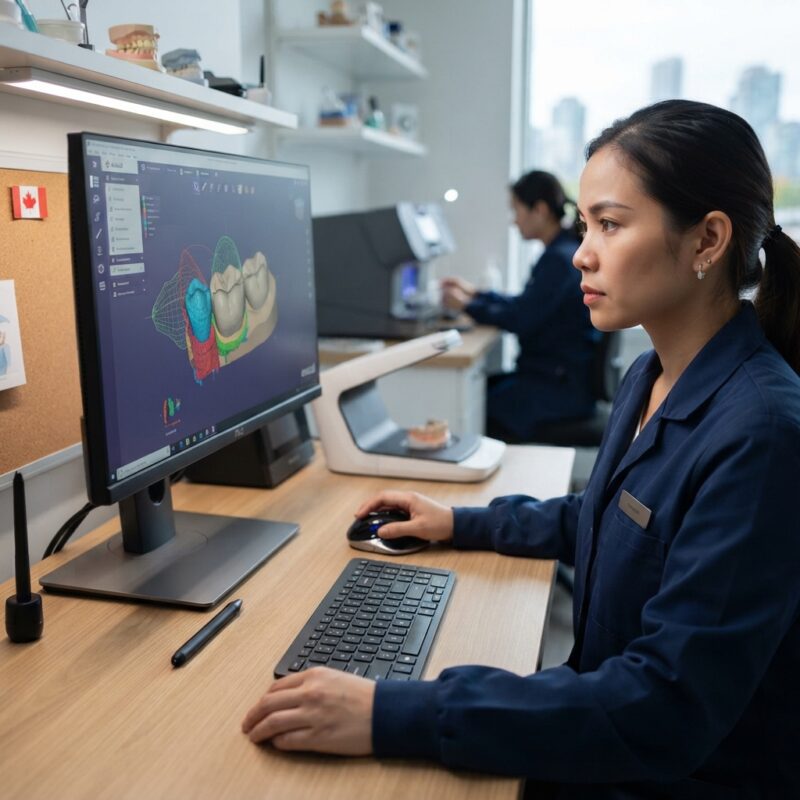
Dental CAD design labs utilize cutting-edge software and hardware to deliver precise digital models for dental prosthetics. Popular CAD software platforms include 3Shape and exocad, which provide comprehensive tools for designing crowns, bridges, implants, and more.
Integration with 3D printing and milling technologies allows labs to offer seamless digital workflows, although the referral program focuses exclusively on design services, not manufacturing. This specialization ensures top-tier digital quality and rapid turnaround times for referred clients.
Dental assistants and hygienists referring clients benefit from these advanced technologies indirectly, as their referrals receive state-of-the-art digital designs, enhancing treatment precision and patient care.
How Dental Assistants and Hygienists in Canada Can Earn Referral Commission from a Dental CAD Design Lab 2026: Key Takeaways
In summary, dental assistants and hygienists in Canada can earn referral commission from a dental CAD design lab 2026 by joining a structured referral partner program that rewards them for introducing new dental clinics and labs to outsourced CAD design services. The program offers:
- Recurring commissions on collected revenue for up to 24 months per client
- Commission rates ranging from 5% to 25%, with no cap on monthly earnings
- A personal referral link and dashboard for transparent tracking
- Payments via PayPal with monthly statements
- Strict privacy protections with no access to patient data
Ethical participation requires reviewing employment agreements and disclosing involvement as required. While earnings depend on effort and client activity, the potential for passive income is real, especially when leveraging existing professional networks.
How Can Dental Assistants and Hygienists Start Referring Today?
The first step is to sign up for the referral partner program, where you will receive your personal referral link and see your exact commission rate and terms. From there, begin sharing the benefits of outsourcing CAD design services to clinics and labs you know. Remember, consistency and professionalism in your referrals build trust and increase your chances of commission earnings.
By taking action in 2026, dental professionals can turn their industry knowledge and contacts into a valuable income stream, supporting their financial goals while enhancing the efficiency of dental practices and labs in Canada.
How Dental Assistants and Hygienists in Canada Can Earn Referral Commission from a Dental CAD Design Lab 2026: Final Advice
Success in the referral program hinges on genuine relationships and ethical referrals. Avoid spamming or aggressive solicitation, and prioritize clinics that truly benefit from CAD design outsourcing. Keep track of your referrals and stay engaged with the lab’s support team to optimize your efforts.
Remember that commissions depend on clients ordering and paying for services, so nurturing these relationships helps maximize your earnings over the 24-month commission period. Your role as a connector between dental practices and innovative CAD design services can create sustainable recurring income without requiring clinical work beyond your current responsibilities.
Useful Resources for Dental Assistants and Hygienists Considering Referral Programs
For more information on dental CAD/CAM technology and industry standards, visit the American Dental Association and explore CAD design software providers like 3Shape. Staying informed about digital dentistry trends will help you speak confidently when referring clients.
This knowledge also complements other digital dental services such as surgical guide design and digital crown design, broadening your referral scope.
Ready to Start Earning Referral Commissions?
If you are a dental assistant or hygienist in Canada interested in earning referral commission from a dental CAD design lab 2026, apply today through the Dental 3D Lab referral partner program to receive your personal referral link. Take control of your financial future by turning your network into a source of recurring income.
Common Mistakes Dental Assistants and Hygienists Should Avoid When Referring to CAD Design Labs
While referral programs offer an exciting revenue opportunity, dental assistants and hygienists must navigate potential pitfalls to maintain professionalism and maximize success. Below are some common mistakes to watch for, along with practical advice to avoid them.
1. Failing to Understand the Services Offered
One frequent misstep is referring dental clinics or labs without fully understanding the CAD design lab’s capabilities and specialties. Each lab may offer different scopes of work, turnaround times, and quality standards.
- Tip: Take time to review the CAD lab’s portfolio, service descriptions, and client testimonials before making referrals. This will ensure you match the right lab to the right clinic’s specific needs.
2. Overpromising on Turnaround Times or Quality
Enthusiasm can lead to promising faster delivery or higher quality than the lab can realistically provide. This can damage your credibility and harm relationships between clinics and the CAD lab.
- Tip: Always confirm expected timelines and quality standards directly with the lab before communicating them to potential referral clients.
3. Neglecting to Disclose Referral Commission Arrangements
Transparency is key to ethical compliance. Failing to disclose your referral commission to the dental practice or lab can raise legal and ethical concerns, potentially violating provincial regulations or professional codes.
- Tip: Be upfront about your role as a referral agent and any commissions involved. This openness builds trust and keeps you in good standing.
4. Ignoring Follow-Up and Relationship Maintenance
Referrals are not a one-time transaction. Neglecting to follow up with both the referred practice and the CAD lab can lead to missed opportunities for recurring referrals or feedback that could improve your referral process.
- Tip: Develop a simple follow-up checklist (e.g., contact after first order, check satisfaction, offer further assistance) to sustain strong professional relationships.
5. Making Referrals Without Permission
Some dental practices may have preferred CAD labs or internal policies restricting outsourcing. Referring without prior discussion or approval can create internal conflict and reduce trust.
- Tip: Always discuss potential referrals with the clinic management or lead dentist first to ensure alignment with their preferences and policies.
Checklist for Dental Assistants and Hygienists Before Making a CAD Design Lab Referral
To help streamline the referral process and avoid common errors, use this practical pre-referral checklist. It ensures you cover all critical bases before connecting a dental practice or lab with a CAD design provider.
- Research the CAD Lab: Confirm the lab’s accreditation, capabilities, and client feedback.
- Understand the Clinic’s Needs: Identify the types of cases they outsource (crowns, implants, orthodontics, etc.) and their volume.
- Discuss with Clinic Leadership: Get buy-in and permission to recommend an external CAD design lab.
- Review Pricing and Turnaround Times: Ensure the lab’s costs and delivery schedules align with the clinic’s expectations.
- Clarify Referral Commission Terms: Understand your payment structure and any tax implications.
- Prepare Disclosure Statement: Be ready to explain your referral role and commissions transparently.
- Gather Promotional Materials: Have brochures, digital assets, or case studies from the CAD lab to share.
- Set Follow-Up Reminders: Schedule times to check in with both parties post-referral.
Cost and Quality Considerations When Choosing a Dental CAD Design Lab
For dental assistants and hygienists referring clinics and labs to CAD design providers, understanding the balance between cost and quality is essential to ensure client satisfaction and repeat business.
Factors Impacting Cost
- Service Complexity: Designs for surgical guides or implant cases often require more intricate work and thus higher fees compared to simpler crown designs.
- Turnaround Speed: Labs may charge premium fees for expedited services, which can be crucial for urgent cases.
- Material Compatibility: Some labs specialize in certain materials (zirconia, PMMA, resin) that might affect pricing.
- Volume Discounts: Labs often offer better rates for high-volume clients, so encouraging clinics to consolidate orders can reduce costs.
Evaluating Quality
- Accuracy of Digital Design: Precision in margin definition, occlusal contacts, and fit reduces chairside adjustments and remakes.
- Communication and Support: Labs that provide clear channels to clarify case details and revisions tend to produce better outcomes.
- Consistency: Consistent quality across cases builds trust and enhances long-term partnerships.
- Technology Investment: Labs utilizing the latest CAD/CAM software and hardware generally achieve superior design fidelity.
Real-World Example: Balancing Cost and Quality
A mid-sized dental clinic in Toronto was referred to two different CAD design labs. Lab A offered a lower price but slower turnaround and less responsive support, while Lab B charged 20% more but was known for rapid delivery and excellent communication. After a few months, the clinic realized that the higher cost of Lab B was offset by fewer remakes and better patient satisfaction, ultimately improving profitability. This example highlights the importance of looking beyond sticker price when making referrals.
Market-Specific Trends in Dental CAD Design Outsourcing in Canada for 2026
Understanding the unique characteristics of the Canadian dental market can help dental assistants and hygienists tailor their referral approach effectively.
Provincial Variations in Adoption
Adoption rates of CAD design outsourcing vary across provinces due to differing regulatory environments and practice models.
- Ontario and British Columbia: Larger, urban centers with higher concentrations of specialty practices are leading adopters of CAD outsourcing.
- Prairie Provinces: Some rural areas experience slower adoption but are rapidly catching up due to tele-dentistry and digital workflows.
- Quebec: Language preferences and provincial regulations require bilingual support and compliance with local standards.
Impact of Dental Service Organizations (DSOs)
DSOs are increasingly influencing outsourcing decisions by centralizing procurement and standardizing workflows across multiple clinics. Referral partners working within or with DSOs may find opportunities to refer multiple locations simultaneously, amplifying commission potential.
Emerging Technologies Shaping the Market
- Artificial Intelligence: AI-assisted CAD design is beginning to reduce design times and improve accuracy, leading labs to differentiate themselves by technology sophistication.
- Cloud-Based Collaboration: Labs offering cloud platforms enable seamless case management and real-time feedback, preferred by digitally-savvy clinics.
- 3D Printing Integration: Some labs integrate design with onsite or third-party 3D printing, offering hybrid solutions that affect pricing and turnaround.
Practical Tip for Referral Agents
Stay informed about the evolving landscape by attending industry webinars, joining professional groups, and subscribing to Canadian dental technology publications. Being knowledgeable about market trends will enhance your credibility and enable you to make more strategic referrals.
Contact the company now to get started and transform your professional connections into tangible rewards.