The Canadian Dental Technology Crisis Entering 2026
The Canadian dental laboratory industry faces an unprecedented structural bottleneck as it navigates 2026. Labor demographics, shifting educational pipelines, and rapid shifts toward digital dentistry have converged to create a challenging human resource landscape. For lab owners, directors, and Dental Service Organizations (DSOs) operating across provinces from British Columbia to Ontario and Nova Scotia, maintaining turnaround times while safeguarding prosthetic quality has become an uphill battle. Identifying actionable dental lab technician shortage solutions in Canada 2026 is no longer just a long-term strategic goal—it is an immediate operational imperative for commercial survival.
Historically, commercial dental laboratories relied on a steady pipeline of certified Registered Dental Technologists (RDTs) graduating from specialized polytechnic programs. However, retirement rates among veteran technicians have outpaced new graduate cohorts for nearly a decade. As seasoned ceramicists, waxers, and metal technicians exit the workforce, Canadian labs are losing decades of tacit bench knowledge. Furthermore, the sheer volume of restorative cases driven by an aging Canadian populace and expanded public oral healthcare coverage has exacerbated the supply-demand imbalance. In this climate, evaluating dental lab technician shortage solutions in Canada 2026 requires rethinking traditional staffing models and embracing modern, technology-enabled production workflows.
The transition from traditional analog fabrication to computer-aided design and manufacturing (CAD/CAM) was initially viewed as a labor saver. While digital scanners, 3D printers, and milling machines have indeed automated physical production, they created a new bottleneck: high-skill CAD design capacity. Scanning intraoral impressions takes minutes, but virtual design requires specialized software proficiency, deep knowledge of dental anatomy, and fine digital dexterity. To prevent digital equipment from sitting idle, laboratory managers are urgently pursuing effective dental lab technician shortage solutions in Canada 2026 that address both digital design capacity and physical bench finishing.
What are the primary dental lab technician shortage solutions in Canada 2026?
The primary dental lab technician shortage solutions in Canada 2026 center on leveraging remote CAD/CAM design outsourcing, automating digital manufacturing workflows, and cross-training existing staff on high-value finishing procedures.
To fully operationalize these primary strategies, forward-thinking Canadian dental laboratories are segmenting their production into specialized modules. By delegating the initial phase of computer-assisted design to offshore or dedicated external digital design partners, local technicians no longer spend six to eight hours per day sitting in front of software software suites like exocad or 3Shape. Instead, local team members can redirect their expertise toward quality control, complex custom shading, anatomical contouring, and client communication with clinicians.
Furthermore, adopting comprehensive digital design outsourcing allows dental laboratories to scale their daily unit output without expanding their physical footprint or adding costly local payroll. Implementing structured dental lab technician shortage solutions in Canada 2026 means viewing digital design as a flexible utility service rather than an internal human resource constraint. The multi-step approach typically involves:
- Offloading High-Volume Standard Cases: Transitioning single-unit posterior crowns, night guards, and simple three-unit bridges to reliable remote CAD designers.
- Optimizing Core Bench Time: Refocusing licensed Canadian RDTs on intricate anterior esthetics, complex custom implant abutments, and complex full-arch rehabilitations.
- Standardizing CAD Parameters: Establishing standardized design preferences (margins, contacts, occlusal relief) so third-party designs mirror the exact artistic style of your local lab.
- Eliminating Nightly Backlogs: Utilizing overnight design turnarounds, ensuring CAD files uploaded at the end of the Canadian business day are fully designed and ready for milling by early morning.
By blending internal craftsmanship with reliable remote CAD design power, Canadian dental labs can maintain rapid turnaround times even during peak order spikes. Implementing these tailored dental lab technician shortage solutions in Canada 2026 effectively insulates the laboratory from local recruitment volatility and wage inflation pressures.
The Impact of the Canadian Dental Care Plan (CDCP) on Lab Capacity
The rollout and maturation of the Canadian Dental Care Plan (CDCP) has significantly reshaped market demands in 2026. By lowering financial barriers for millions of eligible residents, clinical practices across Canada have experienced a surge in patient enrollment and restorative treatment plans. Consequently, dental laboratories are receiving a record volume of prescriptions for removable partial dentures, complete dentures, basic crown and bridge restorations, and night guards. While this influx represents a massive revenue opportunity, it severely strains labs already suffering from severe staff shortages.
To capture this increased case volume without compromising turnaround standards, laboratory owners are searching for sustainable dental lab technician shortage solutions in Canada 2026. When internal CAD technicians are overwhelmed with an influx of standard CDCP restorative cases, lead times stretch from five business days to three weeks. Clinicians, under pressure to meet patient expectations, rapidly migrate their business to competing labs that maintain fast, predictable turnarounds.
To maintain a competitive edge during this clinical volume surge, successful laboratories are leveraging external digital design teams for standardized, high-volume products. For example, utilizing remote workflows for removable denture design enables labs to convert 3D intraoral scans or digitized physical impressions into printable denture bases and tooth setups in hours rather than days. This strategic division of labor serves as one of the most effective dental lab technician shortage solutions in Canada 2026, permitting labs to fulfill rising government-subsidized care demands profitably.
How does CAD/CAM design outsourcing resolve labor bottlenecks for dental labs?
CAD/CAM design outsourcing resolves labor bottlenecks by transferring time-consuming digital CAD restoration design to offshore or dedicated external specialists, allowing local technicians to focus exclusively on clinical fitting, staining, and finishing.
When a laboratory integrates design outsourcing into its daily operation, the typical operational workflow changes dramatically for the better. In a conventional digital setup, a technician must import the scan, mark margins, refine insertion paths, shape the restoration, adjust contact points, and verify occlusion. For a single technician, designing 25 to 30 units a day demands concentrated effort, leaving little time for physical finishing, ceramic layering, or client support. If that technician takes sick leave or resigns, production grinds to a halt.
By executing modern dental lab technician shortage solutions in Canada 2026, the lab converts fixed labor costs into flexible variable expenses. Scans captured in Canadian clinics during daytime hours are uploaded immediately to a secure cloud platform. External design specialists access these files, execute precision CAD modeling to the exact preferences specified by the lab, and upload completed design files (STL/3OX) back to the system. By 7:00 AM EST, the local laboratory’s internal staff simply reviews the designs, approves them, and routes them directly to local milling units or 3D printers.
This hybrid workflow dramatically increases unit capacity per internal bench technician. Instead of designing 25 units per day, a single local RDT can review, approve, mill, finish, and stain 80 to 100 units per day. This exponential jump in productivity highlights why digital outsourcing tops the list of effective dental lab technician shortage solutions in Canada 2026.
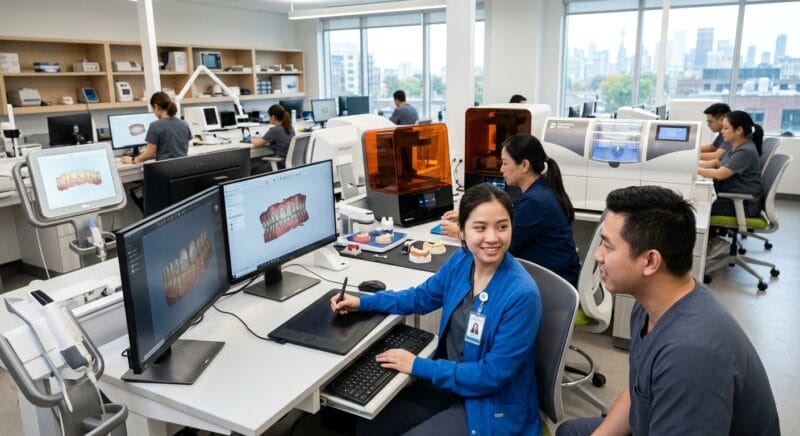
Evaluating Key Digital CAD Specialties for Outsourcing
Modern CAD/CAM design outsourcing covers virtually every discipline within fixed, removable, implant, and orthodontic prosthetics. Canadian dental labs facing talent constraints do not need to restrict outsourcing to simple crowns; specialized design services exist across all major clinical categories:
Crown & Bridge Design
Single crowns, multi-unit bridges, veneers, inlays, and onlays represent the foundation of commercial lab revenue. Outsourcing posterior zirconia crown design ensures fast, standardized outputs with consistent contacts and ideal embrasure spaces. Remote designers adept in CAD software maintain precise dimensional stability across complex multi-unit bridge spans, reducing internal remake rates.
Implant Abutments and Screw-Retained Crowns
Implant restoration design requires strict adherence to titanium base geometry, emergency profiles, and tissue management. Utilizing specialized external designers for custom abutments and screw-retained crowns ensures optimal fit and emergence profile while preserving internal staff capacity for advanced cases like full-arch implant design.
Surgical Guides
Implantology relies heavily on precision-guided surgery. Designing surgical guides demands meticulous matching of CBCT DICOM data with optical intraoral scans. Outsourcing surgical guide design frees Canadian labs from spending hours manipulating software, enabling them to deliver high-precision 3D printable guides to dental surgeons with guaranteed spatial accuracy.
Removable Dentures and Splints
Digital removable prosthetics represent one of the fastest-growing categories in modern dentistry. From digital complete dentures and flexible partial frameworks to custom night guards and occlusal splints, outsourcing digital CAD setup eliminates traditional manual waxing and processing bottlenecks entirely.
Orthodontic Aligners
Clear aligner treatment planning requires complex digital tooth movement sequencing and staging. Outsourcing clear aligner design allows laboratories and DSOs to offer private-label aligner solutions without investing hundreds of hours in internal software training and setup sequencing.
Integrating these diverse restorative options into an outsourced framework offers comprehensive dental lab technician shortage solutions in Canada 2026, positioning the laboratory to cater to every dental discipline seamlessly.
Why is digital design outsourcing essential for Canadian DSOs in 2026?
Digital design outsourcing is essential for Canadian Dental Service Organizations (DSOs) because it allows centralized multi-location clinical networks to instantly scale restoration production without incurring local recruitment delays or high fixed labor overhead.
Dental Service Organizations across Canada are expanding rapidly across major metropolitan markets like Toronto, Vancouver, Calgary, and Montreal. As these clinical networks acquire practices and establish centralized regional processing centers, managing internal dental laboratory overhead becomes a critical strategic variable. Relying on traditional in-house lab technicians in high-rent, high-wage urban areas drastically inflates operating expenditures.
By implementing centralized dental lab technician shortage solutions in Canada 2026, DSOs establish a streamlined digital hub-and-spoke model. Intraoral scans captured at suburban clinic locations are routed directly to a central digital portal. Rather than hiring a massive in-house team of CAD technicians across every clinic or regional center, the DSO utilizes an outsourced design service provider to process thousands of units per month.
This operational model yields several substantial business advantages for growing Canadian DSOs:
- Cost Optimization: Converting unpredictable fixed labor overhead and benefit expenses into a predictable per-unit design cost.
- Unmatched Scalability: Adding ten acquired practices to the network requires zero delay in scaling CAD design capacity.
- Quality Standardization: Centralizing CAD design parameters ensures clinical consistency across all DSO clinic locations regardless of geographic region.
- Rapid Clinical Turnaround: Enabling 24-hour design turnarounds, which reduces patient wait times between scanning and final cementation.
For executive leadership teams managing large dental networks, adopting these digital dental lab technician shortage solutions in Canada 2026 secures operational resilience while expanding gross profit margins across all clinical restorative procedures.
Addressing Quality Control, Security, and Compliance Standards
A common concern among Canadian dental laboratory owners evaluating design outsourcing revolves around quality control, data security, and regulatory compliance. How can a lab owner ensure that designs generated externally match the exact clinical expectations of demanding Canadian dentists?
The answer lies in establishing robust digital onboarding protocols and structured feed-forward loops. Modern offshore and external CAD design partners operate under rigorous quality control management systems. When onboarding a new Canadian lab client, the design service creates detailed anatomical profile templates. These specify preferred occlusal contact tightness (e.g., -20 microns), proximal contact intensity, cement gap space (e.g., 40 microns starting 1mm above the margin), and specific margin design styles (heavy chamfer vs. feather edge).
Regarding data security and privacy, Canadian laboratories must remain compliant with national and provincial health information regulations (such as PIPEDA and provincial health information acts). Leading CAD design platforms employ encrypted file transmission protocols (SSL/TLS Encryption), cloud storage compliant with international security frameworks, and de-identified patient data routing. Intraoral scans sent for CAD design contain dental geometry and anonymous numerical reference codes without exposing sensitive patient health identifiers.
By implementing proper security protocols and strict standardized design parameters, laboratory owners can confidently embrace dental lab technician shortage solutions in Canada 2026 without risking regulatory compliance or sacrificing technical precision.
Financial Impact: Comparing In-House CAD Staffing vs. Outsourced Design
To fully grasp the economic necessity of adopting digital design outsourcing, lab owners must examine the direct and indirect financial costs associated with maintaining exclusively in-house CAD technicians in Canada entering 2026.
Hiring a full-time, experienced digital CAD technician in Canada involves substantial overhead. Beyond competitive base salaries, employers incur payroll taxes, health benefits, paid time off, dedicated hardware workstations, software license renewals, and ongoing technical training. Furthermore, if an internal designer experiences downtime due to low daily scan volumes, the lab still absorbs full fixed hourly wage costs.
Consider the following economic comparison highlighting the cost efficiencies of dental lab technician shortage solutions in Canada 2026:
Scenario A: Exclusively In-House CAD Staffing
An average Canadian CAD technician earns approximately $65,000 to $85,000 CAD annually, plus an additional 15-20% in employer overhead, software licensing fees ($3,000–$5,000 annually per seat), and hardware depreciation. Assuming an average output of 30 designed units per working day (~6,600 units annually), the true internal cost per designed unit frequently ranges between $12.00 CAD and $16.00 CAD. Additionally, capacity is strictly capped at what that individual technician can physically produce during standard working hours.
Scenario B: Hybrid Model using Outsourced CAD Services
By pairing a smaller internal team focused on quality assurance with an external CAD design provider, the per-unit design cost drops significantly to a range of $3.50 to $6.00 CAD per unit (depending on restoration complexity). Fixed overhead disappears, software seat fees are reduced, and the lab pays strictly for the exact volume of units designed. If daily scan volume doubles during seasonal spikes, capacity expands instantly without hiring additional staff.
This clear economic advantage makes CAD design outsourcing one of the most compelling dental lab technician shortage solutions in Canada 2026 for lab managers focused on bottom-line profitability and sustainable business growth.
Step-by-Step Guide: Implementing Digital CAD Design Outsourced Workflows
Transitioning from an overburdened in-house design workflow to a seamless outsourced model requires careful execution. Canadian lab leaders should follow a structured four-phase implementation plan to guarantee zero disruption to daily clinical deliveries:
Phase 1: Workflow and Parameter Definition
Document your laboratory’s unique technical preferences. Create clear guidelines detailing cement gap clearances, occlusal contact preferences, tissue relief distances, and contouring styles. Upload diagnostic sample cases to calibrate the external CAD design team to your exact standards.
Phase 2: Digital Portal and Software Integration
Establish direct connections between your internal lab management system or scanner portals (such as 3Shape Communicate, Medit Link, or exocad) and the external design platform. Ensure seamless file transfer protocols for STL, OBJ, and 3OX formats.
Phase 3: Pilot Testing and Calibration
Initiate a two-week pilot phase by routing 20% to 30% of daily posterior single-unit crowns through the outsourcing partner. Internal RDTs inspect, adjust, and score every returned design, providing constructive feedback to calibrate the external team’s output.
Phase 4: Full Scale and Internal Role Redirection
Once design accuracy reaches consistent 95%+ approval rates without adjustment, expand the outsourcing scope to include multi-unit bridges, custom abutments, night guards, and dentures. Transition internal bench technicians into specialized roles focused on advanced ceramic staining, complex esthetic cases, quality control, and clinician client success.
Following this structured approach guarantees that adopting dental lab technician shortage solutions in Canada 2026 yields immediate operational stability and long-term financial growth.
Future-Proofing Canadian Dental Laboratories Beyond 2026
The structural changes impacting Canada’s dental technology labor market are permanent. Demographics dictate that skilled bench technicians will remain scarce, and educational pipelines will take years to adjust. Meanwhile, digital intraoral scanning adoption among Canadian dental practices is approaching critical mass. Dental laboratories that rely on traditional, localized operational models will continue to struggle with rising labor costs, long turnarounds, and severe capacity ceilings.
Conversely, progressive dental laboratories and DSOs that proactively embrace dental lab technician shortage solutions in Canada 2026 are positioning themselves for dominant market leadership. By combining internal craft leadership with global, scalable CAD design networks, these labs achieve true operational elasticity. They can accommodate rapid growth, serve expanded public programs like the CDCP, and deliver flawless restorative outcomes to clinicians without overwhelming their valuable internal staff.
Ultimately, digital CAD design outsourcing is not merely a stopgap measure for labor shortages; it is the modern structural framework for competitive, scalable, and highly profitable dental laboratory operations in Canada for 2026 and beyond.
Ready to overcome workforce constraints and scale your Canadian lab? Contact our expert CAD/CAM design team today to streamline your digital restorative workflow and unlock immediate operational capacity.