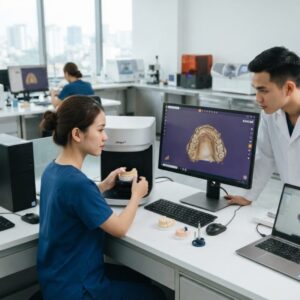
Introduction: The New Era of Dental Lab Design
In the fast-evolving dental industry, how AI is transforming dental lab design workflows in 2026 is a critical topic for labs and Dental Service Organizations (DSOs) striving for competitive advantage. Artificial intelligence technologies are no longer futuristic concepts but active tools reshaping every step of the dental CAD/CAM design process—from crowns and bridges to implants, surgical guides, dentures, orthodontic aligners, and night guards. This article delves deep into the practical applications and benefits of AI integration within outsourced digital dental lab services, offering insights for decision-makers eager to optimize their workflows and improve patient outcomes.
What is AI’s Role in Dental Lab Design Workflows?
AI in dental lab design workflows refers to the application of machine learning, computer vision, and data analytics to automate and enhance the digital design process of dental prosthetics and appliances. This enables faster, more accurate, and consistent outcomes compared to manual methods.
Specifically, AI algorithms analyze 3D digital scans, identify anatomical landmarks, predict optimal prosthetic shapes, and automatically generate design proposals. This reduces the need for repeated manual adjustments and accelerates turnaround times. For example, AI-driven software can automatically generate the occlusal surface of a crown or design complex implant-supported bridges based on patient-specific data, improving precision and reducing human error.
Outsourcing dental lab CAD/CAM design services that leverage AI allows labs and DSOs to access these advanced capabilities without heavy upfront investment in software or training, ensuring scalability and consistent quality across cases.
How Does AI Improve Crown and Bridge Design?
AI improves crown and bridge design by automating margin detection, occlusal surface modeling, and contact point optimization, achieving a more natural fit and function with less manual intervention.
Traditional crown and bridge design can be time-consuming, often requiring multiple iterations to perfect fit and esthetics. AI-powered design software rapidly analyzes digital impressions to detect margins and propose restoration shapes that conform precisely to patient anatomy. Through deep learning models trained on thousands of cases, AI anticipates functional requirements and automatically adjusts designs to optimize durability and comfort.
These AI capabilities reduce human error and variability, enabling faster delivery of high-quality crowns and bridges. Integration with CAD/CAM milling or 3D printing further streamlines production. Dental labs using outsourced AI-driven design services benefit from consistent, reproducible results and can handle higher case volumes efficiently.
In What Ways is AI Enhancing Implant and Surgical Guide Design?
AI enhances implant and surgical guide design by automating data integration, implant position planning, and guide fabrication, which improves surgical precision and patient safety.
Implantology demands meticulous planning to avoid anatomical structures and ensure optimal implant placement. AI algorithms process CBCT scans and intraoral digital impressions to automatically identify bone density, nerve canals, and other critical landmarks. They then propose implant positions based on biomechanical and prosthetic considerations.
For surgical guides, AI generates precise 3D templates that assist clinicians during implant placement. This automation significantly reduces design time and eliminates human errors in guide fabrication. Outsourced design services equipped with AI can provide dental labs and DSOs with ready-to-use surgical guides that comply with regulatory standards and clinical best practices.
Leading technology providers such as Straumann and Nobel Biocare exemplify how AI-powered implant planning is becoming industry standard.
How is AI Revolutionizing Denture and Orthodontic Aligner Design?
AI revolutionizes denture and orthodontic aligner design by automating digital tooth setup, fit adjustments, and treatment simulations, drastically improving customization and patient comfort.
Denture design traditionally relies on manual tooth arrangement and wax try-ins, which are time-consuming and subjective. AI-powered digital workflows analyze jaw relations, muscle dynamics, and esthetic parameters to propose optimal tooth positioning and occlusion. This reduces manual labor and improves repeatability.
Similarly, for orthodontic aligners, AI algorithms model tooth movements and generate treatment plans that visualize the step-by-step correction process. This helps clinicians and patients anticipate results and adjust treatment strategies effectively. Outsourced CAD/CAM design partners utilizing AI can deliver digital denture and aligner designs ready for additive manufacturing or milling with high accuracy and predictability.
What Challenges Does AI Address in Current Dental Lab Workflows?
AI addresses challenges such as manual design bottlenecks, inconsistent quality, long turnaround times, and integration complexity in dental lab workflows.
Manual CAD design is prone to human error and requires significant expertise, leading to variable case quality and delays. AI automates repetitive design tasks, freeing dental technicians to focus on complex decisions and quality control. It also standardizes processes to ensure consistent results regardless of operator skill.
Moreover, AI facilitates seamless integration of data from intraoral scanners, CBCT devices, and milling or 3D printing equipment, reducing errors from data transfer and format compatibility. This connectivity is especially valuable for DSOs managing multiple labs or sites, allowing centralized oversight of design quality and efficiency.
By outsourcing AI-augmented design workflows, dental labs can overcome resource limitations while adopting cutting-edge technologies that keep them competitive.
How Does AI Integration Impact Outsourcing Partnerships?
AI integration enhances outsourcing partnerships by enabling faster, more accurate deliverables and facilitating collaboration through cloud-based platforms and real-time feedback.
Dental labs and DSOs outsourcing CAD/CAM design benefit from AI-powered services that deliver consistent, high-quality digital designs aligned with clinical requirements. AI tools reduce revision cycles, accelerating case turnaround. Cloud collaboration platforms allow remote review, annotation, and approval of designs, improving communication between labs, clinicians, and outsourcing partners.
Furthermore, AI-driven analytics provide insights into workflow efficiency, case complexity, and error patterns, helping outsourcing providers continuously optimize their processes. This transparency builds trust and long-term partnerships.
Providers like exocad and 3Shape are at the forefront of delivering AI-enhanced design platforms that integrate smoothly with outsourcing services.
What Are the Key AI Technologies Powering Dental Lab Design?
Key AI technologies powering dental lab design include deep learning, computer vision, natural language processing, and generative design algorithms.
Deep learning neural networks analyze vast datasets of dental scans and prosthetic designs to learn anatomical variations and ideal design parameters. Computer vision enables precise identification of margins, soft tissue contours, and occlusal surfaces from 3D scans. Natural language processing assists in interpreting clinician notes and prescription parameters to customize designs.
Generative design algorithms use AI to propose multiple design alternatives optimized for strength, esthetics, and function, allowing technicians to select or refine the best option rapidly. These AI technologies combine to automate and augment the dental lab design workflow, enabling unprecedented accuracy and speed.
How Are Labs Measuring the ROI of AI in 2026?
Labs measure the ROI of AI in 2026 through metrics such as reduced design time, lower revision rates, increased case throughput, and improved patient satisfaction.
By tracking design cycle times before and after AI adoption, labs can quantify time savings. Reduction in remakes and chairside adjustments reflects improved initial design accuracy. Increased case capacity without additional staffing indicates efficiency gains.
Patient satisfaction scores and clinician feedback also serve as qualitative ROI markers, as better-fitting prosthetics and appliances lead to improved clinical outcomes and practice reputation.
Investment in AI-enabled outsourcing services often yields rapid payback by lowering costs associated with manual labor and remakes while enhancing lab competitiveness.

What Are Best Practices for Implementing AI in Dental Lab Outsourcing?
Best practices include selecting reputable AI-enabled outsourcing partners, ensuring data security, training staff on AI tools, and maintaining clinician-lab communication.
Labs should evaluate outsourcing providers based on AI capability, integration ease, and compliance with regulatory standards. Protecting patient data and intellectual property during digital file transfer is critical. Training technicians and clinicians on AI-enhanced workflows maximizes the benefits of automation while preserving expert oversight.
Establishing clear communication channels for design feedback and case revisions ensures alignment between clinical goals and AI-generated designs. Combining AI’s strengths with human expertise yields optimal results.
How Is AI Expected to Evolve in Dental Lab Design Beyond 2026?
AI is expected to evolve with deeper integration of augmented reality (AR), real-time adaptive design, and predictive maintenance for dental manufacturing equipment.
AR-enabled design review will allow clinicians and patients to visualize prosthetic fit in virtual environments. AI will increasingly adapt designs dynamically based on intraoperative feedback and patient-specific biomechanical data. Predictive analytics will forecast equipment servicing needs to prevent downtime.
These advancements will further streamline workflows, reduce costs, and enhance patient outcomes, solidifying AI as an indispensable component of dental lab design outsourcing.
How Does AI Work Alongside Other Digital Dental Lab Technologies?
AI works synergistically with intraoral scanners, CBCT imaging, CAD/CAM milling, and 3D printing to create an end-to-end digital dental lab ecosystem.
Intraoral scanners capture precise digital impressions that AI algorithms analyze for prosthetic design. CBCT provides volumetric data critical for implant planning and surgical guide creation. CAD/CAM milling and additive manufacturing fabricate the final restorations and appliances based on AI-optimized designs.
Outsourced AI-driven design services integrate data from these sources, ensuring seamless workflow continuity. This holistic approach enhances accuracy, efficiency, and customization capabilities.
For labs interested in expanding digital capabilities, AI-powered design also works well alongside surgical guide design services and next-generation manufacturing technologies.
Conclusion: Embracing AI to Future-Proof Dental Lab Workflows
Understanding how AI is transforming dental lab design workflows in 2026 is essential for dental labs and DSOs aiming to enhance efficiency, accuracy, and patient outcomes. AI’s automation of crown and bridge design, implant planning, denture setup, and orthodontic treatment simulation delivers measurable benefits that traditional methods cannot match. By partnering with AI-enabled outsourcing services, labs can scale rapidly, reduce errors, and maintain a competitive edge in a rapidly digitizing dental market.
As AI technology continues to mature, it will unlock new possibilities for customization and innovation in dental prosthetics and appliances, making it a critical investment for future-ready dental laboratories.
Practical Step-by-Step Guide to Integrating AI in Dental Lab Workflows
While AI promises transformative benefits, successful integration within dental lab workflows requires careful planning and execution. Here is a detailed step-by-step guide designed to help dental labs and dental practices implement AI-driven design systems efficiently and sustainably.
Step 1: Conduct a Workflow Audit
Before adopting AI tools, conduct a thorough audit of your current design and production workflows. Identify bottlenecks, repetitive tasks, quality control challenges, and communication gaps between clinicians and the lab. For example, many labs find that manual data entry or model scanning is time-consuming and error-prone—prime candidates for AI automation.
Step 2: Define Clear Objectives and KPIs
Set measurable goals such as reducing turnaround times by 20%, improving design accuracy to reduce remakes, or enhancing fit quality as perceived by dental practices. Establish KPIs like design cycle time, error rates, patient satisfaction scores, and cost per case to evaluate AI impact over time.
Step 3: Choose the Right AI Solutions Based on Use Cases
Not all AI tools are equal. Labs focused on implant and surgical guide design may prioritize AI-driven 3D anatomical analysis and virtual placement, while those specializing in dentures should look for AI that enhances occlusal surface prediction and esthetics. Evaluate solutions for compatibility with your existing CAD/CAM systems and data formats.
Step 4: Train Your Team and Build Change Management Processes
Successful AI adoption hinges on people. Invest in hands-on training for designers, technicians, and clinicians to understand AI capabilities and limitations. Establish protocols for human review of AI-generated designs to maintain quality control. Encourage feedback loops to continuously refine AI parameters.
Step 5: Pilot AI on Select Cases and Collect Data
Start with a pilot phase focusing on a small subset of cases, such as posterior crowns or single-unit implants. Closely monitor performance metrics, technician workload, and client feedback. Use this phase to identify integration issues and optimize AI settings before full-scale deployment.
Step 6: Scale AI Across Workflows and Continuously Optimize
Once the pilot confirms improved efficiency and quality, progressively expand AI use to other product lines and workflows. Implement dashboards to track ongoing performance and schedule regular reviews to update AI models based on new clinical data and material innovations.
Step 7: Maintain a Human-in-the-Loop Approach
Even the best AI systems require human oversight. Establish checkpoints where experienced technicians validate AI outputs, ensuring that design nuances and patient-specific considerations are respected. This hybrid approach reduces errors and builds trust with clinicians and patients alike.
Checklist for Evaluating AI Vendors and Solutions for Dental Labs
Choosing the right AI partner is critical to unlocking value. Use this checklist to assess vendors objectively and ensure their solutions align with your lab’s needs and growth plans.
- Technology Compatibility: Does the AI software integrate smoothly with your existing CAD/CAM hardware and design software?
- Customization and Flexibility: Can the AI be tailored to your lab’s specific workflows, materials, and product types?
- Data Security and Compliance: Does the vendor comply with healthcare data privacy standards (e.g., HIPAA) and secure patient information?
- Accuracy and Validation: Are there published studies or case results demonstrating improved design accuracy and clinical outcomes?
- Ease of Use and Training: Is the user interface intuitive? What training and ongoing support does the vendor provide?
- Scalability: Can the AI solution handle increasing case volumes without performance degradation?
- Cost Structure: Are pricing models transparent? Consider upfront costs, licensing fees, and maintenance expenses.
- Customer Support and Updates: How frequently is the AI updated? Is there a responsive support team available for troubleshooting?
- Integration with Outsourcing Partners: Can the AI facilitate collaboration and seamless data exchange with external labs or DSOs?
- User Feedback and References: Seek testimonials or peer reviews from other dental labs and practices using the AI vendor’s solutions.
Common Mistakes to Avoid When Implementing AI in Dental Labs
Many dental labs rush into AI adoption without a strategic approach, leading to wasted investment and frustration. Here are some frequent pitfalls and how to avoid them.
1. Overestimating AI’s Autonomy
AI is a tool to augment human expertise, not replace it. Expecting AI to deliver flawless designs without human review often results in errors, remakes, and damaged client trust. Maintain strict quality control protocols and human-in-the-loop processes.
2. Neglecting Data Quality and Standardization
AI depends heavily on high-quality input data. Poorly captured scans, inconsistent file formats, or incomplete digital impressions undermine AI accuracy. Invest in proper scanning equipment, standardized data handling, and technician training to ensure clean inputs.
3. Lack of Clear Goals and Metrics
Without predefined objectives, it’s impossible to measure AI’s true impact. Avoid vague expectations like “improve design” by setting concrete KPIs such as turnaround time reduction or fit accuracy improvement.
4. Ignoring Change Management and Staff Buy-In
Resistance from technicians or clinicians unfamiliar with AI can stall adoption. Engage your team early, provide adequate training, and highlight AI’s benefits to build enthusiasm and reduce fear of job displacement.
5. Underestimating Integration Complexity
Introducing AI systems that do not seamlessly connect with existing CAD/CAM or practice management software creates workflow disruptions. Evaluate integration capabilities thoroughly and plan IT support accordingly.
6. Failing to Budget for Ongoing Costs
AI solutions often require subscription fees, regular maintenance, and updates. Budget beyond initial acquisition costs to include training refreshers, software upgrades, and potential hardware enhancements.
7. Overlooking Regulatory and Compliance Issues
Ensure that AI tools comply with medical device regulations and patient data privacy laws relevant in your market. Non-compliance can lead to legal liabilities and reputational damage.
Balancing Cost and Quality: What Dental Labs Should Consider When Adopting AI
While AI promises efficiency gains, dental labs must carefully weigh cost versus quality impact to make informed investment decisions. Several factors influence this balance.
Initial Investment and Operational Costs
AI-enabled design software and hardware can require substantial upfront capital, including new scanners, servers, or cloud subscriptions. Labs must evaluate whether these costs are justified by expected productivity gains and error reduction. For example, a mid-sized lab investing $50,000 in AI might save $10,000 annually in labor costs and $15,000 in reduced remakes, achieving ROI in 2-3 years.
Impact on Quality and Client Satisfaction
AI can enhance design consistency and reduce human error, improving prosthetic fit and aesthetics. This leads to higher satisfaction among dental practices and patients, which can increase repeat business and referrals. However, poor AI implementation risks compromising quality, so labs must prioritize thorough validation and technician oversight.
Training and Staffing Considerations
Adopting AI may shift technician roles from manual design to AI supervision and troubleshooting. Labs should consider retraining costs and potential changes in staffing requirements. Upskilling staff can also boost morale and retention by expanding their capabilities.
Cost Savings From Outsourcing and Collaboration
AI facilitates better communication and data exchange with external partners, potentially reducing outsourcing errors and turnaround times. Labs can negotiate better terms with DSOs by demonstrating AI-enabled quality improvements. Conversely, AI may reduce the need for some outsourcing, impacting existing partnerships.
Market-Specific Factors Affecting AI Value
Dental labs in regions with high labor costs or stringent quality standards stand to gain more from AI adoption. In contrast, markets with low-cost manual labor may find ROI slower. Additionally, regulatory environments that require documented design validation may favor AI’s analytical capabilities.
Ongoing Evaluation and Flexibility
Because AI technology evolves rapidly, labs should adopt flexible procurement models (e.g., subscription-based) that allow upgrading or switching vendors. Continuous performance monitoring ensures that AI investments continue to deliver value and align with changing market demands.
If you want to learn more about integrating AI-driven CAD/CAM design services into your workflow, contact us today for a personalized consultation and elevate your lab’s digital capabilities.