Understanding the Dental Technician Shortage in Spain and Italy: Solutions for Dental Labs in 2026
The dental technician shortage in Spain and Italy: solutions for dental labs in 2026 are critical to ensuring continued high-quality dental restorations. Both countries face a growing gap between demand for prosthetic devices—such as crowns & bridges, implants, dentures, orthodontic aligners, and night guards—and the available skilled workforce. This shortage stems from demographic shifts, educational bottlenecks, and increased demand driven by aging populations and expanding dental care access.
Dental labs and dental service organizations (DSOs) must urgently adopt innovative solutions like outsourcing CAD/CAM digital design services to maintain productivity, quality, and turnaround times. This article provides an in-depth analysis of the causes behind the shortage and practical, scalable solutions tailored for dental labs in 2026.
What is driving the dental technician shortage in Spain and Italy?
The dental technician shortage in Spain and Italy results from a combination of demographic, educational, and industry trends that have converged over the last decade.
- Aging workforce: Many experienced technicians are retiring without sufficient new entrants to replace them.
- Limited training capacity: Dental technician programs in Spain and Italy have not expanded proportionally to meet demand.
- Economic factors: Competitive wages and career attractiveness have declined, prompting some technicians to leave the profession or seek opportunities abroad.
- Increased demand: Growing awareness of dental aesthetics and implantology has increased the volume and complexity of restorations required.
These elements culminate in a pressing shortage that impacts dental labs’ ability to deliver timely and precise prosthetics, which in turn affects dentists and patients.
How does outsourcing CAD/CAM digital design address the dental technician shortage in Spain and Italy?
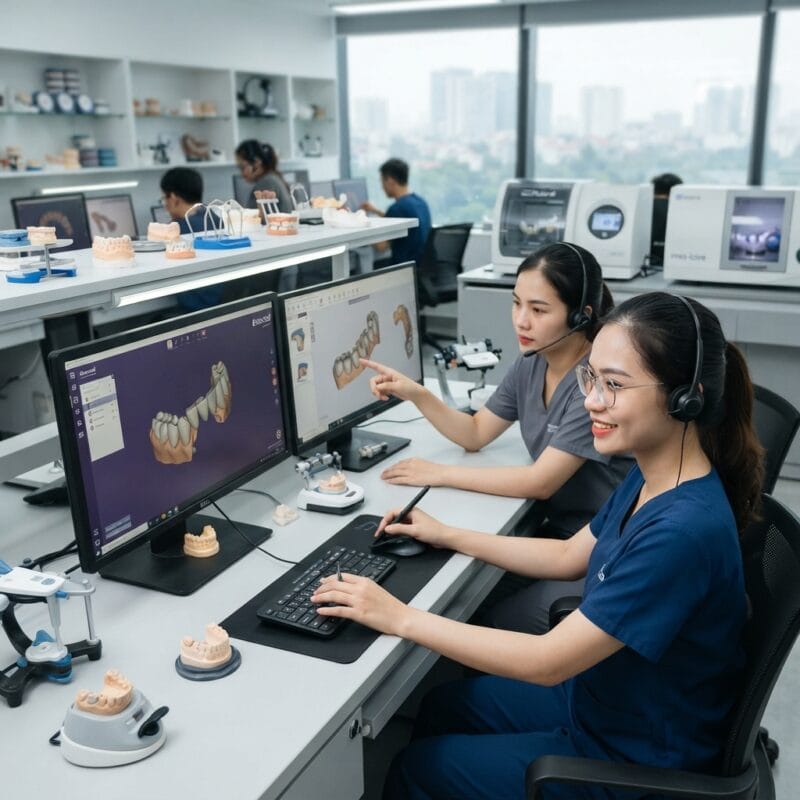
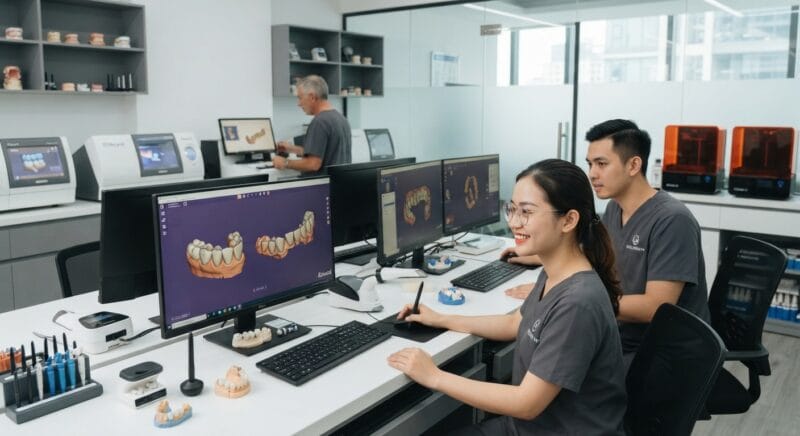
Outsourcing CAD/CAM digital design services helps dental labs overcome the dental technician shortage in Spain and Italy: solutions for dental labs in 2026 by providing access to skilled digital designers without the need for in-house hiring.
By leveraging specialized external CAD/CAM design providers, labs can:
- Scale production: Quickly manage fluctuating case volumes without overstretching internal resources.
- Access expert skills: Utilize cutting-edge digital design expertise in crown & bridge, implant planning, surgical guides, dentures, and orthodontic appliances.
- Reduce turnaround times: Streamline workflows with faster digital processing and fewer remakes.
- Lower overhead costs: Avoid expenses related to recruitment, training, and retaining highly specialized technicians.
This approach integrates seamlessly with established CAD/CAM platforms like those from exocad and 3Shape, enabling digital collaboration and file transfer for efficient case management.
What are the key digital solutions to mitigate technician shortages in dental labs?
Dental labs can adopt several digital solutions focused on CAD/CAM design outsourcing to address the dental technician shortage in Spain and Italy: solutions for dental labs in 2026.
- Digital crown and bridge design: Outsourcing the design of precise crowns and bridges using advanced software ensures consistent quality and fit.
- Implant surgical guide design: Specialized design services create accurate surgical guides that improve implant placement outcomes and reduce chair time.
- Surgical guide fabrication: Utilizing digital workflows for guide manufacturing reduces errors and improves efficiency.
- Digital denture fabrication: Combining intraoral scans with CAD design to produce well-fitting dentures with minimal manual adjustments.
- Orthodontic aligner design: Outsourcing digital setups for clear aligners enhances treatment planning speed and quality.
- Night guard design: Digital design services provide custom night guards with rapid turnaround and precise occlusal fit.
These services help dental labs maintain service levels despite workforce constraints and prepare for future growth in demand.
How can dental labs ensure quality and security when outsourcing CAD/CAM digital design?
Ensuring quality and security when outsourcing digital design is paramount to addressing the dental technician shortage in Spain and Italy: solutions for dental labs in 2026 must include robust quality assurance and data protection measures.
Labs should partner with providers who:
- Follow stringent quality control protocols: Including design reviews, fit verification, and material compatibility checks.
- Use validated CAD software: Such as exocad or 3Shape, which are trusted in the dental industry for precision and reliability.
- Maintain data confidentiality: Employ encrypted file transfer protocols and comply with GDPR regulations applicable in Spain and Italy.
- Provide clear communication channels: To enable case-specific customization and quick resolution of design issues.
By vetting outsourcing partners carefully, dental labs can mitigate risks and uphold their reputation for quality restorations.
What impact will the dental technician shortage in Spain and Italy have on dental labs and DSOs by 2026?
The dental technician shortage in Spain and Italy: solutions for dental labs in 2026 are not only necessary but urgent, as the shortage threatens to increase turnaround times, reduce case acceptance rates, and inflate costs.
DSOs and multi-location dental labs will face particular pressure due to larger case volumes and the need for standardized quality across sites. Without adopting outsourcing and digital workflows, these organizations might struggle to maintain competitive service offerings.
Conversely, labs that implement CAD/CAM outsourcing will better withstand workforce fluctuations, improve operational flexibility, and provide dentists with faster, more reliable prosthetics, strengthening client relationships.
How do leading CAD/CAM platforms facilitate outsourcing solutions?
Leading CAD/CAM platforms such as exocad and 3Shape provide cloud-based collaboration tools and open file formats that simplify outsourcing design tasks, directly addressing the dental technician shortage in Spain and Italy: solutions for dental labs in 2026 rely on these technologies for seamless integration.
These platforms enable labs to upload digital impressions and scans, specify restoration parameters, and receive completed designs ready for milling or 3D printing. Their compatibility with various scanners and milling machines supports diverse workflows across labs and DSOs.
Additionally, many CAD providers offer dedicated portals for outsourcing partners, improving communication and case tracking efficiency.
What are the benefits of outsourcing surgical guide design amid the technician shortage?
Outsourcing surgical guide design is a strategic solution to the dental technician shortage in Spain and Italy: solutions for dental labs in 2026 include delegating this complex, time-consuming task to specialists to enhance accuracy and speed.
Specialized designers can leverage advanced implant planning software from companies like Straumann and Nobel Biocare to create precise guides that reduce surgical risks and improve patient outcomes.
This frees internal technicians to focus on crown and denture fabrication while ensuring surgical guides meet clinical requirements.
Which workflow adjustments can dental labs implement to maximize outsourcing efficiency?
Dental labs can maximize the benefits of outsourcing in response to the dental technician shortage in Spain and Italy: solutions for dental labs in 2026 should include workflow standardization and digital integration.
- Standardized case submission: Use uniform protocols for digital impression upload and case instructions to reduce errors.
- Integrated software platforms: Connect lab management software with CAD design portals for real-time status updates.
- Staff training: Educate internal teams on digital design principles and outsourcing collaboration to improve communication and quality control.
- Feedback loops: Implement processes to review outsourced designs and provide constructive feedback for continuous improvement.
These adjustments ensure smoother collaboration and faster turnaround times despite technician shortages.
What role do digital dentures and orthodontic aligners play in addressing the technician shortage?
Digital dentures and orthodontic aligners represent high-growth product categories that benefit from CAD/CAM outsourcing amid the dental technician shortage in Spain and Italy: solutions for dental labs in 2026 include adopting digital fabrication to reduce manual labor.
Digitally designed dentures allow labs to produce better-fitting prosthetics using intraoral scans and 3D printing, cutting down time-consuming wax-ups and adjustments. Similarly, orthodontic aligner setups outsourced to experienced digital designers can accelerate case planning and manufacturing.
These technologies reduce technician workload and improve scalability for labs facing staffing constraints.
How can dental labs in Spain and Italy prepare for the future workforce challenges?
Preparing for ongoing workforce challenges requires a multifaceted strategy that includes embracing digital transformation and outsourcing as key components in addressing the dental technician shortage in Spain and Italy: solutions for dental labs in 2026 must be sustainable and forward-looking.
- Invest in continuous digital education: Upskill existing staff on CAD/CAM technologies and design software.
- Build long-term outsourcing partnerships: Establish reliable relationships with trusted CAD/CAM design providers.
- Leverage automation: Adopt AI-driven design tools that complement human expertise and reduce repetitive tasks.
- Advocate for expanded training programs: Collaborate with educational institutions to increase technician training capacity.
These efforts will help dental labs navigate the technician shortage while maintaining competitive advantage.
What are the cost implications of outsourcing digital design services?
Outsourcing digital design services can lead to both cost savings and new expenditures, making it a balanced approach to managing the dental technician shortage in Spain and Italy: solutions for dental labs in 2026 must consider financial impacts carefully.
While outsourcing reduces fixed costs such as salaries and benefits, labs incur variable costs based on case volume and complexity. However, improved efficiency, fewer remakes, and faster delivery often offset these expenses.
Moreover, outsourcing enables labs to avoid capital investments in expensive software licenses and hardware upgrades, transferring those responsibilities to the design provider.
How do DSOs benefit uniquely from CAD/CAM outsourcing amid the technician shortage?
Dental Service Organizations (DSOs) benefit uniquely from CAD/CAM outsourcing by achieving centralized digital design services that support multiple clinical locations, directly addressing the dental technician shortage in Spain and Italy: solutions for dental labs in 2026 must accommodate DSO scale and complexity.
Outsourcing allows DSOs to maintain consistent quality standards across their network, reduce internal staffing pressures, and integrate digital workflows that enable data-driven decision-making and inventory management.
This approach enhances patient satisfaction by delivering standardized prosthetics quickly and reliably regardless of geographic location.
Which technological trends will influence dental lab outsourcing in 2026?
Emerging technological trends such as artificial intelligence, cloud computing, and enhanced 3D printing materials will significantly shape the dental technician shortage in Spain and Italy: solutions for dental labs in 2026 must incorporate these innovations to stay competitive.
- AI-assisted design: Automating routine design steps to free human technicians for complex cases.
- Cloud-based collaboration: Enabling real-time communication and file sharing between labs, outsourcing partners, and clinicians.
- Advanced materials: New biocompatible resins and ceramics that require precise digital design for optimal performance.
Keeping abreast of these trends allows dental labs to optimize their outsourcing strategies and deliver superior prosthetics.
How to select the right outsourcing partner for your dental lab?
Selecting the right outsourcing partner is critical to successfully overcoming the dental technician shortage in Spain and Italy: solutions for dental labs in 2026 involve thorough evaluation of provider capabilities.
Key considerations include:
- Technical expertise: Proven experience with your required case types and CAD software platforms.
- Turnaround times: Ability to meet your lab’s scheduling needs consistently.
- Quality assurance: Transparent quality control processes and case revision policies.
- Data security: Compliance with GDPR and secure data handling practices.
- Customer support: Responsive communication and technical assistance.
Engage in trial projects and request references to ensure alignment before committing to long-term contracts.
Conclusion
The dental technician shortage in Spain and Italy: solutions for dental labs in 2026 demand proactive adoption of CAD/CAM digital design outsourcing and workflow modernization. These strategies enable labs and DSOs to maintain high standards of care, improve efficiency, and respond agilely to market demands.
By partnering with reputable design service providers and integrating advanced digital technologies, dental labs can overcome workforce constraints, reduce costs, and enhance patient outcomes. Embracing these solutions today ensures readiness for the evolving dental landscape of tomorrow.
For more information on optimizing your lab’s digital workflow, explore authoritative resources like the American Dental Association.
Adopting outsourcing solutions also works well alongside surgical guide design services and digital denture fabrication strategies.
Contact Us
Ready to overcome the dental technician shortage in Spain and Italy? Contact us today to discover how our CAD/CAM outsourcing services can elevate your dental lab’s capabilities in 2026 and beyond.