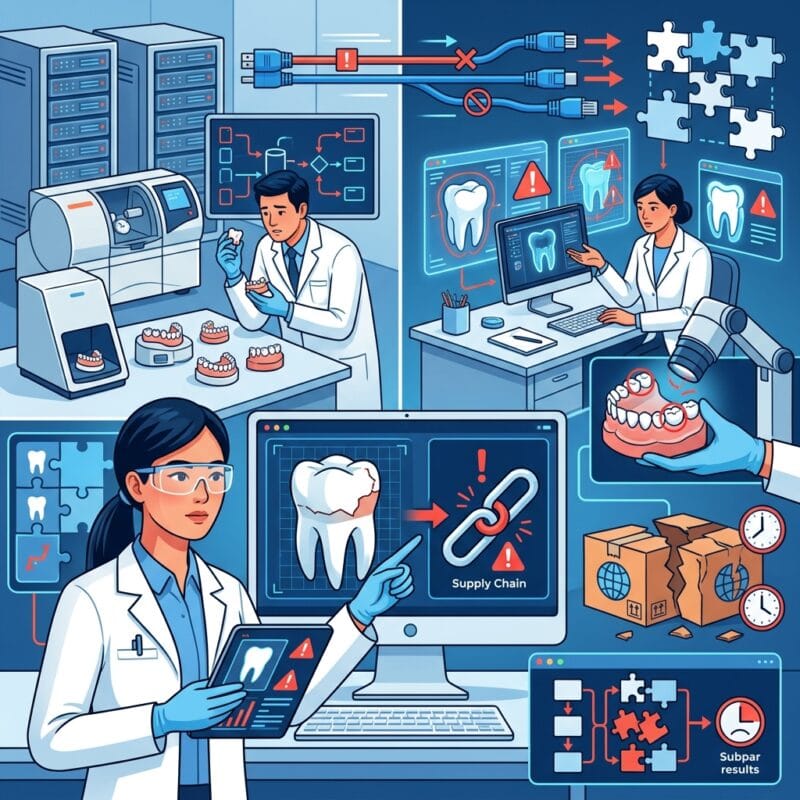
The dental laboratory industry in 2026 operates in an environment defined by unprecedented digital adoption, persistent skilled labor shortages, and rising clinical expectations. Intraoral scanners, high-speed 3D printers, and 5-axis milling centers have transformed the bench technician’s role, shifting focus from physical waxing to computer-aided design (CAD). However, as workload volumes surge across crown and bridge, implant prosthetics, surgical guides, removable dentures, and clear aligners, dental laboratories and Dental Support Organizations (DSOs) across North America are increasingly looking to external design partners. Identifying the operational, technical, and regulatory red flags when choosing an outsourced dental lab in the USA 2026 has consequently become an essential executive discipline.
Outsourcing CAD design allows laboratories to scale production overnight, smooth out daily capacity bottlenecks, and lower overhead costs without sacrificing seating accuracy. Yet, partnering with an unqualified or substandard design center can swiftly destabilize a laboratory’s clinical reputation. From missed seating deadlines and poor contact points to non-compliant patient data handling and hidden fee structures, spotting these red flags when choosing an outsourced dental lab in the USA 2026 before signing long-term service level agreements is paramount.
In this comprehensive industry analysis, we examine the technical pitfalls, workflow breakdowns, regulatory compliance failures, and hidden costs that signal a risky outsourcing partnership. By understanding the red flags when choosing an outsourced dental lab in the USA 2026, laboratory owners, technical directors, and DSO clinical officers can establish resilient, scalable, and high-margin digital design pipelines that stand up to modern clinical demands.
What are the main red flags when choosing an outsourced dental lab in the USA 2026?
The primary red flags when choosing an outsourced dental lab in the USA 2026 center around poor CAD design accuracy, non-compliance with regulatory standards, unpredictable turnaround times, hidden fees, and inadequate technical communication.
When selecting a remote design center, dental labs cannot treat CAD file preparation as a commoditized, administrative utility. Every STL, PLY, or OBJ mesh sent to an offshore or domestic design desk represents a unique patient anatomy that requires strict adherence to occlusion, margin integrity, emergent profile dynamics, and material physics. Ignored or unaddressed, subtle operational defects early in the partnership can quickly blossom into widespread clinical remakes, strained clinician relationships, and ruined profit margins. Laboratories seeking long-term success must systematically evaluate every prospective design vendor against structured technical benchmarks.
1. Incompatibility with Open CAD/CAM Ecosystems and Proprietary Lock-In
A immediate technical warning sign is a design center’s inability to seamlessly ingest and export native digital files across all major CAD platforms. Modern dental technology thrives on open connectivity. If an outsourcing vendor insists on locked proprietary formats, refuses to work with raw scan data, or cannot output construction files compatible with software platforms like exocad or 3Shape, your lab risks operational bottlenecking.
Lock-in limits flexibility. A vendor unable to provide raw construction files (such as exocad `.constructioninfo` or 3Shape `.3dx` packages) prevents your internal technicians from tweaking margin boundaries, adjusts proximal contacts, or re-milling in-house when urgent doctor changes arise. Recognizing proprietary restriction as one of the major red flags when choosing an outsourced dental lab in the USA 2026 protects your facility from becoming digitally trapped by a vendor’s rigid software infrastructure.
- Missing Construction Files: Receiving flattened, uneditable STL outputs rather than editable CAD project files.
- Intraoral Scan Incompatibility: Inability to process direct raw files from leading scanners such as Medit, iTero, TRIOS, or Carestream.
- Restricted Material Libraries: Inflexible preset parameters that ignore your milling machine’s specific material shrink factors and burs.
Furthermore, laboratory technicians who systematically analyze red flags when choosing an outsourced dental lab in the USA 2026 often report that design partners lacking open-architecture mastery struggle when handling hybrid restoration cases that combine multiple software modules, such as surgical guide designs paired with immediate provisional crowns.
2. Regulatory Non-Compliance, FDA Disregard, and Lack of ISO Certification
Regulatory oversight in digital dentistry has tightened significantly entering 2026. While single-tooth crown designs fall under standard laboratory custom device guidelines, complex dental devices—such as 3D-printed surgical guides, clear aligners, and implant abutments—require strict adherence to FDA regulations, Quality System Regulations (QSR), and ISO 13485 certifications.
Outsourcing design to entities that operate completely outside regulated quality frameworks presents another major category of red flags when choosing an outsourced dental lab in the USA 2026. If your laboratory prints surgical guides designed by an uncertified offshore group that fails to maintain tracked design histories or material validation parameters, ultimate legal liability for device failure rests squarely on your lab and the prescribing clinician. Failing to inspect compliance documentation is among the top red flags when choosing an outsourced dental lab in the USA 2026 that can expose your enterprise to catastrophic legal liabilities.
To audit compliance thoroughly, verify that your design partner maintains documented Quality Management Systems (QMS) and provides traceable design histories for every Class II medical device design file delivered to your bench.
3. Inconsistent Turnaround Times and Lack of Service Level Agreements (SLAs)
In the fast-paced modern lab environment, turnarounds dictate seat dates. A design vendor operating without binding, measurable Service Level Agreements (SLAs) acts as one of the most damaging red flags when choosing an outsourced dental lab in the USA 2026. If a design studio cannot guarantee consistent overnight 8-to-12-hour turnaround times for standard single-unit crown and bridge files, your internal production flow will stall, leading to missed delivery windows and frustrated clinical clients.
When reviewing potential red flags when choosing an outsourced dental lab in the USA 2026, turnarounds must be assessed not just on average performance, but during peak seasonal volume spikes. Unreliable vendors often promise fast delivery during trial periods, only to suffer severe lag during high-volume periods like end-of-year insurance pushes. Establishing firm contractual SLAs with concrete financial remedies for missed deadlines is non-negotiable. Rigorously evaluating these turnaround red flags when choosing an outsourced dental lab in the USA 2026 ensures your physical milling schedules, sintering cycles, and finishing benches operate without costly idle time.
Why is quality control critical for outsourced dental CAD design?
Quality control is critical for outsourced dental CAD design because precise marginal integrity, occlusal accuracy, and anatomical contouring directly dictate clinical success, reduce seated adjustments, and prevent costly chairside remakes.
When a laboratory outsources digital crown design, implant abutments, or full arch implant design service work, the design team serves as an extension of the lab’s technical mastery. A failure in design logic—such as an improperly ditch margin, aggressive internal relief, or incorrect anatomical emergence—passes directly through the mill or printer, resulting in physical restorations that fit poorly in the patient’s mouth. Rigorous quality management systems prevent these silent digital defects from turning into expensive chairside failures.
4. Poor Marginal Integrity and Incorrect Parameter Calibration
Substandard marginal fit constitutes one of the clearest clinical red flags when choosing an outsourced dental lab in the USA 2026. In a fully digital workflow, the CAD technician must accurately identify and draw margin lines, set appropriate cement gaps (e.g., 30 to 50 microns starting 1mm above the margin), and ensure adequate material thickness based on the chosen restorative material (zirconia, lithium disilicate, PMMA, or composite resin).
Design teams relying on automated AI line detection without meticulous human quality oversight frequently misinterpret equigingival or subgingival prep boundaries, especially when intraoral scans present blood, saliva, or minor tissue retraction artifacts. Overly loose cement gap defaults may yield crowns that drop into place easily but lack retention, while overly tight gaps result in high spots and fractured seating attempts.
Systematically addressing margin integrity red flags when choosing an outsourced dental lab in the USA 2026 prevents recurring remake cycles that drain lab profitability and undermine dentist trust.
5. Lack of Dedicated Account Technicians and Generic Communication Channels
An outsourcing provider that treats your account as an anonymous, random job queue introduces severe quality control risks. Communication breakdowns represent persistent red flags when choosing an outsourced dental lab in the USA 2026. Every clinician has distinct preferences regarding proximal contact tightness (broad flat contacts vs. point contacts), occlusal clearance (light occlusion in centric relation vs. firm contact), and anatomical deep fissures.
If your outsourced design vendor assigns your jobs to a shifting pool of dozens of unassigned, entry-level operators without account-level supervision, maintaining consistent doctor-specific preferences becomes impossible. High-performing design centers pair your account with a dedicated lead technician or dedicated team that learns your exact parameters, reviews clinical preference sheets, and conducts internal QA before delivering final files.
- Queue-Based Distribution: Jobs are processed by whoever grabs them first, creating wildly varying anatomical styles.
- No Direct Communication: Inability to speak directly or message asynchronously with the actual CAD technician handling the case.
- Ignored Preference Sheets: Failure to respect custom clearance and contact settings for specific dental practices.
Prioritizing direct communication channels is a vital factor when studying red flags when choosing an outsourced dental lab in the USA 2026 to ensure seamless daily collaboration.
6. Opaque Pricing Models, Hidden Surcharges, and Unclear Remake Policies
Unpredictable design billing is high on the list of financial red flags when choosing an outsourced dental lab in the USA 2026. While initial per-unit advertised rates may appear attractive, hidden charges for design revisions, scan prep corrections, full-arch file handling, or software re-exports can quickly inflate monthly operational invoices.
A trustworthy design provider offers transparent, flat-rate pricing structures categorized clearly by restoration complexity. Furthermore, their policy regarding redesigns must be fair: if a design fails due to CAD technician error or failure to follow supplied preference profiles, the redesign should be completed immediately at zero additional charge.
Avoiding opaque fee structures is essential when researching red flags when choosing an outsourced dental lab in the USA 2026 to maintain predictable operating margins and accurate cost-per-case budgeting.
How do you evaluate an outsourced dental CAD design partner?
You evaluate an outsourced dental CAD design partner by auditing their design accuracy through test cases, checking ISO and HIPAA compliance, assessing turnaround reliability, and verifying seamless software integration with platforms like exocad and 3Shape.
A rigorous evaluation process protects your business against costly technical missteps. Rather than committing your entire daily case load immediately, progressive testing using complex trial cases allows you to stress-test a partner’s technical proficiency, communication speed, and software fluency under controlled conditions. Evaluating real-world results exposes subtle issues before they impact your paying clinical accounts.
7. Inability to Handle Complex Implant, Full-Arch, and Surgical Guide Workflows
Many outsourced design studios perform adequately on basic single-unit posterior crowns but fail completely when confronted with complex, multi-unit implant restorations or full-arch All-on-X designs. Relying on a studio with limited clinical versatility highlights complex technical red flags when choosing an outsourced dental lab in the USA 2026.
Modern dental labs need outsourcing partners capable of executing sophisticated restorative dentistry, including custom abutments, titanium base (Ti-base) bridge designs, angle-corrected screw channels, removable bar overdentures, splint modules, and 3D printed surgical guide design files integrated with CBCT DICOM data. If a design vendor lacks skilled implant specialists who understand emergence profile development, soft tissue management, and mechanical screw-retained limitations, your lab will remain trapped handling high-stress cases entirely in-house.
Identifying these full-arch red flags when choosing an outsourced dental lab in the USA 2026 protects your business from embarrassing design flaws on high-value clinical cases where material remakes can cost hundreds of dollars per arch.
8. Inadequate Cybersecurity, Poor Data Encryption, and HIPAA Non-Compliance
Digital scan files, facial photos, and order forms sent to design centers contain Protected Health Information (PHI). Cybersecurity vulnerabilities rank among the most critical legal red flags when choosing an outsourced dental lab in the USA 2026. In the modern regulatory landscape, federal authorities treat digital design portals and cloud storage facilities as business associates subject to HIPAA strictures.
If your design provider relies on unencrypted public file transfer platforms, unencrypted email attachments, or insecure cloud servers to exchange patient files, your laboratory faces catastrophic regulatory fines and data breach exposure. A reputable CAD service utilizes AES 256-bit encrypted portals, role-based user authentication, secure cloud storage, and signed Business Associate Agreements (BAAs) to safeguard patient data across every step of the digital workflow.
Ensuring complete data governance and recognizing cloud transmission vulnerabilities as serious red flags when choosing an outsourced dental lab in the USA 2026 protects your company’s valuable brand equity and client trust.
9. Lack of Scalability for DSO Workflows and Multi-Location Standardization
For Dental Support Organizations (DSOs) and expanding regional lab networks, operational standardization across multiple clinic locations is essential. A design studio that lacks enterprise infrastructure reveals operational red flags when choosing an outsourced dental lab in the USA 2026.
Multi-location group practices require centralized dashboards, standardized digital parameter profiles across disparate doctor groups, role-based administrative access, and real-time tracking of design progress. If an outsourcing partner cannot handle sudden volume surges—such as adding 50 locations overnight—or fails to offer unified billing and centralized quality reporting, the enterprise operational model breaks down. Scaling issues represent major red flags when choosing an outsourced dental lab in the USA 2026 for multi-site dental groups and fast-growing commercial laboratories alike.
Comprehensive Evaluation Checklist: Spotting Red Flags Before Partnering
Before entering into an outsourcing contract or integrating an external design API into your laboratory management system, conduct a comprehensive audit using the checklist below. Uncovering potential red flags when choosing an outsourced dental lab in the USA 2026 during the initial onboarding phase prevents operational friction downstream.
Technical Capability & CAD Proficiency
- Native File Export: Does the vendor provide complete, unmerged design files alongside standard STL outputs?
- Software Compatibility: Are technicians fully certified in exocad, 3Shape Dental System, and specialized implant modules?
- Material Profile Integration: Can the team tailor design parameters to match your specific milling burs, shrinkage factors, and printer shrinkage compensations?
- Complex Case Handling: Do they possess demonstrated expertise in full-arch implant bridges, bite splints, orthodontic aligner staging, and CBCT surgical planning?
Quality Control & Clinical Precision
- Dedicated QA Audit: Does every design undergo secondary review by a master technician before delivery?
- Custom Preference Profiles: Is there a formal system to document, archive, and execute clinician-specific preferences for contacts, occlusion, and relief?
- Low Remake Rate: Can the vendor demonstrate a verified internal redesign/remake rate below 2% across high-volume accounts?
Data Security & Regulatory Integrity
- HIPAA Compliance: Is PHI encrypted in transit and at rest using enterprise-grade 256-bit SSL protocols?
- FDA / ISO Documentation: Does the facility adhere to ISO 13485 standards for Class II medical device designs like surgical guides?
- Secure User Access: Does the design portal offer multi-factor authentication (MFA) and granular permission levels?
Operational Reliability & Service Level Agreements
- Guaranteed Turnarounds: Does the contract specify explicit delivery times (e.g., 8-to-12-hour overnight turnarounds) with performance penalties?
- Dedicated Account Management: Will your lab be assigned a dedicated account lead who understands your lab’s workflow?
- Transparent Billing: Is the pricing model clear, without unexpected surcharges for minor revisions or prep corrections?
Synthesizing Quality and Scalability in Digital Dentistry
The digital revolution in dentistry offers immense profitability and scalability, but only for laboratories that control their technical workflows tightly. By systematically vetting potential design partners against the major red flags when choosing an outsourced dental lab in the USA 2026, laboratory leaders can build hybrid production models that combine local bench craftsmanship with rapid, cost-effective global design power.
Avoid settling for generic design clearinghouses that treat intricate anatomical prosthetics as simple digital shapes. Demanding high technical standards, verifiable regulatory compliance, transparent pricing structures, and robust data protection ensures that your outsourced CAD workflow enhances—rather than jeopardizes—your clinical brand.
Ultimately, actively avoiding these red flags when choosing an outsourced dental lab in the USA 2026 positions your laboratory or DSO for sustainable, long-term growth in an increasingly competitive digital healthcare marketplace. Staying vigilant against red flags when choosing an outsourced dental lab in the USA 2026 safeguards your digital legacy, protects your balance sheet, and elevates patient care standard across every restoration you deliver.
Ready to eliminate red flags and elevate your CAD design workflow? Contact our expert design team today to start your risk-free trial and experience seamless digital design.