The dental industry has reached a pivotal juncture where digital integration is no longer a strategic advantage but a baseline operational requirement. As Dental Service Organizations (DSOs) expand across multi-regional footprints, managing restoration quality, turnaround times, and labor expenditures requires new operating frameworks. Understanding how US DSOs choose outsourced dental lab partners in 2026 offers crucial perspective for executive teams, procurement officers, and lab directors navigating this evolving market.
Driven by ongoing shortages of skilled bench technicians, accelerating adoption of intraoral scanners, and relentless margin pressure, dental groups are shifting away from traditional operational models. Evaluating how US DSOs choose outsourced dental lab partners in 2026 reveals a clear focus on end-to-end digital efficiency, reliable quality control, and robust compliance infrastructure.
What is dental lab CAD CAM design outsourcing?
Dental lab CAD CAM design outsourcing is the practice of delegating digital restoration modeling—such as crowns, implants, and dentures—to specialized off-site design centers that deliver ready-to-mill files.
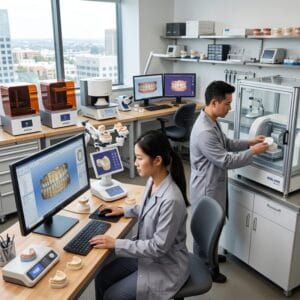
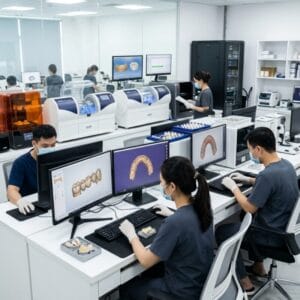
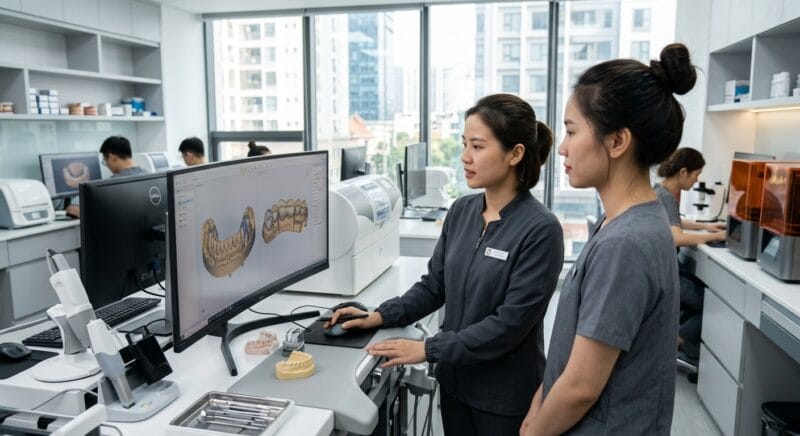
By delegating the computer-aided design (CAD) phase to dedicated virtual design centers, domestic dental laboratories and DSOs can streamline their internal operations. Rather than retaining large teams of full-time software operators, dental organizations send open 3D digital impressions directly to expert CAD technicians. These external partners craft precision restorations and return ready-to-fabricate computer-aided manufacturing (CAM) files, allowing local labs and clinical centers to focus on high-value clinical adjustments, finishing, staining, and patient care.
The Evolution of DSO Procurement in 2026
In prior years, procurement decisions were largely localized and relationship-driven. Clinical directors at individual offices selected nearby commercial laboratories based on personal preference or proximity. However, analyzing how US DSOs choose outsourced dental lab partners in 2026 demonstrates a centralized, data-driven approach designed to handle massive patient volume without sacrificing consistency.
When investigating how US DSOs choose outsourced dental lab partners in 2026, industry analysts consistently identify five overarching objectives:
- Predictable Scalability: The capacity to process fluctuating case volumes across hundreds of practices without operational bottlenecks.
- Standardized Clinical Outcomes: Ensuring a crown fitted in Texas matches the quality, contact tightness, and occlusal accuracy of one delivered in Florida.
- Overnight CAD Turnaround: Leveraging global time zone advantages to receive completed digital files before local morning production begins.
- Reduced Operating Costs: Lowering fixed overhead expenses tied to CAD software licensing, employee benefits, and local technician recruitment.
- Regulatory and Security Compliance: Protecting sensitive patient metadata across every step of the digital transmission pipeline.
Key Criteria: How US DSOs Choose Outsourced Dental Lab Partners in 2026
Selecting an offshore or specialized domestic CAD design partner involves rigorous evaluation. To understand how US DSOs choose outsourced dental lab partners in 2026, one must look at the audit checklists used by modern supply chain executives.
1. Turnaround Speed and Real-Time Workflow Integration
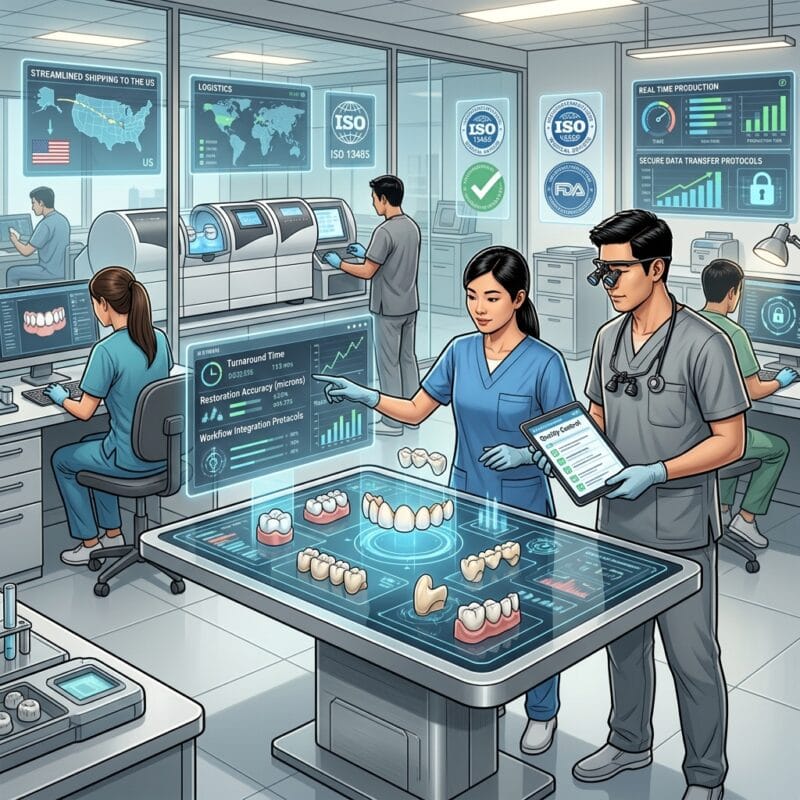
In a fast-paced clinical setting, chairside efficiency depends on rapid file turnaround. When reviewing how US DSOs choose outsourced dental lab partners in 2026, speed is rarely judged on standard business days; it is measured in hours. Top-tier design services offer standard 8-to-12-hour turnaround times for single-unit restorations and expedited 2-to-4-hour windows for emergency cases.
This rapid processing relies on continuous digital handoffs. When an intraoral scan is completed at 5:00 PM EST, it is immediately uploaded to a secure portal. Expert CAD technicians work on the design during overseas daylight hours, delivering validated STL files back by 2:00 AM EST. By the time local technicians arrive at 6:00 AM, milling units and 3D printers can start production immediately.
2. Software Interoperability and Open Architecture Capabilities
DSOs operate across diverse software platforms, intraoral scanners, and production equipment. A main factor in how US DSOs choose outsourced dental lab partners in 2026 is the provider’s ability to remain software-agnostic.
Outsourced design partners must maintain comprehensive software fleets. Whether processing cases in exocad, working within 3Shape Dental System, or handling proprietary software environments, design centers must deliver flawless open-format files (STL, OBJ, PLY) ready for immediate CAM nesting.
How does digital crown design work in a virtual CAD workflow?
Digital crown design works by importing 3D intraoral scan files into CAD software, where specialized designers craft precise virtual restorations before exporting open STL or CAM files for manufacturing.
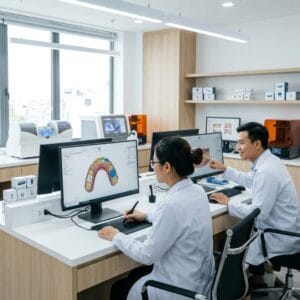
The process begins when the clinician captures a digital impression using an intraoral scanner and uploads the dataset—including margin lines, opposing arch orientation, and shade notes—to a centralized cloud management platform. The virtual design team imports these files into high-performance CAD platforms to establish virtual articulation, evaluate dynamic occlusion, define precise emergence profiles, and refine contact points. Once verified against strict quality presets, the finalized CAD model is sent back to the client for immediate 3D printing or milling.
3. Clinical Range and Comprehensive Case Expertise
A major trend in how US DSOs choose outsourced dental lab partners in 2026 is the consolidation of external vendors. DSOs prefer working with a single robust partner capable of handling every dental specialty rather than managing multiple niche providers.
An ideal design service must support a complete spectrum of dental applications:
- Crown & Bridge: Full-contour zirconia, lithium disilicate, layered restorations, inlays, onlays, and long-span provisional bridges.
- Implant Prosthetics: Custom abutments, screw-retained crowns, titanium bases, and complex full arch implant design frameworks.
- Guided Surgery: Precision fully-guided and pilot-guided surgical templates derived from combined CBCT DICOM and intraoral scan files.
- Removable Prosthetics: Full digital dentures, partial frameworks, try-in setups, and immediate custom dentures.
- Orthodontics & Occlusal Appliances: Clear aligner staging, digital indirect bonding trays, hard/soft night guards, and splints.
This comprehensive versatility explains much of how US DSOs choose outsourced dental lab partners in 2026, as multi-site organizations prefer centralized partner management over fragmented vendor networks.
Standardization, Quality Assurance, and Protocol Alignment
The core challenge of scaling dental clinical services is maintaining consistent restoration quality across diverse regions. Consequently, investigating how US DSOs choose outsourced dental lab partners in 2026 highlights the necessity of strict protocol alignment and customized design parameters.
Before designing a single production unit, enterprise-level design services work closely with DSO clinical boards to establish custom design preference profiles. These profiles define exact specifications for key parameters:
Customizable Design Profiles
Different clinical teams often prefer distinct restoration characteristics. Understanding how US DSOs choose outsourced dental lab partners in 2026 involves seeing how external design teams adapt to varied specifications, such as:
- Occlusal Relief & Clearance: Setting precise virtual space allowances (e.g., -30 microns to 0 microns) to minimize chairside occlusal adjustments.
- Interproximal Contact Intensity: Calibrating contact tightness (e.g., +20 microns) to ensure firm, comfortable seating without heavy grinding.
- Cement Gap Thickness: Customizing spacer thickness based on the target material—whether milling monolithic zirconia, pressing ceramic, or 3D printing temporary resins.
- Emergence Profile Contours: Shaping subgingival transitions to foster soft tissue health, especially around implant restorations.
By enforcing these rules through specialized software, external CAD partners function as a seamless virtual extension of the in-house team. This consistent approach is a primary driver in how US DSOs choose outsourced dental lab partners in 2026.
Why is HIPAA compliance vital when outsourcing dental lab designs?
HIPAA compliance is vital when outsourcing dental lab designs because intraoral scans and patient demographics contain protected health information that must be safeguarded across all digital communications.
Under federal guidelines, digital impression files containing patient names, scan dates, or clinical notes qualify as Protected Health Information (PHI). Outsourced CAD vendors must maintain robust administrative, physical, and technical safeguards—including Business Associate Agreements (BAAs), end-to-end encryption, restricted data access, and SOC 2 Type II certifications—to prevent data breaches, protect patient privacy, and ensure regulatory compliance.
When assessing how US DSOs choose outsourced dental lab partners in 2026, corporate compliance mandates require thorough verification of external data infrastructure. Key elements include:
- Encrypted Data Transmission: Secure socket layer (SSL) and TLS 1.3 protocols applied to all file transfers in transit and at rest.
- Secure Cloud Portals: Eliminating unsecured email file attachments in favor of role-based cloud environments.
- Anonymized Data Pipelines: Stripping extraneous PHI from design files before assigning them to offshore technical queues.
- Active Security Monitoring: Continuous penetration testing, firewalls, and detailed audit logging for every file access event.
Understanding how US DSOs choose outsourced dental lab partners in 2026 means recognizing that regulatory security carries equal weight to technical design quality.
Economic Drivers: TCO and Operating Margin Optimization
Evaluating how US DSOs choose outsourced dental lab partners in 2026 also requires examining financial structures. Inflationary pressures, rising skilled labor costs, and competitive reimbursement schedules demand careful attention to the Total Cost of Ownership (TCO).
Maintaining a fully in-house CAD department requires substantial capital and operational expenditures:
In-House Cost Factors vs. Strategic Outsourcing
A closer look at how US DSOs choose outsourced dental lab partners in 2026 shows a strong preference for variable pricing models over fixed internal overhead:
- Labor Expenses: Full-time CAD technicians require competitive salaries, healthcare benefits, retirement contributions, and ongoing training. Outsourcing turns these fixed human resource costs into predictable, pay-per-unit operating expenses.
- Software Licensing: Maintaining high-end CAD platforms requires annual subscription renewals, module upgrades, and expensive workstation hardware. CAD design partners absorb these capital expenditures at scale.
- Capacity Limits: In-house teams often experience downtime during slow periods yet face severe backlogs during volume spikes. Outsourcing provides flexible capacity, instantly scaling to meet changing demand.
- Rework and Remake Costs: Top design partners provide clear accuracy guarantees and remake policies, protecting labs from compounding material costs due to design errors.
When analyzing how US DSOs choose outsourced dental lab partners in 2026, financial officers consistently prioritize models that convert fixed overhead into scalable variable costs while preserving margin predictability.
Integrating Specialized Clinical Applications
While standard single-unit crowns represent a high volume of daily workflows, examining how US DSOs choose outsourced dental lab partners in 2026 highlights the importance of advanced specialty design capabilities.
Implants and Complex Full-Arch Restorations
Implantology requires extreme precision. CAD designers must manage multi-unit passive fit, customized emergence profiles, angled screw channels, and complex structural frameworks. Partnering with design centers that offer specialized expertise in 3D printed surgical guides and full-arch fixed hybrid bridges empowers DSOs to deliver sophisticated implant treatment plans efficiently.
Digital Dentures and Removable Prosthetics
Digital removable prosthetics are expanding rapidly across group practices. Designing functional digital dentures requires precise control over anatomical borders, dynamic occlusal schemes, tooth setup databases, and arch form variations. When studying how US DSOs choose outsourced dental lab partners in 2026, proven skill in removable CAD design emerges as a key differentiator.
Night Guards and Clear Aligner Staging
Splint and aligner therapy are high-growth clinical areas. Outsourcing the step-by-step digital tooth movement staging for clear aligners, as well as contouring custom protective splints, allows practice chains to scale preventative and orthodontic offerings without increasing administrative burdens.
This technical breadth reinforces how US DSOs choose outsourced dental lab partners in 2026, favoring comprehensive full-service digital design infrastructure over single-category design vendors.
Operational Checklist: Partner Evaluation Framework
For executive teams, lab managers, and clinical leaders establishing strategic partnerships, reviewing how US DSOs choose outsourced dental lab partners in 2026 provides a clear blueprint for partner selection:
Use this evaluation matrix when assessing prospective CAD design services:
1. Technical Infrastructure & Capacity
- Does the vendor run certified software platforms capable of outputting fully open STL, OBJ, and 3OX formats?
- What is the daily design unit capacity, and how are unexpected volume spikes managed?
- Are dedicated account management and technical support available 24/7 across US time zones?
2. Quality Control & Clinical Protocol
- Can the design partner enforce custom doctor preference profiles down to exact micron measurements?
- What multi-tier quality control checks are performed before finalized CAD files are released?
- What is the measured remake rate across major restoration categories?
3. Compliance & Security Verification
- Is the partner willing to execute a formal Business Associate Agreement (BAA)?
- What encryption standards, server redundancies, and access controls protect data transmission?
- Does the design platform operate through an anonymized portal that removes patient identifiers from CAD queues?
4. Onboarding and SLA Terms
- How long does the initial onboarding, calibration, and pilot testing period take?
- What concrete Service Level Agreements (SLAs) cover turnaround times, quality guarantees, and emergency case priority?
- Are pricing structures transparent, with predictable per-unit fees and zero hidden platform charges?
Applying this structured vetting process reflects how US DSOs choose outsourced dental lab partners in 2026 to lower risk and secure dependable long-term outsourcing relationships.
Summary: The Future of Digital Lab Operations
The dental landscape in 2026 rewards organizations that build scalable, high-quality, and digitally integrated operations. Analyzing how US DSOs choose outsourced dental lab partners in 2026 shows that success depends on finding dynamic design partners capable of matching corporate growth trajectories.
By delegating complex CAD tasks to specialized external design teams, dental laboratories and DSO networks lower operational overhead, accelerate case delivery, reduce remakes, and ensure consistent clinical outcomes across every practice location. Understanding how US DSOs choose outsourced dental lab partners in 2026 equips forward-thinking dental leaders to modernize their workflows and achieve long-term growth in an increasingly digital industry.
Ready to elevate your dental laboratory’s productivity and scale your digital restoration workflows effortlessly? Contact our expert CAD design team today to start your free trial and experience rapid overnight turnarounds!