The dental technology sector is undergoing an unprecedented structural evolution. As digital dentistry transitions from an innovative alternative to the foundational standard of care, dental laboratory owners and Dental Support Organizations (DSOs) across North America face a complex operational landscape. At the center of this transformation is human capital. Understanding the projected dental lab technician salary in the USA 2026 is essential for lab directors, operations managers, and executive officers who must balance production capacity, turnaround times, and bottom-line profitability in an inflationary environment.
For decades, dental laboratories relied on a traditional apprenticeship model to train ceramists, waxers, and crown and bridge specialists. Today, the rapid widespread adoption of intraoral scanning, benchtop optical scanners, 5-axis CAD/CAM milling machines, and high-speed resin 3D printers has shifted the required skillset from manual craftwork to sophisticated digital engineering. Consequently, benchmark data regarding the expected dental lab technician salary in the USA 2026 reflects not just cost-of-living adjustments, but a systemic revaluation of technical digital skills across the industry.
Understanding the Dental Lab Technician Salary in the USA 2026 Landscape
To accurately forecast labor costs and establish competitive compensation packages, lab leaders must analyze the macroeconomic forces driving wage increases. According to industry workforce tracking from organizations like the American Dental Association, dental care demand continues to expand due to an aging population requiring complex restorative care, alongside heightened consumer interest in cosmetic dentistry, clear aligners, and full-arch implant restorations.
However, the supply of certified dental technicians (CDTs) and experienced digital designers has not kept pace with clinical demand. Educational programs dedicated to dental laboratory technology have experienced closures over the past decade, creating a widening labor gap. As a result, the baseline dental lab technician salary in the USA 2026 reflects an aggressive candidate-driven market where top-tier digital designers and master ceramists command historical high-water marks in total compensation.
What is driving the dental lab technician salary in the USA 2026 upward?
The dental lab technician salary in the USA 2026 is driven upward primarily by an acute shortage of skilled bench technicians, rapid retirement among experienced ceramists, and increased demand for complex digital CAD/CAM restorations.
This supply-demand imbalance forces commercial dental laboratories to compete aggressively for talent. Modern laboratories are no longer competing merely against neighboring local labs; they compete against nationwide DSO networks, large regional production centers, and remote-friendly digital design firms. This expanded recruitment landscape pushes the baseline dental lab technician salary in the USA 2026 to higher levels across every major metropolitan statistical area.
Furthermore, technical requirements have escalated. A modern technician must understand dental anatomy, occlusal schemes, materials science (such as multi-layered zirconia, lithium disilicate, and PEKKTON), as well as complex software suites. Expertise in platforms like 3Shape Dental System and exocad DentalCAD requires continuous professional development. Laboratories looking to hire individuals capable of seamlessly managing complex full-mouth reconstructions or outsourced crown and bridge design projects must offer competitive compensation packages that reflect these advanced technical proficiencies.
What is the average dental lab technician salary in the USA 2026 across different CAD CAM specialties?
The average dental lab technician salary in the USA 2026 spans between $55,000 for entry-level roles to over $95,000 for master CAD design specialists and implant ceramists.
Compensation structures vary significantly based on specialization, geographic location, digital competency, and leadership responsibilities. Below is a detailed evaluation of projected wage distributions across key laboratory departments for 2026:
- CAD/CAM Digital Designers (Crown & Bridge): Experienced digital operators specializing in single-unit crowns, multi-unit bridges, and inlays/onlays are projected to earn an average dental lab technician salary in the USA 2026 ranging from $62,000 to $82,000 annually, depending on daily unit throughput and remake ratios.
- Implant & Complex Prosthetics Specialists: Technicians proficient in designing custom implant abutments, bar-retained overdentures, and screw-retained hybrid zirconia arches command higher tiers. The average dental lab technician salary in the USA 2026 for high-level implant specialists ranges from $78,000 to $105,000 per year.
- Removable Prosthetics Technicians & Denture Designers: As digital denture software matures, technicians skilled in 3D printed and milled removable prosthetics are seeing substantial pay increases. The projected dental lab technician salary in the USA 2026 for digital removable specialists spans from $58,000 to $76,000.
- Surgical Guide & Orthodontic Aligner Designers: Specialized operators focused on CBCT surgical implant planning, guide fabrication, and clear aligner staging are seeing average salaries between $60,000 and $80,000.
- Master Ceramists & Stain/Glaze Technicians: Aesthetic specialists who provide hand-layering, custom shade matching, and artistic finishing to high-end anterior restorations continue to command premium wages, with the dental lab technician salary in the USA 2026 reaching $85,000 to $115,000+ for elite talent.
Geographic Variations in Technician Compensation
Geographic location remains one of the largest variables in compensation modeling. Commercial labs situated in high-cost-of-living (HCOL) coastal markets face significantly higher payroll overhead than those in rural or Midwestern regions.
In major metropolitan centers such as San Francisco, New York, Seattle, and Boston, the average dental lab technician salary in the USA 2026 is anticipated to sit 20% to 35% above the national median. A senior digital designer in these markets may require an annual salary of $90,000 to $110,000 just to meet basic recruitment thresholds. Conversely, in secondary and tertiary markets across the Southeast and Midwest, the standard dental lab technician salary in the USA 2026 for equivalent roles may range between $52,000 and $68,000.
The True Financial Burden of In-House Technical Staffing
When evaluating the total expense of maintaining an internal technical team, lab owners often overlook costs beyond base wages. Direct compensation is only one portion of the total employee cost structure.
To accurately calculate the impact of the projected dental lab technician salary in the USA 2026 on operational margins, management must factor in fully burdened labor costs, which typically add 25% to 40% on top of the base salary figure. Fully burdened costs include:
- Mandatory Benefits & Insurance: Employer-paid taxes (FICA, FUTA, SUTA), health insurance contributions, dental coverage, worker’s compensation, and retirement matching.
- Software Licensing & Hardware Workstations: Dedicated CAD workstations require high-end GPUs, dual-monitor setups, and annual CAD software subscription fees (often costing thousands of dollars per seat annually).
- Paid Time Off (PTO) & Sick Leave: Non-productive paid hours directly lower total weekly unit production while maintaining full payroll expense.
- Continuous Training & Upgrading: Costs associated with sending staff to hands-on hands-on courses, software upgrade training, and industry symposia.
- Non-Productive Idle Time: Fluctuations in clinical case volume mean salaried technicians are paid during slow periods, raising the effective labor cost per unit produced.
For example, hiring a full-time CAD designer at a base dental lab technician salary in the USA 2026 of $75,000 results in a true fully burdened operational cost of approximately $97,500 to $105,000 annually. When software renewals, workstation hardware amortizations, and idle non-peak hours are added, the effective cost per designed unit can quickly erode gross profit margins.
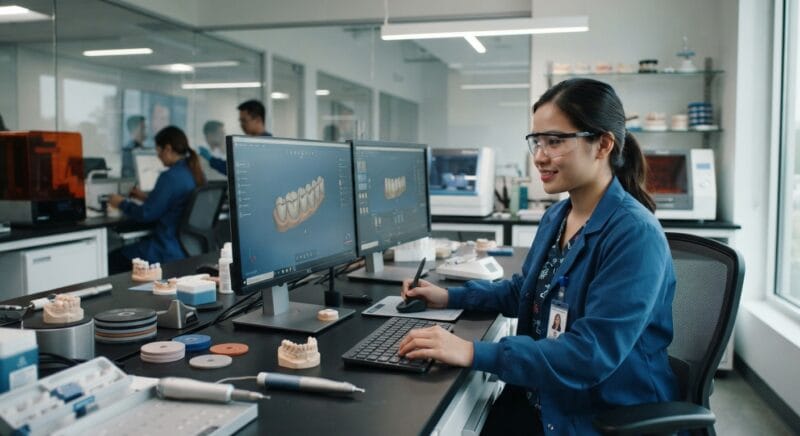
How does dental lab outsourcing offset high technician compensation costs?
Dental lab outsourcing offsets high internal labor expenses by converting fixed technician salaries into predictable, pay-per-case design fees without compromising clinical turnarounds or design quality.
By shifting from a fixed-cost labor model to a variable-cost digital design outsourcing structure, dental laboratories and DSOs can insulate their businesses from the rising pressure of the dental lab technician salary in the USA 2026. Outsourcing CAD design allows laboratories to scale their unit volume dynamically without incurring the capital risk, recruitment delay, and structural overhead of hiring full-time internal personnel.
Consider the strategic operational advantages that outsourcing CAD design provides to growing commercial labs:
1. Total Elasticity and Overhead Protection
Seasonal fluctuations in dental practice case submissions present a constant challenge for lab managers. During peak months (such as year-end insurance benefit burn-off), in-house technical staff are overwhelmed, leading to overtime costs and delayed shipments. During seasonal lulls, the fixed dental lab technician salary in the USA 2026 must still be paid in full despite falling revenues.
Partnering with a dedicated digital design outsourcing service eliminates this friction. Labs pay strictly for completed CAD design files (STL format) on a per-case basis. If production volume increases by 50% overnight, design capacity expands instantly without interviewing, onboarding, or expanding physical workspace. If volume slows down, operational expenses automatically decrease, protecting net cash flow.
2. Eliminating the Recruitment and Retention Crisis
Finding, vetting, and retaining qualified CAD technicians consumes substantial managerial bandwidth. The high turnover environment driven by competitive baseline dental lab technician salary in the USA 2026 offers means key personnel can be poached by larger competitors offering higher pay or fully remote arrangements.
When a key CAD technician resigns, a laboratory’s production capacity can drop overnight, jeopardizing relationships with key dental accounts. Strategic outsourcing provides continuous operational backup. Professional design outsourcing companies maintain deep teams of certified digital dental technicians working around the clock, guaranteeing consistent output regardless of local staffing dynamics.
3. Access to Specialized Design Expertise Across All Restorative Modalities
Few small to medium-sized laboratories can afford to hire dedicated full-time experts across every restorative category. Hiring individual specialists for anatomical crowns, custom implant abutments, surgical guides, night guards, clear aligners, and digital dentures requires multiple full-time payroll slots, each carrying a high average dental lab technician salary in the USA 2026.
By leveraging an expert outsourcing provider, laboratories gain immediate access to specialized design teams across all modalities. Whether you require a routine single posterior zirconia crown or a complex digital surgical guide design for an upcoming full-arch immediate-load case, designs are produced by experienced CAD specialists focused specifically on that discipline.
Financial Comparison: In-House CAD Designer vs. Outsourced Digital Design Service
To evaluate the financial impact of internal staffing versus strategic outsourcing, let us analyze a standard scenario for a growing mid-sized commercial dental laboratory producing approximately 400 CAD/CAM units per month.
Scenario A: Maintaining Internal CAD Staffing
To design 400 units monthly (roughly 18 to 20 units per working day), the lab requires at least one dedicated senior CAD designer and part-time coverage from a secondary technician to handle overflow and PTO coverage.
- Base Senior Designer Salary: $75,000 (standard median dental lab technician salary in the USA 2026)
- Payroll Taxes, Benefits, Health Insurance (30%): $22,500
- CAD Software License & Module Subscriptions: $4,500 / year
- Workstation Depreciation & Hardware Upgrades: $2,000 / year
- Recruitment & Continuing Education: $2,000 / year
- Total Annual Cost: $106,000
- Average Cost Per Designed Unit (4,800 units/year): approximately $22.08 per design
Under Scenario A, if case volume drops to 250 units during a slow month, the fixed costs remain unchanged, driving the effective design cost per unit up to $35.33 per design. Additionally, if the technician takes vacation or calls in sick, production drops or requires costly executive overtime.
Scenario B: Partnering with a CAD/CAM Design Outsourcing Service
In this model, the laboratory maintains its local team for scan intake, physical fabrication (milling, 3D printing, sintering), and high-value aesthetic finishing (staining, glazing, hand-layering ceramics), while outsourcing the raw CAD design phase to a specialized digital partner.
- Annual Base Salary Overhead for Designers: $0
- CAD Software Renewal Costs for Design Seats: $0
- Employee Benefit and Tax Overhead: $0
- Outsourced Design Cost per Unit (Average C&B): ~$6.00 to $9.00 per unit
- Total Annual Cost for 4,800 units (at $8.00 avg): $38,400
- Annual Direct Cost Savings: $67,600 per year (a 63% reduction in design costs)
By opting for Scenario B, the laboratory converts a volatile, expanding payroll risk associated with rising dental lab technician salary in the USA 2026 standards into a lean, predictable cost structure. Savings can be reinvested into advanced 5-axis milling units, high-speed 3D printers, direct clinical marketing, or higher compensation for local aesthetic master ceramists who deliver the final hands-on clinical touch.
Integrating CAD Outsourcing into Your Laboratory Workflow
Transitioning design operations to an outsourced digital partner does not require altering your core clinical relationships or local lab identity. Instead, it strengthens your capacity to deliver consistent, high-precision turnarounds to your dental clients.
Here is how a modernized digital workflow functions when integrating external CAD expertise:
Step 1: Digital Impression Intake & Triage
The laboratory receives intraoral STL files or benchtop scan files directly from clinical clients via open portal systems (such as 3Shape Communicate, Medit Link, or direct portal uploads). Your internal lab coordinator performs a quick quality check on margin clarity, occlusal clearance, and preparation reduction.
Step 2: Secure File Transmission to Design Partner
Scan files, along with specific doctor preferences (margin design, contacts, occlusal tightness, material selection, and relief parameters), are uploaded to the design service’s secure cloud platform. Transmission takes less than two minutes per case.
Step 3: Rapid Digital CAD Design Execution
Experienced design technicians create precise anatomical restorations in software platforms using verified library morphotypes and exact parameters tailored to your lab’s preferred material expansion and milling machine calibrations. Designs for standard crown and bridge cases are typically completed within 8 to 24 hours (overnight turnarounds allow cases uploaded at the end of the business day to be ready for production the next morning).
Step 4: Design Review and Internal Validation
Your local team receives completed CAD design files (STL format) and can quickly preview them using free viewing tools or directly inside your preferred software suite. If adjustments are needed, modifications are handled promptly by the design partner.
Step 5: Local Production, Milling, Printing, and Finishing
Approved CAD files are imported into your CAM software (such as Hyperdent or MillBox) for nesting. Your local team mills zirconia, lithium disilicate, or PMMA, or prints surgical guides and night guards. Your internal technicians focus their time where human art matters most: micro-layering, texture detailing, staining, glazing, and final quality control checks prior to clinical delivery.
Strategic Workforce Planning for 2026 and Beyond
As the market projects continuous upward movement for the median dental lab technician salary in the USA 2026, successful laboratory directors must adopt a balanced hybrid staffing philosophy. The goal is not to eliminate internal technical talent, but to maximize the productivity and profitability of your local workforce.
By delegating time-consuming initial CAD design steps to an established design service, your local technicians can shift from spending hours behind computer screens manipulating digital wax-ups to higher-margin activities:
- Managing complex clinical consultations and shade selections with local dentists.
- Performing custom hand-characterization on anterior aesthetic restorations.
- Inspecting final fit, contact points, and margins to keep remake rates near zero.
- Expanding local client relationships and building clinical sales channels.
This hybrid architecture insulates your laboratory against catastrophic disruptions caused by sudden staff departures, while allowing you to comfortably absorb surging case volumes without incurring the long-term liabilities associated with escalating standard dental lab technician salary in the USA 2026 benchmarks.
Conclusion
The market reality surrounding the dental lab technician salary in the USA 2026 underscores a fundamental truth: skilled technical labor is growing more expensive and increasingly scarce. Commercial dental laboratories and DSOs that attempt to solve capacity challenges purely through traditional internal hiring face expanding payroll overhead, elevated recruitment costs, and volatile profit margins.
By integrating a specialized CAD/CAM digital design outsourcing service into your laboratory’s daily production pipeline, you gain scalable capacity, fixed per-unit costs, and access to master-level design expertise across crown and bridge, implant prosthetics, surgical guides, removable dentures, and clear aligners. Empower your local team to focus on high-value clinical finishing, maintain healthy margins, and build a resilient, future-proof dental laboratory business.
Scale your dental laboratory’s production capacity and reduce overhead costs with our expert CAD design outsourcing services. Contact our digital design team today to start your risk-free trial case.