Understanding the Shift in Lab Structures
As the dental industry moves into 2026, the strategic decision between maintaining a solo dental lab versus expanding to multi location lab operations has become critical for long-term survival. The landscape of dental manufacturing is changing rapidly due to advancements in digital workflows and the growing demand for precision restorative care. When analyzing solo dental lab vs multi location lab operations in 2026, laboratory owners must consider how digital integration impacts overhead costs and production capacity. Many traditional labs that relied on manual craftsmanship are finding it difficult to compete with digitally enabled competitors who can scale more efficiently. This shift is not just about size but about the technological infrastructure supporting the design and milling processes. For DSOs and independent practitioners alike, the choice of a dental lab partner often depends on whether that lab can handle volume without sacrificing quality. Understanding solo dental lab vs multi location lab operations in 2026 helps stakeholders anticipate market trends and align their business models accordingly. We will explore the financial and operational nuances that define these two distinct paths forward.
One major factor influencing this decision is the cost of digital design software and hardware. Investing in state-of-the-art scanners and milling machines is expensive, and solo labs often struggle to justify the ROI on such assets. In contrast, multi location lab operations in 2026 can spread these costs across multiple facilities, reducing the per-unit expense significantly. This economic advantage allows larger operations to offer competitive pricing while maintaining healthy margins. However, solo dental lab vs multi location lab operations in 2026 is not purely a financial equation; it also involves workflow management and customer service expectations. Smaller labs often pride themselves on personalized service, while larger networks prioritize speed and standardization. The balance between these two approaches defines the competitive edge in the current market.
Furthermore, the talent pool available to dental labs is shrinking, making recruitment a key differentiator. Solo dental lab vs multi location lab operations in 2026 reveals that larger organizations have more resources to attract skilled CAD designers and technicians. They can offer better benefits, training, and career progression opportunities that small labs cannot match. This talent concentration leads to higher consistency in output and fewer errors in final restorations. For labs looking to grow, the transition from solo to multi-site requires careful planning to maintain quality control. The debate around solo dental lab vs multi location lab operations in 2026 continues to shape how labs invest in their teams and infrastructure.
What are the primary cost differences between lab models?
The primary cost differences between lab models lie in overhead allocation, equipment depreciation, and labor management strategies. When evaluating solo dental lab vs multi location lab operations in 2026, it becomes clear that fixed costs are distributed differently across each structure. Solo labs typically bear the full brunt of rent, utilities, and software licenses without the benefit of economies of scale. Conversely, multi location lab operations in 2026 can centralize administrative functions and negotiate better rates for supplies and software. This centralization reduces the operational burden on individual site managers and allows for more focused clinical production. The financial implications of solo dental lab vs multi location lab operations in 2026 are significant for cash flow planning and profit forecasting.
Another critical cost factor is the maintenance of digital hardware and software updates. In a solo dental lab vs multi location lab operations in 2026 comparison, larger labs benefit from dedicated IT support teams that prevent costly downtime. Small labs often rely on external contractors who may not be available immediately when a machine fails. This downtime directly impacts turnaround times and client satisfaction. Additionally, the cost of training staff on new digital protocols is higher for solo labs as they lack internal resources. Multi location lab operations in 2026 can create standardized training modules that are deployed across all sites. This approach ensures consistency and reduces the learning curve for new hires. The long-term financial health of a lab often depends on how well it manages these operational costs within the context of solo dental lab vs multi location lab operations in 2026.
How does digital design outsourcing affect turnaround time?
Digital design outsourcing reduces turnaround time by shifting design workload to specialized centers with higher capacity and advanced automation. When considering solo dental lab vs multi location lab operations in 2026, outsourcing allows labs to bypass bottlenecks in internal design departments. This is particularly relevant when analyzing solo dental lab vs multi location lab operations in 2026 because it offers a hybrid model that combines local production with centralized design. Labs can keep milling and finishing in-house while sending digital files to an external partner for design work. This separation of tasks ensures that physical production is not delayed by design revisions or staffing shortages. The impact of solo dental lab vs multi location lab operations in 2026 on turnaround times is often positive when outsourcing is integrated correctly.
Outsourcing also provides flexibility during peak seasons without the need to hire temporary staff. For solo dental lab vs multi location lab operations in 2026, this flexibility is a major advantage over maintaining a rigid in-house workforce. External partners can ramp up production quickly to meet surges in demand from DSOs or large clinics. This scalability ensures that clients receive their restorations on schedule regardless of the lab’s internal capacity. The efficiency gains from solo dental lab vs multi location lab operations in 2026 are measurable through reduced lead times and improved customer retention. Labs that fail to adapt their workflow to include outsourcing may find themselves unable to compete with faster rivals.
Quality control remains a paramount concern when shifting design work externally. In the context of solo dental lab vs multi location lab operations in 2026, robust communication channels are essential to maintain high standards. External designers must adhere to strict guidelines regarding margins, occlusion, and material specifications. Regular audits and feedback loops help ensure that the outsourced work meets the lab’s expectations. This rigorous process helps mitigate the risks associated with solo dental lab vs multi location lab operations in 2026. By partnering with reputable firms, labs can ensure that every restoration is crafted to precise digital specifications.
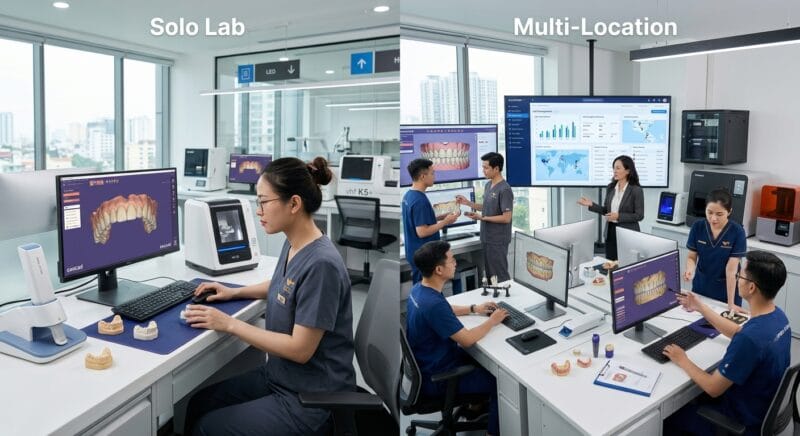
The role of software interoperability is also crucial in modern lab operations. Whether choosing solo dental lab vs multi location lab operations in 2026, the ability to transfer files seamlessly between systems is vital. Incompatible file formats can lead to errors and rework, which increases costs and delays. Labs must ensure their software stack supports universal standards like STL and OBJ to facilitate smooth data exchange. This technical requirement is a key consideration when discussing solo dental lab vs multi location lab operations in 2026. Seamless integration allows for real-time collaboration between design centers and production floors. The ability to manage files efficiently distinguishes successful labs from those struggling with legacy systems.
Scalability and Growth Strategies
Scalability is often the defining factor when comparing solo dental lab vs multi location lab operations in 2026. For a lab to grow, it must have the infrastructure to handle increased case volume without compromising quality. Multi location lab operations in 2026 are inherently designed to scale by opening new branches or acquiring existing labs. This growth strategy allows for geographic expansion and access to new client bases. However, solo dental lab vs multi location lab operations in 2026 highlights that scaling too quickly can strain management and quality assurance processes. Sustainable growth requires a balance between expanding capacity and maintaining operational excellence. Labs that prioritize steady, calculated growth often outperform those that rush to expand.
When evaluating solo dental lab vs multi location lab operations in 2026, it is essential to consider the management overhead associated with expansion. Multi-site operations require robust leadership structures and standardized protocols to ensure consistency across locations. Without these systems, a lab risks developing silos where different sites operate independently with varying standards. Solo labs avoid this complexity but may hit a ceiling on revenue potential due to limited physical space and staff. The strategic decision to expand depends on the owner’s vision and capacity to manage complexity. Understanding solo dental lab vs multi location lab operations in 2026 helps owners plan their growth trajectories realistically.
Digital tools play a significant role in enabling scalability for both models. Cloud-based management systems allow for centralized tracking of cases, inventory, and client communications. In solo dental lab vs multi location lab operations in 2026, these tools are indispensable for coordinating workflows across different sites. They provide real-time visibility into production status and help identify bottlenecks before they become critical. This digital oversight ensures that quality remains consistent regardless of the number of locations. The adoption of such technology is a prerequisite for successful multi location lab operations in 2026. Labs that neglect digital integration will struggle to manage growth effectively.
How does digital design outsourcing affect turnaround time?
Digital design outsourcing reduces turnaround time by shifting design workload to specialized centers with higher capacity and advanced automation. When considering solo dental lab vs multi location lab operations in 2026, outsourcing allows labs to bypass bottlenecks in internal design departments. This is particularly relevant when analyzing solo dental lab vs multi location lab operations in 2026 because it offers a hybrid model that combines local production with centralized design. Labs can keep milling and finishing in-house while sending digital files to an external partner for design work. This separation of tasks ensures that physical production is not delayed by design revisions or staffing shortages. The impact of solo dental lab vs multi location lab operations in 2026 on turnaround times is often positive when outsourcing is integrated correctly.
Outsourcing also provides flexibility during peak seasons without the need to hire temporary staff. For solo dental lab vs multi location lab operations in 2026, this flexibility is a major advantage over maintaining a rigid in-house workforce. External partners can ramp up production quickly to meet surges in demand from DSOs or large clinics. This scalability ensures that clients receive their restorations on schedule regardless of the lab’s internal capacity. The efficiency gains from solo dental lab vs multi location lab operations in 2026 are measurable through reduced lead times and improved customer retention. Labs that fail to adapt their workflow to include outsourcing may find themselves unable to compete with faster rivals.
Quality control remains a paramount concern when shifting design work externally. In the context of solo dental lab vs multi location lab operations in 2026, robust communication channels are essential to maintain high standards. External designers must adhere to strict guidelines regarding margins, occlusion, and material specifications. Regular audits and feedback loops help ensure that the outsourced work meets the lab’s expectations. This rigorous process helps mitigate the risks associated with solo dental lab vs multi location lab operations in 2026. By partnering with reputable firms, labs can ensure that every restoration is crafted to precise digital specifications.
The role of software interoperability is also crucial in modern lab operations. Whether choosing solo dental lab vs multi location lab operations in 2026, the ability to transfer files seamlessly between systems is vital. Incompatible file formats can lead to errors and rework, which increases costs and delays. Labs must ensure their software stack supports universal standards like STL and OBJ to facilitate smooth data exchange. This technical requirement is a key consideration when discussing solo dental lab vs multi location lab operations in 2026. Seamless integration allows for real-time collaboration between design centers and production floors. The ability to manage files efficiently distinguishes successful labs from those struggling with legacy systems.
Scalability and Growth Strategies
Scalability is often the defining factor when comparing solo dental lab vs multi location lab operations in 2026. For a lab to grow, it must have the infrastructure to handle increased case volume without compromising quality. Multi location lab operations in 2026 are inherently designed to scale by opening new branches or acquiring existing labs. This growth strategy allows for geographic expansion and access to new client bases. However, solo dental lab vs multi location lab operations in 2026 highlights that scaling too quickly can strain management and quality assurance processes. Sustainable growth requires a balance between expanding capacity and maintaining operational excellence. Labs that prioritize steady, calculated growth often outperform those that rush to expand.
When evaluating solo dental lab vs multi location lab operations in 2026, it is essential to consider the management overhead associated with expansion. Multi-site operations require robust leadership structures and standardized protocols to ensure consistency across locations. Without these systems, a lab risks developing silos where different sites operate independently with varying standards. Solo labs avoid this complexity but may hit a ceiling on revenue potential due to limited physical space and staff. The strategic decision to expand depends on the owner’s vision and capacity to manage complexity. Understanding solo dental lab vs multi location lab operations in 2026 helps owners plan their growth trajectories realistically.
Digital tools play a significant role in enabling scalability for both models. Cloud-based management systems allow for centralized tracking of cases, inventory, and client communications. In solo dental lab vs multi location lab operations in 2026, these tools are indispensable for coordinating workflows across different sites. They provide real-time visibility into production status and help identify bottlenecks before they become critical. This digital oversight ensures that quality remains consistent regardless of the number of locations. The adoption of such technology is a prerequisite for successful multi location lab operations in 2026. Labs that neglect digital integration will struggle to manage growth effectively.
Outsourcing Partnerships and Quality Assurance
Building strong partnerships with digital design providers is essential for labs navigating solo dental lab vs multi location lab operations in 2026. A reliable partner acts as an extension of the lab’s team, ensuring seamless integration of workflows. This collaboration is vital when analyzing solo dental lab vs multi location lab operations in 2026 because it bridges the gap between local production and global design capabilities. Partners should offer dedicated support and clear communication channels to address any design issues promptly. Trust and transparency form the foundation of these relationships and determine their long-term success. The right outsourcing partner can enhance the lab’s value proposition significantly.
Quality assurance protocols must be standardized across all outsourced projects. In the context of solo dental lab vs multi location lab operations in 2026, this means establishing clear checklists and review processes. Every design file should undergo a thorough review before it reaches the production floor. This step prevents costly errors and ensures that the final product meets clinical requirements. Labs should work with partners who share their commitment to precision and patient safety. Adhering to these standards is crucial for maintaining a strong reputation in the industry. The focus on quality in solo dental lab vs multi location lab operations in 2026 is non-negotiable for sustainable business.
Continuous improvement is another key aspect of successful outsourcing relationships. Labs should regularly review performance metrics and provide feedback to their partners to optimize processes. This ongoing dialogue helps identify areas where efficiency can be improved or costs can be reduced. In solo dental lab vs multi location lab operations in 2026, such improvements directly impact the bottom line and client satisfaction. Partners who are open to feedback and willing to adapt are invaluable assets. This culture of continuous improvement drives innovation and keeps labs competitive in a rapidly changing market.
The Future of Dental Lab Operations
Looking ahead, the industry will continue to favor digital integration and flexible workflows. The comparison of solo dental lab vs multi location lab operations in 2026 suggests that hybrid models will become the norm. Labs that embrace technology and outsourcing will be better positioned to meet evolving client demands. This shift requires a willingness to adapt and invest in the right tools and talent. Those who resist change may find themselves marginalized as the market progresses. The future belongs to labs that prioritize innovation and efficiency.
Additionally, the focus on patient-specific solutions will drive demand for higher precision and customization. Multi location lab operations in 2026 will need to leverage advanced software to handle complex cases efficiently. This capability will differentiate successful labs from those that rely on traditional methods. The ability to deliver personalized care at scale is a key competitive advantage. Understanding solo dental lab vs multi location lab operations in 2026 helps stakeholders prepare for these shifts in patient expectations.
As we move forward, the importance of data analytics in lab management will grow. Tracking key performance indicators allows labs to make informed decisions about resource allocation and strategy. In solo dental lab vs multi location lab operations in 2026, data-driven insights will be essential for optimizing workflows and reducing waste. Labs that harness the power of data will operate more efficiently and profitably. This analytical approach is a critical component of modern lab management. The integration of analytics into daily operations marks the next step in industry evolution.
For further reading on dental industry standards, you can visit the American Dental Association website. Their resources provide valuable insights into clinical guidelines and best practices. Additionally, exploring 3Shape offers detailed information on the latest digital scanning technologies. These tools are essential for labs aiming to modernize their workflows effectively.
Consider how outsourcing fits into your current strategy by reviewing dental lab CAD CAM outsourcing options available today. This resource can help you identify the right partners for your specific needs and goals. Strategic partnerships can transform your operations and drive growth.
By understanding the nuances of solo dental lab vs multi location lab operations in 2026, you can make informed decisions that align with your business goals. The industry is evolving, and staying ahead requires adaptability and a focus on digital excellence. Whether you choose to expand or outsource, the key is to maintain quality and efficiency.
Ready to optimize your lab workflow? Contact us today to discuss how our digital design services can support your growth.