The Indispensable Role of a Dental Sintering Furnace Guide in Modern Dentistry
In the rapidly evolving landscape of digital dentistry, the journey from intraoral scan to final restoration is complex, with each step demanding precision and expertise. Among these critical stages, sintering stands as a cornerstone, transforming milled “green state” materials into durable, biocompatible dental prosthetics. For dental labs and DSOs striving for excellence, a meticulously developed dental sintering furnace guide is not just beneficial—it’s absolutely essential. This guide serves as a blueprint for success, ensuring consistency, predictability, and the highest quality in every restoration.
At its core, sintering is the process of compacting and forming a solid mass of material by heat or pressure without melting it to the point of liquefaction. In dentistry, this typically applies to materials like zirconia, e.max, and specific metals used for frameworks. The quality of the final product—its strength, fit, aesthetics, and longevity—is profoundly influenced by the sintering process. A robust dental sintering furnace guide therefore needs to encompass not only the furnace parameters but also the preparatory steps, especially the preceding digital design phase.
Our digital design outsourcing service specializes in crafting precise CAD/CAM designs that inherently optimize the subsequent sintering process. We understand that the perfect design is the first step towards a perfect restoration, directly impacting how materials behave under heat. By adhering to a comprehensive dental sintering furnace guide, labs can mitigate common issues like warping, cracking, or incorrect shade, ultimately saving time, material, and reputation.
What is Sintering in Digital Dentistry?
Sintering in digital dentistry is the heat treatment process that densifies porous ceramic or metal frameworks, typically milled from pre-sintered blanks, transforming them into their final, robust state. This process is crucial because it gives the restoration its required mechanical properties, such as strength, hardness, and fracture resistance, while also achieving the desired translucency and shade. Without proper sintering, restorations would be brittle, porous, and unsuitable for clinical use. The parameters set within a dental sintering furnace guide dictate the success of this transformation.
For materials like zirconia, which are widely used for crowns, bridges, and implant abutments, the milling process creates a “green state” or “pre-sintered” framework that is oversized and relatively soft. Sintering shrinks this framework to its final, exact dimensions while increasing its density and strength significantly. This shrinkage, which can be up to 25%, must be precisely accounted for during the initial CAD/CAM design phase. A well-executed dental sintering furnace guide ensures that this shrinkage is uniform and predictable, resulting in a restoration that fits perfectly.
The Dental Sintering Furnace Guide: A Foundation for Quality
A comprehensive dental sintering furnace guide is more than just a list of temperature settings; it’s a holistic framework that integrates material science, furnace technology, and digital design principles. It provides step-by-step instructions and best practices for every material type processed in the sintering furnace. Without such a guide, labs risk inconsistent results, material waste, and the need for costly remakes.
Key elements of an effective dental sintering furnace guide include:
- Material-Specific Protocols: Different materials (e.g., various zirconia types, glass ceramics) require distinct sintering curves, ramp rates, hold times, and cooling cycles.
- Furnace Calibration and Maintenance: Regular calibration ensures temperature accuracy, while routine maintenance prevents common furnace malfunctions.
- Loading Instructions: Proper placement of restorations within the furnace is crucial to ensure even heat distribution and prevent distortion.
- Shrinkage Compensation Factors: Precise factors for each material and batch are vital for accurate final dimensions, directly linked to CAD design.
- Troubleshooting Guidelines: A section on common issues (e.g., cracks, discoloration, porosity) and their potential causes and solutions.
By standardizing these elements, a dental sintering furnace guide empowers technicians to operate with confidence and achieve repeatable, high-quality outcomes.
How Does Digital Design Influence the Sintering Process?
Digital design fundamentally dictates the success of the sintering process by establishing the precise dimensions, morphology, and internal structure of the restoration before it enters the furnace. The CAD software allows for the accurate application of shrinkage factors, ensuring that the milled “green state” object will shrink to the desired final size. Without this initial precision, even the most advanced sintering furnace cannot compensate for design flaws.
Consider a zirconia crown: if the digital design does not correctly account for the material’s specific shrinkage rate, the milled green state crown will be either too large or too small after sintering. This leads to poor marginal fit, occlusal discrepancies, and ultimately, clinical failure. Our expert CAD/CAM designers are intimately familiar with the material properties and shrinkage characteristics of various dental ceramics, ensuring that every design is optimized for subsequent sintering. This critical step forms an integral part of an effective dental sintering furnace guide.
Furthermore, complex designs, such as long-span bridges or intricate implant superstructures, require careful consideration of material thickness and support structures during design to prevent distortion or breakage during sintering. Thin areas can overheat or cool too quickly, while overly thick sections may not sinter uniformly. An experienced digital designer anticipates these challenges and incorporates design elements that promote even sintering, adhering to the principles outlined in a comprehensive dental sintering furnace guide.
Optimizing Sintering with Precise CAD/CAM Designs
The synergy between precise CAD/CAM design and the sintering process is undeniable. Optimized designs contribute to:
- Superior Marginal Fit: Accurate digital designs, incorporating correct shrinkage compensation, ensure restorations fit perfectly on the prepared tooth or implant abutment, minimizing cement gaps and reducing the risk of secondary caries or peri-implantitis. This is a direct outcome of following a precise dental sintering furnace guide.
- Enhanced Aesthetics: Uniform material thickness and proper anatomical contours, established in the design phase, contribute to consistent translucency and shade after sintering. Irregularities in thickness can lead to “hot spots” or “cold spots” during sintering, resulting in inconsistent optical properties.
- Maximized Strength and Durability: Designs that avoid sharp angles, incorporate smooth transitions, and maintain appropriate material thicknesses help distribute stress evenly, preventing crack propagation during and after sintering. The structural integrity designed into the restoration directly influences its post-sintering strength.
- Reduced Rework and Remakes: By getting the design right the first time, labs significantly reduce the need for post-sintering adjustments, re-milling, or complete remakes, saving valuable time and materials. This efficiency is a hallmark of a well-implemented dental sintering furnace guide.
Our design team works with leading CAD software like exocad and 3Shape to create designs that are not only anatomically correct but also engineered for optimal sintering performance, aligning perfectly with the most stringent dental sintering furnace guide protocols.
Challenges in Sintering and How Expert Design Mitigates Them
Sintering, while transformative, is not without its challenges. Common issues include:
- Distortion and Warping: Uneven heating or cooling, improper support during sintering, or incorrect shrinkage compensation can lead to restorations that are out of shape. Expert digital design mitigates this by creating balanced structures and accounting for material behavior.
- Cracking: Rapid heating or cooling rates, internal stresses from complex geometries, or inadequate material thickness can cause cracks. Designs that promote gradual transitions and optimal thickness help prevent these stress points.
- Inaccurate Shade and Translucency: These can result from improper sintering protocols (e.g., incorrect temperature, hold time) or variations in material thickness specified during design. Consistent design ensures consistent optical properties.
- Porosity: Inadequate densification during sintering can leave residual porosity, weakening the material. While primarily a furnace issue, consistent material thickness from design aids uniform densification.
An expert digital design, informed by a comprehensive dental sintering furnace guide, anticipates these potential pitfalls. By outsourcing design, labs gain access to specialists who understand the intricate relationship between design parameters and sintering outcomes, thereby reducing these common challenges.
Why is a Comprehensive Dental Sintering Furnace Guide Essential for Every Lab?
A comprehensive dental sintering furnace guide is more than just a set of instructions; it’s a critical quality assurance tool. It ensures that every restoration produced meets the highest standards of precision, strength, and aesthetics. For labs, this translates to:
- Consistency: Standardized protocols lead to predictable results, reducing variability between cases and technicians.
- Efficiency: Clear guidelines minimize trial-and-error, reducing material waste and turnaround times.
- Cost Savings: Fewer remakes mean lower material costs, reduced labor, and increased profitability.
- Reputation: Consistently high-quality restorations enhance a lab’s reputation, leading to more referrals and stronger relationships with dentists and DSOs.
- Compliance: Adherence to established protocols can be important for regulatory compliance and quality certifications.
Implementing and strictly following a detailed dental sintering furnace guide is a hallmark of a professional, quality-focused dental laboratory.
Leveraging Outsourcing for Superior Sintering Outcomes
While a dental sintering furnace guide is crucial, its effectiveness is maximized when paired with expert digital design. This is where outsourcing offers significant advantages for dental labs and DSOs:
- Access to Specialized Expertise: Our team comprises highly trained CAD/CAM designers with deep knowledge of various materials, their shrinkage characteristics, and optimal design principles for sintering. This expertise directly translates into designs that perform flawlessly in the furnace.
- Consistency and Standardization: We follow strict protocols and quality checks for every design, ensuring a level of consistency that can be challenging to maintain with varied in-house skill sets. This standardization complements your internal dental sintering furnace guide.
- Reduced In-House Workload: By outsourcing design, your lab technicians can focus on their core competencies, such as furnace operation, finishing, and quality control, rather than spending hours on complex design tasks. This allows for greater throughput and efficiency.
- Scalability: Outsourcing provides the flexibility to scale your design capacity up or down based on demand, without the overhead of hiring and training additional staff.
- Advanced Technology Adoption: We utilize the latest CAD software and stay abreast of advancements in digital dentistry, ensuring your designs are always cutting-edge and optimized for current sintering technologies. Our designs are always created with an understanding of how they will interact with a comprehensive dental sintering furnace guide.
Ultimately, partnering with a specialized design outsourcing service helps labs produce designs that are inherently “sintering-friendly,” leading to better outcomes and a more streamlined workflow. This also works well alongside การออกแบบมงกุฎฟันดิจิทัล services.
Key Considerations for a Robust Dental Sintering Furnace Guide
Developing and maintaining an effective dental sintering furnace guide requires attention to several critical factors:
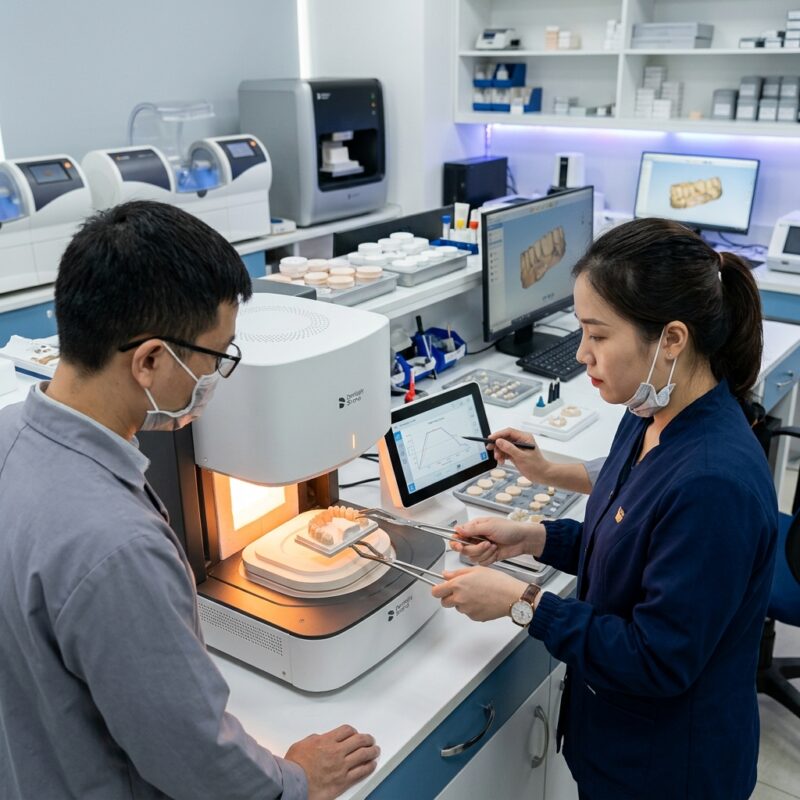
- Material-Specific Sintering Curves: Each material, even different brands of zirconia, has a unique sintering curve. This includes specific ramp rates (how quickly temperature increases), hold times (how long the maximum temperature is maintained), and cooling rates. Deviating from these can lead to compromised material properties.
- Atmosphere Control: Some materials (e.g., certain ceramics) benefit from specific atmospheres (e.g., air, argon) during sintering, which can affect translucency and shade. Your dental sintering furnace guide should specify this.
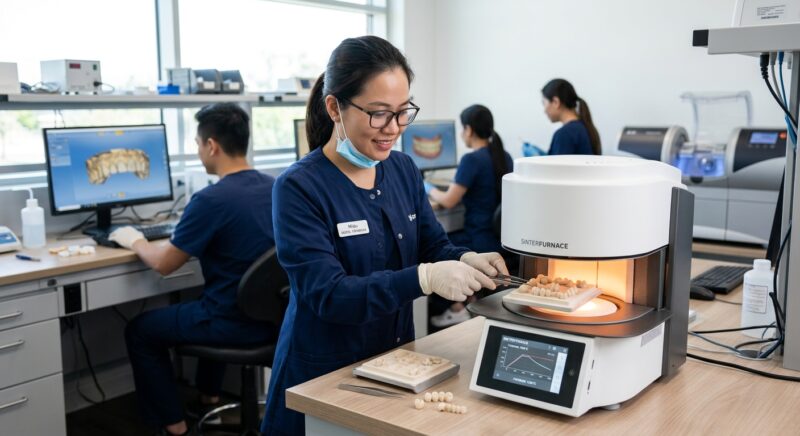
- Furnace Loading and Placement: Proper placement of restorations within the furnace chamber is crucial for even heat distribution. Overloading or incorrect spacing can lead to uneven sintering and distortion.
- Maintenance and Calibration: Regular cleaning, element replacement, and temperature calibration are vital to ensure the furnace operates accurately and consistently over time. A calibrated furnace is fundamental to a reliable dental sintering furnace guide.
- Shrinkage Factor Management: As mentioned, accurate shrinkage factors are paramount. These can vary slightly between material batches and even furnace types. Regular verification and adjustment of these factors are important.
The Role of Advanced CAD Software in Sintering Preparation
Modern CAD software plays an indispensable role in preparing restorations for optimal sintering. Features within programs like Exocad and 3Shape allow designers to:
- Precisely Apply Shrinkage Factors: Inputting the exact shrinkage factor for a specific material blank ensures the final restoration achieves the correct dimensions after sintering.
- Optimize Wall Thickness: Software tools help ensure that all areas of the restoration meet minimum and maximum wall thickness requirements, preventing weak points or areas prone to distortion during sintering.
- Design for Support Structures: For complex geometries, designers can incorporate sprue designs and support structures that facilitate stable sintering and easy post-sintering removal.
- Pre-Sintering Nesting: Efficient nesting of multiple restorations within a milling blank optimizes material usage and can also influence how uniformly heat is applied during sintering.
These advanced functionalities, when wielded by experienced designers, directly contribute to the success metrics outlined in any comprehensive dental sintering furnace guide.
Specific Applications: How Design Affects Sintering for Different Restorations
The impact of digital design on sintering outcomes is universal across various types of restorations:
- Crowns & Bridges: For zirconia crowns and bridges, precise marginal fit and anatomical contours are paramount. Our designs ensure correct shrinkage compensation and uniform wall thickness to prevent distortion and achieve ideal aesthetics and strength after sintering.
- Implant Abutments: Custom implant abutments require extreme precision for fit with the implant interface and the final crown. The design must account for sintering shrinkage to maintain this critical accuracy, as detailed in a specialized dental sintering furnace guide.
- Surgical Guides: While surgical guides themselves are typically printed and not sintered, the accuracy of the underlying digital model and the guide’s design directly impacts the subsequent implant placement, which often involves sintered implant components. The design principles for accuracy are critical. This process often integrates with บริการวางแผนอิมพลานต์.
- Denture Frameworks: For partial denture frameworks milled from CoCr alloys, sintering (or more accurately, heat treatment/densification for metals) is a critical step. The digital design ensures the framework’s strength, fit, and retention elements are precisely formed and will withstand the thermal processing without warping.
- Orthodontic Aligners & Night Guards: These are typically thermoformed over 3D printed models, not sintered themselves. However, the accuracy of the 3D printed models, which originate from digital designs, is paramount. Any inaccuracies in the digital design would lead to poorly fitting models and, consequently, ineffective aligners or night guards.
Future Trends in Sintering Technology and Digital Design
The field of dental sintering is continually advancing. We are seeing developments in faster sintering cycles, specialized furnaces for specific materials, and even “sintering on demand” technologies. Concurrently, CAD software is becoming even more sophisticated, offering advanced material simulation and predictive analytics for sintering outcomes. Our commitment to staying at the forefront of digital dentistry ensures that our design services are always optimized for these evolving technologies, continuously refining the principles of a modern dental sintering furnace guide.
To ensure your lab consistently produces top-tier restorations, partnering with experts in digital design is a strategic investment. Contact us today to learn how our CAD/CAM outsourcing services can elevate your lab’s efficiency and product quality.