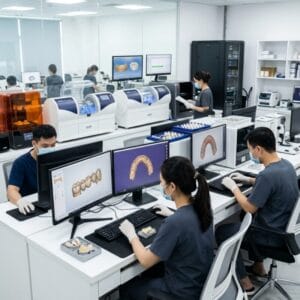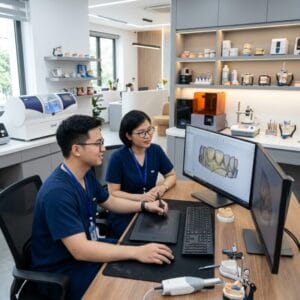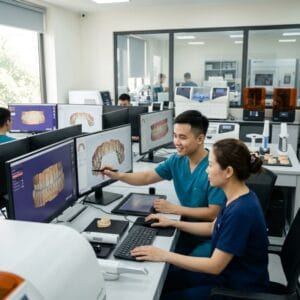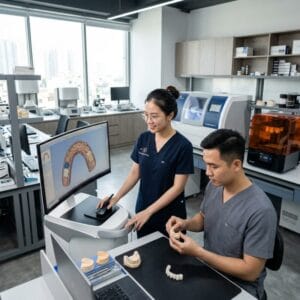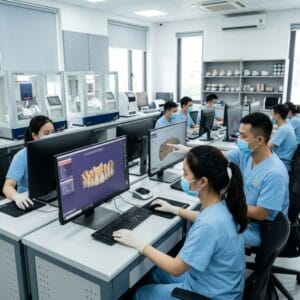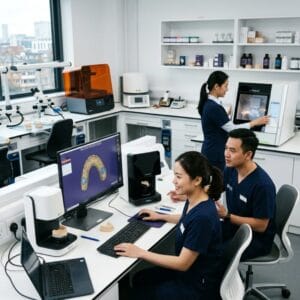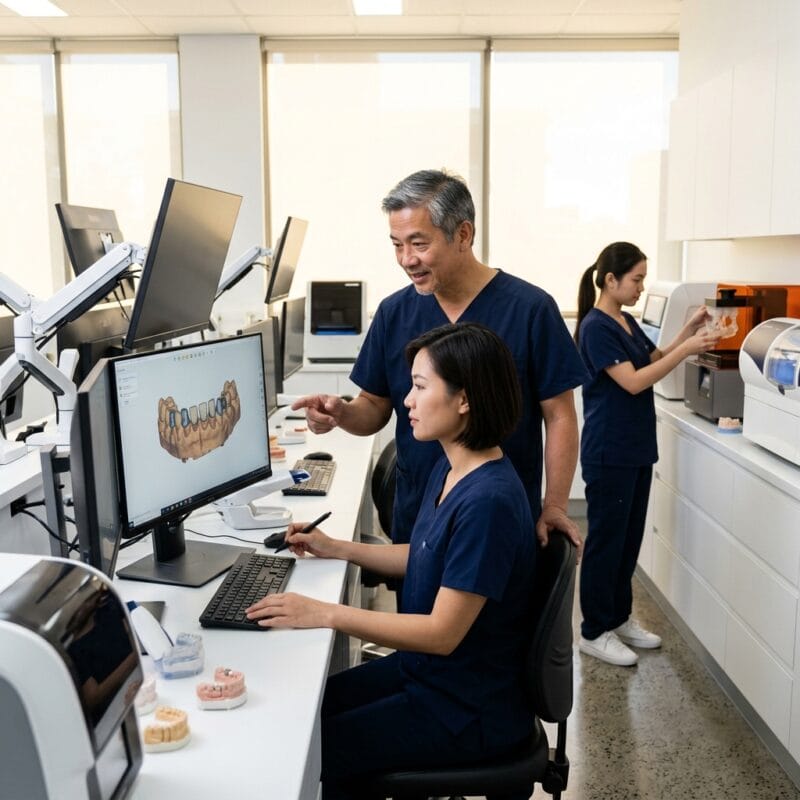
The dental technician shortage in Australia 2026 is no longer a distant operational concern; it is an active structural crisis reshaping the dental laboratory landscape across Sydney, Melbourne, Brisbane, Perth, and regional healthcare hubs. As dental practices rapidly adopt intraoral scanners and clinical demand for advanced prosthetics accelerates, the supply of qualified local bench technicians and CAD/CAM designers has hit a historical low. Dental laboratory owners, commercial lab managers, and clinical leaders within Dental Support Organizations (DSOs) are finding it increasingly difficult to maintain acceptable turnaround times and profit margins.
To remain competitive and protect service level agreements (SLAs), laboratory managers are forced to rethink traditional staffing models. Relying purely on local recruitment drives is no longer viable when the talent pipeline is fundamentally constrained. As the dental technician shortage in Australia 2026 continues to shrink the pool of qualified ceramicists, waxers, and CAD operators, digital design outsourcing has emerged as an indispensable operational strategy for forward-thinking dental facilities.
By leveraging expert offsite CAD/CAM design services, Australian laboratories can decouple their production capacity from local headcount limitations. Offloading digital file processing, margin marking, and 3D CAD design allows local teams to concentrate on value-added finishing, clinical consultation, and quality assurance. In this comprehensive analysis, we explore the underlying drivers of the talent crisis and explain how digital outsourcing provides an immediate, scalable solution during the ongoing dental technician shortage in Australia 2026.
Why is the dental technician shortage in Australia 2026 reaching critical levels?
The dental technician shortage in Australia 2026 is reaching critical levels due to a high rate of retiring senior bench technicians, a declining number of accredited TAFE training programs, and a rapid surge in clinical demand for digital dental prosthetics.
For several decades, Australian dental laboratories relied on a steady pipeline of skilled tradespeople trained through Vocational Education and Training (VET) networks and TAFE institutes. However, institutional closures, course restructuring, and declining student enrollments over the past decade have severely reduced the number of newly qualified dental technicians entering the workforce. Combined with an aging demographic of master technicians reaching retirement age, the industry is experiencing an unprecedented loss of technical expertise. This systemic deficit directly amplifies the impact of the dental technician shortage in Australia 2026 across both metropolitan and regional areas.
Simultaneously, the demand side of the equation has expanded dramatically. Dental practitioners across Australia are placing more implants, prescribing more clear aligners, and requesting aesthetic ceramic restorations at higher volumes than ever before. The widespread adoption of intraoral scanning technology has eliminated physical impression bottlenecks at the clinic level, flooding laboratories with digital scan files. Without an equivalent expansion in qualified CAD design technicians, Australian laboratories face critical production bottlenecks caused by the dental technician shortage in Australia 2026.
Key Factors Accelerating the Talent Deficit
- Demographic Realities: A substantial percentage of certified Australian bench technicians are over the age of 55, leading to a steady stream of retirements that deepens the dental technician shortage in Australia 2026.
- Reduced Educational Infrastructure: Fewer TAFE campuses offer dedicated Diploma of Dental Technology programs, severely restricting new talent acquisition.
- Technology Shift Gaps: While mature technicians possess extensive analog knowledge, many lack specialized training in high-throughput CAD/CAM design software, compounding the challenges of the dental technician shortage in Australia 2026.
- Wage Inflation Pressures: Bidding wars for limited local talent have inflated technician salaries, squeezing lab operating margins amidst the dental technician shortage in Australia 2026.
Financial and Operational Impacts on Dental Laboratories and DSOs
The economic fallout associated with the dental technician shortage in Australia 2026 extends far beyond human resources departments. It directly threatens business sustainability, client retention, and clinical outcomes across the entire dental ecosystem.
When a laboratory operates understaffed, internal production cycles lengthen. Standard 5-day turnaround times for basic crown and bridge cases stretch to 10 or 15 business days. For dental practices, delayed restoration delivery leads to rescheduled patient appointments, chairtime inefficiencies, and clinician frustration. Over time, clinics switch their business to alternative providers or overseas direct labs, severely damaging local commercial relationships. The financial drag caused by the dental technician shortage in Australia 2026 thus impacts top-line revenue as well as bottom-line profitability.
Furthermore, internal lab staff forced to work excessive overtime to manage backlogs experience high rates of workplace burnout. Overworked technicians are prone to higher error rates, leading to remakes, poor marginal fit, and compromised occlusion. Remakes consume valuable milling machine time and material blocks, multiplying operational costs during the dental technician shortage in Australia 2026. For DSOs managing large networks of clinics, these operational friction points translate into systemic patient dissatisfaction and reduced brand equity.
How does CAD/CAM design outsourcing help dental labs in Australia?
CAD/CAM design outsourcing allows dental laboratories to offload digital scan file processing and restoration design to specialized third-party technicians, immediately expanding production capacity without adding local headcount.
Rather than struggling to recruit hard-to-find local CAD operators, laboratories can establish a direct digital connection with an experienced design partner. When a dental practice submits an intraoral scan, the lab routes the raw STL or DICOM file to the remote design partner. Highly trained CAD specialists process the file, mark margins, establish contact points, refine virtual occlusion, and output a production-ready design file. This streamlined workflow effectively solves the operational constraints imposed by the dental technician shortage in Australia 2026.
By delegating screen-based design work to external CAD professionals, Australian lab owners maximize the efficiency of their existing staff. Local technicians can dedicate their time exclusively to physical bench tasks that require hands-on artistic mastery, such as ceramic layering, internal characterization, custom shade matching, and final fitting. This division of labor neutralizes the productivity losses associated with the dental technician shortage in Australia 2026 while enhancing overall job satisfaction for the local team.
In addition, utilizing offshore or third-party CAD design allows Australian facilities to take advantage of time zone differences. Scans submitted at the end of the Australian business day can be designed overnight and ready for local milling or 3D printing first thing the following morning. Overnight file turnaround turns the dental technician shortage in Australia 2026 into a catalyst for operational transformation and continuous 24-hour manufacturing cycles.
Addressing Key Dental Restoration Modalities
To fully mitigate the impact of the dental technician shortage in Australia 2026, outsourcing strategies must cover all core restorative modalities. A modern digital design service acts as a seamless extension of your lab across multiple disciplines:
1. Crown & Bridge Design
Full-contour zirconia, lithium disilicate, and layered ceramic restorations require meticulous design parameters to prevent chipping and ensure longevity. Expert remote designers utilize advanced digital suites to create anatomical crowns and multi-unit bridges with perfect contacts and emergence profiles. Partnering with a specialist for crown and bridge CAD design guarantees consistent anatomical accuracy, relieving the strain caused by the dental technician shortage in Australia 2026.
2. Implant Restorations and Custom Abutments
Implant prosthetics demand precise digital alignment between Ti-bases, scan bodies, and surrounding tissue profiles. Experienced CAD designers handle complex screw-retained crowns, custom titanium abutments, and multi-unit implant bridges across major implant systems. Accessing specialized implant CAD capabilities helps labs manage complex cases despite the dental technician shortage in Australia 2026.
3. Surgical Guides and Implant Planning
Guided surgery requires accurate integration of DICOM CBCT data and optical intraoral surface scans. Offloading virtual implant planning and surgical guide design enables labs to offer high-margin clinical services without investing in dedicated local design specialists during the dental technician shortage in Australia 2026. Utilizing expert support for 3D printed surgical guide design keeps your lab at the forefront of digital dentistry.
4. Removable Prosthetics and Digital Dentures
Designing digital full and partial removable dentures involves precise boundary definitions, tooth setting, and tissue relief calibration. Offsite CAD experts trained in digital removable workflows generate ready-to-print or ready-to-mill denture bases and tooth arches, neutralizing skill gaps stemming from the dental technician shortage in Australia 2026.
5. Orthodontic Aligners and Night Guards
Preventative and orthodontic appliances, including clear aligner staging, splints, and night guards, represent volume-heavy workflows that consume extensive design hours. Automated and technician-guided CAD design for splints ensures exact occlusal clearance and smooth contours, allowing your lab to scale production through the dental technician shortage in Australia 2026.
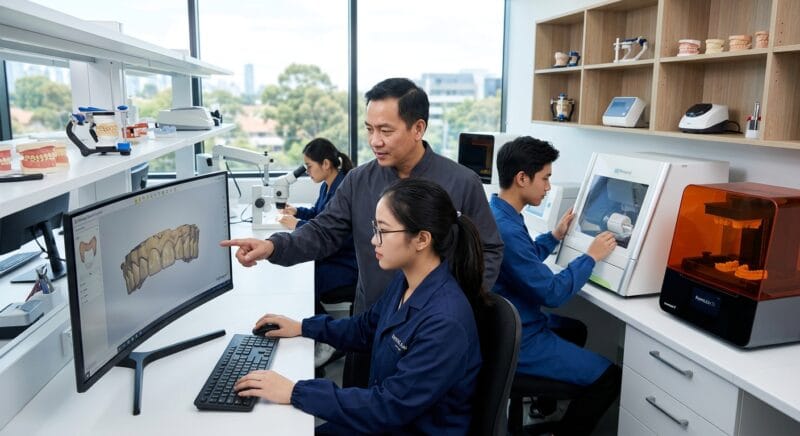
What is digital crown and bridge design outsourcing?
Digital crown and bridge design outsourcing is the process of sending intraoral optical scans to external dental CAD specialists who design single-unit crowns, multi-unit bridges, and implant restorations using advanced software.
Instead of maintaining an expensive internal CAD department, Australian labs forward intraoral scan data directly to secure design centers. The external CAD technicians utilize open-architecture design platforms such as exocad and 3Shape to build precise 3D restoration geometries tailored to clinician preferences and material specifications. Once designed, the final files are returned as open STL files ready for immediate in-house manufacturing, bypassing local labor constraints linked to the dental technician shortage in Australia 2026.
This approach transforms fixed labor costs into variable, usage-based operational expenses. Labs pay only for the designs they generate, providing total financial elasticity during fluctuating clinical order volumes. For growing businesses navigating the dental technician shortage in Australia 2026, this financial flexibility is a crucial driver of sustainable profitability.
Integrating CAD/CAM Outsourcing into Existing Lab Workflows
Implementing digital design outsourcing into an active laboratory workflow is straightforward, requiring no major capital expenditure or workflow interruption. The process follows a standardized digital communication model designed to combat the dental technician shortage in Australia 2026:
- Scan Acquisition: The clinician captures intraoral scans using any open scanner (e.g., Medit, iTero, Trios, Carestream) and uploads the case to the lab portal.
- File Redirection: The lab checks the order details and automatically securely routes the scan files and clinical instructions to the external CAD partner, ensuring uninterrupted throughput despite the dental technician shortage in Australia 2026.
- Precision Design: Dedicated remote CAD technicians analyze margins, virtual articulators, occlusal clearance, and contact tightness according to the lab’s specific master parameters.
- Quality Control & Approval: Designed 3D CAD files are uploaded back to the lab’s dashboard for local review, providing complete quality assurance oversight during the dental technician shortage in Australia 2026.
- Local Manufacturing: Approved STL files are sent directly to local wet/dry milling machines or high-resolution 3D printers for manufacturing, finishing, and polishing.
This closed-loop system ensures that lab directors maintain total control over final product quality, aesthetics, and material choices. By automating the labor-intensive screen-work phase, Australian labs effectively insulate their operations from the regional impact of the dental technician shortage in Australia 2026.
Strategic Advantages for Dental Support Organizations (DSOs)
Dental Support Organizations operating multi-site clinical networks across Australia face unique operational risks related to the dental technician shortage in Australia 2026. DSOs require consistent restoration quality, predictable pricing, and tight turnaround schedules across hundreds of treating dentists.
When internal centralized labs or preferred commercial lab suppliers hit capacity ceilings due to the dental technician shortage in Australia 2026, clinical workflows across the entire DSO network stall. By standardizing digital CAD design outsourcing across all member clinics, DSOs secure a centralized, virtually unlimited design engine that scales instantly with practice acquisitions and organic volume growth.
Furthermore, outsourcing design files eliminates single-point-of-failure risks associated with staff illness, resignations, or vacation leave within central DSO laboratory facilities. The seamless scalability of offshore CAD design networks provides complete operational redundancy, protecting DSO revenue streams against the industry-wide dental technician shortage in Australia 2026.
Overcoming Misconceptions About Digital Design Outsourcing
Despite the clear benefits, some laboratory owners hesitate to embrace outsourcing due to common industry misconceptions regarding quality, security, and communication. However, modern digital design services have evolved to eliminate these concerns, specifically solving challenges raised by the dental technician shortage in Australia 2026.
One prevalent myth is that offsite designers cannot match the precise quality parameters preferred by individual Australian dentists. In reality, professional CAD design centers create customized digital profiles for every lab client, capturing exact preferences for contact tightness, occlusal relief, cement space thickness, and margin design. These custom presets ensure repeatable accuracy across every case, bypassing human error often encountered when short-staffed labs suffer from the dental technician shortage in Australia 2026.
Another concern involves data security and HIPAA/Privacy Act compliance. Top-tier design partners utilize encrypted cloud architecture and secure file transfer protocols, protecting sensitive patient health information throughout the design exchange. By partnering with standard-compliant design specialists, labs protect patient data while overcoming the severe operational drag of the dental technician shortage in Australia 2026.
Comparing In-House CAD Staffing vs. Outsourced CAD Services
When assessing how to navigate the dental technician shortage in Australia 2026, a direct cost-benefit analysis between recruiting in-house CAD technicians and partnering with a digital design provider highlights significant strategic advantages:
- Recruitment and Retention Costs: Hiring a skilled local CAD designer in Australia requires substantial recruitment fees, competitive salary packages, superannuation, and ongoing training expenses. In contrast, outsourcing requires zero recruitment overhead, neutralizing labor market inflation caused by the dental technician shortage in Australia 2026.
- Software Licensing & Hardware Investment: Running internal design stations demands annual CAD software license renewals, high-performance workstations, and graphics hardware. Outsourcing shifts software maintenance and upgrade costs entirely to the service provider during the dental technician shortage in Australia 2026.
- Scalability & Utilization: In-house technicians represent a fixed overhead expense regardless of daily file volume. Digital design outsourcing scales dynamically up or down based on actual clinical demand, protecting lab cash flow during seasonal dips while absorbing sudden volume spikes during the dental technician shortage in Australia 2026.
Preparing Your Laboratory Infrastructure for 2026 and Beyond
Navigating the changing landscape of Australian dentistry requires proactive operational leadership. Waiting for market forces to resolve the national labor deficit is a risky strategy. Lab owners who take decisive steps today to incorporate third-party CAD design into their core business model will emerge as market leaders despite the dental technician shortage in Australia 2026.
To successfully transition into a hybrid production model, laboratory leaders should conduct an internal audit of their current production capacity. Identify internal bottlenecks, measure average turnaround times, and calculate the true cost per designed unit in-house. Once baseline metrics are established, initiate a trial integration with a trusted CAD design service to validate quality, turnaround speeds, and communication protocols. Embracing this hybrid approach ensures your facility remains resilient, profitable, and fully operational throughout the dental technician shortage in Australia 2026.
By delegating digital file processing to dedicated design experts, you safeguard your business against local labor shortages, optimize internal resource allocation, and position your lab to deliver superior clinical value to Australian dentists for years to come.
Ready to protect your lab from labor bottlenecks and scale production effortlessly? Contact our expert CAD/CAM design team today to start your free trial and experience seamless digital outsourcing.