The dental landscape across the United Kingdom is undergoing an unprecedented digital transformation. As intraoral scanners become standard equipment in dental practices from London to Edinburgh, traditional physical impressions are rapidly giving way to direct optical STL and PLY files. For dental technicians, entrepreneurs, and clinical group networks, understanding how to start a dental lab in the UK in 2026 offers an extraordinary commercial opportunity. However, modernizing market entry requires navigating complex regulatory frameworks, capital hardware decisions, and evolving digital CAD/CAM infrastructure.
Historically, opening a dental laboratory demanded immense upfront capital investments in heavy machinery, casting ovens, toxic chemical processing zones, and large teams of specialized hand-waxing technicians. In 2026, the blueprint has changed fundamentally. Today, learning how to start a dental lab in the UK in 2026 centers on digital data management, agile CAD design workflows, precise 3D printing, and strategic outsourcing partnerships. By establishing a modern, digitally driven facility, new lab owners can lower initial operational costs while delivering superior accuracy for crowns, bridges, dental implants, surgical guides, removable prosthetics, and clear aligners.
This comprehensive guide details every critical pillar you must master when planning how to start a dental lab in the UK in 2026. From General Dental Council rules and MHRA compliance to hardware selection and CAD design scale, this technical overview provides a clear roadmap for success in today’s competitive dental market.
What regulatory bodies govern UK dental laboratories in 2026?
Dental laboratories operating in the United Kingdom are primarily regulated by the Medicines and Healthcare products Regulatory Agency (MHRA) for medical devices and the General Dental Council (GDC) for professional practice registration. Anyone studying how to start a dental lab in the UK in 2026 must realize that regulatory compliance is not optional—it forms the absolute baseline of your business’s legal permission to trade and manufacture custom-made dental appliances.
The regulatory framework in the UK ensures that every dental restoration, from a single lithium disilicate crown to a full-arch implant bridge, meets stringent safety, traceability, and quality standards. Understanding these requirements from day one prevents costly legal interruptions and builds immediate credibility with prospective clinical clients.
MHRA Registration and Custom-Made Devices Regulations
Under the UK Medical Devices Regulations, all dental prosthetics, orthotics, and restorations manufactured for specific patients are classified as Custom-Made Medical Devices. When researching how to start a dental lab in the UK in 2026, your top administrative priority must be registering your enterprise with the MHRA via their online system.
As a registered manufacturer of custom-made devices, your lab must maintain strict records for every case. This includes maintaining a statement of conformity for every appliance delivered to a dentist, documenting raw material lot numbers (such as zirconia blocks, cobalt-chromium alloys, or 3D printing resins), and retaining these records for a minimum of five years. Furthermore, if you plan on utilizing offshore CAD design services or external manufacturing partners, your MHRA documentation must explicitly reflect your quality management system (QMS) audit trail for data exchange and material compliance.
General Dental Council (GDC) Scope of Practice
In the UK, qualified dental technicians and clinical dental technicians (CDTs) must be registered with the GDC to practice legally. If you are exploring how to start a dental lab in the UK in 2026 as a business owner who is not a registered dental technician, you may still own and operate the business entity, but all technical production, design review, and clinical sign-offs must be executed or supervised by GDC-registered personnel.
The GDC sets explicit standards for patient safety, continuous professional development (CPD), and ethical practice. Your operational protocols must ensure that digital designs, whether produced in-house or sourced via specialized partners, are thoroughly reviewed by qualified GDC registrants prior to final manufacturing and delivery to the dental clinic.
UKCA Marking and Conformity Post-Brexit Updates
Navigating UKCA (UK Conformity Assessed) marking requirements is a pivotal component of how to start a dental lab in the UK in 2026. While custom-made medical devices do not carry a formal UKCA mark in the same manner as mass-produced medical equipment, they must fully comply with the underlying safety and performance requirements set out in the UK MDR guidelines. You must ensure that all consumables—from milling burs to liquid stains—hold valid UKCA or CE marks recognized under current UK legislation.
Business Structure and Financial Planning for 2026
A frequent error made by skilled dental technicians researching how to start a dental lab in the UK in 2026 is focusing entirely on technical craft while neglecting core financial engineering. A successful dental lab requires a robust business model tailored to the modern UK dental market, which is increasingly divided between private cosmetic dentistry and NHS dental services.
How much does it cost to open a dental lab in the UK?
Opening a modern UK dental laboratory typically requires an initial capital investment ranging from £30,000 for a streamlined digital setup to over £150,000 for a fully equipped milling and printing facility. The total startup cost depends heavily on whether you choose to invest in heavy capital equipment or adopt a lean digital CAD design outsourcing model.
To better understand capital requirements, let us break down the primary startup expenditure categories when evaluating how to start a dental lab in the UK in 2026:
- Facility Lease and Fit-Out: Rent, electrical upgrades, localized dust extraction, HVAC systems, and ergonomic workstations (£10,000 – £30,000).
- Hardware (Scanners, Printers, Mills): Desktop optical scanners, high-resolution 3D printers, post-processing wash/cure stations, and 5-axis wet/dry milling machines (£15,000 – £80,000+).
- CAD Software & IT Infrastructure: Design software licenses, high-performance workstations, secure cloud storage, and cybersecurity protocols (£5,000 – £15,000).
- Regulatory & Legal Setup: MHRA registration fees, GDC registrations, indemnity insurance, and legal counsel (£2,000 – £5,000).
- Initial Working Capital: Consumable inventories, marketing, utility reserves, and initial staff salaries (£10,000 – £30,000).
By analyzing these numbers, prospective founders learning how to start a dental lab in the UK in 2026 can immediately see that hardware and software represent the largest variable expenses. Reducing these capital expenditures through strategic CAD workflow models drastically shortens your timeline to profitability.
Comparing Business Models: Traditional vs. Fully Digital Hybrid
When planning how to start a dental lab in the UK in 2026, you must decide which of the three modern operational models best fits your vision and financial capacity:
1. The Traditional Analogue Lab: Relies heavily on stone models, manual waxing, investment casting, and hand-layering ceramics. While lower in initial software costs, it requires high labor overhead, vast physical space, and expensive skilled manual technicians who are increasingly scarce in the UK market.
2. The In-House Full Digital Lab: Invests heavily in desktop scanners, CAD software seats, 5-axis mills, 3D printers, and ceramic sintering furnaces. This model offers complete localized control but demands substantial upfront capital, ongoing software annual renewal fees, and specialized internal CAD technicians.
3. The Lean Digital Hybrid Model: Receives digital intraoral scans (IOS) directly from clinics, handles local 3D printing and final characterization/staining in-house, but outsources core digital CAD design (crowns, bridges, custom abutments, surgical guides, dentures) to dedicated CAD design services. This approach represents the most efficient framework for anyone studying how to start a dental lab in the UK in 2026, as it optimizes margins and drastically reduces technical labor bottlenecks.
Selecting the Ideal Location and Laboratory Layout
Unlike traditional labs that required industrial zoning due to heavy noise, fumes, and burn-out furnaces, a modern digital dental lab can operate efficiently in smaller, cleaner commercial spaces. When evaluating real estate options for how to start a dental lab in the UK in 2026, physical footprint requirements are vastly simplified by digital workflows.
Workstation Ergonomics and Environmental Health
Even in a digitally focused facility, environmental health and safety remain critical. Your facility must comply with Health and Safety Executive (HSE) standards regarding dust control and chemical exposure. Fine ceramic dust, zirconia particulates, and liquid photopolymer resins require dedicated local exhaust ventilation (LEV) systems, UV-safe lighting zones for resin handling, and ergonomic seating for staff technicians sitting at CAD monitors for extended shifts.
IT Infrastructure and Data Security Compliance
Digital dental labs are fundamental handling hubs for sensitive patient healthcare data. An essential element of how to start a dental lab in the UK in 2026 is establishing a secure IT network that complies with UK GDPR and Data Protection Act 2018 standards. You must implement encrypted cloud storage solution architecture, secure file transfer protocol (SFTP) portals for receiving patient intraoral scans, and automated daily backups of customer CAD design archives.
Essential CAD/CAM Technology and Software Infrastructure
To successfully execute a business plan on how to start a dental lab in the UK in 2026, your technical architecture must seamlessly connect clinicians’ intraoral scanners to your production hardware or design partners. Modern dentists utilize a wide range of scanning hardware, meaning your digital infrastructure must remain strictly open-system.
Industry-standard clinical scanners—such as those produced by Medit and Dentsply Sirona—export open STL, PLY, or OBJ digital files. Your laboratory must be capable of ingesting these files without format lock-in or data loss.
Core Dental CAD Software Platforms
At the center of digital laboratory operations lies CAD (Computer-Aided Design) design software. When mapping out how to start a dental lab in the UK in 2026, you will primarily encounter two market-leading platforms:
- Exocad: Renowned for its modular flexibility, powerful open architecture, and extensive library of implant components, tooth models, and attachment types. It is widely regarded as an industry standard for complex implant bridges and crown & bridge work.
- 3Shape Dental System: Offers a highly integrated ecosystem with automated workflows, intuitive user interfaces, and powerful modules for dental prosthetics, clear aligners, and removable partial dentures.
While licensing these software suites is a standard step in how to start a dental lab in the UK in 2026, startup lab owners often face high module costs, steep learning curves, and ongoing annual update fees. Managing internal CAD technicians during peak demand can create operational friction and delay turnarounds.
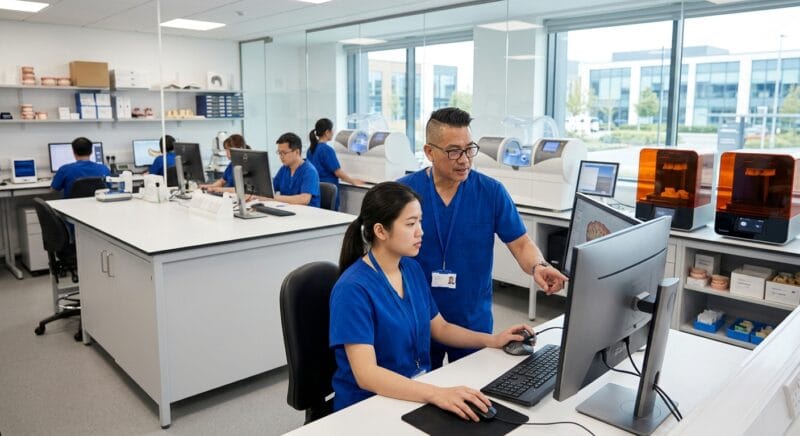
How Outsourcing CAD Design Powers New UK Dental Labs in 2026
The traditional model of hiring multiple full-time, highly paid CAD designers before opening your doors is fast becoming obsolete. A major strategy within how to start a dental lab in the UK in 2026 is building your operational model around specialized CAD design outsourcing.
By partnering with an expert dental CAD design service, new lab owners can scale their operational capacity instantly without adding static payroll overhead. This allows you to accept an unrestricted volume of cases from day one while maintaining rapid turnaround times and flawless anatomical accuracy.
Eliminating Technical Capacity Bottlenecks
When launching a new business, case volume can be unpredictable. Some weeks bring dozens of complex full-arch cases; others bring a steady trickle of single crowns. If you rely entirely on in-house CAD staff while learning how to start a dental lab in the UK in 2026, you face either paid downtime during quiet periods or severe production backlogs during busy weeks.
Outsourcing design work converts fixed CAD labor expenses into predictable, unit-based variable costs. Whether you receive five cases a day or fifty, your design capacity expands seamlessly to meet demand without requiring new hardware investments or additional software license seats.
Comprehensive Case Coverage: From Restorative to Orthodontics
Modern clinical practices expect their dental laboratory partner to handle a comprehensive range of dental products. By leveraging an external CAD design partner as part of your master strategy for how to start a dental lab in the UK in 2026, your new business can instantly offer expert design capabilities across every major discipline:
- Crown & Bridge: Monolithic zirconia crowns, layered lithium disilicate restorations, composite inlays/onlays, and multi-unit posterior bridges designed to exact margin tolerances.
- Dental Implants: Custom titanium abutments, screw-retained zirconia crowns, and intricate full arch implant bridge design cases with exact passive fit parameters.
- Surgical Guides: Precision-guided implant surgery templates constructed using targeted CBCT DICOM and intraoral scan merging via dedicated custom surgical guide design workflows.
- Removable Prosthetics: High-definition digital full and partial framework designs, flexible dentures, and customized 3D printed denture design setups optimized for modern resin printing.
- Occlusal Splints & Night Guards: Tailored splints featuring adjusted functional ramps and programmed contact points for treating bruxism and TMJ disorders.
- Orthodontic Aligners: Clear aligner staging, digital tooth movement sequencing, and attachment placement tailored to doctor preferences.
Integrating these advanced capabilities into your portfolio on day one elevates your new UK dental laboratory from a basic local shop to a full-service digital solution center.
Step-by-Step Execution Blueprint: Launching Your UK Lab in 2026
To give structure to your journey of learning how to start a dental lab in the UK in 2026, the following detailed step-by-step roadmap outlines the path from initial conception to delivering your first commercial restorations.
Step 1: Conduct Local Market Analysis and Define Your Niche
Before buying equipment or registering with regulators, analyze the local clinical demand in your target region of the UK. Are local dental practices struggling with long turnaround times from massive corporate dental labs? Are private clinics seeking higher aesthetic precision for cosmetic veneers and clear aligners? Identifying gaps in local clinical service allows you to position your lab’s value proposition effectively when implementing how to start a dental lab in the UK in 2026.
Step 2: Formalize Business Registration and Corporate Structure
Register your business entity with Companies House as a Private Limited Company (Ltd) or sole trader structure. Setup dedicated commercial banking accounts, register for VAT if projected sales exceed the statutory UK threshold, and retain an accountant familiar with UK manufacturing tax incentives, such as R&D Tax Relief and Capital Allowances on plant equipment investments.
Step 3: Secure Comprehensive Business and Liability Insurance
Operating a dental laboratory in the UK requires robust insurance cover. When structuring how to start a dental lab in the UK in 2026, secure policy policies covering Public Liability, Employers’ Liability (mandatory in the UK if hiring staff), Product Liability for medical devices, and Commercial Property insurance covering sensitive hardware and IT networks.
Step 4: Register with the MHRA and Establish Quality Systems
Submit your enterprise application via the MHRA Device Online Registration System (DORS). Create an operational Quality Management System (QMS) binder containing written Standard Operating Procedures (SOPs) for case intake, material traceability, design verification, cross-contamination prevention, and customer complaint handling. Ensuring these systems are active early is a fundamental requirement when mastering how to start a dental lab in the UK in 2026.
Step 5: Setup Your Digital Infrastructure and Laboratory Space
Fit out your workspace with necessary electrical connections, localized dust control, high-speed fiber internet connection, and dedicated dental printing/milling equipment. Establish your encrypted file intake portal so local dental practices can easily submit digital cases. Integrate your CAD workflow, ensuring your remote design outsourcing protocols are established and tested with sample STL scans.
Step 6: Conduct Technical Quality Control and Pilot Calibration
Prior to accepting live commercial cases, run pilot calibration tests. Receive test STL scans, send them to your external CAD design partner, mill or print the resulting output files in-house, and assess fit, marginal integrity, and occlusion using physical master dies or articulating models. This step guarantees that when you officially launch, your quality standards meet or exceed clinician expectations.
Step 7: Launch Marketing Campaigns to UK Dental Practices
With production workflows verified, initiate active outreach to targeted dental practices, dental groups, and Dental Service Organizations (DSOs). Highlight your rapid turnaround capabilities, digital open-system compatibility, precise CAD design quality, and full compliance with MHRA standard practices.
Financial Optimization and Growth Strategies for 2026
Once your laboratory is open, mastering how to start a dental lab in the UK in 2026 shifts from launch mechanics to long-term profitability and sustainable scaling. Maximizing gross profit margins requires continuous monitoring of material costs, labor efficiency, and equipment utilization.
Understanding Unit Cost Economics
To run a profitable lab, you must maintain precise control over the unit cost of every restoration produced. Let us analyze a simplified financial comparison for a single monolithic zirconia crown under two operational approaches:
Approach A: In-House CAD Technician (Low Volume)
If you hire a full-time CAD technician at £35,000–£45,000 annual salary plus software licensing and benefits, and your startup lab only produces 150 crowns per month initially, your internal labor cost per design can exceed £20 per crown. Add material costs, milling amortizations, and overhead, and your total production cost leaves thin profit margins when competing against established market rates.
Approach B: Digital Design Outsourcing Model
By leveraging a dedicated external CAD design service, your design cost per single crown drops to a predictable, low unit fee. You pay only for completed designs without paying fixed salaries or software update maintenance during slow periods. This slashes your cost per unit, leaving healthy profit margins even at initial lower production volumes. This financial agility is why outsourcing is so central to how to start a dental lab in the UK in 2026.
Scaling Revenue with DSO and Group Practice Contracts
Dental Service Organizations (DSOs) and multi-location corporate groups represent a massive segment of the UK dental market in 2026. These clinical groups demand high-volume production, standardized quality control across every branch, rapid turnaround times, and competitive pricing schedules.
For a newly opened laboratory, securing a contract with a DSO can instantly transform your financial trajectory. However, handling DSO volume internal design demands can quickly overwhelm small lab staff. Utilizing a full-service CAD design outsourcing infrastructure empowers your lab to confidently pitch for large DSO contracts, knowing your back-end design team can absorb hundreds of units daily without compromising turnarounds or aesthetic consistency.
Summary Checklist: How to Start a Dental Lab in the UK in 2026
To keep your launch on track, reference this quick operational checklist summarizing the primary strategic phases on how to start a dental lab in the UK in 2026:
- Market & Business Setup: Formalize Ltd business entity, set up business accounts, secure insurance cover, and establish an accountant.
- Regulatory Compliance: Register company with the MHRA via DORS, establish Custom-Made Device statement protocols, and register lead personnel with the GDC.
- Infrastructure & Hardware: Secure commercial space, install IT security networks, high-speed internet, dust extraction systems, and digital 3D printers/milling hardware.
- Digital Workflow Integration: Select open software protocols, set up digital client intake channels, and establish dedicated CAD design outsourcing partnerships.
- Quality Assurance & Testing: Process calibration trial cases with your design partner to verify margin accuracy, occlusal contacts, and material fit parameters.
- Commercial Launch: Initiate direct marketing to local private practices, NHS clinics, and regional DSOs across the UK.
Navigating how to start a dental lab in the UK in 2026 requires technical skill, precise regulatory compliance, and smart financial management. By embracing a lean, digital-first strategy powered by expert CAD design outsourcing, your new UK dental laboratory can bypass traditional operational bottlenecks, lower initial capital investment, and deliver outstanding prosthetic quality to clinical clients across the region.
Ready to launch your UK dental lab with scalable, high-precision digital workflows? Contact our expert dental CAD design team today to streamline your design output and boost your profit margins from day one.