Introduction: Understanding the Urgency of Reducing Dental Lab Costs in Europe
As the dental industry in Germany and across Europe evolves, labs and dental service organizations (DSOs) face increasing pressure to optimize costs without compromising quality. The question of how to reduce dental lab costs in Germany and Europe in 2026 has become central to maintaining profitability and competitiveness. Rising material prices, labor costs, and the demand for faster turnaround times require innovative solutions to streamline workflows and maximize efficiency.
In this article, we explore comprehensive strategies centered on CAD/CAM digital design outsourcing services that address these challenges head-on. From crown and bridge work to surgical guides and orthodontic aligners, outsourcing digital workflows can transform cost structures for dental labs and DSOs.
What Is Dental Lab CAD/CAM Digital Design Outsourcing?
Dental lab CAD/CAM digital design outsourcing is the practice of contracting external specialized providers to handle the digital design of dental restorations and appliances. These services encompass creating virtual models for crowns, bridges, implants, dentures, night guards, and orthodontic devices using advanced computer-aided design and manufacturing software.
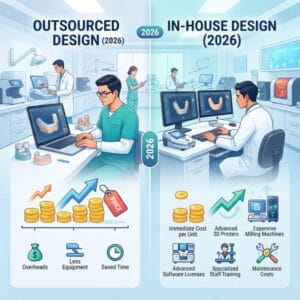
By outsourcing these digital design tasks, dental labs can reduce investment in expensive CAD/CAM equipment, software licenses, and skilled personnel. This approach also allows labs to scale production flexibly and access cutting-edge digital workflows without the overhead costs of maintaining in-house design teams.
Leading design software providers, such as 3Shape and exocad, have enabled service providers to offer high-precision, consistent digital designs that labs can trust. This trend is particularly significant in Germany, where precision and quality are paramount but come with high operating expenses.
Why Is Cost Reduction Vital for Dental Labs and DSOs in Europe?
Cost reduction is essential due to increasing raw material prices, labor shortages, and competitive market pressures in Europe’s dental sector. Germany, as one of the largest dental markets in Europe, experiences particularly high labor and regulatory costs. These factors collectively squeeze margins, making cost-effective solutions a necessity rather than an option.
Moreover, patient expectations are rising for quicker delivery of customized dental restorations, which requires efficient production workflows. Labs that fail to reduce costs risk losing business to more agile competitors or foreign outsourcing options. Therefore, understanding how to reduce dental lab costs in Germany and Europe in 2026 is a strategic imperative for long-term sustainability.
How Does Outsourcing CAD/CAM Design Help Reduce Costs?
Outsourcing CAD/CAM design transfers fixed costs into variable costs and leverages economies of scale from specialized digital design providers. Instead of investing heavily in expensive scanners, design software, and training, dental labs can pay per case or subscription fees for design services.
- Reduced capital expenditures: Outsourcing eliminates the need to purchase costly equipment such as 3D scanners and milling machines.
- Lower labor costs: Digital design experts handle the complex modeling work more efficiently than in-house staff, reducing overtime and errors.
- Faster turnaround: Specialized providers often maintain 24/7 operations, speeding up case completion and delivery.
- Access to latest technology: Outsourcing partners invest continuously in software upgrades and training, ensuring cutting-edge designs.
These factors directly contribute to how to reduce dental lab costs in Germany and Europe in 2026 by optimizing workflows and reducing overhead.
What Are the Key Services Offered in CAD/CAM Digital Design Outsourcing?
Outsourcing providers typically offer a range of digital design services including crowns and bridges, implant restorations, surgical guides, dentures, orthodontic aligners, and night guards. Each service requires specialized knowledge and software capabilities to ensure clinical accuracy and patient satisfaction.
For instance, designing precise implant surgical guides demands integration of CT scan data with intraoral scans, which requires expertise and advanced software such as those from Medit or 3Shape. Orthodontic aligner designs must consider tooth movement patterns and sequential staging, which digital outsourcing providers can expertly manage.
By outsourcing these specific digital design tasks, labs can focus on fabrication and finishing, streamlining the entire prosthetic production chain and effectively managing costs.
How to Choose the Right CAD/CAM Digital Design Outsourcing Partner?
Choosing the right outsourcing partner involves evaluating their technical expertise, turnaround times, quality assurance processes, and cost structure. Labs should look for providers with proven experience in European dental standards, robust digital workflows, and transparent pricing models.
Additionally, partners that offer integration with popular design software platforms and cloud-based case management systems facilitate smoother collaboration. Certifications and compliance with medical device regulations in the EU are also critical factors.
Questions to ask potential partners include their accuracy benchmarks, revision policies, and support capabilities. Selecting a reliable partner directly impacts how to reduce dental lab costs in Germany and Europe in 2026 by minimizing costly remakes and delays.
What Are the Technological Trends Driving Cost Reduction in 2026?
Emerging technologies such as AI-assisted design, improved 3D printing materials, and cloud-based collaboration platforms are shaping how to reduce dental lab costs in Germany and Europe in 2026. AI tools can automate design adjustments, reducing human error and speeding up case approvals.
Meanwhile, advancements in 3D printing resins and milling materials enable more accurate and durable prosthetics with less waste. Cloud platforms allow seamless communication between labs, clinics, and design providers, cutting down on logistical delays.
Integrating these technologies within outsourcing models amplifies cost-saving benefits by enhancing productivity and reducing material and labor inefficiencies.
What Are the Best Practices for Maximizing Savings with Outsourcing?
Maximizing savings requires clear communication, standardized case protocols, and continuous quality monitoring. Labs should establish detailed design briefs and digital impression standards to reduce back-and-forth revisions. Using common file formats such as STL or PLY ensures compatibility and speeds up processing.
Regularly reviewing turnaround times and error rates with outsourcing partners helps identify bottlenecks and improvement areas. Labs can also negotiate volume-based discounts or bundled service packages to reduce per-case costs.
By implementing these best practices, dental labs can sustainably reduce costs while maintaining high-quality outcomes, addressing the core question of how to reduce dental lab costs in Germany and Europe in 2026.
How Does Outsourcing Affect Quality and Patient Outcomes?
When managed properly, outsourcing CAD/CAM digital design improves quality and patient outcomes by leveraging specialized expertise and advanced technologies. Design providers focus exclusively on digital workflows, ensuring precision and adherence to clinical requirements.
High-quality digital designs reduce adjustments during fitting, improve prosthetic longevity, and enhance patient satisfaction. Outsourcing also allows labs to stay current with evolving dental materials and techniques by accessing partner expertise.
Thus, cost reduction does not come at the expense of quality but rather complements it through efficient and accurate digital workflows.
How to Integrate CAD/CAM Outsourcing into Existing Lab Workflows?
Integrating outsourcing involves establishing digital communication channels, training staff on case submission protocols, and aligning production schedules. Labs should invest in compatible scanning technology to capture accurate digital impressions that outsourcing partners can process immediately.
Using cloud-based case management systems ensures real-time tracking and feedback. Scheduling regular coordination meetings with outsourcing providers helps maintain alignment on case priorities and deadlines.
This integration reduces errors, accelerates turnaround, and optimizes resources, directly contributing to how to reduce dental lab costs in Germany and Europe in 2026.
Case Study: Cost Savings Through CAD/CAM Design Outsourcing in a German DSO
A prominent German dental service organization implemented CAD/CAM digital design outsourcing for all crown and bridge cases in 2025. By shifting digital design work to a specialized partner, the DSO reduced software licensing and training expenses by 40% and decreased average case turnaround time by 25%.
Material waste also declined due to improved design accuracy, and the DSO expanded its production capacity without hiring additional in-house designers. This case demonstrates real-world application of how to reduce dental lab costs in Germany and Europe in 2026 effectively.
Future Outlook: What to Expect for Dental Lab Costs Post-2026?
Looking beyond 2026, dental labs in Germany and Europe will increasingly rely on digital innovation and outsourcing partnerships to maintain cost efficiency. Automation, AI, and enhanced materials will further reduce production times and errors.
Labs that adopt flexible outsourcing models and invest in staff digital literacy will be best positioned to adapt to market changes and patient demands. Continuous evaluation of cost structures and technology integration will remain critical.
Understanding how to reduce dental lab costs in Germany and Europe in 2026 is just the first step toward sustainable growth in an evolving dental ecosystem.
Conclusion: Taking Action on Cost Reduction Strategies
In summary, how to reduce dental lab costs in Germany and Europe in 2026 hinges on embracing CAD/CAM digital design outsourcing, leveraging emerging technologies, and optimizing workflows. This approach enables dental labs and DSOs to minimize expenses, improve turnaround times, and maintain high-quality prosthetics.
By partnering with specialized digital design providers, labs can transform fixed costs into scalable expenses, gain access to cutting-edge tools, and stay competitive in a challenging market.
For dental labs looking to implement these strategies effectively, it is crucial to choose experienced outsourcing partners aligned with European standards and to integrate processes seamlessly.
Get Started with Digital Design Outsourcing Today
Step-by-Step Implementation Guide for CAD/CAM Digital Design Outsourcing
Transitioning from fully in-house dental lab design to a hybrid or fully outsourced CAD/CAM digital design model requires careful planning and execution to ensure cost savings without sacrificing quality or turnaround time. Below is a detailed step-by-step guide tailored for dental labs and DSOs in Europe looking to implement outsourcing effectively.
Step 1: Conduct a Comprehensive Workflow Audit
- Map Current Processes: Document every step in your current design and manufacturing workflows, including software used, personnel involved, turnaround times, and bottlenecks.
- Identify Cost Drivers: Analyze labor hours, material waste, rework rates, and overhead costs associated with each stage.
- Evaluate Technology Gaps: Assess your in-house CAD/CAM equipment capabilities versus market standards to identify areas where outsourcing can add value.
Step 2: Define Outsourcing Objectives and Scope
- Set Clear Goals: Define specific targets such as reducing design labor costs by 20%, improving design accuracy, or shortening turnaround times by 15%.
- Select Services to Outsource: Decide whether to outsource only design, or include additional services like digital model preparation, virtual articulation, or case planning.
- Determine Volume and Frequency: Estimate the volume of cases to be outsourced and the expected frequency to ensure your partner can meet demand.
Step 3: Develop a Vendor Selection and Onboarding Plan
- Prepare a Vendor Checklist: Include criteria such as technology compatibility, turnaround time guarantees, pricing models, quality certifications, and client references.
- Run Pilot Projects: Start with a small batch of cases to test the vendor’s design accuracy, communication efficiency, and compliance with specifications.
- Train Internal Staff: Educate your team on how to prepare and submit digital files properly, manage feedback loops, and handle any required adjustments.
Step 4: Establish Clear Communication and Quality Control Protocols
- Define Feedback Loops: Set timelines and methods for reviewing designs, requesting revisions, and approving final files.
- Implement Quality Metrics: Use measurable KPIs such as design accuracy rates, error frequency, and turnaround adherence to monitor vendor performance.
- Schedule Regular Reviews: Hold monthly or quarterly meetings with your outsourcing partner to discuss performance, challenges, and improvements.
Step 5: Scale Up and Optimize
- Expand Case Volume Gradually: Increase outsourcing volumes as confidence and process maturity grow.
- Continuously Analyze Cost and Quality Data: Use data analytics to identify further savings or quality gains opportunities.
- Leverage Vendor Innovations: Collaborate on adopting new CAD/CAM technologies or digital workflows offered by your partner to stay competitive.
Common Mistakes to Avoid When Outsourcing Dental Lab CAD/CAM Design
While outsourcing can offer significant cost and efficiency benefits, several pitfalls can undermine its success. Being aware of these common mistakes helps dental labs and DSOs establish sustainable partnerships and maximize ROI.
1. Choosing a Vendor Based Solely on Price
Cost is important, but selecting a partner purely on the lowest price often results in compromised quality, missed deadlines, or hidden fees. Instead, focus on total value including reliability, technical expertise, and customer service.
2. Neglecting Compatibility of Digital Systems
Failing to ensure that your in-house CAD/CAM software and file formats are compatible with the outsourcing partner’s systems can cause file corruption, delays, and rework. Always verify supported formats and conduct test exchanges.
3. Inadequate Internal Training
Without properly training your team on how to prepare digital files, communicate instructions, and review outsourced designs, mistakes and miscommunications increase. Invest time in staff upskilling and clear process documentation.
4. Overlooking Regulatory and Data Security Compliance
Dental labs in Europe must comply with GDPR and medical device regulations when sharing patient data and digital designs. Not vetting outsourcing partners for compliance risks legal penalties and data breaches.
5. Ignoring Turnaround Time Variability
Assuming consistently fast turnaround times without accounting for peak demand periods or unexpected delays can disrupt lab workflows and patient scheduling. Build in buffer times and establish clear service level agreements (SLAs).
6. Failing to Define Quality Control Measures
Without agreed-upon quality standards and inspection protocols, labs may receive designs that don’t meet specifications, leading to rework and wasted materials. Implement rigorous quality checkpoints with your vendor.
Cost and Quality Considerations in CAD/CAM Digital Design Outsourcing
Understanding the cost structures and quality implications of outsourcing CAD/CAM digital design is critical for dental labs and DSOs aiming to optimize expenditures without compromising clinical outcomes.
Cost Components to Analyze
- Per-Case Design Fees: Most vendors charge based on the complexity of the case (e.g., single crown vs. multi-unit bridge) and the number of design iterations.
- Setup and Onboarding Costs: Initial fees for integration, staff training, and custom workflow development may apply.
- Software Licensing and Maintenance: Some outsourcing agreements include access to proprietary design software; others require labs to maintain licenses.
- Shipping and Handling: If physical models or restorations are involved, consider logistics costs alongside digital fees.
- Hidden Costs: Account for potential costs from rework, delays, or quality issues that increase labor and material expenses.
Balancing Cost with Quality and Outcomes
While cheaper design fees may appear attractive, low-cost outsourcing that compromises design precision can lead to ill-fitting restorations, increased chairside adjustments, patient dissatisfaction, and ultimately higher total costs.
- Material Waste Reduction: Accurate digital designs reduce the need for remakes and wasted materials, offsetting slightly higher design fees.
- Improved Case Acceptance: High-quality designs enhance patient satisfaction and trust, potentially increasing referrals and business volume.
- Faster Turnaround Times: Efficient digital workflows enable quicker delivery, improving scheduling flexibility and cash flow.
- Staff Productivity: Outsourcing design frees internal technicians to focus on manufacturing and finishing, improving overall lab throughput.
Market-Specific Pricing Trends in Europe
Costs and quality expectations vary across European countries due to differing labor rates, regulatory environments, and market maturity:
- Germany and Switzerland: Higher labor costs drive stronger incentives for outsourcing, but quality standards are stringent, requiring premium service providers.
- Eastern Europe: Emerging markets offer competitive pricing with improving technology adoption, appealing to labs balancing cost and quality.
- UK and Scandinavia: Focus on digital innovation and patient-centric care encourages adoption of advanced CAD/CAM outsourcing with emphasis on turnaround speed.
- Southern Europe: Price sensitivity remains high, but increasing demand for esthetic and implant restorations is driving investment in CAD/CAM solutions.
Checklist for Integrating CAD/CAM Digital Design Outsourcing into Your Lab
This practical checklist helps dental labs and DSOs ensure a smooth transition to outsourcing while minimizing disruption and maximizing benefits.
- Assess Current Workflows: Identify design steps suitable for outsourcing and quantify volumes.
- Evaluate Potential Vendors: Review technology, experience, pricing, compliance, and references.
- Run Pilot Projects: Test vendor capabilities with a limited number of cases.
- Train Staff: Provide detailed training on digital file preparation and communication protocols.
- Define SLAs and KPIs: Establish expectations for turnaround time, design accuracy, and communication.
- Implement Quality Control: Develop inspection checklists and rejection criteria for outsourced designs.
- Ensure Data Security Compliance: Verify GDPR and medical device regulation adherence in contracts.
- Set Up Communication Channels: Use centralized platforms or software for case submissions and feedback.
- Monitor Performance: Track cost savings, quality metrics, and turnaround adherence monthly.
- Schedule Regular Vendor Reviews: Discuss improvements, challenges, and innovations quarterly.
- Plan for Scalability: Prepare for increasing outsourcing volumes based on demand and partner capacity.
- Document Lessons Learned: Continuously update procedures based on real-world outcomes.
Contact us to learn how our CAD/CAM dental lab outsourcing services can help you reduce costs and enhance efficiency in 2026. Let’s partner to optimize your lab’s digital workflow and drive sustainable growth.