
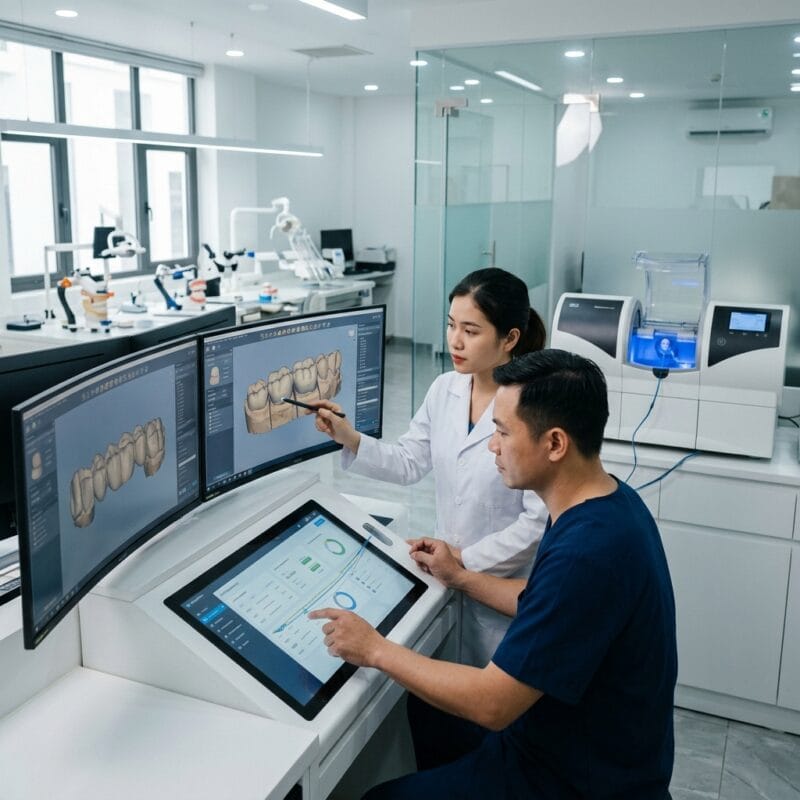
The dental laboratory industry has undergone a monumental shift from analog craftsmanship to precise digital manufacturing over the last decade. However, even in highly digitized facilities, operational friction often persists between design workstations and administrative business systems. When examining modern operational strategies, integrating CAD software with lab management systems 2026 has emerged as the cornerstone for achieving true scalable efficiency. Without seamless communication between computer-aided design (CAD) engines and laboratory management systems (LMS), dental laboratories and Dental Support Organizations (DSOs) suffer from data silos, manual entry bottlenecks, and costly administrative delays.
Laboratory directors quickly realize that integrating CAD software with lab management systems 2026 bridges the gap between raw intraoral scans and final milling or 3D printing stages. Whether a lab specializes in crown and bridge, complex implant restorations, removable prosthetics, or clear aligners, digital cohesion is no longer an optional luxury. In this comprehensive guide, we analyze how integrating CAD software with lab management systems 2026 empowers commercial dental laboratories and DSOs to maximize throughput, optimize CAD design outsourcing, and eliminate production errors.
The Evolution of Dental Laboratory Software Ecosystems
Historically, commercial dental laboratories operated using disparate, unlinked software applications. A practitioner submitted an intraoral scan via an online portal; administrative personnel logged the prescription into an accounting or lab management program; and design technicians manually imported clinical files into standalone CAD packages. By integrating CAD software with lab management systems 2026, managers can eliminate double-entry of client prescriptions and significantly reduce manual labor.
Modern dental laboratory software environments demand direct interoperability. Modern open-architecture platforms now leverage real-time application programming interfaces (APIs) and unified cloud databases. Furthermore, integrating CAD software with lab management systems 2026 ensures that case metadata, such as tooth numbers, margin specifications, material choices, and shade selections, automatically populates design software directly from the initial clinical order.
For high-volume laboratories, integrating CAD software with lab management systems 2026 transforms disparate digital tools into an interconnected automated workflow. Design technicians no longer waste billable hours verifying whether an intraoral scan file matches a specific work order or searching local servers for updated prescription notes. Consequently, integrating CAD software with lab management systems 2026 serves as the primary engine for scaling clinical output without proportionally increasing administrative staff.
Why is integrating CAD software with lab management systems 2026 vital for growing dental laboratories?
Integrating CAD software with lab management systems 2026 is vital because it eliminates redundant data entry, synchronizes case status in real time, and prevents costly manufacturing errors across high-volume digital workflows.
When managing complex restorative cases like crown and bridge or multi-unit restorations, integrating CAD software with lab management systems 2026 prevents mix-ups during file ingestion and design assignment. Without integration, technicians must manually match stereolithography (.STL) or object (.OBJ) mesh files with patient files located in separate accounting or scheduling software. This manual handoff introduces human error, particularly during peak volume hours when dozens of intraoral scans arrive simultaneously.
Lab managers who prioritize integrating CAD software with lab management systems 2026 report significant drops in remakes caused by misread prescription notes. When prescription parameters—such as cement gap thickness, dynamic occlusion preferences, or pontic design styles—flow automatically from the LMS into the CAD environment, software defaults align instantly with doctor preferences. This eliminates guesswork for in-house designers as well as external CAD design partners.
Furthermore, integrating CAD software with lab management systems 2026 provides leadership with complete visibility into job tracking. Production managers can inspect exact status updates—from scan reception and CAD drafting through milling, sintering, quality control, and shipping—without leaving their central dashboard.
Technical Mechanics: How API and Webhook Data Transfer Works
At a technical level, integrating CAD software with lab management systems 2026 relies on bidirectional RESTful APIs and standardized webhooks that trigger actions across both systems automatically. When a clinician submits an order through a practice portal, the LMS generates a unique case token. This token encapsulates patient demographic information, target turnaround dates, clinical photos, and raw scan files.
Leading CAD platforms like exocad offer robust development kits that facilitate integrating CAD software with lab management systems 2026 seamlessly across local and cloud environments. Through these interfaces, when a case opens in the CAD application, the software queries the LMS database, locks the clinical instructions, and presents the designer with a pre-configured digital work slate tailored specifically to the requesting clinician’s preferences.
When handling advanced procedures such as full arch implant design, integrating CAD software with lab management systems 2026 tracks critical components and multi-unit abutments throughout the process. The CAD system sends material usage data back to the LMS upon design completion. Thus, integrating CAD software with lab management systems 2026 protects material inventory by automatically deducting titanium bases, multi-unit abutment analogs, or specific zirconia discs as designs complete.
- Automated Ingestion: Incoming intraoral scan files are automatically linked to customer billing accounts.
- Dynamic Rule Engine: Prescriptions automatically load clinician preferences into CAD design parameters.
- Inventory Synchronization: CAM nesting metadata triggers automatic stock deduction for milling discs, 3D printing resins, and implant hardware.
- Status Synchronization: Design completion signals the LMS to advance case status to CAM production or external milling queues.
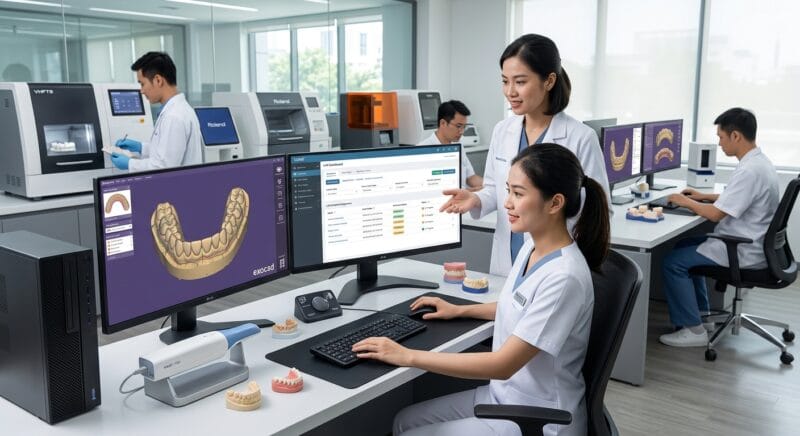
How does integrating CAD software with lab management systems 2026 improve turnaround times?
Integrating CAD software with lab management systems 2026 improves turnaround times by instantly routing incoming intraoral scan files directly into automated design queues without manual intervention.
By automated background routing, integrating CAD software with lab management systems 2026 cuts hours out of the intake phase. In legacy laboratory setups, scans received after business hours sit idle until administrative staff process them the following morning. With an integrated architecture, an intraoral scan uploaded at midnight is instantly logged, validated, and assigned to an open CAD station or queued for an external CAD outsourcing partner within minutes.
Open architecture platforms like 3Shape show that integrating CAD software with lab management systems 2026 allows overnight design outsourcing partners to receive cases instantly. Digital design partners retrieve case files directly via secured cloud APIs, complete crown, denture, or night guard designs during off-hours, and upload completed 3D design files directly back into the lab’s management system before morning shifts begin.
This dramatic reduction in intake and design latency enables labs to offer guaranteed 24-hour to 48-hour turnaround times for standard crowns, custom implant abutments, and 3D printed surgical guides. Consequently, integrating CAD software with lab management systems 2026 gives commercial dental labs a decisive competitive edge when competing for DSO contracts and high-volume clinical accounts.
Streamlining Specialized Workflows: Removables, Implants, and Aligners
While single crowns represent a high percentage of daily laboratory volume, complex specialty prosthetics benefit enormously from system integration. By integrating CAD software with lab management systems 2026, multi-step clinical workflows maintain rigorous quality standards while eliminating physical tracking sheets.
Crown & Bridge and Custom Abutments
For standard crown and bridge cases, integrating CAD software with lab management systems 2026 ensures precise dynamic contact values and shade matching protocols. CAD operators immediately see clinical preferences logged in the LMS, eliminating back-and-forth phone calls with dental practices regarding missing design instructions.
Surgical Guides and Orthodontic Aligners
Surgical guide manufacturing and clear aligner staging require precise tracking of multi-stage digital files. By integrating CAD software with lab management systems 2026, diagnostic wax-ups,CBCT DICOM alignments, and aligner revision steps remain strictly grouped within a single digital case folder accessible to both technicians and clinical evaluators.
Dentures and Night Guards
Removable prosthetics are undergoing rapid digital conversion. When executing 3D printed denture design projects, integrating CAD software with lab management systems 2026 monitors post-processing steps, tooth library selection, and base resin curing times. Similarly, night guard production benefits from integrated workflows by auto-calculating occlusal guard thickness based on clinician preferences stored directly in the LMS registry.
What are the primary financial benefits of integrating CAD software with lab management systems 2026?
The primary financial benefits of integrating CAD software with lab management systems 2026 include reduced remakes, decreased labor overhead, optimized material usage, and accelerated billing cycles.
DSOs expanding across multiple regions find that integrating CAD software with lab management systems 2026 standardizes operational metrics across all locations. By establishing a unified data pipeline between design tools and core ERP management platforms, executives analyze profitability per unit, evaluate technician output, and track outsourcing expenditures in real time.
Whether managing clear aligners, surgical guides, or custom prosthetics, integrating CAD software with lab management systems 2026 captures accurate production costs. Every minute of CAD technician design time, every milliliter of 3D printing resin, and every pre-milled implant blank used is tied directly to the final invoice generated by the LMS. This level of financial precision prevents margin erosion on complex restorative cases.
Furthermore, integrating CAD software with lab management systems 2026 reduces administrative labor costs. Dental labs no longer require full-time administrative staff dedicated solely to manually downloading intraoral scan files, re-typing prescriptions, or tracking down lost case files across local network drives.
Optimizing the On-Demand CAD Outsourcing Partnership
As dental labs expand, balancing in-house design capacity with fluctuating daily order volumes becomes a significant operational challenge. Outsourcing CAD design to dedicated digital design partners provides high-volume elasticity. However, manual file transfers to external design centers can introduce operational bottlenecks. By integrating CAD software with lab management systems 2026, outsourcing workflows become entirely frictionless.
When in-house CAD technicians reach maximum daily capacity, an integrated LMS automatically routes excess incoming cases to trusted CAD design outsourcing providers. Because of integrating CAD software with lab management systems 2026, external designers receive complete digital case files containing clinical photos, scan data, and doctor-specific anatomical preferences directly through secure cloud connections.
Once external designers complete the CAD work, the finished design files flow seamlessly back into the lab’s management portal for automated quality control verification. Therefore, integrating CAD software with lab management systems 2026 allows laboratory owners to scale production infinitely without making major capital investments in fixed in-house CAD workstations or full-time salaries.
Implementation Roadmap for Dental Labs and DSOs in 2026
Successfully implementing an integrated software ecosystem requires careful planning, technical evaluation, and staff training. Organizations committed to integrating CAD software with lab management systems 2026 should follow a structured three-phase implementation framework.
Phase 1: Audit and Workflow Mapping
Before integrating CAD software with lab management systems 2026, conduct a complete operational audit. Document every manual touchpoint occurring from clinical scan intake to final shipping. Identify recurring data entry errors, software bottlenecks, and specific clinician preference requirements that must be digitized into the central LMS database.
Phase 2: Platform Selection and API Configuration
Select open-architecture CAD and LMS platforms that support native RESTful API integrations and webhook automation. When integrating CAD software with lab management systems 2026, work closely with software vendors or specialized digital lab integration consultants to configure data mappings, dynamic rules, and security protocols.
Phase 3: Sandbox Testing and Staff Training
Prior to full production deployment, test system data flows within a sandbox testing environment. Validate that intraoral scans, patient metadata, and material settings transfer accurately between platforms. Thoroughly train CAD technicians, administrative staff, and production managers on the streamlined interface. Emphasize how integrating CAD software with lab management systems 2026 simplifies their daily responsibilities and enhances quality control.
Security, Compliance, and Data Governance Considerations
When integrating CAD software with lab management systems 2026, maintaining patient data privacy and regulatory compliance is paramount. Electronic Protected Health Information (ePHI) contained within intraoral scans, face scans, and patient prescriptions must be protected by robust security measures during transit and at rest.
Modern lab architectures must enforce end-to-end encryption across all API endpoints when integrating CAD software with lab management systems 2026. Cloud storage repositories housing STL, PLY, and OBJ files must comply with regional data protection standards such as HIPAA in the United States and GDPR in Europe. Role-based access controls ensure that only authorized design personnel and operational staff access sensitive patient information.
Additionally, integrating CAD software with lab management systems 2026 ensures regulatory compliance for medical device manufacturing. By maintaining an unalterable digital audit trail of CAD design files, nesting logs, material batch numbers, and quality control sign-offs, dental labs can effortlessly comply with FDA medical device tracking mandates and ISO certification standards.
Future Trends: AI-Driven Design Automation and Predictive Analytics
Looking ahead, integrating CAD software with lab management systems 2026 serves as the critical foundation for adopting artificial intelligence (AI) across dental laboratory operations. AI-powered CAD design engines require direct, structured access to historical case data, clinical outcomes, and doctor feedback to continuously refine automatic crown generation algorithms.
By integrating CAD software with lab management systems 2026, dental labs feed standardized operational data into predictive analytics engines. These AI tools accurately forecast future material consumption, predict equipment maintenance needs on milling machines, and automatically balance daily design workloads among available in-house technicians and external outsourcing partners.
Ultimately, commercial dental laboratories that prioritize integrating CAD software with lab management systems 2026 position themselves at the forefront of modern digital dentistry. They achieve unmatched operational speed, virtually eliminate remakes, optimize labor costs, and build a scalable foundation capable of handling rapid business expansion.
Ready to streamline your digital dental workflow and boost production capacity? Contact our expert CAD design outsourcing team today to integrate high-quality, on-demand design services into your laboratory management ecosystem.


