Embracing the Digital Frontier: Why Your Lab Needs a Dental Lab Digital Design Partner
The dental industry is undergoing a profound transformation, driven by advancements in digital technology. From intraoral scanners to sophisticated CAD/CAM systems, the shift from traditional analog workflows to streamlined digital processes is undeniable. For dental labs and Dental Service Organizations (DSOs), keeping pace with these innovations while managing operational costs and maintaining high-quality output can be a significant challenge. This is where the strategic advantage of a dedicated dental lab digital design partner comes into play.
Outsourcing your CAD/CAM digital design needs isn’t just about offloading tasks; it’s about smart growth, enhanced efficiency, and access to specialized expertise without the overhead. Whether you’re a small lab grappling with an increased workload or a large DSO seeking to standardize quality and scale operations, partnering with a digital design specialist can be a game-changer. This article will delve into the multifaceted benefits of leveraging a dental lab digital design partner, exploring the range of services offered and how such a partnership can propel your business forward.
What is a Dental Lab Digital Design Partner?
A dental lab digital design partner is an external service provider specializing in the CAD/CAM design of dental restorations and appliances, offering their expertise to dental laboratories and DSOs. These partners utilize advanced digital software and highly skilled designers to create precise, ready-for-manufacture files for a wide array of dental prosthetics, including crowns, bridges, implants, surgical guides, dentures, orthodontic aligners, and night guards.
The core function of a dental lab digital design partner is to seamlessly integrate into your digital workflow. Instead of investing heavily in additional software licenses, recruiting and training specialized CAD designers, or dealing with peak-period bottlenecks, labs can simply transmit their digital impression data (e.g., intraoral scans or scanned models) to the partner. The partner then handles the intricate design phase, returning a fully validated, high-quality design file that your lab can directly use for milling, 3D printing, or further processing. This model allows labs to focus on their core competencies—manufacturing and quality control—while scaling their design capabilities on demand.
The Evolving Landscape of Digital Dentistry for Labs and DSOs
The journey to a fully digital dental workflow is complex. It involves significant investment in technology, continuous staff training, and adapting to new protocols. Many labs find themselves in a hybrid state, gradually transitioning from analog to digital. DSOs, with their multi-location structures, face the added challenge of ensuring consistency and efficiency across all their practices and labs.
- Investment Costs: High upfront costs for CAD software, powerful workstations, and ongoing maintenance.
- Talent Gap: Shortage of experienced CAD designers who are proficient in various software platforms and clinical indications.
- Scalability Issues: Difficulty in managing fluctuating workloads without over- or under-staffing the design department.
- Specialization: The need for specialized knowledge across diverse indications, from complex implant cases to full-arch prosthetics.
- Quality Control: Ensuring consistent, high-quality designs that meet specific clinician preferences and industry standards.
A professional dental lab digital design partner directly addresses these pain points, offering a flexible and cost-effective solution that allows labs and DSOs to leverage cutting-edge design capabilities without the associated internal burdens. This partnership model is not just a trend; it’s a strategic imperative for future-proofing your dental business.
Key Advantages of Partnering with a Dental Lab Digital Design Partner
The decision to engage a dental lab digital design partner brings a multitude of strategic and operational benefits. These advantages directly impact a lab’s profitability, efficiency, and ability to deliver exceptional patient care.
1. Enhanced Efficiency and Faster Turnaround Times
Outsourcing design tasks frees up your in-house technicians to focus on production and finishing. A dedicated digital design partner operates with optimized workflows, often across different time zones, allowing for quicker design cycles. This means you can receive ready-to-mill files faster, reducing overall case turnaround times and improving your service delivery to dentists.
2. Access to Specialized Expertise and Advanced Software
Top-tier digital design partners employ a team of highly trained and experienced CAD designers who are experts in various dental indications and proficient in multiple leading software platforms like exocad, 3Shape Dental System, and Medit Design. This gives your lab access to a depth of knowledge that might be impractical or too costly to maintain internally, especially for complex cases like full-arch implant restorations or intricate surgical guides. Their continuous training ensures they are always up-to-date with the latest design protocols and software updates.
3. Cost Reduction and Predictable Expenses
Eliminate the significant capital expenditure associated with purchasing and maintaining multiple CAD software licenses, high-performance computers, and specialized scanners. You also save on recruitment, training, and salary costs for in-house CAD designers. A dental lab digital design partner typically operates on a per-case fee, transforming a variable and often unpredictable cost center into a fixed, predictable expense that scales with your needs.
4. Scalability and Flexibility
Whether you experience a sudden surge in case volume or a seasonal dip, a digital design partner provides unparalleled scalability. You can ramp up or down your design capacity on demand without the challenges of hiring or laying off staff. This flexibility is crucial for DSOs managing growth across multiple locations or labs dealing with fluctuating demand, ensuring consistent service levels regardless of the workload.
5. Consistent Quality and Standardization
Reputable design partners adhere to strict quality control protocols, ensuring every design meets exacting standards. They can help DSOs standardize design parameters across all their affiliated labs, leading to uniform quality and predictable outcomes. This consistency builds trust with clinicians and reduces remakes.
6. Focus on Core Competencies
By delegating design tasks, your lab can reallocate resources and focus on what it does best: crafting high-quality restorations and fostering strong client relationships. This strategic focus can lead to improved overall lab efficiency and greater job satisfaction for your in-house team.
Comprehensive Services Offered by a Dental Lab Digital Design Partner
A versatile dental lab digital design partner offers a broad spectrum of services, catering to nearly every aspect of digital dental fabrication. This comprehensive approach allows labs and DSOs to consolidate their outsourcing needs with a single, reliable provider.
Crown & Bridge Design
From single posterior crowns to complex multi-unit anterior bridges and full-arch solutions, digital design services cover a vast range. Designers meticulously create anatomically correct and functionally sound restorations, considering occlusion, emergence profile, contact points, and esthetics. This includes designs for:
- Full Contour Crowns: Zirconia, Emax, PMMA, wax, and metal.
- Copings & Frameworks: For porcelain-fused-to-metal (PFM) or zirconia build-ups.
- Inlays & Onlays: Precision-fit conservative restorations.
- Multi-Unit Bridges: Spanning multiple teeth, ensuring proper support and distribution of forces.
The precision of digital design minimizes chairside adjustments, saving time for clinicians and improving patient experience.
Implant Planning & Abutment Design
Implantology demands extreme precision. A skilled dental lab digital design partner provides critical support for implant cases, ensuring optimal outcomes.
- Custom Abutments: Designing patient-specific abutments (titanium, zirconia, hybrid) that provide ideal support for the crown and promote healthy soft tissue contours.
- Screw-Retained Crowns & Bridges: Designing restorations that integrate directly with the implant, often preferred for their retrievability.
- Full-Arch Implant Restorations: Complex designs for cases like “All-on-4” or “All-on-X,” requiring precise alignment and load distribution.
This specialization ensures that the prosthetic component perfectly matches the implant system and clinical requirements.
Surgical Guides
Surgical guides are indispensable for precise and safe implant placement. A dental lab digital design partner can design highly accurate surgical guides based on CBCT scans and intraoral data. These guides ensure that implants are placed at the correct angulation, depth, and position, minimizing risks and optimizing prosthetic outcomes. This service is crucial for clinicians adopting fully guided surgery protocols, enhancing predictability and reducing surgical time. The design process involves careful consideration of bone density, nerve proximity, and the planned prosthetic restoration.
Dentures (Full and Partial)
Digital denture design is revolutionizing a traditionally labor-intensive process. A dental lab digital design partner can design full and partial dentures, offering significant advantages in terms of fit, aesthetics, and reproducibility.
- Digital Denture Setup: Precisely arranging denture teeth based on anatomical landmarks and patient-specific requirements.
- Try-In Dentures: Designing virtual or 3D-printable try-in dentures for patient approval before final fabrication.
- Removable Partial Denture (RPD) Frameworks: Designing highly accurate metal or thermoplastic frameworks.
Digital dentures offer superior fit, comfort, and a streamlined workflow compared to conventional methods.
Orthodontic Aligners
The demand for clear aligners continues to grow. Design partners can assist with the complex planning and staging required for orthodontic aligner therapy. This involves:
- Treatment Planning: Virtual tooth movement simulations and staging of aligner trays.
- Aligner Design: Creating sequential aligner designs that guide teeth through planned movements.
- Retention Appliances: Designing retainers to maintain results post-treatment.
This specialization allows labs to enter or expand into the lucrative orthodontic aligner market without significant internal investment.
Night Guards / Splints
Therapeutic appliances like night guards and splints are also ideal candidates for digital design. Whether for bruxism, TMD management, or athletic protection, a dental lab digital design partner can create custom-fit appliances that offer superior comfort and effectiveness. The digital workflow ensures precise fit and allows for easy reproduction if a replacement is needed. This includes various types such as occlusal splints, Michigan splints, and NTI appliances.
The Digital Workflow with Your Dental Lab Digital Design Partner
The integration of a digital design partner into your lab’s workflow is typically seamless and straightforward, designed for maximum efficiency.
1. Data Acquisition (Scan)
The process begins with your dental practice or lab acquiring digital impression data. This can be done via:
- Intraoral Scanners: Directly capturing 3D data of the patient’s oral cavity (e.g., Medit i700, 3Shape TRIOS, Dentsply Sirona Primescan).
- Model Scanners: Digitizing traditional plaster models or impressions at your lab.
- CBCT Scans: For implant planning and surgical guide design, providing 3D bone structure data.
The resulting STL, PLY, or DICOM files are the foundation for the digital design process.
2. Data Transmission to Your Dental Lab Digital Design Partner
Once the digital data is acquired, it is securely transmitted to your design partner. Reputable partners utilize secure cloud platforms or encrypted file transfer protocols to ensure patient data privacy and compliance (e.g., HIPAA). Along with the scan data, you provide a detailed prescription outlining the specific restoration, materials, shade, and any particular clinical instructions or preferences.
3. Digital Design and Quality Assurance
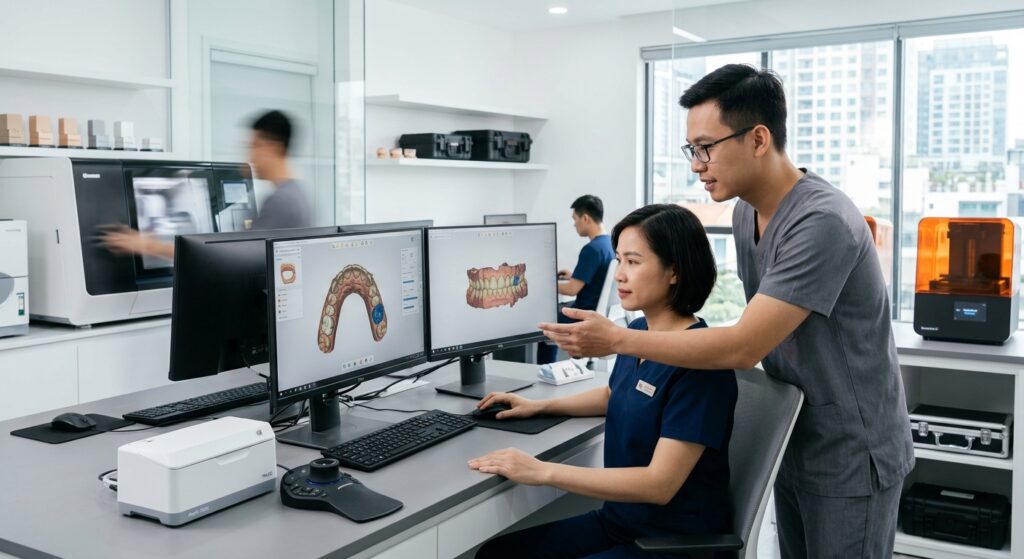
Upon receiving the data and prescription, the design partner’s expert CAD technicians commence the design process. They use sophisticated software to create the virtual restoration, meticulously adhering to your specifications and established anatomical and functional principles. Throughout this stage, stringent quality control checks are performed to ensure precision, optimal fit, and esthetics. This is where the value of a skilled dental lab digital design partner truly shines, as their expertise translates raw data into a perfectly designed prosthetic.
4. Review and Approval
After the design is completed, the digital file (typically an STL) is sent back to your lab for review. You can inspect the design using your own CAD software, allowing for any final adjustments or approvals. This collaborative step ensures that the final design meets your exact expectations and those of the prescribing clinician. This iterative feedback loop is crucial for building a strong partnership.
5. Manufacturing and Delivery
Once approved, the design file is ready for manufacturing. Your lab can then use the file to mill, 3D print, or further process the restoration using your in-house CAD/CAM equipment. The efficiency gained in the design phase directly translates to faster and more predictable manufacturing processes in your facility. This seamless handover solidifies the role of the design partner as an extension of your own lab’s capabilities, greatly enhancing your operational fluidity. This also works well alongside dental 3D printing services.
Choosing the Right Dental Lab Digital Design Partner: Key Considerations
Selecting the ideal dental lab digital design partner is a critical decision that can significantly impact your lab’s success. Here are essential factors to consider:
1. Expertise and Experience
Look for a partner with a proven track record and extensive experience across a wide range of indications. Their designers should possess deep anatomical knowledge, clinical understanding, and proficiency in multiple CAD software platforms. Ask about their team’s certifications and ongoing training.
2. Quality Control and Accuracy
Inquire about their internal quality assurance protocols. How do they ensure design accuracy, fit, and adherence to your specifications? A strong partner will have rigorous checks in place to minimize errors and remakes.
3. Turnaround Times and Reliability
Timeliness is paramount in dentistry. Evaluate their typical turnaround times for different case types and their ability to handle urgent requests. A reliable partner consistently delivers on time, every time.
4. Communication and Support
Effective communication is the cornerstone of any successful partnership. The partner should offer clear, responsive communication channels and dedicated support. Can you easily discuss cases, provide feedback, and get questions answered? This is especially important for complex cases and ensuring your specific preferences are met. A good dental lab digital design partner acts as a true extension of your team.
5. Data Security and Privacy (HIPAA Compliance)
Patient data is highly sensitive. Ensure the partner has robust data security measures in place, is fully compliant with HIPAA regulations (or relevant local privacy laws), and utilizes secure file transfer and storage systems. This protects both your lab and your clients.
6. Software Compatibility
Verify that the partner works with the CAD software platforms that are compatible with your lab’s milling machines and 3D printers. Most reputable partners support major platforms like exocad, 3Shape, and Dental Wings, ensuring seamless integration into your existing workflow.
7. Cost Structure and Transparency
Understand their pricing model. Is it per case, subscription-based, or tiered? Ensure there are no hidden fees and that the cost structure is transparent and predictable. A competitive pricing model without compromising quality is key.
8. Customization and Flexibility
Can the partner adapt to your specific preferences, protocols, and unique case requirements? A truly valuable dental lab digital design partner offers flexibility and a willingness to tailor their services to your lab’s individual needs rather than a one-size-fits-all approach.
For more insights into the broader impact of digital technologies in dentistry, resources from organizations like the American Dental Association can be invaluable.
The Future is Digital: Partnering for Success
The dental industry will continue its rapid digital evolution. Labs and DSOs that embrace these changes and strategically leverage external expertise will be best positioned for long-term success. A professional dental lab digital design partner is more than just a vendor; they are a strategic ally in navigating this future.
By outsourcing your digital design needs, you’re not just buying a service; you’re investing in efficiency, scalability, expertise, and ultimately, your lab’s competitive edge. This partnership allows you to expand your service offerings, reduce operational bottlenecks, and consistently deliver high-quality restorations to your dental clients. It’s about building a robust, agile business model that can thrive in the demanding digital age. Consider how a strong dental lab digital design partner can elevate your capabilities, particularly in areas like full arch implant solutions.
Ready to unlock the full potential of digital dentistry for your lab or DSO? Contact us today to learn how our expert digital design services can become your competitive advantage.