Understanding Referral Agent Objection Handling: Why Clinics Hesitate to Outsource CAD Design and How to Answer 2026
The phrase referral agent objection handling: why clinics hesitate to outsource CAD design and how to answer 2026 embodies a critical challenge for dental lab referral agents and sales professionals. Clinics often show reluctance to outsource CAD design due to concerns about quality control, data security, turnaround times, and cost. By understanding these objections and learning effective ways to respond, referral agents can boost their confidence, close more referrals, and build a steady stream of recurring commissions.
For dental labs and DSOs, outsourcing CAD/CAM digital design services—including crowns, bridges, implants, surgical guides, dentures, orthodontic aligners, and night guards—offers access to expert designers, faster workflows, and cost savings. Yet, hesitation remains common among clinics. This article dives into the main objections, practical rebuttals, and the financial opportunities for referral agents through programs like the Dental 3D Lab referral partner program.
What is dental lab CAD/CAM outsourcing and why is it growing?
Dental lab CAD/CAM outsourcing involves contracting external specialists to handle digital design tasks for dental restorations and devices using CAD (Computer-Aided Design) and CAM (Computer-Aided Manufacturing) technology.
This service is growing rapidly because it allows dental labs and clinics to:
- Access highly skilled digital designers without hiring full-time staff
- Scale production efficiently during demand spikes
- Improve turnaround times by leveraging dedicated design teams
- Reduce capital costs associated with expensive CAD/CAM equipment
- Focus internal resources on manufacturing or clinical care
With innovations from companies like exocad and 3Shape, digital workflows have become more reliable and precise, encouraging labs and DSOs to explore outsourcing partnerships.
What are the common objections clinics raise about outsourcing CAD design?
The key objections referral agents encounter are:
- Quality concerns: Clinics worry external designers won’t meet their standards, risking remakes and unhappy patients.
- Data security and confidentiality: Fear of patient information leaks or HIPAA violations.
- Turnaround time uncertainty: Clinics want rapid delivery and fear outsourcing delays.
- Cost worries: Perception that outsourcing is more expensive or less transparent than internal design.
- Lack of control: Clinics want direct communication with designers and worry about losing influence on cases.
- Resistance to change: Comfort with current processes creates inertia against trying new providers.
Understanding these objections deeply is the first step in referral agent objection handling: why clinics hesitate to outsource CAD design and how to answer 2026.
How to address quality concerns effectively?
Quality is the top priority for dental clinics and labs. To handle this objection, referral agents should emphasize:
- Expertise: Outsourcing partners specialize in digital design and employ certified technicians trained on the latest software.
- Quality assurance: Many digital design services have multi-stage QA processes to catch errors before files are sent back.
- Preferred pricing and communication: Referred clinics receive a preferred price list and dedicated support, ensuring clear communication and swift revisions.
- Proven track record: Refer to successful case examples and industry-standard compliance.
For example, Dental 3D Lab focuses solely on CAD design, not milling or manufacturing, ensuring concentrated expertise that leads to consistently reliable results.
Why do clinics worry about data security and how can agents reassure them?
Clinics hesitate because patient data privacy is legally mandated and ethically critical. Agents must reassure them that:
- Strict confidentiality protocols: The outsourcing lab never accesses patient-identifiable content—only anonymized dental scans and prescription data.
- Compliance with regulations: Partners follow HIPAA and local data protection laws.
- Secure digital transfer: Files are sent via encrypted channels and stored securely.
Transparency about these measures helps overcome fears and builds trust, a key facet of referral agent objection handling: why clinics hesitate to outsource CAD design and how to answer 2026.
How can referral agents explain turnaround time concerns?
Clinics want to avoid delays that impact patient care. Agents should highlight that outsourced design teams:
- Are dedicated experts working full-time on digital cases, often faster than in-house teams juggling multiple tasks.
- Use efficient CAD/CAM software such as Medit scanners and design platforms to speed up workflows.
- Offer transparent project tracking and communication channels for updates and revisions.
- Provide guaranteed turnaround times in service agreements, reducing uncertainty.
With clear expectations and preferred pricing, clinics can confidently outsource without sacrificing speed.
What about cost concerns? Is outsourcing more expensive?
Cost objections usually stem from misunderstanding the total value. Referral agents can explain:
- Outsourcing eliminates the need for expensive CAD/CAM hardware purchase and maintenance.
- Reduces labor costs by avoiding hiring, training, and retaining specialized designers.
- Minimizes costly remakes through expert design and quality control.
- Preferred pricing for referral clients means competitive rates.
- Overall, outsourcing is often more cost-effective when factoring in overhead and opportunity costs.
This clarity helps agents illustrate the true return on investment for clinics.
How to overcome concerns about loss of control and communication?
Some clinics worry that outsourcing means losing influence on case details. Agents should reassure them that:
- Dedicated account managers and direct communication channels exist to maintain transparency.
- Revisions and feedback loops are standard practice to ensure designs match clinical expectations.
- Clients keep control over final approvals and prescriptions.
- The outsourcing lab’s role is to support and enhance the clinic’s workflow, not replace clinical judgment.
These points help clinics feel empowered rather than sidelined.
What role does resistance to change play in hesitation?
Resistance to change is a common human factor. To address it, agents can:
- Share testimonials or examples of clinics that successfully transitioned to outsourcing.
- Offer trial periods or pilot projects with minimal risk.
- Educate clinics on the evolving dental technology landscape and benefits of digital workflows.
- Emphasize ongoing support and training availability.
This helps clinics move from skepticism to curiosity and eventually adoption.
How can referral agents leverage these objection handling techniques to maximize income?
Referral agents who master referral agent objection handling: why clinics hesitate to outsource CAD design and how to answer 2026 unlock significant earning potential. Here’s how:
- Recurring commission model: Agents earn a commission from every referred clinic’s revenue collected for 24 months.
- No cap on earnings: The more clinics referred who order design services, the higher the monthly passive income.
- Commission rates: Range between 5% to 25%, with exact rates and terms revealed after account creation.
- Example calculation (illustrative): 5 clinics each generating $1,000 monthly CAD design revenue x 10% commission rate = $500 monthly commission.
Successfully overcoming objections leads to more referrals, and more referrals mean more commission. This is a genuine opportunity for dental assistants, treatment coordinators, lab reps, and office managers who already hold networks and credibility.
What ethical considerations should referral agents keep in mind?
Before referring, agents should:
- Review their employment contracts and confidentiality agreements to avoid conflicts of interest.
- Disclose referrals where required by employer policies.
- Refer only clients they are free to refer without breaching patient privacy or company rules.
- Not use patient information or solicit patients directly.
- Understand they are responsible for their own taxes on commission income and should consult accountants.
Maintaining ethical standards protects the agent’s reputation and ensures long-term success.
How to get started with a dental lab CAD/CAM referral partner program?
Getting started is straightforward. Agents create an account to receive a personal referral link. Every clinic or lab registering through this link is permanently attributed to the agent, who then earns commission on actual revenue collected for 24 months from each client.
Agents access a dashboard showing clients, revenue, commissions, and a chat feature with the lab’s support team. Payments are made monthly via PayPal, and months close automatically at the start of the next month.
Preferred price lists for referred clients and a focus on CAD design only (no milling or manufacturing) make it an attractive partnership.
How does this outsourcing model benefit DSOs and multi-location clinics?
Dental Service Organizations (DSOs) and multi-location clinics face unique challenges:
- Maintaining consistent quality across locations
- Streamlining workflows to reduce overhead
- Scaling digital design needs flexibly without internal hiring
Outsourcing CAD design centralizes expertise and standardizes quality, while referral agents can introduce these advantages to DSOs, creating a win-win scenario.
What are the best practices for referral agents to succeed in 2026?
To thrive in referral agent objection handling: why clinics hesitate to outsource CAD design and how to answer 2026, agents should:
- Understand common objections and prepare tailored responses.
- Educate prospects on the financial and clinical benefits of outsourcing.
- Leverage existing relationships and networks within dental clinics and labs.
- Be transparent about commission terms and ethical boundaries.
- Follow up consistently to nurture leads into clients.
- Use digital marketing tools and social media to expand reach.
By doing so, referral agents can build a sustainable, lucrative income stream from passive, recurring commissions while helping clinics embrace modern CAD/CAM workflows.
How does CAD/CAM outsourcing integrate with other dental lab services?
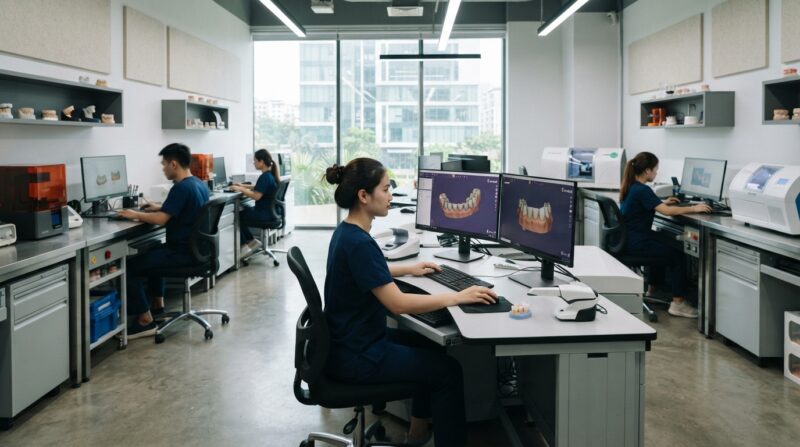
Outsourced CAD design complements other dental lab offerings by providing high-quality digital files that labs use for milling, 3D printing, or manual finishing. This integration enhances efficiency and precision.
Referral agents can mention that CAD design outsourcing also works well alongside surgical guide design services and implant planning, expanding clinic capabilities without extra capital investment.
What digital tools and software support outsourced CAD design?
Leading software platforms include exocad, 3Shape, and Medit scanners, which streamline design workflows and ensure compatibility with various dental lab manufacturing devices.
Outsourced design teams leverage these tools to deliver precise crowns, bridges, dentures, aligners, and night guards that meet clinics’ specifications.
How can referral agents explain the financial arithmetic of the commission program?
Understanding the numbers helps agents set realistic goals. For example (illustrative):
- Refer 4 clinics.
- Each clinic generates approximately $1,200 in monthly CAD design revenue.
- Commission rate is 15% (within the 5%–25% range).
- Monthly commission = 4 x $1,200 x 15% = $720.
This $720 is passive income earned monthly for up to 24 months per client, with no ceiling to growth as more clients are referred. The exact rate and terms will be visible upon account creation.
What should agents do if clinics remain hesitant after initial conversations?
Persistence and education are key. Agents can:
- Offer to set up trial cases or pilot projects to reduce perceived risk.
- Provide case studies or references from other satisfied clients.
- Invite clinics to webinars or workshops about CAD/CAM outsourcing benefits.
- Maintain a consultative approach focused on clinic needs.
Over time, this builds trust and often converts hesitation into commitment.
Conclusion: Why mastering referral agent objection handling is crucial in 2026
In today’s competitive dental market, referral agent objection handling: why clinics hesitate to outsource CAD design and how to answer 2026 is more than a skill—it’s a gateway to unlocking recurring income and strengthening professional networks.
The Dental 3D Lab referral partner program offers a transparent, scalable opportunity for dental professionals to monetize their connections ethically while helping clinics access specialized CAD/CAM design expertise.
Step-by-Step Guide for Referral Agents: Navigating Initial Clinic Conversations
Successfully handling objections starts the moment a referral agent initiates contact with a dental clinic. A structured approach ensures that key concerns are addressed systematically, fostering trust and increasing the likelihood of a referral partnership. Here’s a practical step-by-step guide that referral agents can follow during initial clinic conversations:
- Step 1: Research and Preparation
- Understand the clinic’s size, specialties, and current lab relationships.
- Identify potential pain points related to CAD design or turnaround times.
- Prepare tailored talking points that highlight how outsourcing can address these specific challenges.
- Step 2: Open with Empathy and Questions
- Start by acknowledging the clinic’s current processes and successes.
- Ask open-ended questions such as, “What challenges have you faced with your current CAD design workflow?” or “What would you improve if you could?”
- Listen actively and take notes on their concerns.
- Step 3: Address Objections with Data and Examples
- When concerns arise, respond with specific case studies or metrics, e.g., “One clinic we work with reduced their turnaround time by 30% after outsourcing CAD design.”
- Use clear analogies, such as comparing CAD outsourcing to specialized outsourcing in other industries (e.g., IT or accounting) to reduce internal burden.
- Step 4: Present a Pilot or Trial Offer
- Suggest a limited scope trial project to demonstrate quality and efficiency without full commitment.
- Highlight no-risk terms and the opportunity to evaluate the service firsthand.
- Step 5: Clarify Communication Protocols
- Explain how the lab maintains transparent communication and how feedback loops work.
- Offer a dedicated point of contact for ease of interaction.
- Step 6: Summarize Next Steps and Follow Up
- Recap key points and agreed-upon actions.
- Set expectations for timelines on trial results or further discussions.
- Send a personalized follow-up email summarizing the conversation to reinforce trust.
Common Mistakes Referral Agents Make When Handling Clinic Objections
Even experienced referral agents can fall into pitfalls that reduce their effectiveness in addressing clinic objections. Recognizing and avoiding these common mistakes can dramatically improve referral success rates:
- Overpromising on Turnaround and Quality – Agents sometimes promise unrealistic timelines or flawless results without fully understanding lab capacities, which can backfire and damage credibility.
- Ignoring Underlying Concerns – Clinics often express surface objections but have deeper worries (e.g., fear of losing patient trust). Failing to probe these underlying issues can stall progress.
- Using Jargon or Overly Technical Explanations – Overloading clinic staff with technical CAD/CAM terminology without clear relevance can confuse and alienate them.
- Failing to Personalize the Approach – Treating every clinic the same without tailoring responses to their specific workflows, size, or specialties misses opportunities to connect meaningfully.
- Neglecting Post-Conversation Follow-Up – Not sending follow-up materials or failing to check back promptly after initial meetings leaves clinics uncertain and less engaged.
- Underestimating the Importance of Relationship Building – Focusing solely on closing deals rather than nurturing long-term trust can result in fewer repeat referrals.
Cost vs. Quality: Balancing Priorities When Discussing CAD Design Outsourcing
One of the most sensitive topics for clinics is the cost-quality equation. Referral agents must be able to explain how outsourcing CAD design can be both cost-effective and quality-assured. Here are practical insights and considerations:
Understanding Cost Components
- Direct Costs: Fees charged by the dental lab for CAD design services. These may vary based on complexity, volume, and turnaround requirements.
- Indirect Costs: Savings on in-house labor, software licensing, hardware maintenance, and training that clinics avoid by outsourcing.
- Opportunity Costs: Time saved that can be redirected towards patient care or business growth.
Quality Considerations Beyond Price
- Expertise: Specialized CAD designers often bring higher skill levels due to focused experience, leading to fewer revisions and better-fitting prosthetics.
- Technology Investment: Labs investing in the latest CAD/CAM software and scanning technology produce more precise designs that reduce chairside adjustments.
- Quality Control Protocols: Outsourcing partners typically have multi-stage quality checks, including digital verification and expert reviews, which may be difficult to replicate in-house.
How to Present Cost-Quality Trade-Offs to Clinics
- Use real-world examples showing how slightly higher upfront costs for outsourcing can reduce overall expenses by decreasing remakes and chairside time.
- Provide a checklist comparing in-house and outsourced CAD design costs and benefits, helping clinics make informed decisions.
- Highlight scalable pricing models that align costs with clinic growth and case volume.
Sample Cost-Benefit Checklist for Clinics
- In-House CAD Design:
- Software licenses and upgrades
- Staff salaries and training
- Hardware maintenance
- Potential downtime and delays
- Quality variability depending on staff experience
- Outsourced CAD Design:
- Flat or per-case fees
- No software or hardware investments needed
- Access to expert designers
- Faster turnaround times due to specialization
- Quality assurance protocols built-in
Market-Specific Insights: Tailoring Objection Handling to Different Clinic Types
Dental clinics vary widely in size, specialty, and business model; referral agents who understand these market specifics can better customize their objection handling strategies.
Small Independent Practices
- Typical Concerns: Budget constraints, fear of losing personal touch with lab technicians, limited digital infrastructure.
- Recommended Approach: Emphasize cost savings from avoiding expensive software and training, offer easy-to-use digital submission tools, and assure personalized communication with the lab’s design team.
- Example: A small family dental practice reduced their CAD design costs by 25% while improving prosthetic fit by outsourcing, without disrupting their patient experience.
Multi-Location Dental Service Organizations (DSOs)
- Typical Concerns: Consistency across locations, data security, integration with centralized digital systems.
- Recommended Approach: Highlight the lab’s ability to standardize design protocols and provide secure cloud-based data management. Showcase examples of successful multi-location partnerships.
- Example: A DSO with 15 locations achieved uniform crown aesthetics and reduced design errors by using a dedicated outsourced CAD design partner.
Specialty Clinics (Orthodontics, Prosthodontics, Implant Centers)
- Typical Concerns: Need for highly specialized design expertise, precision for complex cases, integration with advanced treatment planning.
- Recommended Approach: Present evidence of the lab’s specialized skill sets and certifications, plus their experience handling intricate cases and coordinating with treatment planning software.
- Example: An implant center improved patient satisfaction scores by 20% after switching to a CAD design partner with expertise in implant-supported prosthetics.
Ready to turn your network into a reliable commission stream? Apply now and start your journey today.