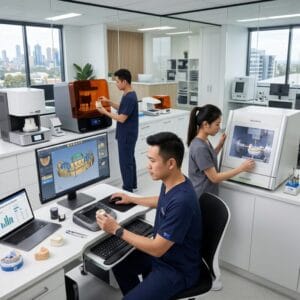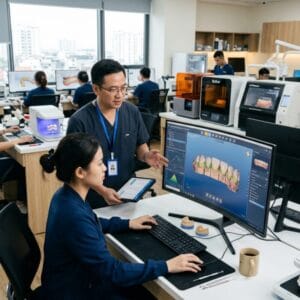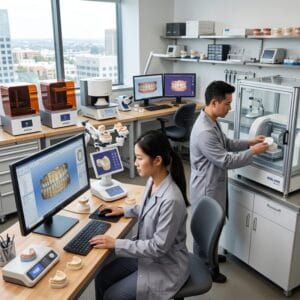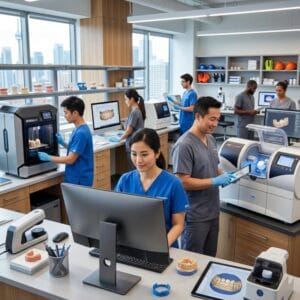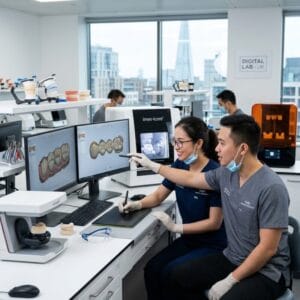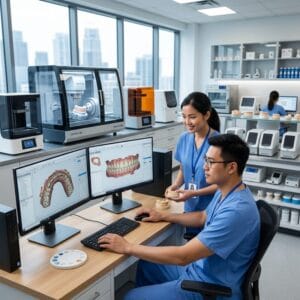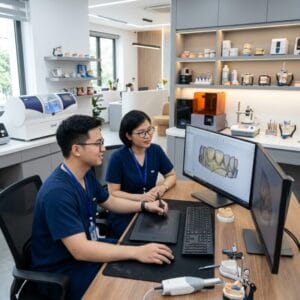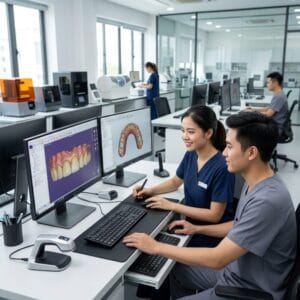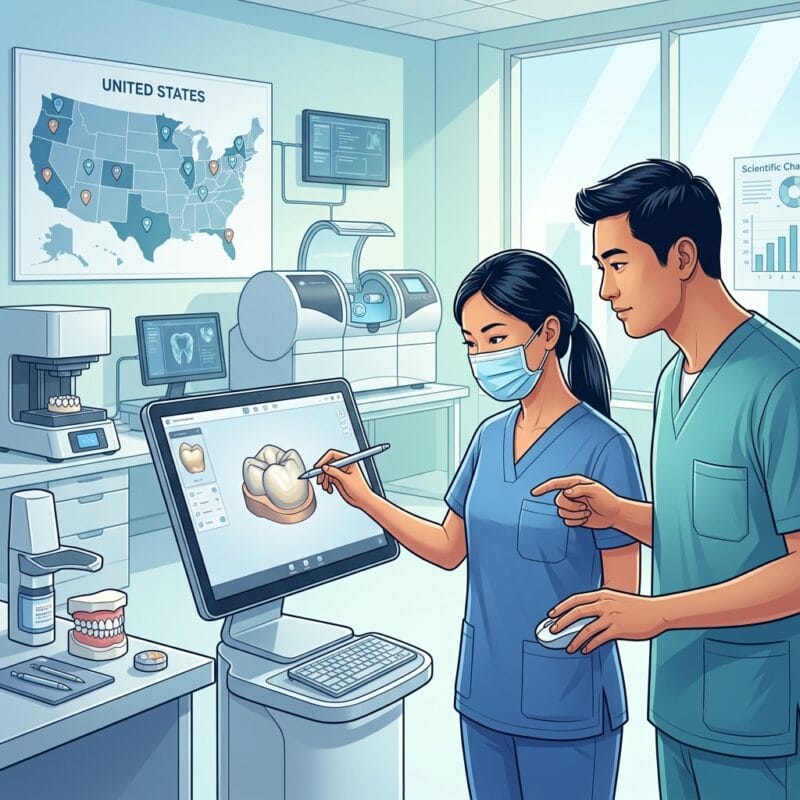
The dental laboratory industry is undergoing an unprecedented structural transition as paper prescriptions and physical alginate impressions yield completely to intraoral scanning, CBCT diagnostics, and digital design automation. Entrepreneurs and laboratory owners evaluating expansion opportunities must weigh critical state-level variables, including corporate tax structures, commercial real estate overhead, dental practice density, and regional labor availability. Evaluating the best states to open a dental lab in the USA in 2026 requires analyzing both macro-economic policies and localized oral healthcare market demands.
While traditional dental laboratories required close physical proximity to clinical clients to handle manual shade matching and daily local courier pick-ups, the ubiquity of high-speed digital file transmission has transformed the economic geography of dental manufacturing. Today, an enterprise finding the best states to open a dental lab in the USA in 2026 can establish production headquarters in high-growth, business-friendly tax havens while seamlessly servicing clinicians across the nation. By combining strategic site selection with digital workflow integration, forward-thinking lab owners can optimize operating profit margins and overcome skilled labor shortages.
In this comprehensive market report, we examine the macroeconomic forces driving site selection for new commercial dental laboratories, detail the top geographic markets in the United States, and explain how leveraging offshore digital CAD/CAM design services alters the traditional cost-structure equation for prospective laboratory owners.
Macroeconomic Drivers Shaping Site Selection for Dental Laboratories in 2026
Before ranking specific territories, laboratory entrepreneurs must understand the foundational economic forces that govern medical device manufacturing performance. Evaluating the best states to open a dental lab in the USA in 2026 involves analyzing four core criteria: tax climate, clinical density, population migration, and workforce availability.
First, corporate income tax rates, franchise taxes, and state sales taxes on equipment investments directly impact gross margins. Commercial milling machines, 3D printing fleets, and sintered zirconia ovens represent substantial capital expenditures. Choosing a state that offers sales tax exemptions for manufacturing equipment or imposes zero corporate income tax dramatically accelerates return on investment (ROI).
Second, analyzing the ratio of practicing dentists and dental service organizations (DSOs) per capita is paramount. Authoritative demographic reports from the American Dental Association consistently demonstrate that regional clusters of restorative practice create immediate local demand for crown and bridge production, implant prosthetics, surgical guides, and removable dentures. Identifying the best states to open a dental lab in the USA in 2026 requires cross-referencing high dentist-to-population ratios with overall population growth trends.
Third, net domestic migration continues to shift clinical demand toward Sunbelt and Mountain West states. As retiree and working-class populations relocate to favorable economic climates, regional demand for comprehensive restorative dentistry—including full-arch zirconia bridges, implant bars, and digital dentures—surges proportionately. Consequently, establishing production facilities in these migration corridors positions lab owners directly in the path of expanding clinical volume.
What are the best states to open a dental lab in the USA in 2026?
The best states to open a dental lab in the USA in 2026 are Texas, Florida, Tennessee, North Carolina, and Indiana due to their low tax burdens, rapid population growth, high density of practicing dentists, and favorable business operating environments.
Texas ranks at the top of the list for enterprise-scale dental laboratory deployment. With no personal or corporate state income tax, competitive utility costs, and massive urban growth in Dallas-Fort Worth, Houston, Austin, and San Antonio, Texas offers an unparalleled combination of clinical market density and low operational overhead. Furthermore, Texas maintains flexible commercial zoning laws and robust logistics infrastructure, allowing lab owners to establish central hubs that support nationwide shipping.
Florida represents another premier destination when identifying the best states to open a dental lab in the USA in 2026. Florida features zero state personal income tax, a business-friendly economic environment, and one of the highest concentrations of aging patients requiring complex prosthodontic care in the world. High demand for custom implant abutment design and full-removable prosthetics makes Florida a exceptionally lucrative market for modern dental laboratories.
Tennessee stands out for its zero state income tax on earned wages, highly competitive industrial real estate rates, and central strategic location for air cargo hubs. Based in cities such as Nashville or Memphis, a dental lab can leverage late-night FedEx or UPS flight departures to guarantee overnight delivery of physical appliances across the eastern half of the United States. Prospective owners evaluating the best states to open a dental lab in the USA in 2026 frequently select Tennessee for its distribution capabilities.
Detailed Evaluation of Top Business Climates for Dental Labs
To provide actionable intelligence for laboratory executives, let us examine the operational advantages of the top five jurisdictions in greater detail.
1. Texas
Texas continues to attract corporate expansion across all sectors of healthcare manufacturing. For dental laboratory owners, the state offers zero corporate net income tax (subject only to the modest Texas Franchise Tax) and robust economic incentives for job creation. The state’s rapid growth has led to a major influx of private equity-backed DSOs and multi-location group practices. Determining the best states to open a dental lab in the USA in 2026 yields Texas as a frontrunner due to its proximity to expanding dental practices and strong regional logistics networks.
2. Florida
Florida’s demographic profile creates consistent demand for high-value restorative cases. Senior demographics drive ongoing needs for implant prosthetics, hybrid dentures, night guards, and clear aligners. Laboratories located in Florida benefit from high volume clinical orders and a thriving private practice ecosystem. When analyzing the best states to open a dental lab in the USA in 2026, Florida consistently provides one of the highest gross revenue opportunities per dental practice cluster.
3. Tennessee
Tennessee combines structural tax efficiency with unmatched central shipping capabilities. The state boasts an exceptionally favorable cost of doing business, low property taxes, and reasonable payroll expenditures. A commercial laboratory established in Tennessee can easily fulfill work from clinicians across neighboring southeastern states while taking advantage of lower operational costs. As a result, analysts frequently list Tennessee among the best states to open a dental lab in the USA in 2026.
4. North Carolina
North Carolina has systematically lowered its corporate income tax rate, aiming for a complete phase-out by 2030. Home to major research universities and biotech clusters in the Research Triangle and Charlotte regions, North Carolina provides lab owners with access to a highly skilled, tech-literate workforce. The state’s balance between technological infrastructure and lower operating costs makes it a prime candidate for companies researching the best states to open a dental lab in the USA in 2026.
5. Indiana
For laboratory owners focused on Midwestern distribution networks, Indiana presents a compelling economic case. The state features a flat, low corporate income tax, predictable regulatory frameworks, and affordable industrial facility leases. Moreover, Indiana’s strong historical background in medical device production creates a supportive environment for manufacturing investments. Evaluating the best states to open a dental lab in the USA in 2026 highlights Indiana as an efficient operational hub for midwestern and national fulfillment.
How do tax policies impact dental lab profitability?
State tax policies directly affect dental lab profitability by reducing corporate net income tax burdens, eliminating equipment sales taxes, and lowering payroll costs necessary to operate laboratory facilities.
When launching a new laboratory, initial capital expenditure (CAPEX) is heavily allocated toward machinery, software, and real estate build-outs. High-end 5-axis milling units, industrial 3D printers, sintering furnaces, and laboratory benching require hundreds of thousands of dollars in upfront capital. States that exempt manufacturing machinery from state sales tax immediately preserve cash flow, allowing owners to reinvest in advanced technology. Understanding these tax nuances is a key component when determining the best states to open a dental lab in the USA in 2026.
Furthermore, recurring operational expenses (OPEX) are governed by local corporate income tax and commercial property tax rates. In high-tax states, a laboratory must generate significantly higher gross revenue simply to achieve net income parity with a similar lab operating in a zero-tax state like Texas, Florida, or Tennessee. The table below illustrates the structural tax comparison across major prospective states:
- Texas: 0% Corporate Tax, 0% Personal Tax, Low Real Estate Costs, Franchise Tax applies.
- Florida: 0% Personal Tax, 5.5% Corporate Income Tax, Strong Senior Demographics.
- Tennessee: 0% Personal Income Tax on wages, 6.5% Corporate Tax, Centralized Logistics Hub.
- North Carolina: Decreasing Corporate Income Tax rate (phasing to 0%), Strong Tech Talent Pool.
- Indiana: Low flat corporate tax rate, highly competitive commercial lease costs.
Consequently, calculating long-term profitability requires factoring state tax structures directly into your pro forma financial modeling when choosing the best states to open a dental lab in the USA in 2026.
Overcoming Skilled Labor Shortages Through CAD/CAM Outsourcing
Historically, the biggest barrier to launching a dental laboratory was securing highly skilled, CDT-certified technicians to perform manual waxing, porcelain layering, and anatomical contouring. The nationwide shortage of experienced dental technicians has created intense wage competition in major metropolitan markets. Even after identifying the best states to open a dental lab in the USA in 2026, acquiring local design talent can present a significant bottleneck.
To overcome this bottleneck, modern dental lab entrepreneurs are restructuring their workforce strategy by decoupling physical manufacturing from digital CAD design. Instead of hiring multiple full-time, high-salaried internal CAD designers, startup labs are partnering with specialized B2B digital design outsourcing services.
Why is digital CAD CAM design outsourcing crucial for new dental labs?
Digital CAD CAM design outsourcing allows new dental laboratories to scale production instantly without investing in expensive design software licenses or full-time internal technician overhead.
By leveraging expert remote designers proficient in leading CAD software platforms such as exocad and 3Shape, a startup laboratory can accept intraoral optical scans from dentists immediately on day one. When a digital scan arrives, the raw STL, PLY, or OBJ file is uploaded to an expert B2B design partner. Certified offshore technicians perform precise margin line placement, contact point calibration, and occlusal anatomical modeling before returning production-ready STL files directly to the lab for local milling or 3D printing.
This hybrid operational model offers three major competitive advantages for businesses operating in the best states to open a dental lab in the USA in 2026:
- Substantial Overhead Reduction: Labs eliminate fixed payroll obligations, employee benefits, software license maintenance fees, and hardware upgrades associated with internal design departments.
- Uncapped Scalability: Production capacity is limited only by local milling machine uptime. During peak seasonal volumes, labs can scale design output seamlessly without recruiting bottlenecks.
- Consistent Clinical Quality: Dedicated design partners employ specialists who focus exclusively on specific indication categories—such as crown and bridge, full-contour zirconia, surgical guides, digital denture CAD workflows, clear aligners, or custom implant abutments—ensuring high precision and low remake rates.
As a result, entrepreneurs searching for the best states to open a dental lab in the USA in 2026 can focus their local site selection purely on real estate costs, regional logistics, tax efficiency, and clinical marketing, knowing that their digital design infrastructure is completely scalable via remote outsourcing.
Regulatory Compliance and State Dental Board Considerations
Another crucial element when selecting the best states to open a dental lab in the USA in 2026 is understanding state-specific statutory regulations governing dental laboratory operations. Regulations vary considerably across state jurisdictions.
Some states enforce strict dental laboratory registration laws, mandatory Certified Dental Technician (CDT) oversight, and mandatory continuing education credits for laboratory personnel. Other states maintain minimal regulatory oversight, treating dental labs strictly as commercial light-manufacturing entities. When evaluating the best states to open a dental lab in the USA in 2026, prospective owners must carefully review local dental board policies regarding:
- Mandatory registration of commercial laboratories with the state board of dentistry.
- Requirements for supervising CDTs on-site during operational hours.
- Material disclosure mandates and point-of-origin labeling rules for medical devices.
- Prescription retention timelines and infection control protocols.
By proactively establishing compliance frameworks, lab owners protect their capital investment and foster transparent, trusted relationships with clinical clients across all jurisdictions.
Strategic Blueprint: Launching a Lean Digital Lab in 2026
To summarize how to effectively execute a dental laboratory start-up in 2026, let us walk through a step-by-step operational strategy that maximizes profit potential regardless of geographic location.
Step 1: Choose an Favorable State Jurisdiction
Select your location based on business tax climate, commercial rent costs, and logistics access rather than legacy labor markets. Utilizing the research outlined for the best states to open a dental lab in the USA in 2026, target economic regions like Texas, Florida, Tennessee, North Carolina, or Indiana.
Step 2: Build a Compact, High-Efficiency Production Facility
Because digital workflows replace bulky plaster rooms and manual waxing benches, modern labs require significantly smaller square footage. Design a streamlined footprint dedicated primarily to digital scanning verification, 5-axis CAD/CAM milling, ceramic sintering furnaces, resin 3D printing, and automated post-processing finishing stations.
Step 3: Integrate a Specialized CAD Design Outsourcing Partner
Partner with an expert B2B digital design service capable of handling full-scope prosthetics. Ensure your outsourcing team supports comprehensive software ecosystems and delivers rapid turnaround times for crowns, bridges, custom implant abutments, surgical guides, night guards, and aligners. Selecting the best states to open a dental lab in the USA in 2026 works best when backed by a robust, remote digital design backbone.
Step 4: Market Digital Capabilities to Regional Clinicians
Position your laboratory as a technology-driven oral healthcare partner. Target local private practices and DSOs with marketing focused on fast turnaround times, precise contact/margin fit, and seamless intraoral scanner file integration. By minimizing internal design costs, your lab can offer highly competitive pricing while maintaining outstanding profit margins.
Ultimately, identifying the best states to open a dental lab in the USA in 2026 involves balancing state economic policies with modern digital operational frameworks. By choosing a business-friendly state and integrating B2B design outsourcing, new laboratory owners can establish a highly profitable, scalable, and resilient enterprise in the evolving dental industry.
Ready to scale your modern laboratory production and lower CAD design overhead? Contact our expert digital design team today to streamline your design workflows and accelerate your enterprise growth.